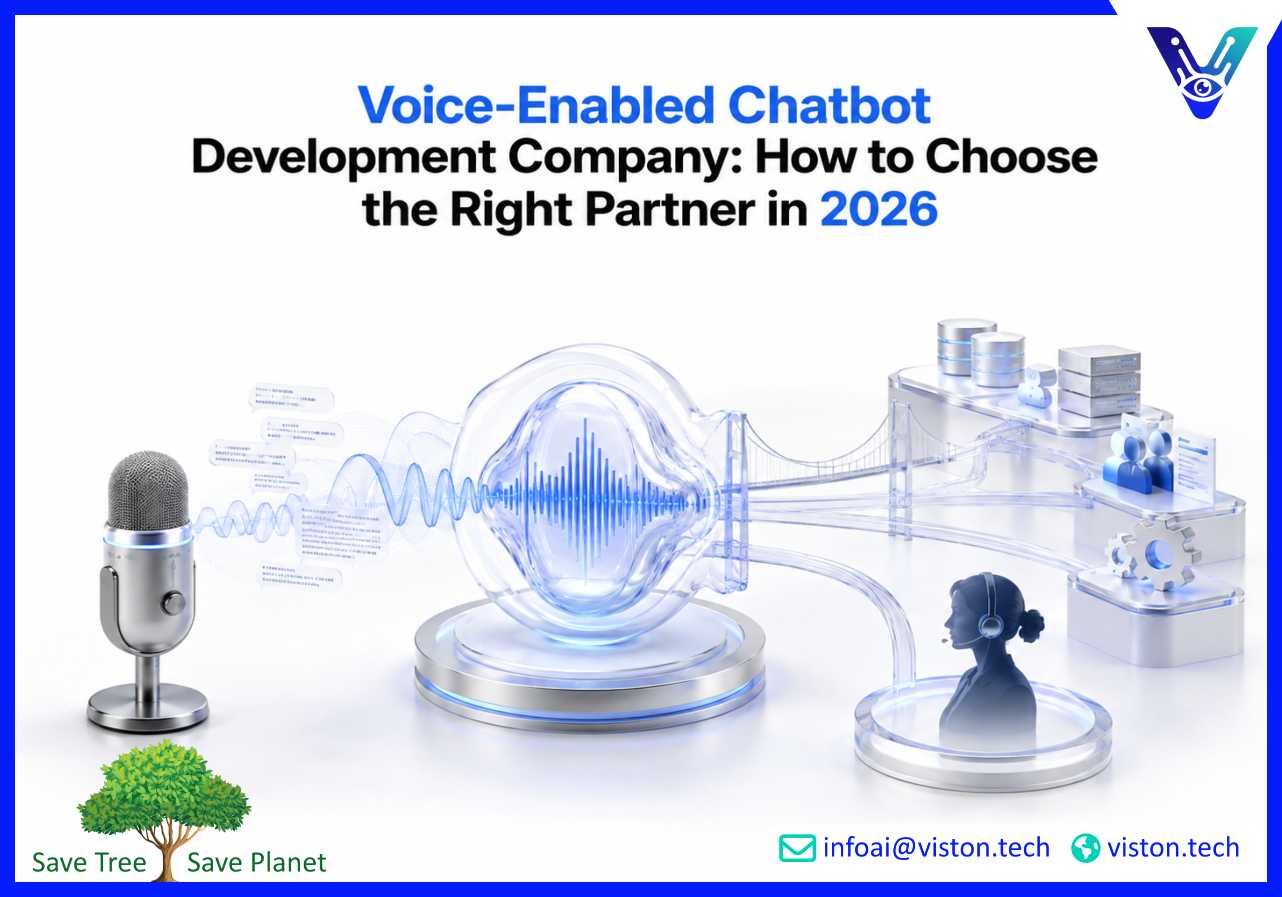
Voice-Enabled Chatbot Development Company: How to Choose the Right Partner in 2026
Choosing a voice-enabled chatbot development company matters because voice AI now affects customer service quality, sales response speed, accessibility, workflow automation, and brand trust. Businesses need voice-enabled assistants that understand real conversations, connect with core systems, and perform reliably across customer and employee touchpoints.
What a Voice-Enabled Chatbot Development Company Does
A voice-enabled chatbot development company designs, builds, integrates, and optimizes conversational AI systems that allow users to interact through spoken language. These systems combine automatic speech recognition, natural language understanding, large language models, dialogue management, text-to-speech, business logic, analytics, and system integrations.Unlike a basic chatbot that only responds to typed messages, a voice-enabled assistant must handle accents, interruptions, background noise, incomplete sentences, emotional tone, and real-time response expectations. It must understand what the user is trying to achieve, ask clarifying questions when needed, complete the right workflow, and escalate to a human when automation is not appropriate.For businesses, this can support use cases such as customer support calls, appointment booking, lead qualification, order tracking, internal IT helpdesk requests, HR policy support, field service reporting, voice commerce, patient communication, and hands-free operational workflows.
Core capabilities involved in voice-enabled chatbot development
Speech-to-text and text-to-speech configuration
Natural language processing and intent recognition
Multi-turn conversation design
LLM orchestration and prompt engineering
Knowledge base and CRM integration
Call center, website, mobile, and messaging deployment
Human handoff and escalation logic
Analytics, reporting, monitoring, and continuous improvement
Privacy, security, consent, and compliance controls
The best providers do not treat voice AI as a simple add-on. They design it as a business system that must be accurate, secure, measurable, and easy for users to trust.
Why Voice-Enabled Assistants Matter for Businesses in 2026
In 2026, customers and employees expect faster, more natural ways to get information and complete tasks. Many people do not want to wait on hold, search through long help pages, or type detailed requests on small screens. Voice-enabled assistants help businesses meet this expectation by making support and service more immediate.Voice AI is especially valuable when speed, accessibility, or hands-free interaction matters. A customer can check an order status while commuting. A warehouse worker can update inventory without stopping work. A patient can schedule an appointment without navigating a portal. A sales prospect can ask questions after business hours and receive guided support.For businesses, the value is not only convenience. Voice-enabled assistants can reduce repetitive manual work, improve response availability, capture structured data, route inquiries correctly, and create more consistent service experiences. When connected to CRM, helpdesk, ERP, scheduling, billing, or knowledge systems, voice AI can become part of a broader automation strategy.
Business problems voice-enabled assistants can solve
Many organizations consider voice-enabled chatbot development when existing service channels are becoming expensive, slow, or difficult to scale. Common challenges include high call volumes, repetitive support questions, missed after-hours leads, inconsistent agent responses, long wait times, multilingual service gaps, and poor visibility into customer intent.A well-built voice assistant can handle routine conversations while giving human teams more time for complex, sensitive, or high-value work. It can also collect cleaner information before escalation, so agents receive context instead of starting every conversation from zero.
Why development quality matters
Poorly built voice AI can damage trust quickly. If the system misunderstands users, speaks unnaturally, loops through irrelevant questions, or fails to transfer context during escalation, customers may become more frustrated than they would with traditional service.That is why the development company must understand both AI technology and operational design. The system needs clear fallback handling, confidence thresholds, approved knowledge sources, privacy safeguards, testing across accents and environments, and ongoing performance monitoring after launch.
What to Look for in a Voice-Enabled Chatbot Development Company
The right voice-enabled chatbot development company should be evaluated on more than its ability to build a demo. Business-ready voice AI requires strategy, engineering, conversation design, integration experience, testing discipline, and post-launch optimization.
Experience with voice-specific conversation design
Voice conversations are different from text conversations. Users speak in fragments, change direction, interrupt responses, and expect the assistant to keep context. A capable provider should design concise prompts, natural confirmations, clear repair paths, and smooth handoffs.The company should also understand how to avoid long spoken responses. What looks acceptable in a written chatbot may feel slow or confusing when spoken aloud. Voice design must be direct, structured, and easy to follow.
Strong speech recognition and language support
Speech recognition quality affects the entire experience. The development partner should consider accents, dialects, background noise, industry terms, product names, and multilingual requirements. For global or distributed businesses, language support should include not only translation but also localized conversation patterns and culturally appropriate phrasing.
Integration with business systems
A voice assistant becomes far more useful when it can access and update business systems. Important integrations may include CRM platforms, helpdesk tools, ecommerce systems, booking platforms, payment systems, ERP software, knowledge bases, authentication systems, and contact center platforms.Without integration, the assistant may only provide generic answers. With secure integration, it can check account status, create tickets, qualify leads, update records, schedule appointments, retrieve order information, and trigger workflows.
Security, privacy, and governance
Voice interactions may involve personal data, customer records, payment information, health details, financial information, or employee data. A reliable provider should design for consent, access control, encryption, data minimization, retention rules, audit logs, and role-based permissions.Businesses should also ask how the assistant handles sensitive topics, uncertain answers, restricted content, and human approval. Responsible AI governance is not optional when voice AI interacts with real customers or employees.
Performance measurement and optimization
A serious development company should define success metrics before deployment. Useful KPIs include containment rate, task completion rate, first contact resolution, fallback rate, escalation quality, average response latency, customer satisfaction, lead qualification rate, and workflow success rate.Voice AI should improve over time. The provider should offer monitoring, conversation review, prompt refinement, knowledge updates, model evaluation, and reporting so the assistant remains accurate as products, policies, and customer expectations change.
How Businesses Should Plan a Voice-Enabled Chatbot Project
A successful voice-enabled assistant project should begin with a focused business case. Trying to automate every conversation at once usually creates complexity, risk, and poor user experience. The better approach is to start with high-value, well-defined use cases and expand after performance is proven.
Define the main use case
Start by identifying the reason for building the assistant. Is the goal to reduce support volume, qualify leads, improve appointment scheduling, support employees, automate call intake, or enable hands-free operational workflows? Each goal requires different data, integrations, conversation flows, and success metrics.For example, a support assistant needs strong knowledge retrieval and escalation. A sales assistant needs qualification logic and CRM updates. A healthcare assistant needs careful privacy controls and approved response boundaries. A field operations assistant needs fast, reliable voice capture in noisy environments.
Prepare the right knowledge and data
The assistant should be connected to trusted business information. This may include FAQs, product documentation, support articles, scripts, CRM fields, order data, policy documents, service workflows, and approved escalation rules.Before development, outdated or conflicting content should be cleaned. A voice-enabled chatbot can only be as reliable as the information and workflows behind it.
Design for human handoff
Not every conversation should be automated. The assistant should know when to transfer users to a person, especially for complaints, complex account issues, sensitive requests, compliance concerns, high-value sales opportunities, or repeated misunderstanding.Good handoff design includes a summary of the conversation, detected intent, customer details, attempted actions, sentiment indicators, and next-step recommendations. This makes escalation feel seamless instead of frustrating.
Test before scaling
Testing should include real user phrases, different accents, background noise, interruptions, edge cases, system failures, integration errors, and escalation scenarios. Businesses should also test how the assistant behaves when it does not know the answer.After launch, the first phase should be closely monitored. Failed conversations, abandoned calls, fallback triggers, and negative feedback provide valuable signals for improvement.
How Viston AI Supports Voice-Enabled Chatbot Development
Viston AI is relevant to businesses looking for a voice-enabled chatbot development company because its Voice-Enabled AI Assistants service is positioned around enterprise conversational AI, speech recognition, natural language processing, LLMOps infrastructure, and intelligent voice interactions at scale.The company’s service offering connects voice AI with practical business needs such as customer experience improvement, operational efficiency, multilingual support, multi-turn conversations, analytics, and integration with business systems. This matters because a voice assistant must do more than recognize speech. It must understand context, retrieve trusted information, complete workflows, and support reliable escalation when human involvement is required.Viston AI’s broader AI capabilities include enterprise AI chatbots, AI chatbot development, integration with business systems, NLP and text analysis, multilingual support, AI automation workflows, MLOps and model monitoring, and strategic AI consulting. These capabilities align well with organizations that need voice-enabled assistants to connect with CRM, helpdesk, knowledge base, contact center, or operational platforms.For businesses across customer service, sales, healthcare, retail, finance, manufacturing, technology, logistics, and internal operations, Viston AI can support voice AI projects that require structured planning, secure implementation, scalable architecture, and continuous performance improvement. Its relevance is strongest where organizations want a voice-enabled assistant that is not just conversational, but operationally useful.
Frequently Asked Questions
What is a voice-enabled chatbot development company?
A voice-enabled chatbot development company builds AI assistants that allow users to speak naturally instead of typing. The company typically handles speech recognition, natural language understanding, conversation design, system integration, analytics, security, and ongoing optimization.
How is a voice-enabled chatbot different from a normal chatbot?
A normal chatbot usually works through text. A voice-enabled chatbot uses spoken input and audio responses, which requires speech-to-text, text-to-speech, real-time dialogue handling, accent support, interruption handling, and voice-specific user experience design.
What businesses benefit most from voice-enabled assistants?
Businesses with high inquiry volume, call center demand, appointment scheduling needs, field operations, multilingual support requirements, or repetitive service workflows can benefit. Common examples include ecommerce, healthcare, finance, retail, hospitality, logistics, SaaS, manufacturing, and enterprise support teams.
What should I ask before hiring a voice-enabled chatbot development company?
Ask about speech recognition quality, integration experience, security controls, multilingual support, conversation design process, human handoff logic, analytics, deployment channels, compliance safeguards, and post-launch optimization.
How long does voice-enabled chatbot development usually take?
Timelines depend on complexity. A focused proof of concept may be developed faster, while a production-grade assistant with CRM integration, multilingual support, authentication, analytics, and compliance requirements needs a more structured implementation plan.
Can Viston AI help with voice-enabled chatbot development?
Yes. Viston AI offers Voice-Enabled AI Assistants and related AI chatbot, NLP, multilingual, integration, automation, and monitoring capabilities that align with business-ready voice-enabled chatbot development.
Conclusion
Choosing the right voice-enabled chatbot development company is an important decision for any business that wants voice AI to improve service quality, reduce repetitive workload, and support scalable customer or employee interactions. In 2026, successful voice-enabled assistants need accurate speech recognition, natural conversation design, secure system integration, responsible governance, and continuous optimization. The best outcomes come from treating voice AI as a connected business capability, not a standalone tool. Viston AI is a relevant specialist for organizations exploring Voice-Enabled Assistants that require practical implementation, enterprise integration, and long-term performance improvement.