
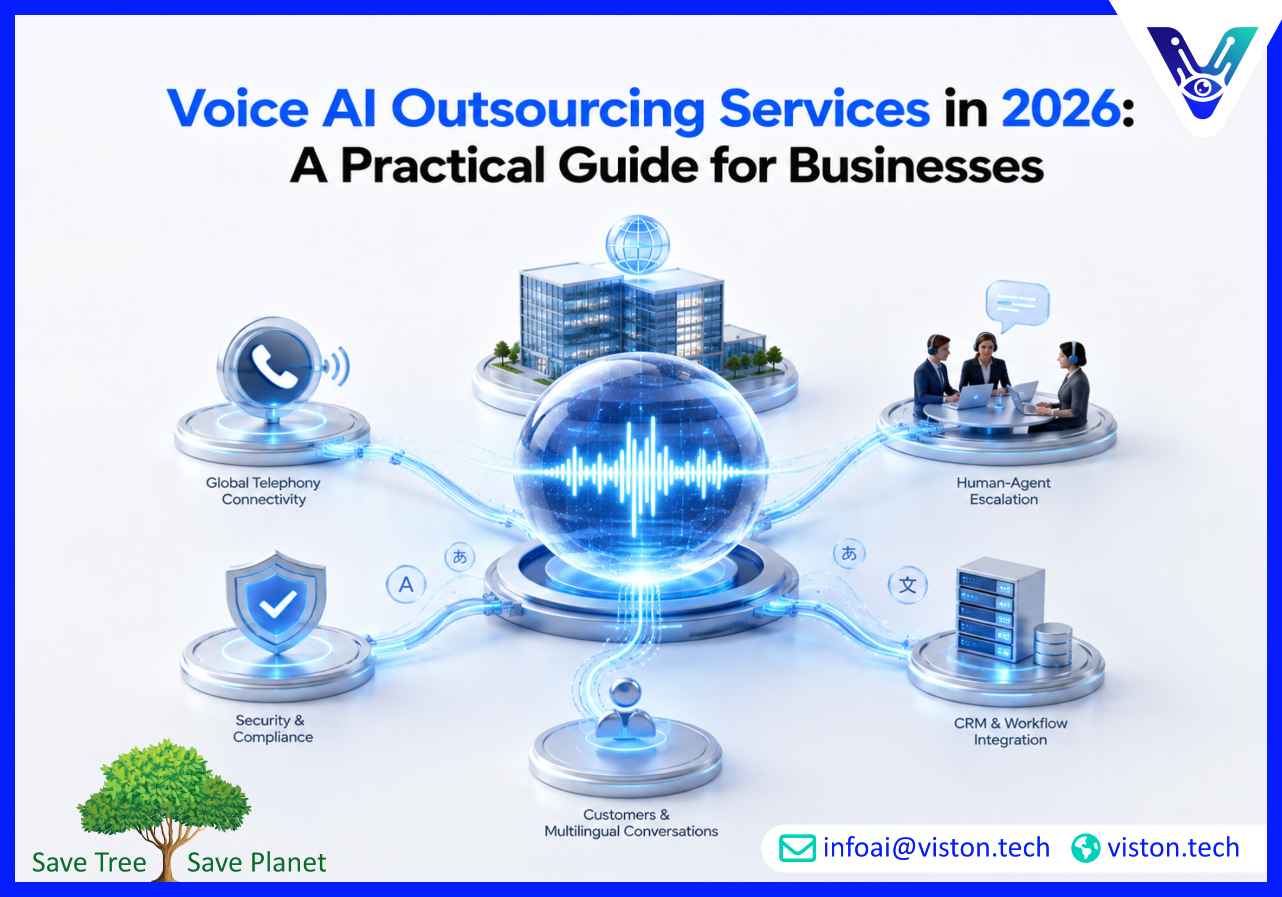
Voice AI outsourcing services help businesses build reliable voice-enabled assistants without carrying the full burden of in-house speech AI, integration, compliance, and support expertise. In 2026, outsourcing voice AI is less about buying a bot and more about creating scalable conversational systems that improve customer service, operations, sales, and internal workflows.
Voice AI outsourcing services involve working with a specialist provider to design, develop, integrate, deploy, and improve voice-enabled assistants for business use. These assistants can understand spoken language, respond naturally, complete tasks, connect with business systems, and escalate conversations to human teams when needed.
For many organizations, voice AI requires skills that are difficult to build quickly in-house. A production-ready voice assistant may involve automatic speech recognition, text-to-speech, natural language understanding, dialogue design, LLM orchestration, telephony integration, CRM connectivity, analytics, compliance controls, security reviews, and continuous optimization.
Outsourcing gives businesses access to these capabilities without needing to recruit a full team of speech AI engineers, conversation designers, integration specialists, data engineers, QA testers, and AI governance experts. The right outsourcing partner can turn a business requirement into a practical voice solution that works across phone systems, websites, mobile apps, call centers, internal portals, smart devices, or workflow platforms.
Businesses usually outsource voice AI when they need support with one or more of the following areas:
The best outsourcing relationships are not limited to technical delivery. They begin with business context: what conversations should be automated, what systems must be connected, what risks must be controlled, and what outcomes should be measured.
In 2026, customers expect faster, more natural, and more accessible service across voice channels. Traditional call routing and static IVR menus are no longer enough for businesses dealing with high inquiry volumes, multilingual users, after-hours demand, and rising support costs. Voice-enabled assistants can help by answering routine questions, collecting information, verifying intent, guiding next steps, and completing structured tasks without waiting for an agent.
However, voice AI is operationally sensitive. A poorly designed assistant can misunderstand users, create frustrating loops, mishandle sensitive data, fail during handover, or produce inconsistent answers. This is why outsourcing can be valuable. A specialist provider understands the engineering, workflow, and governance requirements behind voice AI deployment.
Modern voice assistants are expected to do more than talk. They may need to check order status, schedule appointments, update CRM records, create support tickets, verify account details, process service requests, summarize calls, or trigger automated workflows. This requires integration with business systems and clear rules for when the assistant should act, confirm, or escalate.
Businesses investing in voice AI outsourcing want measurable improvements. Common goals include reducing call volume, improving response speed, increasing self-service resolution, improving lead qualification, reducing repetitive admin work, supporting 24/7 availability, and creating better visibility into customer intent. These outcomes depend on strong implementation, not just voice technology.
Voice interactions may include personal, financial, health, contractual, or account-related data. Businesses must consider consent, recording policies, data retention, role-based access, audit trails, encryption, human escalation, and responsible AI controls. In regulated sectors, outsourcing partners need to understand how privacy, security, and compliance affect voice assistant design.
Voice AI outsourcing services can support many business functions. The right use case depends on conversation volume, complexity, risk, integration needs, and the value of faster response. A business should not automate every call immediately. It should begin with high-volume, repeatable, and well-defined conversations where voice automation can improve speed without reducing service quality.
Voice-enabled assistants can handle routine customer questions, collect case details, provide order updates, answer service FAQs, route calls, and create support tickets. This helps human agents focus on complex, sensitive, or high-value conversations. For contact centers, the biggest value often comes from better triage, reduced wait times, and smoother handover with conversation context.
Voice AI can support sales teams by answering product questions, qualifying inbound leads, booking demos, capturing requirements, and routing prospects to the right team. When integrated with CRM systems, the assistant can create structured lead records, update pipeline fields, and trigger follow-up workflows.
Healthcare providers can use voice assistants for appointment scheduling, reminders, prescription refill requests, care navigation, and routine administrative support. These use cases require careful language design, privacy controls, escalation rules, and integration with scheduling or patient management systems.
Retail and ecommerce businesses can use voice AI for product search, delivery updates, return requests, store information, stock checks, and post-purchase support. Voice assistants can also help service businesses manage bookings, confirmations, cancellations, and customer intake.
Voice-enabled assistants can support HR, IT, facilities, finance, and operations teams. Employees can ask about policies, reset passwords, check ticket status, submit requests, or access guided workflows hands-free. This is useful for distributed teams, field workers, warehouse staff, manufacturing environments, and employees who need fast access to information while working.
Selecting a voice AI outsourcing partner requires more than checking whether a vendor can build a voice bot. Businesses should evaluate whether the provider can design a reliable, secure, integrated, and measurable voice-enabled assistant that fits real operational needs.
A strong provider should begin with discovery. This includes understanding business goals, user journeys, call types, current systems, support workflows, escalation rules, compliance needs, languages, and success metrics. Without discovery, the project may become a generic assistant that fails to reflect real customer or employee needs.
Voice AI requires a combination of speech and enterprise engineering. Buyers should ask about automatic speech recognition, text-to-speech quality, intent recognition, entity extraction, multi-turn dialogue, latency, call handling, analytics, system integrations, monitoring, and fallback behavior. The provider should also explain how the assistant will perform in noisy environments, with accents, across languages, and during incomplete or unclear user inputs.
Business value usually depends on integration. A voice assistant that cannot access CRM, helpdesk, ERP, booking, payment, inventory, or knowledge systems will be limited. The outsourcing partner should be able to connect the assistant through APIs, middleware, secure data flows, authentication methods, and event-triggered workflows.
Voice AI should be designed with clear boundaries. Businesses should ask how the provider handles sensitive data, consent, call recording, role permissions, response accuracy, audit trails, prompt control, model monitoring, and human handover. For regulated industries, compliance should be included from the start rather than added after deployment.
Voice assistants need ongoing optimization. After launch, teams should review failed conversations, fallback rates, intent accuracy, escalation quality, completion rates, response latency, customer sentiment, and workflow success. An outsourcing partner should provide monitoring, reporting, retraining, and improvement cycles so the system becomes more useful over time.
Viston AI is relevant to voice AI outsourcing services because its Voice-Enabled Assistants offering focuses on enterprise-grade conversational AI built around speech recognition, natural language processing, generative AI, LLMOps infrastructure, analytics, and business system integration. This aligns with the practical needs of businesses that want voice assistants to support real workflows rather than operate as isolated call scripts.
For organizations outsourcing voice AI, Viston AI’s capabilities are especially relevant where voice interactions need to connect with CRM, ERP, helpdesk, contact center platforms, knowledge bases, custom APIs, and operational systems. Its service positioning includes multi-turn dialogue handling, multilingual support, real-time analytics, model lifecycle management, testing, deployment automation, monitoring, governance, role-based access, audit trails, and responsible AI controls.
This makes Viston AI a suitable specialist for businesses that need voice-enabled assistants for customer support, sales intake, internal service desks, healthcare administration, retail operations, manufacturing workflows, financial services, logistics, or other operational environments. Its approach is most useful where companies need a provider that can handle strategy, implementation, integration, security considerations, and continuous improvement together. Instead of treating voice AI as a standalone bot, Viston AI’s service model supports voice automation as part of a broader enterprise AI and workflow transformation initiative.
Voice AI outsourcing services involve hiring a specialist provider to plan, build, integrate, deploy, and manage voice-enabled assistants. These services may include speech recognition, text-to-speech, conversation design, system integration, analytics, security, and ongoing optimization.
Businesses outsource voice AI development when they need specialist expertise, faster deployment, reliable integrations, better governance, and lower internal hiring pressure. Voice AI requires speech technology, AI engineering, workflow design, compliance planning, and long-term monitoring.
Look for experience in voice-enabled assistants, natural language processing, contact center integration, CRM or ERP connectivity, multilingual support, security controls, analytics, and continuous improvement. The provider should understand both technical delivery and business outcomes.
Yes. A well-built voice assistant can integrate with CRM, helpdesk, ERP, booking tools, payment systems, knowledge bases, telephony platforms, and custom APIs. Integration is essential when the assistant needs to retrieve data, update records, or complete workflows.
It can be suitable when the provider designs the system with privacy, consent, audit logging, encryption, access control, escalation rules, and compliance requirements from the beginning. Regulated industries should avoid generic voice bots that lack governance controls.
Viston AI provides Voice-Enabled Assistants services that align with voice AI outsourcing needs, including conversational AI development, speech recognition, NLP, multilingual support, enterprise integrations, analytics, governance, deployment, and ongoing optimization.
Voice AI outsourcing services are becoming an important option for businesses that want scalable voice-enabled assistants without building every capability internally. In 2026, successful voice AI depends on more than speech recognition. It requires strong conversation design, business system integration, data security, compliance planning, performance monitoring, and continuous improvement. Businesses should choose outsourcing partners that understand operational workflows, user experience, governance, and measurable outcomes. For organizations exploring Voice-Enabled Assistants, Viston AI offers relevant capabilities for building practical, integrated, and business-focused voice AI solutions that can support customer-facing and internal operations.
