
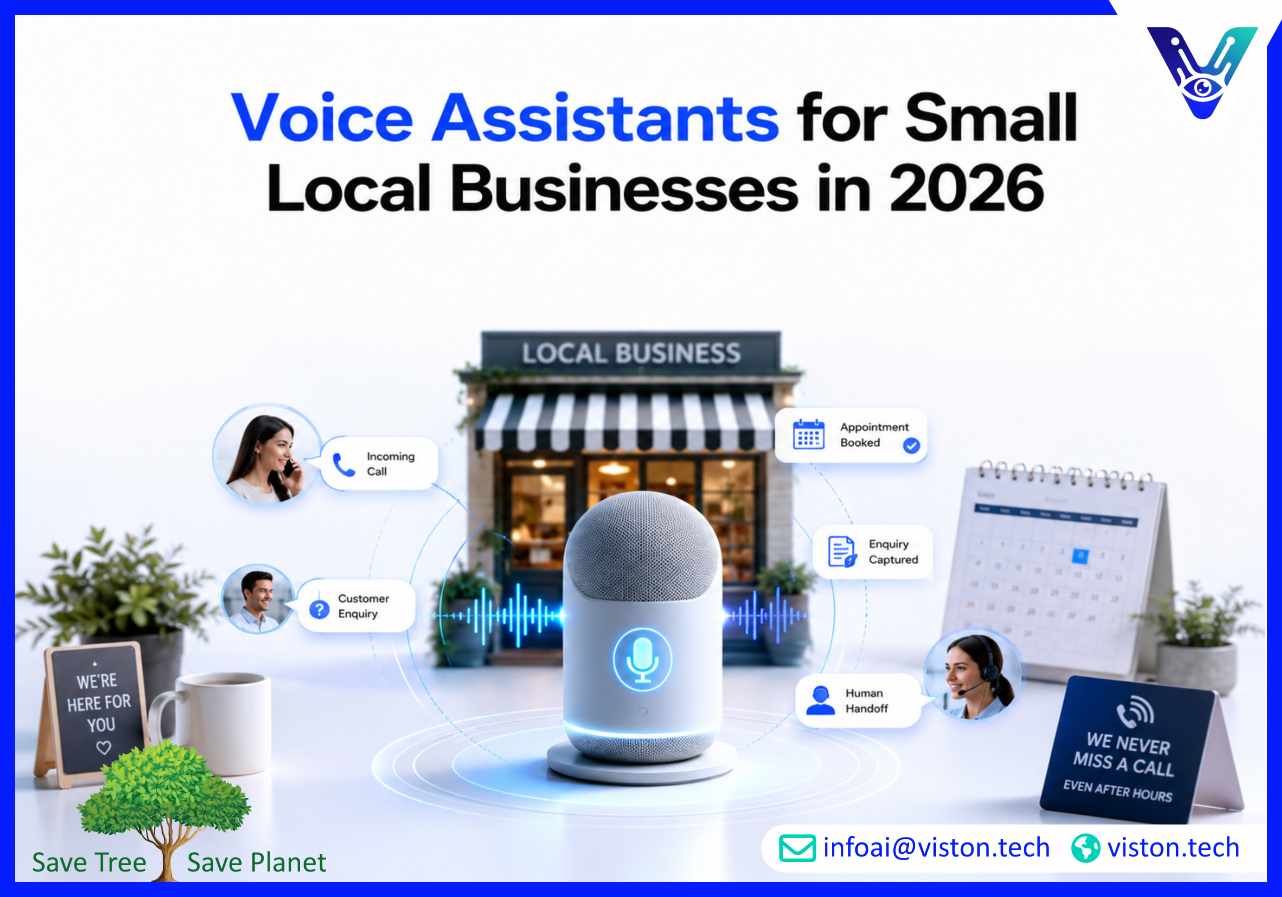
Voice assistants for small local businesses are becoming a practical way to answer calls, handle routine questions, support bookings, qualify enquiries, and improve customer service without adding constant manual workload.
A voice assistant is an AI-powered system that communicates with customers through spoken language. Instead of requiring people to press keypad options, wait on hold, or type into a chat box, the assistant listens, understands intent, responds naturally, and can trigger simple business actions. Modern AI voice assistants commonly use speech recognition, natural language understanding, and text-to-speech technology to support spoken conversations.
For a small local business, this does not need to mean a complex enterprise contact center. It can be a focused voice-enabled assistant that handles the most common customer needs: “Are you open today?”, “Can I book an appointment?”, “Do you deliver?”, “What services do you offer?”, “How much does this cost?”, or “Can someone call me back?”
The value is not just automation. The real benefit is consistency. Local businesses often depend on phone calls, walk-ins, WhatsApp messages, website enquiries, and repeat customer relationships. Missed calls can mean missed revenue. Slow responses can send customers to a competitor. A well-designed voice assistant helps reduce these gaps by making basic service information available even when staff are busy, closed, or serving customers in person.
In 2026, small business buyers expect AI systems to be practical, affordable, accurate, and easy to manage. They do not want technology that creates confusion or feels disconnected from daily operations. A useful voice assistant should reflect the business’s real services, opening hours, booking rules, location details, pricing approach, and customer tone. It should know when to answer directly and when to hand the conversation to a human.
The best voice assistant for a local business is not the one with the most features. It is the one that solves the most frequent service problems reliably and fits the way the business already works.
Small local businesses operate under pressure. They need to respond quickly, keep service personal, control costs, and avoid unnecessary admin. Many teams are small, so the same person may be handling calls, serving customers, managing appointments, replying to messages, updating stock, and following up on leads. Voice-enabled assistants can reduce some of this repetitive workload without removing the human element from the business.
Customer expectations have changed. People are used to instant answers from search engines, messaging apps, delivery platforms, and online booking tools. When they contact a local business, they often expect the same speed. If they cannot get an answer quickly, they may simply move to another provider. This matters for restaurants, clinics, salons, repair services, real estate offices, fitness studios, local retailers, legal offices, dental practices, trades, and professional service firms.
Many local businesses lose opportunities because staff cannot answer every call during peak hours. A salon may miss booking requests during busy appointment blocks. A clinic may receive repeated calls about availability. A repair business may miss urgent job enquiries while technicians are on-site. A restaurant may receive the same questions about reservations, menus, or delivery areas every day.
A voice assistant can handle these routine calls, collect useful information, and send the right details to the team. This does not replace staff. It gives staff cleaner information and reduces interruptions.
Customers trust local businesses because of reliability. If answers vary from one staff member to another, or if basic information is outdated, the customer experience suffers. A voice assistant can provide consistent answers about business hours, services, policies, booking rules, pricing ranges, location, and next steps.
Consistency also supports staff training. New employees do not need to answer every repeated question manually. The assistant can handle standard enquiries while staff focus on higher-value customer interactions.
Many customers search and call outside normal working hours. A voice assistant can respond when the business is closed, capture an enquiry, confirm the next available appointment window, or explain when a team member will follow up. This is especially useful for service businesses where timing affects conversion, such as emergency repairs, local healthcare, beauty services, property enquiries, and home improvement.
The most effective voice assistant projects begin with a clear use case. Small businesses should avoid trying to automate every conversation from day one. A focused assistant that performs three or four tasks well is usually more valuable than a broad assistant that gives uncertain answers.
Voice assistants can help customers request appointments, check basic availability, confirm contact details, and reduce back-and-forth communication. This is useful for clinics, dental offices, salons, spas, consultants, repair services, fitness trainers, tutors, and local professional service providers.
For scheduling to work well, the assistant should connect with a calendar or booking platform. It also needs clear rules: appointment duration, cancellation policy, staff availability, service categories, location options, and confirmation messages.
Most local businesses receive repeated questions. A voice assistant can answer common enquiries about pricing ranges, service areas, delivery options, product availability, parking, payment methods, opening hours, and required documents. This reduces the number of simple calls handled by staff.
The assistant should be trained on approved business information. If the customer asks something outside its scope, it should not guess. It should collect the question and route it to a human.
For service-led local businesses, every enquiry is not equal. Some customers are ready to book, while others are only comparing options. A voice assistant can ask simple qualifying questions such as service required, urgency, location, budget range, preferred time, and contact details.
This helps the business prioritize high-intent leads. For example, a plumbing company can separate emergency calls from general quote requests. A real estate office can identify buyers, sellers, renters, and investors. A clinic can route new patient enquiries differently from existing patient follow-ups.
Retailers, restaurants, pharmacies, repair shops, and local delivery businesses can use voice assistants to provide basic status updates. The assistant may answer whether an order is ready, whether delivery is available, or how long a repair may take. When connected with operational systems, it can give more accurate answers without staff checking manually.
Local businesses often serve communities with different language preferences. A multilingual voice assistant can help customers feel understood and reduce communication barriers. This is especially relevant for healthcare, government-adjacent services, hospitality, retail, education, travel, and community-based businesses.
Multilingual support should be implemented carefully. The assistant needs accurate translations, culturally appropriate responses, and clear escalation options when the conversation becomes sensitive or complex.
A successful voice assistant project starts with operational clarity, not technology selection. Small businesses should identify where calls, enquiries, and routine conversations create the most friction. Then they should build the assistant around those real problems.
Review recent calls, emails, website enquiries, chat messages, and staff feedback. Identify the questions customers ask every day. These are usually the best starting points because they are repetitive, low risk, and easy to structure.
Examples include opening hours, service availability, appointment booking, pricing guidance, location details, delivery options, refund policy, documents required, and callback requests. If the assistant can answer these accurately, the business can reduce manual workload quickly.
Boundaries are essential. A local healthcare provider may not want a voice assistant giving clinical advice. A law firm may not want it giving legal recommendations. A financial adviser may not want it making personalized investment comments. A repair company may not want it guaranteeing exact costs before inspection.
Good voice assistant design includes safe fallback responses, clear disclaimers where appropriate, and escalation triggers. The assistant should know when to say that a team member needs to confirm the answer.
A voice assistant becomes more useful when it integrates with everyday tools. For small local businesses, this may include Google Calendar, booking software, CRM platforms, spreadsheets, point-of-sale systems, helpdesk tools, WhatsApp workflows, email notifications, or internal task managers.
The goal is to avoid creating another disconnected inbox. If the assistant captures a booking request, it should place the information somewhere the team already checks. If it qualifies a lead, it should send the details to the right person. If it logs a support request, it should create a clear record.
Small businesses should track simple, practical metrics. These may include answered calls, missed-call reduction, bookings created, enquiry completion rate, callback requests, customer satisfaction, escalation rate, and staff time saved. The business should also review failed conversations to improve the assistant’s training over time.
Voice assistants should not be treated as a one-time setup. Business hours change, services change, prices change, staff availability changes, and customer questions change. Regular updates keep the assistant accurate and useful.
Viston AI is relevant to voice assistants for small local businesses because it offers Voice-Enabled AI Assistants as part of its AI chatbot and virtual assistant development capabilities. Its service page describes voice assistant solutions that combine natural language processing, speech recognition, LLMOps infrastructure, multi-turn dialogue handling, analytics, multilingual support, business system integration, and responsible AI governance.
For small local businesses, these capabilities can be applied in a focused and practical way. A business does not need an oversized enterprise rollout to benefit from voice automation. It may need a voice assistant that answers routine customer questions, captures bookings, qualifies enquiries, connects to a calendar or CRM, and escalates complex requests to staff with context.
Viston AI’s broader AI service portfolio also includes AI chatbot development, integration with business systems, multilingual support, NLP, automation workflows, model monitoring, and AI strategy. This matters because voice assistants work best when they are connected to real business processes rather than acting as isolated call scripts. A small business may start with one use case, such as appointment handling, and later expand into lead routing, customer follow-up, service reminders, or multilingual support.
For local service providers, retailers, clinics, hospitality businesses, trades, and appointment-based teams, Viston AI’s approach can support a more reliable customer response experience while helping staff spend less time on repetitive calls and more time on service delivery.
Voice assistants for small local businesses are AI-powered systems that handle spoken customer interactions. They can answer common questions, capture enquiries, support appointment booking, route calls, and help customers get basic information quickly.
Yes. A small business can use a focused voice assistant for simple tasks such as answering FAQs, collecting callback details, confirming business hours, or helping with booking requests. It does not need to be a full contact center system.
Appointment-based, service-led, and call-heavy businesses often benefit most. Examples include salons, clinics, restaurants, repair services, real estate offices, fitness studios, dental practices, local retailers, legal offices, and home service providers.
A small business should begin with routine, low-risk conversations. The assistant should handle common questions and simple workflows, while complex, sensitive, urgent, or high-value enquiries should be escalated to a human team member.
Key factors include speech accuracy, integration options, booking workflow support, multilingual capability, analytics, data security, escalation handling, ease of updates, and whether the provider understands real business operations rather than only the technology.
Viston AI’s Voice-Enabled AI Assistants service aligns with this need because it covers speech recognition, NLP, conversation handling, business system integration, multilingual support, analytics, and automation workflows that can be adapted for local business use cases.
Voice assistants for small local businesses are no longer only a futuristic idea or enterprise tool. In 2026, they can help local teams answer calls, capture enquiries, support bookings, reduce repetitive questions, and improve customer responsiveness. The best results come from starting with clear use cases, accurate business information, safe escalation rules, and practical integrations. For businesses considering Voice-Enabled Assistants, the goal should be simple: make customer communication faster, more consistent, and easier for staff to manage. Viston AI offers relevant capabilities for businesses that want voice automation connected to real workflows and measurable service outcomes.
