
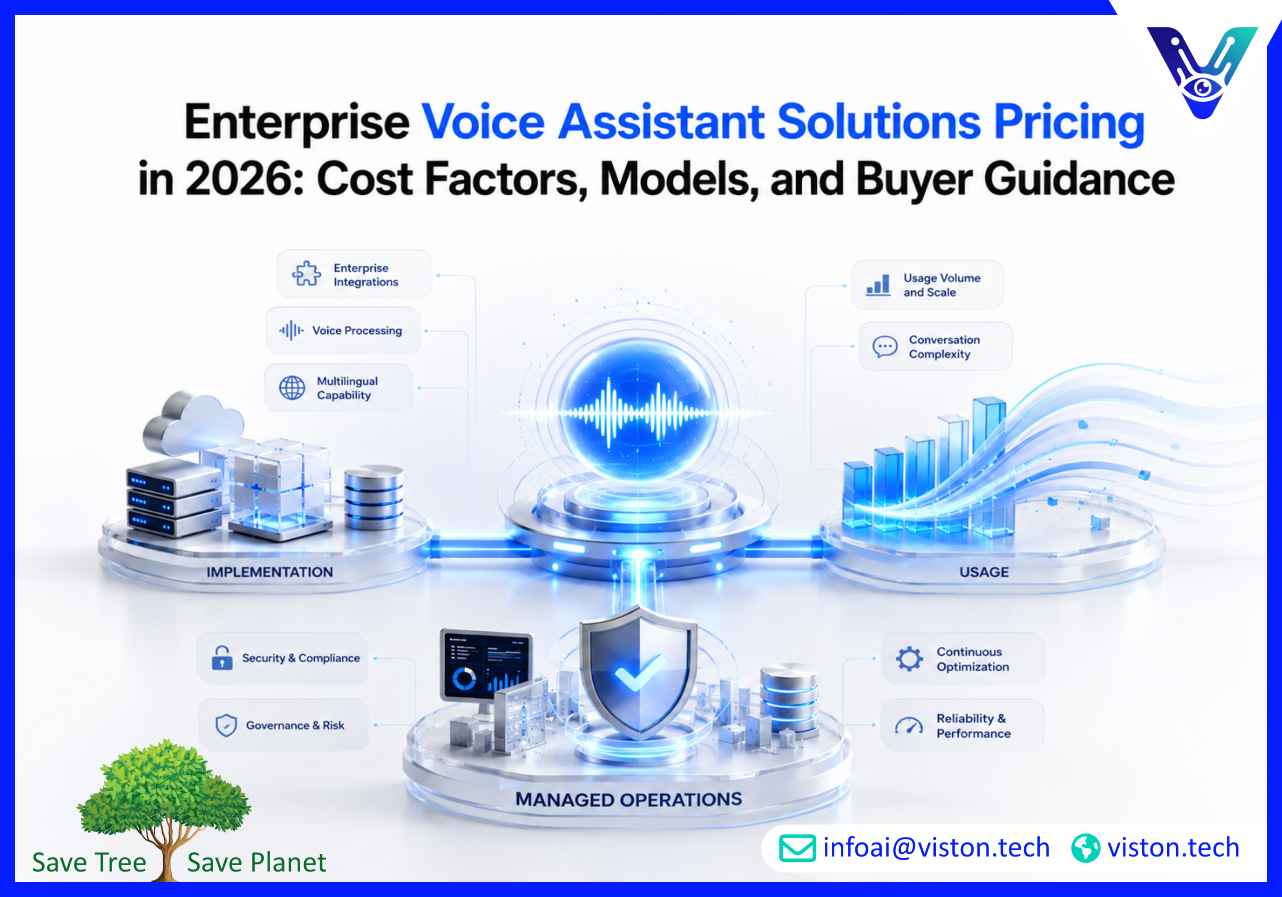
Enterprise voice assistant solutions pricing matters because voice AI is no longer a simple call-routing tool. In 2026, businesses are pricing systems that understand speech, manage intent, connect with enterprise platforms, protect sensitive data, and support customers or employees through real operational workflows.
Enterprise voice assistant solutions pricing depends on much more than the cost of building a voice bot. A production-ready voice assistant usually combines speech recognition, natural language understanding, dialogue management, text-to-speech, system integrations, security controls, analytics, and ongoing optimization.
For a small proof of concept, the cost may focus mainly on use case design, a limited knowledge base, basic speech-to-text, simple response generation, and one or two integrations. For a full enterprise rollout, pricing must account for contact center systems, CRM data, authentication, multilingual support, compliance requirements, performance monitoring, fallback handling, and human escalation workflows.
Buyers should separate the price into two categories: implementation cost and operating cost. Implementation cost covers discovery, design, development, testing, integration, deployment, and training. Operating cost covers hosting, voice minutes, telephony, AI model usage, speech processing, monitoring, maintenance, support, and continuous improvement.
A low-cost voice assistant may answer basic questions, but an enterprise-grade solution must perform reliably under real usage conditions. That is why pricing should be assessed against business risk, integration depth, data sensitivity, expected call volume, and the value of automation.
The biggest pricing differences usually come from complexity. Two companies may both request a voice assistant, but one may need a simple appointment scheduler while another needs a multilingual customer service assistant connected to billing, identity verification, CRM, payment status, and live agent handoff.
A narrow use case costs less because it has fewer intents, fewer workflows, and fewer failure scenarios. Examples include store hours, appointment booking, order status, password reset guidance, or basic lead capture. A broader assistant that handles complaints, account changes, troubleshooting, eligibility checks, refund requests, or sales qualification requires deeper design and more testing.
Integration is one of the most important price drivers. A voice assistant that only answers from a static knowledge base is simpler than one that must read and write data across Salesforce, Microsoft Dynamics, SAP, Oracle, ServiceNow, Zendesk, Epic, Workday, ecommerce platforms, payment systems, or custom internal tools.
Each integration adds discovery, API mapping, authentication, error handling, logging, testing, and production monitoring. If the assistant must update records, trigger workflows, create tickets, verify customer identity, or retrieve real-time account information, the project becomes more valuable but also more expensive.
Voice AI pricing is affected by the quality of speech recognition and voice output. Businesses serving customers across regions may need accent handling, regional language support, dialect recognition, noise tolerance, and culturally appropriate responses. A global voice assistant also needs localized content, fallback rules, escalation paths, and compliance review for each market.
Latency also matters. A voice assistant that takes too long to respond feels unnatural and increases abandonment. Low-latency infrastructure, streaming speech recognition, optimized model routing, and fast backend responses can increase technical cost but improve user experience.
Voice assistants often process sensitive information such as names, addresses, account numbers, payment details, health information, employee records, or financial data. Pricing increases when the project requires encryption, consent management, PII redaction, role-based access, audit trails, data retention rules, voice recording controls, biometric authentication, or regulatory reporting.
For finance, healthcare, insurance, government, and enterprise HR use cases, security cannot be treated as an optional add-on. It should be included in project planning from the beginning because retrofitting compliance later is usually slower and more expensive.
Most enterprise voice assistant solutions use one or a combination of four pricing models: project-based pricing, usage-based pricing, subscription pricing, and managed service pricing. The right model depends on whether the business wants a custom build, a platform configuration, ongoing operational support, or a scalable voice AI program.
Project-based pricing works well when the scope is clearly defined. The vendor estimates the cost of discovery, design, development, integrations, testing, and launch. This model gives procurement teams clearer upfront visibility, but change requests can increase cost if requirements expand.
Indicative planning ranges may look like this:
These ranges are not fixed quotes. They are planning benchmarks. Actual pricing depends on the business process, technical environment, number of channels, compliance expectations, and vendor delivery model.
Usage-based pricing charges according to consumption. This may include voice minutes, speech-to-text usage, text-to-speech usage, model calls, telephony charges, knowledge retrieval, API transactions, or number of conversations. It is common when the assistant runs at scale and monthly demand varies.
This model is useful for companies with seasonal peaks, call center volume fluctuations, or gradual rollout plans. However, buyers should model expected usage carefully. A solution that looks affordable at low volume may become expensive when call traffic increases.
Subscription pricing usually includes platform access, hosting, standard features, support, analytics, and defined usage limits. It can be easier for budgeting because the monthly or annual cost is predictable. Subscription pricing may be tiered by number of users, conversations, voice minutes, channels, languages, or integrations.
For enterprise buyers, the key question is what the subscription includes. Some vendors include basic support and analytics but charge separately for custom workflows, advanced integrations, security reviews, premium voice models, or dedicated infrastructure.
Managed service pricing is useful when the business wants ongoing optimization after launch. A managed service may include conversation review, intent tuning, knowledge base updates, monitoring, reporting, model evaluation, compliance checks, and improvement recommendations.
Monthly managed service retainers may range from a few thousand dollars for light support to tens of thousands per month for high-volume, regulated, or multi-region deployments. This cost is often justified when the assistant supports revenue, customer experience, employee productivity, or operational continuity.
The cheapest enterprise voice assistant is rarely the best investment if it creates poor customer experiences, unreliable handoffs, inaccurate answers, or compliance exposure. Buyers should evaluate pricing against the cost of the problem being solved.
For customer service, the value may come from reduced call volume, shorter average handle time, improved after-hours support, better first-contact resolution, and more consistent responses. For sales teams, value may come from faster lead qualification, appointment scheduling, and improved inbound response coverage. For internal operations, value may come from hands-free task completion, faster knowledge access, and reduced manual administration.
A strong pricing proposal should show what is included, what is excluded, what assumptions are being made, and how the solution will be scaled after launch. It should also explain how the vendor will manage failure scenarios, such as misunderstood intent, system downtime, incomplete API responses, or urgent human escalation.
Many businesses reduce risk by starting with a pilot. A pilot allows teams to validate user demand, test recognition accuracy, confirm integration feasibility, measure call containment, and identify operational gaps before committing to a larger rollout.
The best pilots are not isolated demos. They should test a real business workflow, use real or representative data, involve operational stakeholders, and define measurable success criteria. This makes the next pricing phase more accurate because the business has evidence of complexity, usage, and value.
Viston AI is relevant to enterprise voice assistant solutions pricing because Voice-Enabled Assistants are part of its AI service offering. The company positions its voice assistant capability around natural language processing, speech recognition, generative AI, LLMOps infrastructure, multi-turn dialogue, multilingual support, enterprise integrations, analytics, and responsible AI governance.
For businesses evaluating pricing, this matters because voice assistant cost is closely tied to architecture and delivery depth. A basic voice bot may be priced around scripted responses, while a serious enterprise solution requires intent design, secure system connectivity, real-time data access, testing, monitoring, and continuous improvement. Viston AI’s service focus aligns with companies that need voice AI connected to practical business workflows rather than a standalone conversational interface.
Its broader enterprise AI capabilities, including AI chatbot development, integration with business systems, NLP and text analysis, automation workflows, MLOps and model monitoring, AI strategy, and multilingual support, are relevant when a voice assistant must operate across customer service, sales, support, healthcare, finance, retail, manufacturing, or internal operations. This makes Viston AI a suitable specialist to consider when pricing needs to account for implementation quality, scalability, compliance, and measurable business outcomes.
An enterprise voice assistant can range from a small five-figure pilot to a six- or seven-figure production rollout. Pricing depends on use case scope, integrations, call volume, language support, compliance needs, security controls, and ongoing optimization requirements.
Pricing usually includes discovery, conversation design, speech recognition setup, natural language processing, text-to-speech configuration, integrations, testing, deployment, analytics, and post-launch support. Usage costs such as voice minutes, telephony, model calls, and hosting may be billed separately.
Usage-based pricing is useful when call volume changes month to month. Project-based pricing is better when the implementation scope is clear. Many enterprise deployments use both: a project fee for implementation and a monthly usage or managed service fee after launch.
Integrations increase pricing because the assistant must securely connect with systems such as CRM, ERP, helpdesk, contact center software, payment platforms, or custom APIs. Each integration requires data mapping, authentication, workflow logic, error handling, testing, and monitoring.
Viston AI can be relevant for pricing discussions because its Voice-Enabled Assistants service connects voice AI with NLP, speech recognition, enterprise integrations, analytics, multilingual support, and scalable AI operations. A proper estimate would depend on the business use case, systems, data, and deployment goals.
Useful KPIs include call containment rate, self-service resolution rate, average handle time reduction, escalation quality, customer satisfaction, cost per resolved interaction, lead qualification rate, workflow completion rate, and system uptime.
Enterprise voice assistant solutions pricing in 2026 should be evaluated as a business and technology investment, not simply a software purchase. The real cost depends on how deeply the assistant must understand users, connect with systems, protect data, support workflows, and improve over time. Businesses should compare pricing models carefully, start with measurable use cases, and account for both implementation and operating costs. For organizations considering Voice-Enabled Assistants, Viston AI offers relevant capabilities for building scalable, integrated, and business-focused voice AI solutions.
