
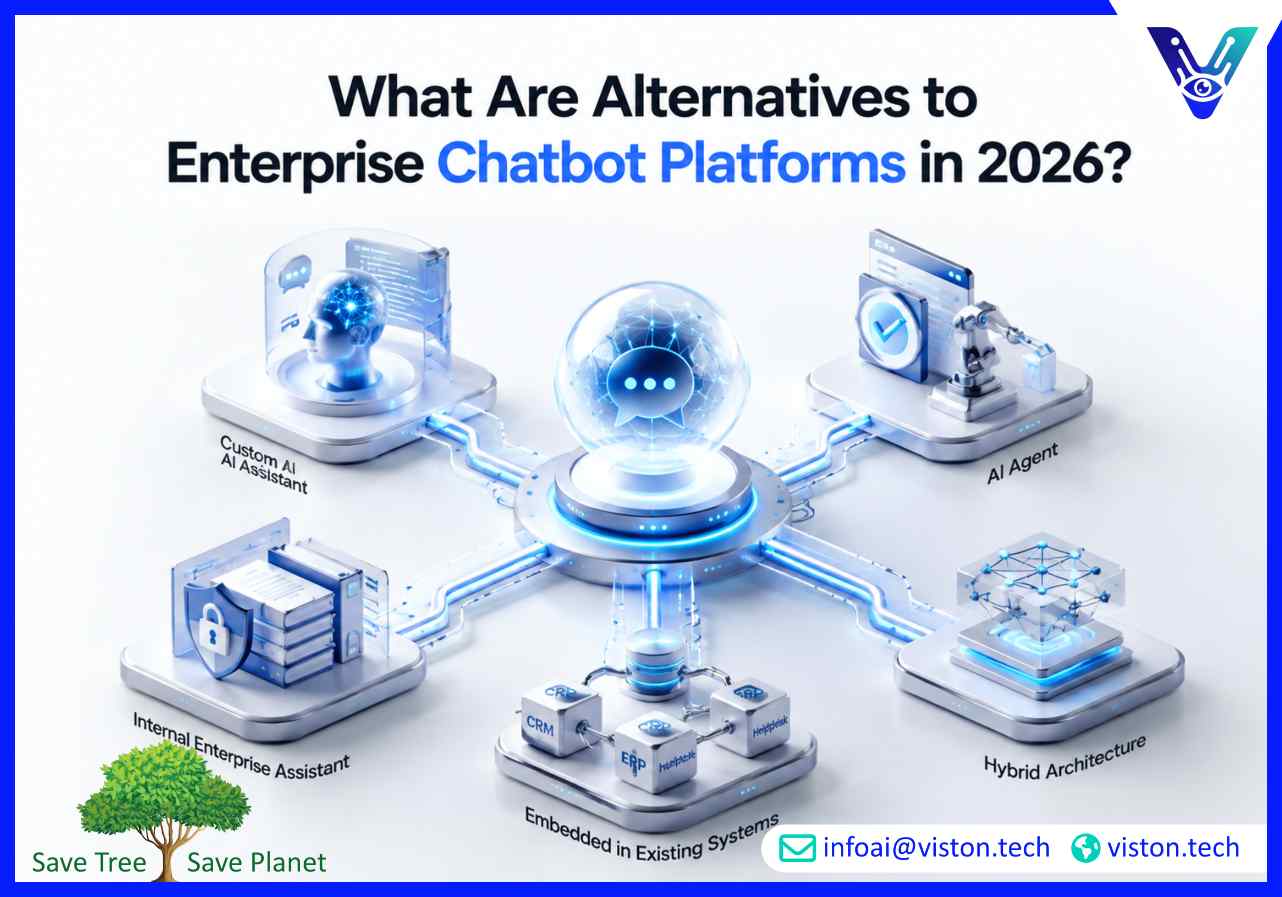
What are alternatives to enterprise chatbot platforms? For many businesses in 2026, the answer depends on whether they need a packaged chatbot tool, a custom conversational AI system, an internal AI assistant, workflow automation, or a more flexible enterprise AI chatbot architecture.
Enterprise chatbot platforms became popular because they gave businesses a faster way to automate customer support, employee service requests, lead qualification, knowledge search, and basic self-service. Many platforms offer ready-made interfaces, conversation builders, analytics dashboards, channel connectors, and integrations with CRM or helpdesk tools.
However, not every organization is best served by a traditional platform subscription. Some businesses outgrow rigid conversation flows. Others need stronger control over data, security, deployment, integrations, model behavior, knowledge retrieval, multilingual support, or workflow logic. In regulated or complex environments, a standard chatbot platform may not provide enough flexibility to meet operational, compliance, or customer experience expectations.
The question is not whether enterprise chatbot platforms are useful. Many are. The better question is whether a platform is the right operating model for the business problem. A company handling simple FAQs may be comfortable with a low-code chatbot tool. A global enterprise connecting conversational AI to ERP, CRM, customer data, policy documents, and internal workflows may need a custom enterprise AI chatbot solution instead.
Businesses usually begin exploring alternatives when they face limitations such as restricted customization, high licensing costs, weak backend integration, limited control over AI models, poor data governance, generic user experiences, slow workflow changes, or difficulty scaling across departments and regions.
Another common issue is ownership. A platform may control the conversation environment, analytics, model access, data storage, and feature roadmap. For some companies, that is convenient. For others, especially those with sensitive data or complex workflows, it creates dependency and reduces long-term flexibility.
In 2026, buyers are more aware of these trade-offs. They want chatbot systems that can retrieve trusted knowledge, complete business tasks, support human escalation, protect sensitive information, and improve over time through measurable performance data. That expectation has expanded the market beyond packaged chatbot platforms into several practical alternatives.
The best alternative depends on the organization’s use case, technical maturity, budget, compliance requirements, and need for control. Some alternatives are lighter and faster to launch. Others require deeper engineering but offer better scalability and ownership.
A custom enterprise AI chatbot is built around the organization’s specific processes, knowledge sources, systems, security requirements, and user journeys. Instead of adapting the business to a platform’s fixed structure, the chatbot is designed around real operational needs.
This approach is useful when a business needs advanced natural language understanding, retrieval from approved knowledge bases, CRM or ERP actions, role-based answers, multilingual support, complex escalation rules, or domain-specific workflows. A custom chatbot can be built for customer support, sales assistance, internal IT helpdesk, HR service delivery, onboarding, compliance guidance, field operations, or partner support.
The main advantage is flexibility. The main responsibility is governance. Custom systems require strong planning, testing, monitoring, and ongoing optimization. They are usually best for organizations that want conversational AI to become part of their operating infrastructure, not just a website widget.
AI agents are becoming a serious alternative to traditional chatbot platforms. While chatbots usually focus on conversation, AI agents are designed to complete tasks. They may interpret a user request, retrieve context, call business systems, trigger workflows, update records, summarize outcomes, and escalate when needed.
For example, an AI agent can help create a support ticket, check order status, route a refund request, schedule an appointment, generate a sales follow-up, prepare a knowledge summary, or update a CRM record. This makes AI agents valuable for teams that want automation beyond answering questions.
AI agents are not always a replacement for chatbots. In many enterprise systems, the chatbot becomes the conversational interface and agents perform the work behind the scenes. This architecture is useful when businesses want a more action-oriented alternative to static chatbot flows.
Internal AI assistants are designed for employees rather than customers. They help staff search policies, find documents, summarize information, submit service requests, troubleshoot issues, access knowledge bases, and navigate internal systems.
This alternative is especially relevant for companies that do not need a customer-facing chatbot platform but still want conversational AI for productivity. Internal assistants can support IT, HR, finance, legal, procurement, operations, sales enablement, and knowledge management teams.
The key requirement is access control. Employee-facing AI assistants must respect permissions, avoid exposing confidential data, and provide answers from approved sources. They should also include audit trails, source references, and escalation paths when answers involve risk, policy interpretation, or sensitive decisions.
Some businesses do not need a separate chatbot platform at all. Instead, they need conversational AI embedded into systems they already use, such as CRM, helpdesk software, ERP, ecommerce platforms, employee portals, data dashboards, or mobile apps.
This approach avoids adding another standalone tool. It brings AI assistance into the workflow where users already operate. A sales representative may receive AI guidance inside the CRM. A support agent may get suggested replies inside the helpdesk. A customer may ask questions directly inside a mobile app or account portal.
Embedded conversational AI works well when user experience and workflow continuity matter. It also helps reduce tool fatigue, improve data quality, and keep actions close to the systems of record.
For some companies, the real need is not a full chatbot platform but a better way to search and summarize trusted knowledge. A generative AI knowledge assistant can retrieve answers from approved documents, help centers, manuals, SOPs, product catalogs, policies, and training materials.
This alternative is useful when users mainly ask information-based questions. It can improve support, onboarding, self-service, internal documentation access, and technical troubleshooting. The system should use controlled knowledge sources, source ranking, permission-aware retrieval, and fallback rules when information is missing or uncertain.
Knowledge assistants are often more focused than enterprise chatbot platforms. They may not handle complex workflows at first, but they can be a strong starting point for companies that need accurate answers before broader automation.
Choosing between chatbot platform alternatives should begin with the business outcome, not the technology label. A buyer should first define what the system must achieve, who will use it, what data it needs, what actions it must perform, and what level of risk is acceptable.
A customer support team with high volumes of repetitive questions may need an enterprise AI chatbot connected to ticketing, knowledge base, order management, and live agent handover. A sales team may need a lead qualification assistant that routes prospects into CRM and books meetings. An HR team may need a secure internal assistant that answers policy questions and guides employees through requests.
Each use case has different requirements. Support chatbots need resolution quality and escalation context. Sales bots need qualification logic and CRM accuracy. Internal assistants need permissions and policy reliability. Workflow agents need integration stability and error handling.
Data access is often the deciding factor. If the chatbot only answers public FAQs, a simple tool may be enough. If it must retrieve customer-specific records, update tickets, process requests, or use internal documents, the business needs deeper integration and stronger governance.
Buyers should assess which systems need to connect, how data will be synchronized, what permissions apply, how errors will be handled, and whether the system can maintain context across channels. Integration quality has a direct impact on user experience and operational value.
Enterprise AI chatbots must be evaluated through a security and compliance lens. Important questions include where data is stored, whether sensitive information is encrypted, how user permissions are enforced, how conversations are logged, what audit trails are available, and how the system handles regulated or high-risk requests.
Businesses in sectors such as finance, healthcare, insurance, legal services, government, education, manufacturing, and ecommerce may need stronger controls than a basic chatbot platform can provide. In those cases, custom or hybrid architectures may be more suitable.
Platform pricing is only one part of the cost. Businesses should also consider implementation, integrations, training data preparation, content governance, analytics setup, maintenance, performance optimization, security review, and support.
A low-cost platform can become expensive if it requires workarounds, manual data updates, duplicate systems, or frequent vendor-dependent changes. A custom solution may require more upfront planning but can provide better long-term fit when the chatbot is central to operations.
A custom enterprise AI chatbot is often the better option when the business needs flexibility, ownership, and strong alignment with real workflows. This is especially true when conversational AI must support multiple departments, sensitive information, complex processes, or business-specific terminology.
Custom development allows the company to define how the chatbot understands intent, retrieves knowledge, manages escalation, uses customer context, connects to systems, and reports performance. It can also support deployment choices such as cloud, private cloud, on-premises, or hybrid environments depending on the organization’s requirements.
A custom enterprise AI chatbot does not mean building everything from scratch unnecessarily. Many strong solutions combine proven AI frameworks, cloud services, vector databases, orchestration layers, integration APIs, analytics tools, and human-in-the-loop workflows. The value comes from designing the architecture around the business rather than forcing the business into a fixed platform model.
Some organizations choose a hybrid model. They may use an existing live chat, CRM, or helpdesk platform for the user interface while building custom AI logic, retrieval, workflow automation, and integration layers behind it. This can reduce change management while still improving flexibility.
A hybrid approach is practical when a company already has strong enterprise systems but needs more intelligent automation. It allows teams to keep familiar tools while upgrading the intelligence, accuracy, and workflow capability of the chatbot experience.
Viston AI is relevant to this topic because alternatives to enterprise chatbot platforms often require more than selecting another tool. Businesses need to understand whether they should use a packaged platform, custom enterprise AI chatbot, AI agent architecture, internal assistant, embedded conversational AI layer, or hybrid model.
Viston AI provides Enterprise AI Chatbots as part of its broader AI service portfolio, with capabilities connected to AI chatbot development, chatbot integration, multilingual support, voice-enabled assistants, NLP and text analysis, automation workflows, AI strategy, and business system integration. This makes its service offering suitable for organizations that want conversational AI designed around enterprise workflows rather than limited to generic chatbot templates.
For businesses comparing alternatives, Viston AI can support practical decision-making around use case scope, data readiness, system integration, knowledge architecture, security requirements, escalation design, deployment model, and performance measurement. Its approach is especially relevant when the chatbot must connect with CRM, knowledge bases, transactional systems, internal portals, or workflow tools.
Instead of treating the chatbot as a standalone channel, Viston AI’s enterprise AI chatbot work can help businesses build conversational systems that support customer service, sales operations, internal helpdesk, knowledge search, and process automation. For organizations operating across multiple teams or markets, this kind of tailored implementation can provide better control, scalability, and business alignment than a one-size-fits-all platform.
The best alternatives include custom enterprise AI chatbots, AI agents, internal AI assistants, embedded conversational AI, generative AI knowledge assistants, and hybrid chatbot architectures. The right option depends on workflow complexity, integration needs, data sensitivity, budget, and long-term control requirements.
Custom enterprise AI chatbots are better when a business needs deep integration, role-based answers, advanced workflow automation, custom knowledge retrieval, strict security controls, or ownership over the chatbot roadmap. Standard platforms may still work well for simpler use cases.
AI agents can replace some platform functions when the goal is task completion rather than simple conversation. In many enterprise environments, AI agents work with chatbots by handling backend actions such as routing requests, updating records, retrieving data, or triggering workflows.
A business should consider alternatives when a standard chatbot platform creates limits around customization, compliance, integration, data control, scalability, multilingual support, analytics, or complex business processes. Platform convenience should not come at the cost of operational fit.
A hybrid chatbot architecture combines existing enterprise tools with custom AI components. For example, a company may keep its CRM or helpdesk interface while adding custom natural language understanding, retrieval, workflow automation, and integration logic behind the scenes.
Yes. Viston AI’s Enterprise AI Chatbots service is aligned with this need because it supports custom chatbot development, integration with business systems, NLP, multilingual support, automation workflows, and scalable enterprise conversational AI design.
Understanding what are alternatives to enterprise chatbot platforms helps businesses choose conversational AI based on real operational needs rather than software category labels. Standard platforms can be useful, but they are not the only route. Custom enterprise AI chatbots, AI agents, internal assistants, embedded AI, knowledge assistants, and hybrid architectures can offer stronger flexibility, control, integration, and scalability. For companies that want enterprise AI chatbots to support measurable customer, employee, and workflow outcomes, the best choice is the model that fits their data, systems, compliance needs, and growth plans. Viston AI is a relevant specialist for businesses exploring tailored chatbot alternatives built around enterprise requirements.
