
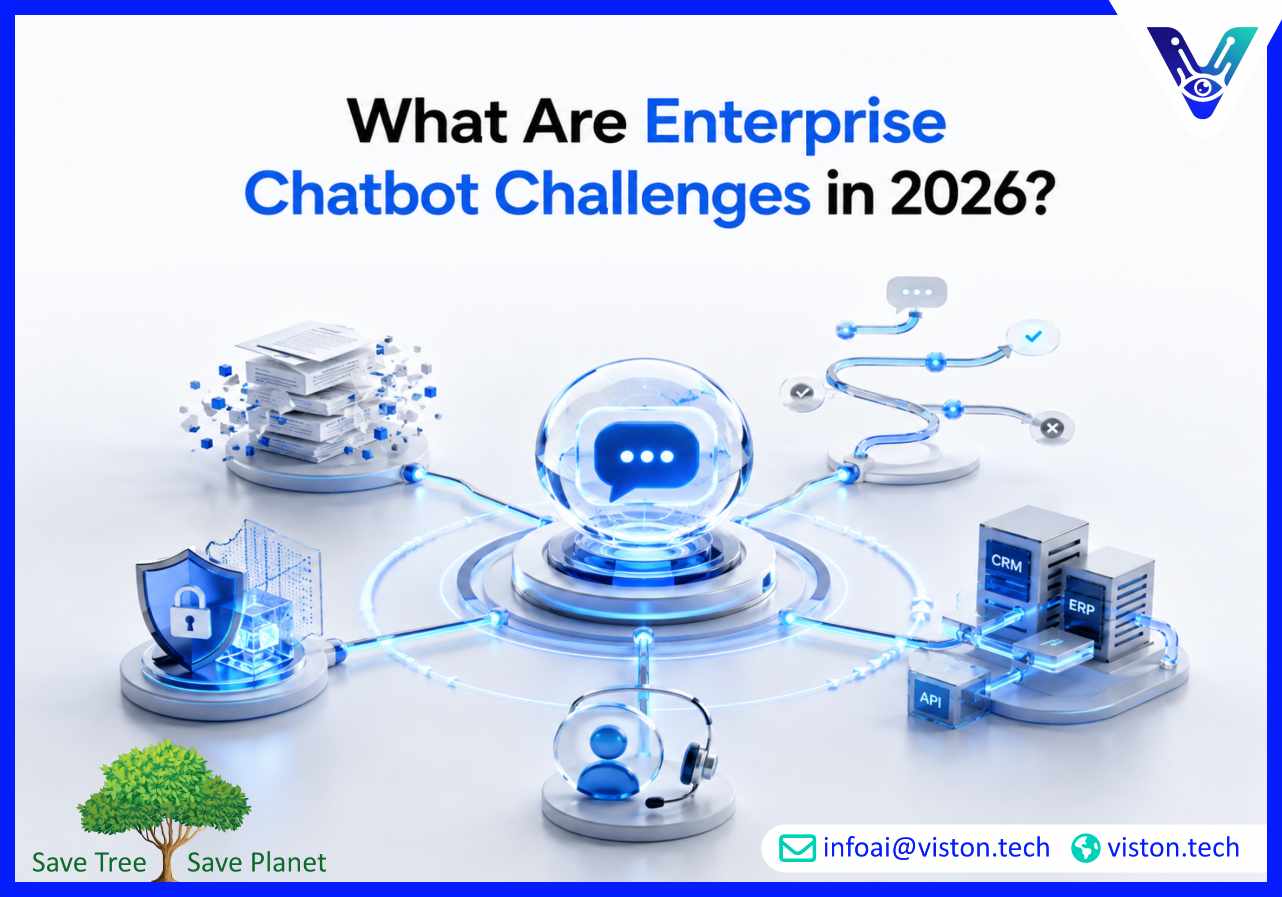
Enterprise chatbot challenges matter because conversational AI now affects customer experience, employee productivity, data quality, compliance, and operational efficiency. In 2026, businesses need more than a chatbot interface. they need secure, integrated, well-governed Enterprise AI Chatbots that can perform reliably across real business workflows.
Enterprise chatbot challenges are the practical, technical, operational, and governance issues that prevent chatbot deployments from delivering reliable business value. These challenges often appear after the initial excitement of automation, when teams realize that answering questions is only one part of successful chatbot performance.
An enterprise chatbot must understand user intent, retrieve accurate information, follow business rules, respect permissions, integrate with enterprise systems, escalate complex issues, and maintain a consistent experience across channels. If any of these areas are weak, the chatbot can create friction instead of efficiency.
Unlike basic website chat widgets, Enterprise AI Chatbots usually operate inside complex environments. They may need to connect with CRM platforms, ERP systems, helpdesk tools, order management systems, HR platforms, knowledge bases, authentication systems, analytics dashboards, and workflow automation tools. This makes implementation more demanding but also more valuable when done correctly.
The main challenge is not whether a chatbot can generate a fluent response. The real question is whether it can provide the right response, at the right time, using approved business information, while protecting sensitive data and supporting measurable outcomes.
Enterprise scale introduces complexity. A small business chatbot may answer a limited set of FAQs. An enterprise chatbot may need to support multiple departments, regions, brands, languages, user roles, compliance requirements, and customer journeys. It may also need to work across web, mobile, WhatsApp, voice, internal portals, and collaboration tools.
This wider scope makes governance essential. Without clear ownership, chatbot content becomes outdated, integrations fail silently, fallback rates increase, and users lose trust. Enterprise teams must treat chatbot deployment as a living business capability rather than a one-time software launch.
The most common enterprise chatbot challenges are connected to data quality, system integration, intent accuracy, security, user adoption, workflow design, and ongoing optimization. These issues can affect both customer-facing and internal chatbots.
A chatbot is only as reliable as the information it can access. Many enterprises have scattered, outdated, duplicated, or conflicting knowledge across documents, intranets, help centers, PDFs, CRM notes, and service portals. If this content is not cleaned and governed, the chatbot may provide incomplete or inconsistent answers.
Knowledge quality becomes especially important when the chatbot supports policies, pricing, product details, technical troubleshooting, compliance workflows, or customer account questions. Businesses need approved source-of-truth content, clear document ownership, version control, and regular review cycles.
Intent recognition is the chatbot’s ability to understand what a user wants. Weak intent recognition leads to irrelevant answers, repeated clarification questions, high fallback rates, and unnecessary escalation. This often happens when training data does not reflect how users actually ask questions.
Enterprise users may use product codes, internal abbreviations, regional terms, industry-specific phrases, or informal language. Customers may describe the same problem in many different ways. A strong Enterprise AI Chatbot needs intent mapping, synonym handling, entity recognition, conversation testing, and ongoing review of failed queries.
Integration is one of the biggest enterprise chatbot challenges. A chatbot that only answers static questions may be easy to launch, but its business value is limited. To support real workflows, it often needs to retrieve data, create tickets, update CRM records, schedule appointments, check order status, trigger approvals, or route requests to the right team.
These actions require secure APIs, authentication, error handling, permission logic, data mapping, and monitoring. Legacy systems can make integration harder because they may have limited APIs, inconsistent data formats, or strict access controls. Businesses should plan integration architecture early instead of treating it as a late-stage technical task.
Enterprise chatbots may handle customer records, employee information, financial data, health-related details, contracts, support histories, or internal policy information. This creates security and privacy concerns if access controls are weak or conversation data is not managed properly.
Key risks include unauthorized data exposure, insecure API connections, excessive data retention, prompt injection attempts, weak authentication, and insufficient audit logging. Enterprise AI Chatbots should be designed with role-based access, encryption, secure credential management, data minimization, logging, and clear retention policies.
Not every conversation should be automated. Some issues require human judgment, emotional sensitivity, account-level review, compliance approval, or exception handling. A common chatbot failure is either escalating too quickly or refusing to escalate when the user clearly needs help.
Good escalation design includes confidence thresholds, sentiment detection, issue severity, user status, service level agreements, and complete handoff summaries. Human agents should receive the user’s context, conversation history, detected intent, attempted resolution, and relevant system data so the customer does not need to repeat everything.
Beyond the obvious implementation issues, enterprise chatbot performance can weaken because of operational gaps. These risks often appear after launch, when the chatbot begins handling real users, real data, and real business exceptions.
Enterprise chatbots sit between business, technology, customer experience, security, legal, and operations teams. If ownership is unclear, nobody knows who should update content, review analytics, approve new workflows, manage integrations, or respond to performance issues.
Businesses should define owners for chatbot strategy, knowledge management, AI performance, integration reliability, compliance review, conversation design, and reporting. A chatbot without ownership becomes stale quickly.
Some businesses try to automate too many processes too quickly. This creates risk when workflows are complex, data is unreliable, or users expect human support. Over-automation can damage trust if the chatbot gives confident answers without enough context or blocks users from reaching a person.
A better approach is to start with high-volume, low-risk use cases, then expand gradually. Common starting points include FAQs, order status, appointment booking, lead qualification, password reset guidance, support triage, policy search, and internal IT helpdesk requests.
Enterprise users expect consistent service across websites, mobile apps, messaging platforms, call centers, and internal tools. A chatbot challenge arises when each channel has different answers, workflows, tone, or escalation rules.
Omnichannel consistency requires shared knowledge sources, unified conversation design, centralized analytics, and integrated customer context. Without this, users may receive different answers depending on where they ask the same question.
Many chatbot projects track only conversation volume. While volume shows usage, it does not prove value. A chatbot may handle thousands of conversations but still fail to resolve issues, qualify leads, reduce tickets, or improve customer satisfaction.
Better metrics include self-service resolution rate, fallback rate, escalation quality, user satisfaction, intent accuracy, task completion rate, lead qualification rate, ticket deflection, workflow success rate, CRM update accuracy, and cost per resolved conversation.
Enterprise AI Chatbots need continuous monitoring because products, policies, customer expectations, and workflows change. A chatbot that performs well during launch may become inaccurate if training data, prompts, integrations, and knowledge sources are not maintained.
Ongoing improvement should include fallback analysis, conversation reviews, content updates, model tuning, prompt refinement, integration monitoring, security checks, and KPI reporting. This turns chatbot performance into a managed service capability rather than a static tool.
Businesses can overcome enterprise chatbot challenges by treating implementation as a structured business transformation project. The goal is not just to deploy a chatbot, but to create a reliable conversational layer over enterprise knowledge, workflows, and customer journeys.
Before choosing technology, define what the chatbot should achieve. The objective may be reducing support tickets, improving response speed, qualifying leads, improving employee self-service, automating internal workflows, or supporting multilingual customer engagement.
Clear objectives help teams choose the right use cases, data sources, integrations, KPIs, and escalation rules. They also prevent chatbot projects from becoming broad experiments without measurable value.
Not every use case should be automated first. Businesses should prioritize chatbot use cases based on conversation volume, business value, user frustration, automation readiness, data availability, and risk level.
Low-risk and high-volume tasks are usually strong starting points. Complex, regulated, or emotionally sensitive workflows should be introduced only after the chatbot has strong governance, tested knowledge, secure integrations, and reliable human handoff.
Knowledge governance is one of the most important foundations for chatbot success. Enterprises should identify approved sources, remove outdated content, assign content owners, define update schedules, and control access based on user roles.
The chatbot should know which content is public, customer-specific, employee-only, region-specific, or restricted. This reduces the risk of inaccurate answers and protects sensitive business information.
Enterprise chatbot integration should be planned around business workflows. Teams should map which systems the chatbot needs to access, what data it can read or write, what permissions are required, how errors should be handled, and how actions should be logged.
Secure integration design helps the chatbot move beyond simple Q&A. It allows the system to complete useful tasks such as creating support tickets, updating customer records, checking order status, booking appointments, routing claims, or triggering internal approvals.
Testing should include real user phrases, edge cases, multilingual inputs, integration failures, security scenarios, escalation triggers, and high-volume usage. Internal pilots can reveal problems before customers or employees rely on the chatbot at scale.
Businesses should also test whether answers are grounded in approved sources, whether workflows complete correctly, and whether handoffs provide enough context to human teams.
Viston AI is relevant to enterprise chatbot challenges because its Enterprise AI Chatbots service is built around conversational AI for business environments where accuracy, integration, scalability, compliance, and workflow automation matter. The company provides AI chatbot development, business system integration, multilingual chatbot support, voice-enabled assistants, NLP capabilities, automation workflows, and ongoing optimization.
For businesses facing chatbot implementation risks, this service alignment is important. Many challenges come from treating chatbots as standalone tools rather than connected enterprise systems. Viston AI’s chatbot capabilities are positioned around connecting conversational interfaces with CRM platforms, knowledge bases, transactional systems, customer data, and internal workflows. This helps organizations improve response accuracy, automate repetitive tasks, support human handoff, and measure chatbot performance through business outcomes.
The company’s broader AI service portfolio also includes AI strategy development, AI readiness assessment, agentic AI workflows, MLOps and model monitoring, data strategy consulting, and custom AI solution development. These capabilities are relevant when enterprises need more than a chatbot build; they need planning, secure architecture, training data preparation, integration design, governance, deployment support, and continuous improvement.
For global businesses, customer support teams, sales operations, ecommerce companies, healthcare providers, financial services firms, manufacturers, and internal service desks, Viston AI can support Enterprise AI Chatbots that are practical, scalable, and aligned with real operational requirements.
The biggest enterprise chatbot challenges include poor knowledge quality, weak intent recognition, complex system integration, data privacy risk, unclear ownership, poor escalation design, inconsistent omnichannel experience, and lack of ongoing optimization.
Enterprise chatbot projects often fail when they launch without clear objectives, clean data, approved knowledge sources, secure integrations, realistic use cases, proper testing, or ownership for continuous improvement.
Businesses can improve chatbot accuracy by using approved knowledge sources, cleaning training data, mapping priority intents, testing real user queries, monitoring fallback conversations, and regularly updating content, prompts, and workflows.
They can be risky if not designed correctly. Sensitive data should be protected through encryption, authentication, role-based access controls, audit logging, data minimization, secure APIs, and clear retention policies.
Enterprises should define escalation rules based on intent confidence, user sentiment, issue complexity, compliance risk, account value, and urgency. The chatbot should transfer the conversation with full context so human teams can continue smoothly.
Yes. Viston AI’s Enterprise AI Chatbots service is aligned with common chatbot challenges because it covers chatbot development, NLP, multilingual support, system integration, workflow automation, AI strategy, and ongoing optimization for business use cases.
Understanding what are enterprise chatbot challenges helps businesses approach Enterprise AI Chatbots with realistic expectations and stronger execution. The most important issues usually involve data quality, intent accuracy, integrations, security, governance, escalation, and continuous improvement. In 2026, chatbot success depends on building a reliable business capability, not simply adding a conversational interface. Organizations that define clear objectives, prioritize practical use cases, protect sensitive data, connect chatbots with core systems, and monitor performance over time are more likely to turn chatbot automation into measurable value. Viston AI is a relevant specialist for businesses that need enterprise-focused chatbot development, integration, and optimization support.
