What Is RAG in Enterprise Chatbots? A 2026 Guide for Business Teams
RAG in enterprise chatbots helps businesses deliver more accurate, current, and context-aware answers by connecting AI conversations to approved company knowledge. In 2026, this matters for organizations that need chatbots to support customers, employees, operations, and sales without relying only on generic model knowledge.
What RAG in Enterprise Chatbots Means
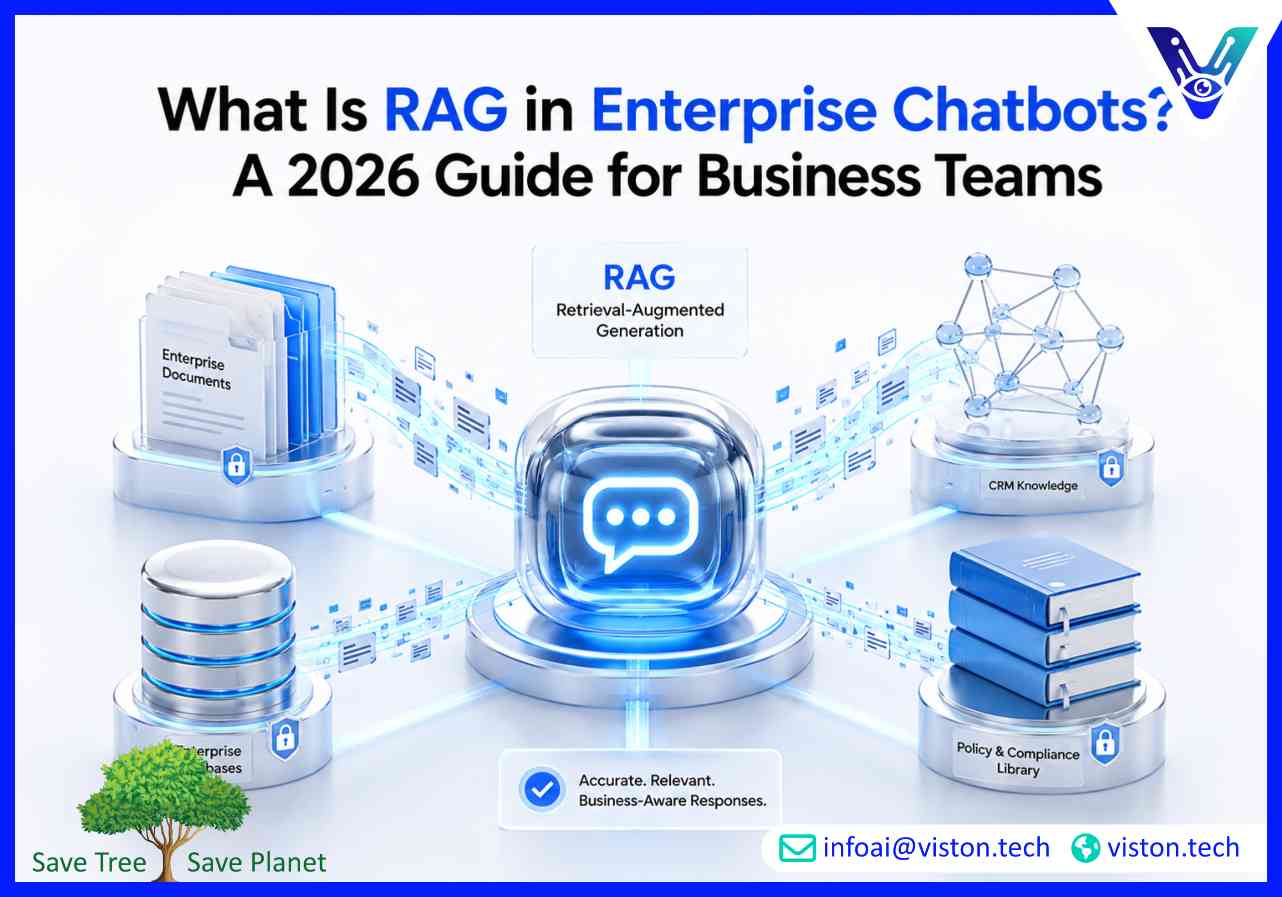
RAG stands for Retrieval-Augmented Generation. In simple terms, it is a chatbot architecture that allows a large language model to retrieve relevant information from trusted business sources before generating an answer. Instead of depending only on what the model learned during training, the chatbot searches approved knowledge, brings the most relevant content into the prompt, and produces a response based on that context.For enterprise chatbots, RAG is especially valuable because business information changes constantly. Product specifications, policies, pricing rules, support procedures, compliance requirements, inventory details, account status, and internal workflows may change weekly or even daily. A chatbot that cannot access current information can easily give incomplete or outdated answers.RAG does not replace the language model. It improves how the model works inside a business environment. The model still understands the question and generates the response, but the answer is grounded in retrieved information from approved sources such as knowledge bases, CRM systems, help centers, document repositories, ticketing platforms, product catalogs, or internal policy libraries.
How RAG works in a chatbot conversation
A typical RAG-powered enterprise chatbot follows a structured flow:
The user asks a question in natural language.
The chatbot analyzes the intent, keywords, entities, and context.
The retrieval layer searches trusted business sources for relevant information.
The system ranks and filters the retrieved content based on relevance, permissions, and confidence.
The selected information is added to the prompt as supporting context.
The language model generates an answer using that retrieved context.
The chatbot may cite sources internally, trigger a workflow, or escalate to a human when confidence is low.
This process makes RAG useful for enterprise AI chatbots because it connects conversational intelligence with real business knowledge. The chatbot can answer questions that are specific to the company, the customer, the product, the department, or the workflow.
Why RAG Matters for Enterprise Chatbots in 2026
In 2026, enterprise chatbot expectations are much higher than basic FAQ automation. Businesses want chatbots that can support complex service journeys, internal knowledge search, multilingual assistance, sales qualification, onboarding, compliance workflows, technical support, and operational tasks. RAG helps make these use cases more practical because it gives the chatbot access to current, business-specific information.Without RAG, an AI chatbot may provide fluent answers that sound confident but are not grounded in the company’s actual policies, systems, or documentation. This creates risk. A chatbot may explain the wrong return policy, reference an old product feature, provide inaccurate troubleshooting advice, or give an answer that conflicts with internal procedures. For enterprise use, accuracy and traceability matter as much as speed.
RAG reduces dependency on static training data
Traditional chatbot training often depends on predefined answers, intent examples, and manually maintained conversation flows. This can work for narrow use cases, but it becomes difficult to scale when content changes frequently. RAG allows the chatbot to use live or regularly updated knowledge sources, reducing the need to retrain the entire system whenever business information changes.This does not mean businesses can ignore data quality. RAG performs well only when the underlying knowledge is clean, structured, searchable, and governed. If documents are outdated, duplicated, poorly labeled, or inconsistent, the chatbot may retrieve weak information and produce weak answers.
RAG improves knowledge access across teams
Enterprises often store knowledge across many systems. Customer support teams may use helpdesk articles, sales teams may rely on CRM notes, product teams may maintain release documentation, HR teams may manage policy documents, and operations teams may keep SOPs in separate repositories. RAG helps create a conversational layer across these information sources.For employees, this can reduce time spent searching internal documents. For customers, it can improve answer quality and reduce unnecessary escalation. For managers, it can create better visibility into knowledge gaps, recurring questions, failed searches, and content that needs improvement.
RAG supports more reliable customer and employee experiences
A RAG-enabled chatbot can handle more specific questions than a generic chatbot. For example, a customer may ask about warranty eligibility for a particular product model. An employee may ask which approval process applies to a regional procurement request. A support agent may ask for the latest troubleshooting steps for a software integration. RAG helps the chatbot retrieve the relevant source material before answering.This makes the experience feel more useful because the chatbot is not simply giving general guidance. It is responding with information connected to the business context.
Key Components of a RAG-Powered Enterprise Chatbot
A successful RAG implementation is not just a chatbot connected to a folder of documents. It requires a carefully designed architecture that handles retrieval quality, data governance, access control, response generation, monitoring, and continuous improvement. Each layer affects the reliability of the final answer.
Approved knowledge sources
The first component is a trusted knowledge foundation. This may include help center content, product documentation, sales enablement material, policy documents, CRM records, ticket histories, technical manuals, contracts, inventory systems, or internal SOPs. Before using these sources, enterprises should define which systems are authoritative and which content should not be used by the chatbot.Source ownership matters. Someone must be responsible for keeping each knowledge area current. A RAG chatbot is only as reliable as the information it can retrieve.
Indexing and retrieval layer
The retrieval layer prepares content so the chatbot can search it efficiently. Documents may be split into smaller sections, enriched with metadata, converted into embeddings for semantic search, and stored in a searchable index or vector database. Some enterprise systems use hybrid search, combining keyword search with semantic retrieval to improve accuracy.Good retrieval is one of the most important parts of RAG. If the chatbot retrieves irrelevant or incomplete content, the generated answer will suffer. Many enterprise deployments also use reranking, metadata filtering, query rewriting, and confidence scoring to improve retrieval quality.
Prompt augmentation and response generation
Once relevant content is retrieved, it is inserted into the prompt as supporting context. The prompt may include instructions about tone, source priority, answer boundaries, escalation rules, compliance language, and what to do when information is missing. The language model then generates a response based on the retrieved content.For enterprise chatbots, the response should be clear, useful, and controlled. The chatbot should avoid making claims that are not supported by the retrieved information. When the answer cannot be confirmed, it should ask a clarifying question, provide a limited response, or route the conversation to a human agent.
Security, permissions, and governance
Enterprise RAG must respect access controls. A customer should not retrieve internal documents. An employee should not access restricted HR, legal, financial, or customer records without permission. A regional user may need information filtered by country, department, business unit, or role.This is why role-based access, authentication, audit logging, encryption, data residency, retention rules, and permission-aware retrieval are essential. RAG can improve chatbot accuracy, but unmanaged retrieval can also expose sensitive information if governance is weak.
Evaluation and monitoring
RAG performance should be measured continuously. Useful metrics include retrieval relevance, answer accuracy, fallback rate, escalation rate, user satisfaction, response latency, source coverage, hallucination risk, and workflow success rate. Enterprises should review failed conversations, missing intents, outdated sources, and low-confidence answers to improve the system over time.
Business Use Cases for RAG in Enterprise AI Chatbots
RAG is most useful when a chatbot needs to answer questions using company-specific, frequently changing, or detailed knowledge. This makes it relevant across many enterprise chatbot use cases.
Customer support and service automation
Customer support chatbots can use RAG to retrieve troubleshooting steps, warranty rules, return policies, service guides, account information, and ticket history. This helps customers receive faster and more accurate answers while reducing repetitive workload for support agents.RAG is especially useful when customers ask detailed questions that do not fit a fixed FAQ. Instead of forcing users into rigid menu options, the chatbot can search relevant support content and generate a contextual response.
Internal knowledge search
Employees often waste time searching for policies, process documents, templates, technical guidance, and operational procedures. A RAG-powered internal chatbot can act as a conversational knowledge assistant, helping teams find the right information faster.This can support HR, IT, finance, legal, procurement, sales operations, product support, compliance, and onboarding. The chatbot can answer common questions, summarize policy sections, direct employees to the right document, or escalate to the correct internal team.
Sales and lead qualification
Enterprise sales chatbots can use RAG to answer product questions, explain service capabilities, qualify leads, recommend next steps, and route inquiries to the right team. When connected to approved sales content and CRM data, the chatbot can provide more relevant answers than a generic website assistant.This is useful for B2B buyers who ask detailed questions about integrations, implementation timelines, security requirements, use cases, pricing models, or technical fit. RAG helps the chatbot respond with information aligned to the company’s actual offering.
Technical support and troubleshooting
Technical support teams can use RAG chatbots to retrieve documentation, release notes, API references, error explanations, configuration steps, and maintenance procedures. The chatbot can guide users through diagnostics while escalating complex cases with context.For enterprise environments, this can reduce downtime, improve first-contact resolution, and help support agents access relevant technical knowledge faster.
Compliance and policy guidance
RAG can help employees and customers navigate approved compliance information, but it must be implemented carefully. The chatbot should retrieve only authorized content, provide controlled guidance, and avoid replacing legal, medical, financial, or compliance judgment where human review is required.In sensitive workflows, RAG should support informed decision-making rather than act as the final authority. Escalation rules, audit trails, and source traceability are essential.
How Viston AI Helps Businesses Build RAG-Ready Enterprise AI Chatbots
Viston AI is relevant to RAG in enterprise chatbots because its Enterprise AI Chatbots service focuses on building conversational AI for complex business environments where accuracy, integration, governance, and scalability matter. RAG works best when a chatbot is connected to trusted enterprise knowledge sources, business systems, and secure workflows rather than operating as a standalone chat widget.Viston AI’s capabilities align with the practical requirements of RAG-enabled chatbot delivery, including natural language understanding, real-time knowledge integration, CRM and system connectivity, multilingual support, workflow automation, escalation logic, analytics, and enterprise security controls. These capabilities are important for companies that want chatbots to answer business-specific questions, support customers across channels, assist employees, and connect conversations to operational outcomes.For organizations considering Enterprise AI Chatbots, Viston AI can support the planning and implementation work behind a reliable RAG architecture. This includes understanding business objectives, preparing knowledge sources, designing retrieval workflows, connecting chatbots to enterprise systems, configuring access controls, testing chatbot responses, and monitoring performance after deployment.The value of this approach is practical. A RAG-enabled chatbot should not only answer questions; it should help businesses reduce repetitive support work, improve response accuracy, preserve brand consistency, support human handoffs, and create a more dependable conversational experience across customer-facing and internal use cases.
Frequently Asked Questions
What does RAG mean in enterprise chatbots?
RAG means Retrieval-Augmented Generation. In enterprise chatbots, it refers to a system where the chatbot retrieves relevant information from approved company sources before generating an answer. This helps responses stay more accurate, current, and business-specific.
Why is RAG important for enterprise AI chatbots?
RAG is important because enterprise chatbots often need to answer questions based on internal knowledge, policies, product details, customer data, or operational workflows. It reduces reliance on generic model knowledge and helps ground chatbot responses in trusted business information.
Does RAG eliminate chatbot hallucinations?
RAG can reduce hallucination risk, but it does not eliminate it completely. The quality of the retrieved content, prompt design, permissions, response rules, and evaluation process all affect accuracy. Enterprises still need monitoring, testing, and governance.
What data sources can a RAG chatbot use?
A RAG chatbot can use knowledge bases, help center articles, product documentation, CRM records, support tickets, internal policies, technical manuals, inventory systems, ERP data, and other approved business sources. The best sources are current, structured, accurate, and permission-controlled.
Is RAG better than traditional chatbot training?
RAG is often better for use cases where information changes frequently or is too broad for static training. Traditional intent training is still useful for conversation design, routing, and workflow logic. Many enterprise chatbots use both RAG and structured conversation flows.
Can Viston AI build RAG-powered enterprise chatbots?
Viston AI’s Enterprise AI Chatbots service is aligned with RAG-powered chatbot requirements because it supports knowledge integration, business system connectivity, NLP, workflow automation, multilingual support, escalation logic, and ongoing chatbot optimization.
Conclusion
RAG in enterprise chatbots is a practical way to make conversational AI more accurate, current, and useful for business environments. By retrieving trusted information before generating answers, RAG helps chatbots support customer service, internal knowledge search, sales assistance, technical support, and policy guidance with greater reliability. In 2026, businesses should treat RAG as part of a broader Enterprise AI Chatbots strategy that includes clean knowledge sources, secure access controls, strong retrieval design, evaluation, monitoring, and human escalation. Viston AI offers relevant enterprise chatbot capabilities for organizations that want RAG-ready conversational systems built around real business needs.