
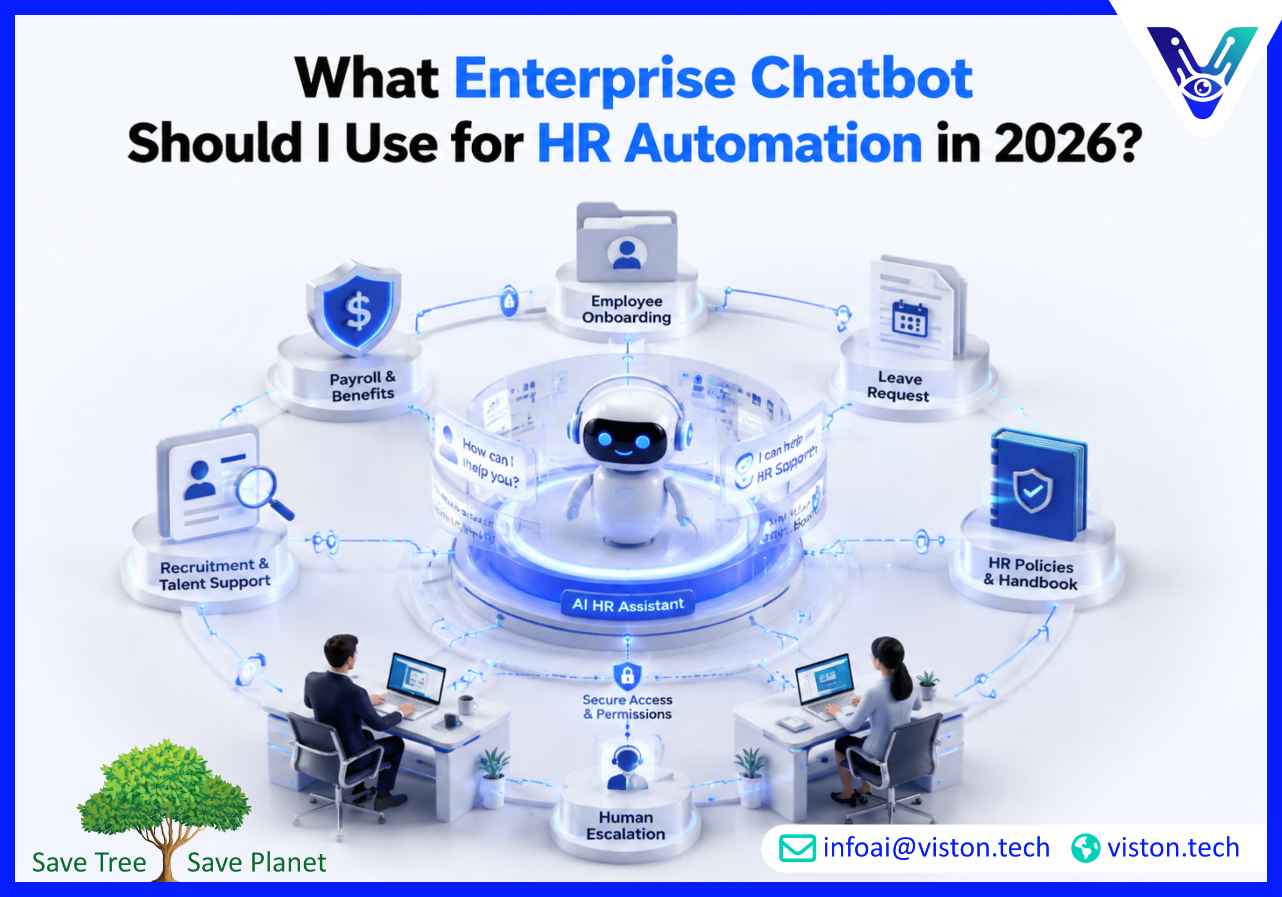
Choosing what enterprise chatbot should I use for HR automation is a serious operational decision. The right chatbot can reduce repetitive HR workload, improve employee self-service, protect sensitive data, and support faster internal processes across recruitment, onboarding, policy support, leave requests, payroll queries, and employee engagement.
An enterprise chatbot for HR automation is not just a basic FAQ bot. In a business environment, it should act as a secure conversational layer between employees, HR teams, managers, candidates, and internal systems. Its role is to help people get accurate answers, complete HR tasks, and access the right process without waiting for manual support every time.
For HR teams, the biggest value comes from automating high-volume, repetitive requests while keeping sensitive or judgment-based cases under human control. Common examples include leave balance checks, holiday policy questions, onboarding instructions, benefits information, payroll status queries, document collection, training reminders, internal ticket creation, candidate screening updates, and employee helpdesk support.
The best enterprise HR chatbot should understand natural language, connect with HR systems, respect role-based permissions, and provide reliable answers from approved company knowledge. It should also escalate complex or sensitive matters to HR professionals when needed. This is important because HR communication often involves personal information, employment policies, compensation, compliance obligations, and employee trust.
A strong HR automation chatbot can help with:
The chatbot you choose should depend on which of these workflows matter most to your organization. A company that wants to automate recruitment will need different capabilities from a company focused on employee self-service or internal HR operations.
When deciding what enterprise chatbot to use for HR automation, the first step is to separate simple chatbot features from enterprise-ready capabilities. HR is a sensitive business function, so the chatbot must be secure, accurate, integrated, scalable, and easy for employees to use.
HR chatbots may process personal details, job information, payroll questions, leave records, benefits data, performance-related queries, and internal policy documents. This means security cannot be treated as an add-on. The chatbot should support encryption, access controls, authentication, audit logs, data retention rules, and clear permission boundaries.
Employees should only receive information they are allowed to access. A general employee may ask about their own leave balance, while a manager may need team-level approval information. HR administrators may need broader access. The chatbot should recognize these differences and enforce them consistently.
An HR chatbot becomes truly useful when it connects with existing systems. This may include HRMS, HCM, payroll software, applicant tracking systems, learning management systems, identity management tools, collaboration platforms, ticketing software, and internal knowledge bases.
Without integration, the chatbot can only answer static questions. With integration, it can retrieve leave balances, create HR tickets, guide onboarding steps, update request status, trigger approval workflows, send reminders, and route cases to the right team. For enterprises, integration is often the difference between a helpful chatbot and a disconnected chat widget.
Employees do not always use formal HR language. One person may ask, “How many days off do I have?” while another may ask, “What is my leave balance?” or “Can I take PTO next week?” A capable enterprise chatbot should understand different ways employees express the same intent.
It should also understand company-specific terms, department names, benefit labels, policy names, job roles, locations, and internal abbreviations. This requires careful training, approved knowledge sources, and ongoing optimization based on real employee queries.
Not every HR issue should be automated. Sensitive matters such as disputes, grievances, harassment concerns, medical leave, termination questions, compensation exceptions, and performance issues often require human review. The chatbot should know when to stop, collect basic context safely, and transfer the case to the right HR professional.
A good escalation flow includes conversation history, user details, detected intent, priority level, and any relevant documents or workflow status. This helps HR teams respond faster without asking employees to repeat everything.
The best enterprise chatbot for HR automation is the one that fits your use case, risk level, system environment, employee base, and operational goals. Businesses should avoid choosing a chatbot only because it looks advanced in a demo. HR automation needs practical reliability, not just impressive conversation ability.
Begin by identifying the HR questions and processes that consume the most time. These are usually leave queries, payroll questions, onboarding tasks, benefits explanations, document requests, policy clarification, and status updates. These use cases are often good starting points because they are repetitive, measurable, and easier to standardize.
Once the chatbot performs well on these workflows, the scope can expand to recruitment support, manager approvals, employee engagement, internal training, and more complex HR service delivery.
An HR chatbot should not guess policy answers. It should respond from approved sources such as employee handbooks, HR policy documents, benefits guides, payroll FAQs, onboarding checklists, compliance documents, and internal workflow rules.
Knowledge governance is essential. HR content changes regularly, especially around benefits, leave rules, remote work policies, performance cycles, and compliance procedures. The chatbot should support content updates, source control, review workflows, and clear ownership so outdated answers do not create confusion.
A chatbot that can answer questions is useful. A chatbot that can complete HR workflows is more valuable. Look for capabilities such as ticket creation, approval routing, reminders, form collection, document upload guidance, system lookup, and case status updates.
For example, when an employee asks about parental leave, the chatbot should be able to explain eligibility, provide the correct process, collect initial details if appropriate, and route the request securely to HR. When a new hire asks what to do next, the chatbot should guide them through onboarding steps and connect them with relevant resources.
Many enterprises operate across regions, languages, offices, and employment categories. A chatbot used for HR automation should be able to support different employee groups without giving one-size-fits-all answers. Location-specific policies, local holidays, employment rules, benefit plans, and language preferences may all affect the response.
If your workforce is distributed, multilingual capability and localized knowledge management should be part of the evaluation. Employees should receive information that is relevant to their location, role, and employment status.
HR automation can improve service delivery, but a poorly designed chatbot can create operational, legal, and employee experience risks. The chatbot should be selected and implemented carefully, especially when it handles personal data or policy-related guidance.
One of the biggest risks is allowing the chatbot to access too much information without proper permission rules. HR data is sensitive. The chatbot should never expose employee records, compensation details, health-related information, private cases, or internal notes to unauthorized users.
Role-based access, secure authentication, and audit trails should be built into the design. Enterprises should also define what the chatbot can answer, what it should refuse, and when it should escalate.
An HR chatbot should support decisions, not replace human responsibility for sensitive employment matters. It can help collect information, explain processes, summarize policies, and route cases. However, decisions involving discipline, grievances, accommodations, termination, compensation exceptions, or legal risk should remain under qualified human control.
This balance protects employees and the business. The chatbot should improve access and efficiency without creating the impression that complex HR judgment has been delegated entirely to automation.
If the chatbot uses outdated HR documents, employees may receive incorrect guidance. This can create confusion around leave eligibility, benefits enrollment, payroll dates, expense policies, remote work rules, or internal procedures.
Before launch, HR teams should clean and approve knowledge sources. After launch, they should review fallback queries, employee feedback, escalation patterns, and policy updates regularly. HR automation works best when the chatbot is governed like a live employee service channel.
Employees will not use a chatbot if it feels confusing, rigid, or unhelpful. The chatbot should be easy to access through familiar channels such as the company intranet, HR portal, Slack, Microsoft Teams, website, or mobile app. It should use clear language, offer quick options, ask only necessary questions, and provide a human handoff when the issue becomes sensitive or complex.
The goal is not to block access to HR. The goal is to make HR support faster, clearer, and easier to navigate.
Viston AI is relevant for organizations evaluating enterprise chatbot options because its Enterprise AI Chatbots service focuses on building conversational AI for complex business environments. HR automation requires more than a generic chatbot interface; it needs natural language understanding, secure workflow design, knowledge integration, system connectivity, analytics, escalation logic, and ongoing optimization.
Viston AI’s capabilities align with these requirements through enterprise AI chatbot development, AI chatbot integration, multilingual chatbot support, NLP and text analysis, workflow automation, business system integration, AI strategy, and model monitoring. For HR use cases, these capabilities can support employee self-service, internal policy search, onboarding guidance, HR ticket routing, multilingual employee support, and integration with existing HR or business systems.
This type of approach is useful for businesses that want HR automation to work as part of a broader enterprise process rather than a standalone chatbot. A well-designed HR chatbot must connect to approved knowledge, protect employee information, measure performance, and improve over time. Viston AI can be positioned as a specialist partner for organizations that need an enterprise-focused chatbot solution designed around practical workflows, responsible automation, and scalable internal service delivery.
You should use an enterprise chatbot that supports secure HR data handling, natural language understanding, integration with HR systems, approved knowledge base access, workflow automation, analytics, multilingual support, and human escalation. The best choice depends on whether your priority is employee self-service, recruitment, onboarding, HR ticketing, or policy support.
Yes, an HR chatbot can answer payroll and benefits questions when it is connected to approved HR content or relevant systems. It should provide general policy guidance, retrieve authorized employee-specific information only after authentication, and escalate sensitive or unusual cases to HR staff.
An enterprise HR chatbot can be secure if it is designed with encryption, authentication, role-based access, audit logging, data minimization, permission controls, and clear escalation rules. Security should be reviewed before deployment, especially when the chatbot connects to payroll, HRMS, or employee records.
No. HR chatbots should reduce repetitive workload and improve access to information, but they should not replace HR professionals. Sensitive employee issues, policy exceptions, grievances, accommodations, and complex decisions require human judgment and proper review.
Useful KPIs include employee self-service resolution rate, HR ticket reduction, average response time, escalation rate, employee satisfaction, onboarding completion rate, fallback rate, workflow success rate, and accuracy of system updates. These metrics show whether the chatbot is improving HR service delivery.
Viston AI’s Enterprise AI Chatbots service is aligned with HR automation needs because it covers conversational AI development, system integration, workflow automation, multilingual support, NLP, analytics, security-focused implementation, and ongoing optimization for enterprise environments.
Choosing what enterprise chatbot should I use for HR automation comes down to one practical question: can the chatbot support employees accurately, securely, and efficiently across real HR workflows? The right enterprise AI chatbot should answer approved HR questions, automate repetitive tasks, integrate with HR systems, protect sensitive employee data, and escalate complex issues to human teams. In 2026, HR automation is most valuable when it improves employee experience without weakening governance or trust. For businesses looking for a scalable and workflow-focused chatbot partner, Viston AI offers relevant Enterprise AI Chatbots capabilities that align with modern HR automation needs.
