
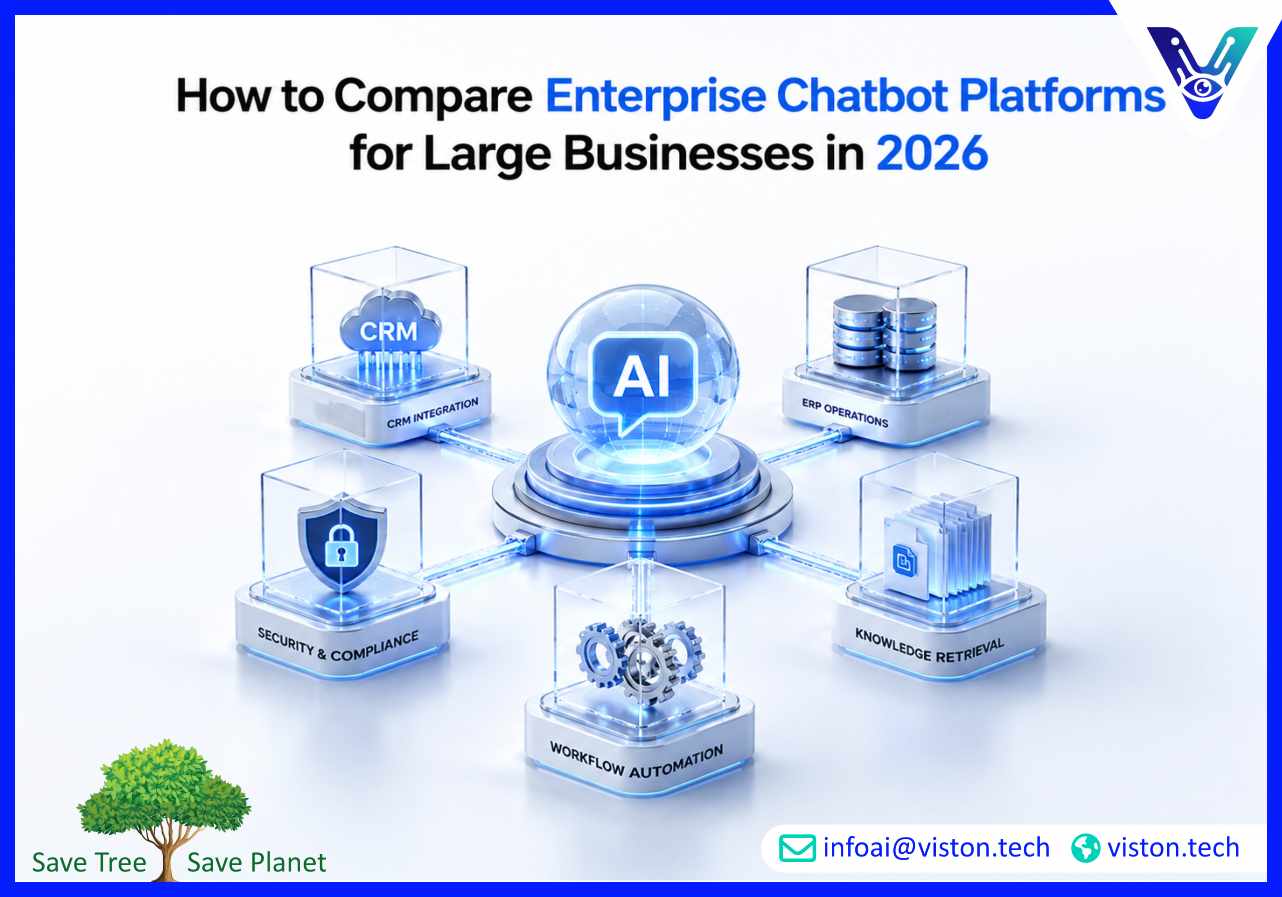
Compare enterprise chatbot platforms for large businesses with a clear view of integration depth, security, automation quality, scalability, governance, and long-term business value. In 2026, the right platform must support complex operations, not just answer basic customer questions.
Large businesses evaluate enterprise chatbot platforms differently from small teams. A simple website chat widget may be enough for basic lead capture, but enterprise environments need conversational systems that can work across departments, brands, regions, languages, customer segments, and internal workflows.
The platform must support more than scripted conversations. It should understand user intent, retrieve information from trusted knowledge sources, integrate with CRM and ERP systems, escalate to human teams when needed, and create useful operational records. For global companies, it may also need multilingual support, region-specific compliance controls, channel consistency, and role-based access.
The central question is not “Which chatbot has the most features?” The better question is “Which chatbot platform can operate safely and reliably inside our business environment?” That distinction matters because large businesses often deal with sensitive customer data, regulated workflows, legacy systems, complex approval chains, and high conversation volumes.
A strong enterprise chatbot platform should help large businesses improve service quality, reduce repetitive workload, qualify leads, support employees, automate routine workflows, and make customer interactions easier to manage. These outcomes depend on the quality of the chatbot architecture, not only the user interface.
Business leaders should look for capabilities such as secure knowledge retrieval, CRM integration, helpdesk routing, workflow automation, analytics, escalation management, conversation auditing, and continuous improvement. Without these foundations, even an advanced AI chatbot can become difficult to govern at scale.
Before comparing vendors or technical capabilities, large businesses should define the chatbot’s role. A customer support chatbot needs strong resolution tracking, ticket deflection, escalation quality, and knowledge base integration. A sales chatbot needs lead qualification, CRM updates, campaign attribution, and meeting booking. An internal employee assistant needs access controls, policy search, HR or IT workflow support, and auditability.
When the use case is clear, platform comparison becomes more practical. The right choice is the one that fits business workflows, data structure, security requirements, and support expectations.
Enterprise chatbot platforms usually fall into several categories. Each model has strengths, limitations, and buyer considerations. Large businesses should compare these categories based on control, implementation speed, integration complexity, compliance needs, and long-term flexibility.
SaaS chatbot platforms are often attractive because they provide prebuilt tools for conversation design, analytics, channel deployment, and team management. They can help businesses launch faster, especially for standard customer support, lead generation, and FAQ automation.
The trade-off is flexibility. Some SaaS platforms may limit how deeply the chatbot can integrate with legacy systems, proprietary workflows, custom data structures, or complex enterprise approval rules. Large businesses should review API access, data residency options, model controls, knowledge source management, and customization limits before committing.
Some enterprise chatbots are built inside CRM, service desk, or customer experience platforms. This can be useful when the chatbot’s main job is to support sales, customer service, account management, or ticket handling. Native access to customer records, case histories, and agent workflows can reduce implementation friction.
The limitation is that these platforms may be strongest inside their own ecosystem. If a large business uses multiple CRMs, regional helpdesks, separate ecommerce systems, or custom operational tools, the chatbot may need additional integration work. Decision-makers should check whether the platform can handle cross-system workflows, not just conversations within one application.
Cloud-native platforms can offer strong scalability, model flexibility, data infrastructure, and enterprise security controls. They are often suitable for businesses with mature technical teams, complex AI requirements, or strict governance needs.
These platforms can support advanced architectures such as retrieval-augmented generation, custom orchestration, API-based workflows, and monitoring pipelines. However, they may require more implementation expertise than packaged chatbot tools. Large businesses should consider whether they have the internal AI, data engineering, security, and DevOps capacity to manage the platform effectively.
Custom chatbot development is often relevant when a large business needs deeper control over workflows, data access, user experience, compliance logic, integrations, and AI behavior. A custom approach can connect the chatbot to specific enterprise systems, internal knowledge structures, approval chains, and industry processes.
The trade-off is that custom development requires stronger planning, technical governance, and ongoing optimization. It is not always the fastest route, but it can be the most suitable option when the chatbot must support high-value, regulated, multilingual, or operationally complex use cases.
Feature lists can make chatbot platforms look similar. Most vendors will mention AI, automation, analytics, integrations, and omnichannel support. Large businesses need a deeper evaluation framework that tests whether those capabilities work in real enterprise conditions.
Integration is one of the most important comparison points. A chatbot that cannot connect reliably to CRM, ERP, helpdesk, order management, identity management, knowledge bases, payment systems, or internal workflow tools will remain limited.
Large businesses should assess API quality, connector availability, authentication methods, real-time data sync, error handling, logging, and system update accuracy. The chatbot should not only retrieve information; it should also trigger approved workflows, update records correctly, and preserve a clear audit trail.
Modern enterprise AI chatbots often depend on trusted knowledge sources. The platform should help teams control which documents, databases, policies, FAQs, product records, and support articles the chatbot can access. It should also manage outdated content, conflicting answers, permission-based knowledge, and source traceability.
Retrieval quality matters because large businesses cannot afford confident but inaccurate answers. A good platform should support grounding, confidence thresholds, fallback responses, escalation triggers, and content governance.
Enterprise chatbot platforms may handle personal data, account details, support cases, financial information, employee records, or regulated business content. Security cannot be treated as a later configuration step.
Buyers should review encryption, access control, single sign-on, role-based permissions, audit logs, retention policies, data residency, redaction, consent handling, and compliance alignment. For regulated industries, the chatbot should support clear boundaries around what it can answer, what it must not disclose, and when it must route to a human specialist.
No enterprise chatbot should be expected to resolve every issue. The platform must know when to escalate and how to transfer context. A poor handoff forces customers or employees to repeat information, which damages trust and increases workload.
Strong handoff includes conversation history, detected intent, sentiment, account details, previous actions, recommended next steps, and priority level. For large support teams, routing logic should match language, region, product line, customer tier, and issue type.
Large businesses need chatbot analytics that connect conversations to business outcomes. Useful metrics include containment rate, resolution rate, fallback rate, escalation rate, customer satisfaction, lead qualification rate, workflow success rate, cost per resolved conversation, and CRM update accuracy.
The best enterprise chatbot platforms make performance visible by intent, channel, region, language, department, and user segment. This allows teams to improve knowledge coverage, adjust automation rules, reduce friction, and identify where human support is still needed.
Comparing enterprise chatbot platforms should include implementation risk. A platform may look strong during a demo but struggle during rollout if business data is messy, integrations are incomplete, workflows are unclear, or governance is weak.
Common risks include inaccurate knowledge sources, poor intent mapping, weak escalation rules, disconnected systems, duplicate records, privacy gaps, low user adoption, and unclear ownership after launch. These issues are not always caused by the chatbot platform alone. They often come from poor implementation planning.
Large businesses should run a structured discovery process before deployment. This includes use case prioritization, data readiness review, security assessment, integration mapping, channel planning, user journey design, and KPI definition.
Enterprise AI chatbots need governance because they interact directly with customers, employees, and business systems. Governance should define who owns chatbot content, who approves workflow changes, who reviews failed conversations, who monitors compliance, and how improvements are released.
In 2026, responsible AI expectations are higher. Large businesses should evaluate whether the platform supports auditability, human oversight, safe fallback behavior, access controls, model monitoring, and explainable escalation rules. A chatbot that cannot be monitored and controlled may create operational and reputational risk.
Scalability is not only about handling more messages. A scalable enterprise chatbot platform should support multiple business units, languages, channels, knowledge sources, workflows, and reporting needs without creating chaos. It should allow teams to reuse components while maintaining local control where needed.
For example, a global company may want consistent brand tone but different compliance rules by region. It may need one core knowledge structure with localized content for different markets. It may also need separate analytics views for customer support, sales, operations, and leadership.
Large businesses should compare total cost and value, not only platform subscription fees. The real cost includes implementation, integration, data preparation, testing, training, governance, ongoing optimization, support, and future expansion.
A cheaper platform may become expensive if it requires heavy manual work, creates unreliable records, lacks governance, or cannot scale. A more flexible solution may justify its investment if it reduces repetitive work, improves customer experience, increases lead quality, strengthens reporting, and supports long-term automation.
Viston AI is relevant to this topic because its Enterprise AI Chatbots service is built around the needs large businesses usually face when comparing chatbot platforms: system integration, contextual conversations, workflow automation, multilingual support, knowledge connectivity, and enterprise-grade security expectations.
Instead of treating a chatbot as a standalone interface, Viston AI positions enterprise chatbot delivery around connected conversational AI. Its service offering includes AI chatbot development, integration with business systems, natural language processing, multilingual support, voice-enabled assistants, automation workflows, and AI strategy capabilities. These areas matter when a large business needs a chatbot that can work across CRM, ERP, helpdesk, knowledge bases, messaging channels, and internal processes.
For enterprise organizations, the practical value is in designing chatbot architecture around real operational needs. That may include customer support automation, lead qualification, employee helpdesk support, knowledge search, appointment workflows, case routing, or transactional support. Viston AI’s approach is especially relevant when businesses want more control than a generic chatbot tool can provide, but also need implementation guidance, integration planning, and ongoing optimization.
For large businesses comparing enterprise chatbot platforms in global markets, Viston AI can be considered a specialist partner for building scalable chatbot systems that connect conversation quality with business workflows, governance, and measurable outcomes.
Large businesses should look for integration depth, security controls, knowledge management, multilingual capability, workflow automation, analytics, human handoff quality, scalability, and governance features. The best platform should fit existing business systems and operational requirements.
SaaS platforms can be faster to launch and easier to manage for standard use cases. Custom enterprise AI chatbots may be better when a business needs deeper integrations, specialized workflows, stricter compliance controls, or tailored user experiences across complex operations.
Enterprise chatbot platforms usually integrate through APIs, connectors, middleware, or custom integration layers. A strong integration allows the chatbot to retrieve records, update cases, qualify leads, trigger workflows, and log conversation data accurately.
Governance helps control chatbot content, permissions, escalation rules, compliance boundaries, performance reviews, and improvement cycles. Without governance, an AI chatbot can produce inconsistent answers, expose sensitive information, or create unreliable workflow outcomes.
Yes, but only when they support multilingual conversations, regional content control, data privacy requirements, channel flexibility, localized workflows, and scalable administration. Global businesses should test platform performance across languages, regions, and business units before full rollout.
Viston AI’s Enterprise AI Chatbots service is aligned with platform evaluation and implementation because it covers chatbot development, system integration, automation workflows, multilingual support, NLP, and enterprise-focused AI strategy.
Knowing how to compare enterprise chatbot platforms for large businesses is essential before investing in Enterprise AI Chatbots. The right platform should support secure integrations, accurate knowledge retrieval, workflow automation, human handoff, analytics, governance, and long-term scalability. Large organizations should compare platforms based on operational fit rather than surface-level features. In 2026, chatbot success depends on how well the system connects with business data, customer journeys, employee workflows, compliance needs, and measurable outcomes. Viston AI offers relevant expertise for businesses that need enterprise chatbot solutions designed around integration, usability, and scalable automation.
