
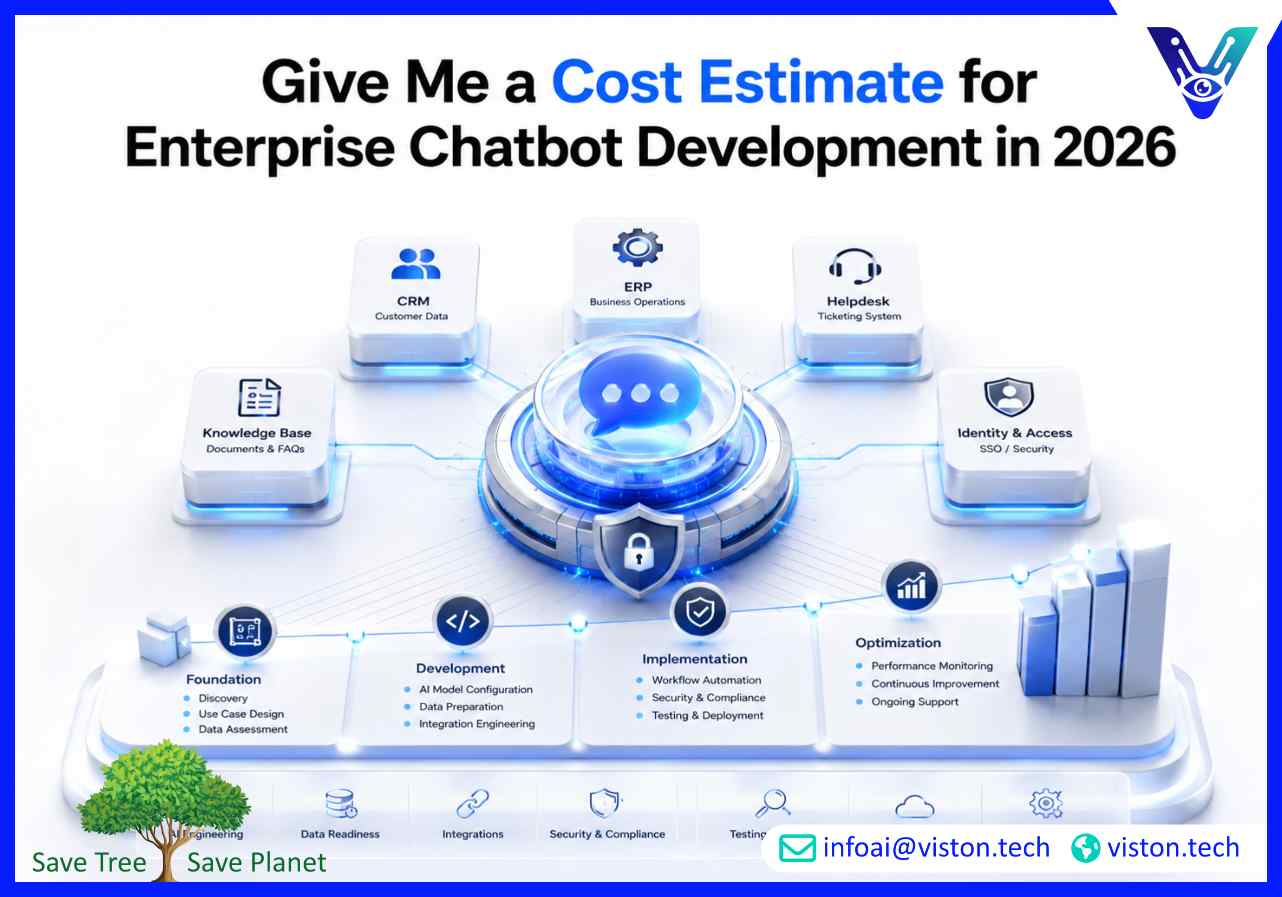
Getting a realistic cost estimate for enterprise chatbot development helps businesses plan budgets, compare vendor proposals, and understand what drives pricing beyond the chatbot interface. In 2026, enterprise AI chatbots require planning around integrations, security, data quality, workflows, multilingual support, analytics, and long-term optimization.
Enterprise chatbot development is not just the cost of creating a chat window on a website. For larger organizations, the cost usually includes discovery, use case planning, conversation design, AI model configuration, knowledge base preparation, backend integration, testing, deployment, security review, analytics setup, and ongoing improvement.
A simple chatbot that answers predefined FAQs costs much less than an enterprise AI chatbot that connects with CRM, ERP, HR systems, ticketing platforms, ecommerce databases, internal knowledge bases, identity systems, and workflow automation tools. The more the chatbot needs to understand context, retrieve business data, trigger actions, and support users across channels, the more planning and engineering effort is required.
In most enterprise projects, the biggest cost drivers are not only the AI model or chatbot platform. They are the business complexity behind the chatbot. A chatbot that needs to qualify leads, create support tickets, update customer records, check order status, manage employee requests, or guide regulated workflows needs stronger architecture, permissions, integrations, and testing.
Although exact pricing depends on scope, a practical 2026 estimate can be grouped into three broad ranges:
These ranges are useful for early budgeting, but they should not be treated as fixed quotes. A chatbot for internal HR automation will have different requirements from a customer support chatbot, sales assistant, fintech service bot, healthcare intake assistant, or enterprise knowledge assistant.
The cost of enterprise chatbot development depends on the work required to make the chatbot reliable, secure, useful, and scalable. A low-cost chatbot may look attractive at first, but if it cannot handle real user questions, integrate with core systems, or provide accurate handoffs, it can create more operational problems than it solves.
The first pricing factor is the chatbot’s purpose. A chatbot that answers common questions from a controlled FAQ database is relatively straightforward. A chatbot that performs account lookups, updates records, handles approvals, routes requests, or supports multiple business departments requires deeper planning and development.
Common enterprise chatbot use cases include customer support automation, lead qualification, employee helpdesk support, HR policy assistance, IT service desk automation, appointment booking, onboarding support, product guidance, sales enablement, internal knowledge search, and workflow automation.
Good chatbot development requires careful conversation design. The chatbot must understand what users are trying to do, ask the right follow-up questions, avoid unnecessary steps, and know when to escalate. This work includes intent mapping, dialogue flows, fallback handling, human handoff logic, tone guidelines, and response templates.
Costs increase when the chatbot must support multiple user journeys, departments, customer segments, product lines, or regional variations. Poor conversation design can reduce completion rates and increase frustration, even when the underlying AI model is strong.
Enterprise AI chatbots often use natural language processing, retrieval-based knowledge search, generative AI, and sometimes private or fine-tuned language models. The cost depends on whether the chatbot uses a rule-based structure, a commercial AI platform, a custom model, retrieval-augmented generation, or a hybrid architecture.
Retrieval-based chatbots require clean knowledge sources, document indexing, source control, response grounding, relevance testing, and confidence thresholds. These capabilities help reduce inaccurate answers and make the chatbot more trustworthy for business use.
Many enterprises underestimate the cost of preparing chatbot data. Existing documents, FAQs, support tickets, product guides, policy manuals, and internal SOPs may be outdated, duplicated, incomplete, or inconsistent. Before they can support a chatbot, they often need to be cleaned, structured, approved, and mapped to user intents.
Data preparation may include content audit, knowledge base restructuring, taxonomy creation, document formatting, metadata tagging, access control mapping, and answer validation. This work directly affects chatbot accuracy and long-term performance.
Integrations are one of the largest cost drivers in enterprise chatbot development. A chatbot that only answers questions is easier to build than one that connects to Salesforce, HubSpot, Zendesk, ServiceNow, Microsoft Dynamics, SAP, Oracle, Shopify, internal databases, HRMS platforms, payment systems, or custom APIs.
Integration costs depend on API availability, authentication requirements, data quality, business rules, error handling, workflow complexity, and security controls. Each integration must be designed, developed, tested, monitored, and maintained.
Enterprise AI chatbots often handle sensitive customer, employee, financial, operational, or contractual information. This makes security and compliance an important part of the budget. Requirements may include encryption, authentication, single sign-on, audit logs, role-based permissions, data minimization, retention rules, consent handling, and restricted response logic.
For regulated industries, compliance review can significantly affect cost. The chatbot may need stronger guardrails, approved response libraries, escalation rules, region-specific handling, and detailed monitoring.
A useful chatbot cost estimate should show where the budget goes. This helps decision-makers compare proposals more accurately and avoid choosing a vendor based only on a headline price. Enterprise chatbot development usually includes several connected phases.
Estimated cost: $3,000 to $15,000.
This phase defines the chatbot’s business objective, users, priority use cases, channels, system dependencies, success metrics, risks, and implementation roadmap. For enterprise projects, discovery is essential because it prevents scope confusion and helps identify which features should be built first.
Estimated cost: $5,000 to $25,000.
This includes intent mapping, user journeys, conversation scripts, fallback flows, escalation rules, response tone, and interface planning. A chatbot designed for customer support will need different flows from a sales assistant or internal employee helpdesk.
Estimated cost: $15,000 to $80,000 or more.
This is the core build phase. It may include chatbot logic, NLP setup, AI model configuration, retrieval workflows, prompt design, backend services, admin controls, user interface development, and channel deployment. Costs increase as the chatbot becomes more context-aware, personalized, and action-oriented.
Estimated cost: $5,000 to $50,000.
This phase prepares the content and data the chatbot will use. It may involve reviewing existing documents, cleaning FAQs, structuring help content, preparing approved answers, indexing knowledge sources, and defining access rules. For knowledge-heavy enterprises, this stage can become a major part of the project.
Estimated cost: $10,000 to $100,000 or more.
System integration may include CRM, helpdesk, ERP, HRMS, ecommerce, payment, identity, analytics, or custom internal systems. Simple CRM lead creation may be affordable, while multi-system workflow automation with permissions, error handling, and real-time synchronization requires more engineering effort.
Estimated cost: $5,000 to $30,000.
Testing includes functional testing, conversation testing, integration testing, security validation, fallback testing, load testing, user acceptance testing, and response quality review. For enterprise AI chatbots, testing should include real-world user scenarios, edge cases, and escalation paths.
Estimated cost: $3,000 to $20,000.
This includes production deployment, channel configuration, analytics setup, admin training, team handover, launch monitoring, and early optimization. Enterprise teams may also need documentation, governance workflows, and reporting dashboards.
Estimated monthly cost: $2,000 to $20,000 or more.
After launch, the chatbot needs monitoring, content updates, fallback review, intent improvement, system maintenance, analytics reporting, model tuning, compliance checks, and new feature development. Ongoing support is important because business policies, user behavior, products, workflows, and data sources change over time.
A realistic budget starts with the business outcome, not the technology. Enterprises should define what the chatbot must achieve and then estimate the development effort required to support that outcome safely and reliably.
Many successful enterprise chatbot projects begin with a focused scope. Instead of automating every department at once, businesses can start with high-volume, low-risk use cases such as FAQs, ticket triage, lead capture, appointment booking, internal IT requests, or knowledge base search.
This approach reduces upfront cost and gives teams real performance data before expanding. Once the chatbot proves value, additional workflows, channels, languages, integrations, and departments can be added in phases.
Procurement teams should separate immediate requirements from later improvements. Must-have features may include user authentication, CRM integration, ticket creation, escalation, analytics, and approved knowledge search. Future enhancements may include voice support, advanced personalization, predictive routing, multilingual expansion, or deeper workflow automation.
This phased approach makes budgeting easier and prevents unnecessary complexity during the first launch.
Enterprise chatbot development requires input from internal teams. Subject matter experts may need to review content, support teams may need to validate conversation flows, IT teams may need to approve integrations, compliance teams may need to review response rules, and business leaders may need to define KPIs.
These internal costs may not appear on a vendor invoice, but they affect timelines and project success. A realistic budget should include time for stakeholder workshops, content review, testing, approvals, and post-launch optimization.
Businesses should connect chatbot spend to measurable outcomes such as reduced ticket volume, faster response time, higher lead qualification rate, lower cost per resolved conversation, improved employee productivity, better customer satisfaction, and more consistent service delivery.
Without defined KPIs, it becomes difficult to judge whether the chatbot is worth the investment. The best budgets include both development cost and the measurement framework needed to prove ongoing value.
Viston AI is relevant to enterprise chatbot development cost planning because its AI service portfolio includes enterprise AI chatbots, AI automation, workflow bots, generative AI, predictive analytics, computer vision, and integration-focused AI solutions. Its positioning emphasizes end-to-end AI services that connect with existing enterprise systems, which is important when chatbot budgets depend heavily on integration, automation, and operational complexity.
For businesses estimating chatbot costs, this matters because a reliable enterprise chatbot is rarely a standalone tool. It needs to work with customer data, internal knowledge, support workflows, sales processes, HR operations, analytics, and business systems. Viston AI’s enterprise AI chatbot capabilities are aligned with projects that require natural language understanding, workflow automation, multilingual support, voice-enabled assistants, and business system integration.
Organizations evaluating chatbot development can use Viston AI as a specialist partner when they need more than a basic FAQ bot. Its service relevance is strongest where businesses want AI chatbots that support operational workflows, reduce repetitive manual work, improve user support, and connect chatbot performance to measurable business outcomes.
For companies without a defined target industry or location, the practical advantage is flexibility. A provider with broad AI and automation capabilities can help scope chatbot requirements based on business process complexity, integration needs, data readiness, and long-term optimization priorities rather than applying a one-size-fits-all chatbot package.
Enterprise chatbot development typically costs between $10,000 and $300,000 or more, depending on complexity. Basic FAQ bots are at the lower end, while advanced AI chatbots with integrations, workflow automation, multilingual support, security controls, and custom architecture cost significantly more.
Enterprise AI chatbots cost more because they often require custom workflows, secure integrations, role-based access, knowledge base preparation, analytics, compliance controls, and ongoing optimization. They are built to support business operations, not only answer simple questions.
System integration is often the biggest cost driver. Connecting a chatbot to CRM, ERP, helpdesk, HRMS, ecommerce, identity, or internal databases requires engineering, testing, authentication, error handling, and maintenance.
Yes. Businesses can reduce costs by starting with a focused use case, using existing knowledge base content, prioritizing essential integrations, launching in phases, and improving the chatbot over time based on real performance data.
Yes. Ongoing maintenance is necessary because user questions, business policies, products, workflows, and integrations change. Regular monitoring, fallback review, content updates, and performance optimization help keep the chatbot accurate and useful.
Viston AI’s Enterprise AI Chatbots service is relevant for businesses that need cost planning around chatbot development, workflow automation, system integration, and AI-powered support. A proper estimate would depend on use cases, data readiness, integrations, security needs, and launch scope.
A cost estimate for enterprise chatbot development should look beyond the chatbot interface and account for strategy, conversation design, AI configuration, data preparation, integrations, testing, security, deployment, and ongoing optimization. In 2026, Enterprise AI Chatbots are expected to support real workflows, accurate answers, measurable outcomes, and scalable operations. Businesses can manage cost by starting with focused use cases, prioritizing essential integrations, and expanding in phases. Viston AI offers relevant enterprise chatbot and automation capabilities for organizations that want chatbot development planned around practical business value rather than generic automation.
