
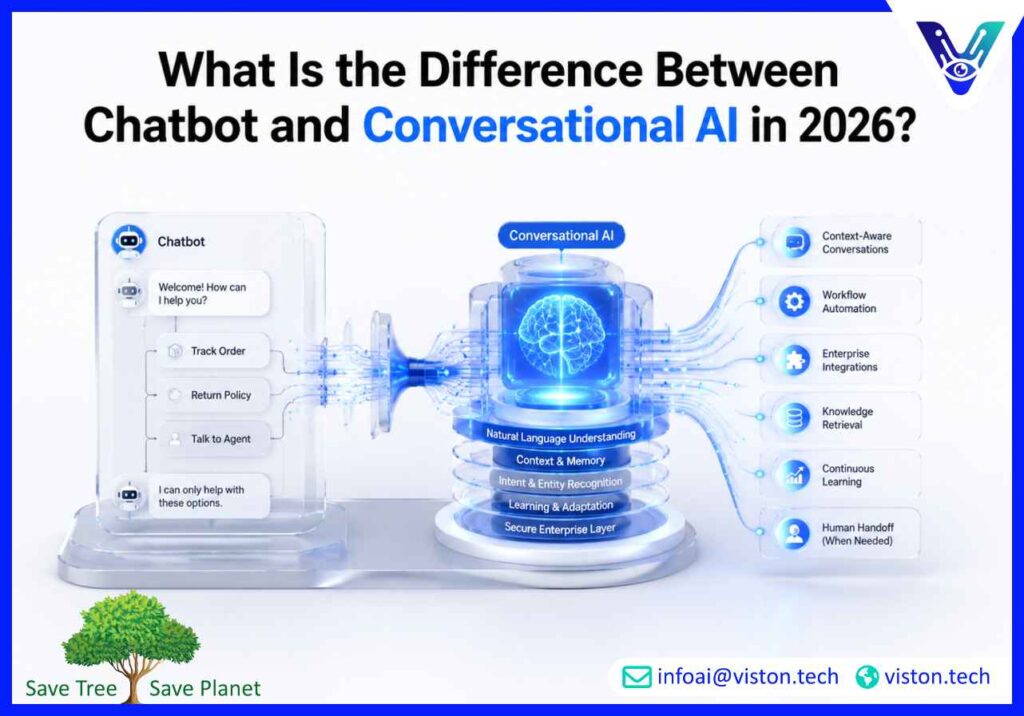
Understanding the difference between chatbot and conversational AI helps businesses choose the right automation approach for customer support, sales, employee service, knowledge access, and enterprise workflows. In 2026, this distinction matters because buyers need reliable, integrated, secure, and scalable Enterprise AI Chatbots rather than basic scripted tools.
The simplest difference is this: a chatbot is the interface or application that users interact with, while conversational AI is the technology layer that allows digital systems to understand, process, and respond to human language more intelligently.
A chatbot can be very basic. It may follow a fixed script, show menu options, answer predefined FAQs, or route users based on buttons and keywords. These chatbots are useful for simple, predictable tasks such as answering opening hours, collecting contact details, sharing order tracking links, or guiding users through a short form.
Conversational AI is broader and more advanced. It uses technologies such as natural language processing, natural language understanding, machine learning, large language models, intent recognition, entity extraction, sentiment analysis, and context management. These capabilities allow a system to understand what a user means, not just what words they typed.
This means conversational AI can power chatbots, voice assistants, virtual agents, internal knowledge assistants, support automation tools, sales assistants, and workflow bots. A chatbot may or may not use conversational AI, but conversational AI can be used inside many types of intelligent digital assistants.
A customer visits a website and asks, “What are your business hours?” A basic chatbot checks a predefined FAQ and replies with the stored answer. If the customer asks the same question differently, such as “When are you open tomorrow?” the chatbot may fail unless that exact variation has been programmed.
A customer asks, “Can I reschedule my delivery because I won’t be home after 4 PM?” A conversational AI system can detect the intent, understand the time constraint, check delivery options through an integrated system, suggest available slots, update the delivery record, and confirm the change.
That difference is important for enterprises. A simple chatbot can answer questions. A conversational AI-powered enterprise chatbot can understand context, access systems, trigger workflows, escalate to humans, and improve through ongoing optimization.
In 2026, businesses no longer evaluate chatbots only as website pop-ups. They expect conversational systems to support real business operations. Customers want fast answers, employees want easier access to information, and leaders want automation that reduces workload without creating risk.
This is where the difference between chatbot and conversational AI becomes commercially important. Choosing the wrong solution can lead to poor user experience, low adoption, inaccurate answers, weak reporting, failed integrations, and unnecessary human intervention.
Basic chatbots still have a place in business. They work well when the conversation path is simple, the answer set is stable, and users do not need personalized responses. For example, a rule-based chatbot may be enough for collecting newsletter signups, showing branch locations, answering basic FAQs, or routing users to the right department.
The limitation is flexibility. A basic chatbot usually struggles when users ask questions in unexpected ways, combine multiple needs in one message, change topic during the conversation, or require information from business systems.
Conversational AI is designed for more dynamic interactions. It can understand natural language, detect intent, maintain context, identify entities such as product names or dates, and generate more relevant responses. When connected to enterprise platforms, it can also retrieve data and complete actions.
For example, an enterprise customer support chatbot can check account status, create a support ticket, recommend troubleshooting steps, identify negative sentiment, and transfer the user to a human agent with conversation history. A sales assistant can qualify leads, answer product questions, book meetings, and update CRM records. An internal HR assistant can help employees find policy information, submit requests, and complete onboarding tasks.
Many businesses use “chatbot” and “conversational AI” interchangeably. That can create confusion during vendor selection. A company may believe it is buying an intelligent enterprise chatbot, but receive a limited script-based tool that cannot understand business-specific language or integrate with core systems.
For decision-makers, the practical question is not just “Do we need a chatbot?” The better question is “What level of conversational intelligence, integration, security, and workflow automation do we need?”
To understand the difference clearly, businesses should look at how each system works behind the scenes. The user may see a similar chat interface, but the architecture, intelligence, and business value can be very different.
A rule-based chatbot follows predefined logic. It relies on decision trees, buttons, keywords, and fixed response paths. If the user chooses option A, the chatbot shows response A. If the user selects option B, the chatbot moves to another branch.
This approach is predictable and easy to control. It can be useful for simple use cases where accuracy depends on strict scripting. However, it requires manual updates whenever the business adds new questions, products, policies, or user journeys.
An AI chatbot uses conversational AI capabilities to interpret user input. It identifies what the user wants, extracts relevant details, checks the appropriate knowledge source or system, and responds in a more natural way. It can also ask clarifying questions when the request is incomplete.
For example, if a user says, “I need help with my invoice from last month,” an AI chatbot can detect billing intent, identify the time reference, ask for verification if needed, retrieve invoice data, and guide the user through the next step.
Enterprise conversational AI goes further by connecting language understanding with business systems and governance. It may integrate with CRM, ERP, helpdesk software, knowledge bases, payment platforms, authentication systems, analytics tools, and internal databases.
This enables the chatbot to move from answering questions to completing tasks. It can create tickets, update customer records, check order status, schedule appointments, process service requests, retrieve policy information, or escalate sensitive cases to the right human team.
These capabilities matter because enterprise chatbot performance depends on more than conversation design. It depends on data quality, integration depth, business rules, escalation logic, monitoring, and continuous improvement.
The right choice depends on the business goal. Not every company needs an advanced conversational AI system for every use case. Some workflows are simple enough for a structured chatbot. Others require enterprise-grade AI chatbot development because users expect flexible, contextual, and action-oriented support.
A basic chatbot may be suitable when the business needs to answer a limited set of questions, guide users through fixed options, collect basic information, or reduce repetitive inquiries without complex system integration.
This can work for small FAQ flows, appointment inquiry forms, basic lead capture, event registration, branch location lookup, or simple routing to departments. The key advantage is speed and simplicity. The main disadvantage is limited intelligence.
Conversational AI is the better choice when users ask questions in many different ways, the chatbot needs to understand business-specific terminology, conversations involve multiple steps, or responses depend on user context.
It is also the better option when the chatbot must access real-time data, personalize answers, automate tasks, support multiple channels, work across languages, or assist both customers and employees.
Enterprise AI Chatbots are most relevant when a business needs conversational AI inside a controlled, scalable, and integrated operating environment. These solutions are built for organizations that handle higher conversation volume, sensitive information, multiple departments, complex workflows, and measurable business outcomes.
For example, an enterprise chatbot may support customer service, sales qualification, internal IT helpdesk, HR policy search, claims processing, order management, onboarding, compliance support, or knowledge discovery. In these environments, the chatbot must be accurate, secure, auditable, and connected to the systems that teams already use.
These questions help businesses avoid buying a tool that looks modern on the surface but cannot support real operational needs.
Viston AI is relevant to the difference between chatbot and conversational AI because its Enterprise AI Chatbots service focuses on building intelligent conversational systems for business complexity, not only simple scripted chat tools. Its capabilities align with the practical needs of organizations that want chatbots to support customer interactions, internal workflows, multilingual communication, system integration, and measurable automation outcomes.
For businesses evaluating this category, Viston AI’s service approach is useful because enterprise chatbot success depends on several connected elements: natural language understanding, workflow design, knowledge integration, CRM or business system connectivity, security controls, human handoff logic, analytics, and continuous optimization. These elements are what separate a basic chatbot from a conversational AI-powered enterprise assistant.
Viston AI’s broader AI service portfolio includes AI chatbot development, AI chatbot integration, NLP and text analysis, multilingual support, voice-enabled assistants, AI automation workflows, strategic AI consulting, and model monitoring. This makes the company relevant for organizations that want conversational AI to operate as part of a larger digital transformation strategy rather than as an isolated website widget.
For companies serving customers, employees, partners, or distributed teams, Viston AI can help design Enterprise AI Chatbots that answer questions, support workflows, connect with business data, and improve over time through performance monitoring and optimization.
No. A chatbot is the user-facing application or interface, while conversational AI is the technology that enables more intelligent language understanding and response generation. Some chatbots use conversational AI, but many basic chatbots only follow predefined scripts or decision trees.
Yes. A chatbot can work without conversational AI if it is rule-based. It may use buttons, menus, keywords, and fixed responses. This can be useful for simple tasks, but it usually cannot handle complex, unexpected, or highly personalized conversations.
Conversational AI is better for enterprise chatbots because it can understand natural language, maintain context, integrate with business systems, personalize responses, support escalation, and automate workflows. These capabilities are important for customer support, sales, HR, IT, operations, and knowledge management.
A business example is an AI chatbot that helps customers check order status, update delivery details, process returns, answer product questions, and escalate complex issues to support agents with full conversation history. This goes beyond a basic FAQ chatbot because it understands intent and connects to backend systems.
Small businesses can start with a basic chatbot if their needs are simple, such as answering FAQs or collecting leads. They should consider conversational AI when conversations become more complex, users need personalized responses, or the chatbot must connect with CRM, booking, ecommerce, or support systems.
Yes. Viston AI offers Enterprise AI Chatbots and related chatbot development, integration, NLP, multilingual support, workflow automation, and optimization services. These capabilities are aligned with businesses that need intelligent, scalable, and integrated conversational AI solutions.
The difference between chatbot and conversational AI is important for any business planning to automate communication in 2026. A chatbot is the interface users interact with, while conversational AI is the intelligence that helps the system understand language, context, intent, and business workflows. Basic chatbots can support simple tasks, but Enterprise AI Chatbots powered by conversational AI are better suited for organizations that need integration, scalability, security, personalization, and measurable outcomes. For businesses evaluating this space, Viston AI offers relevant expertise in building conversational AI solutions that connect chatbot experiences with real operational value.
