
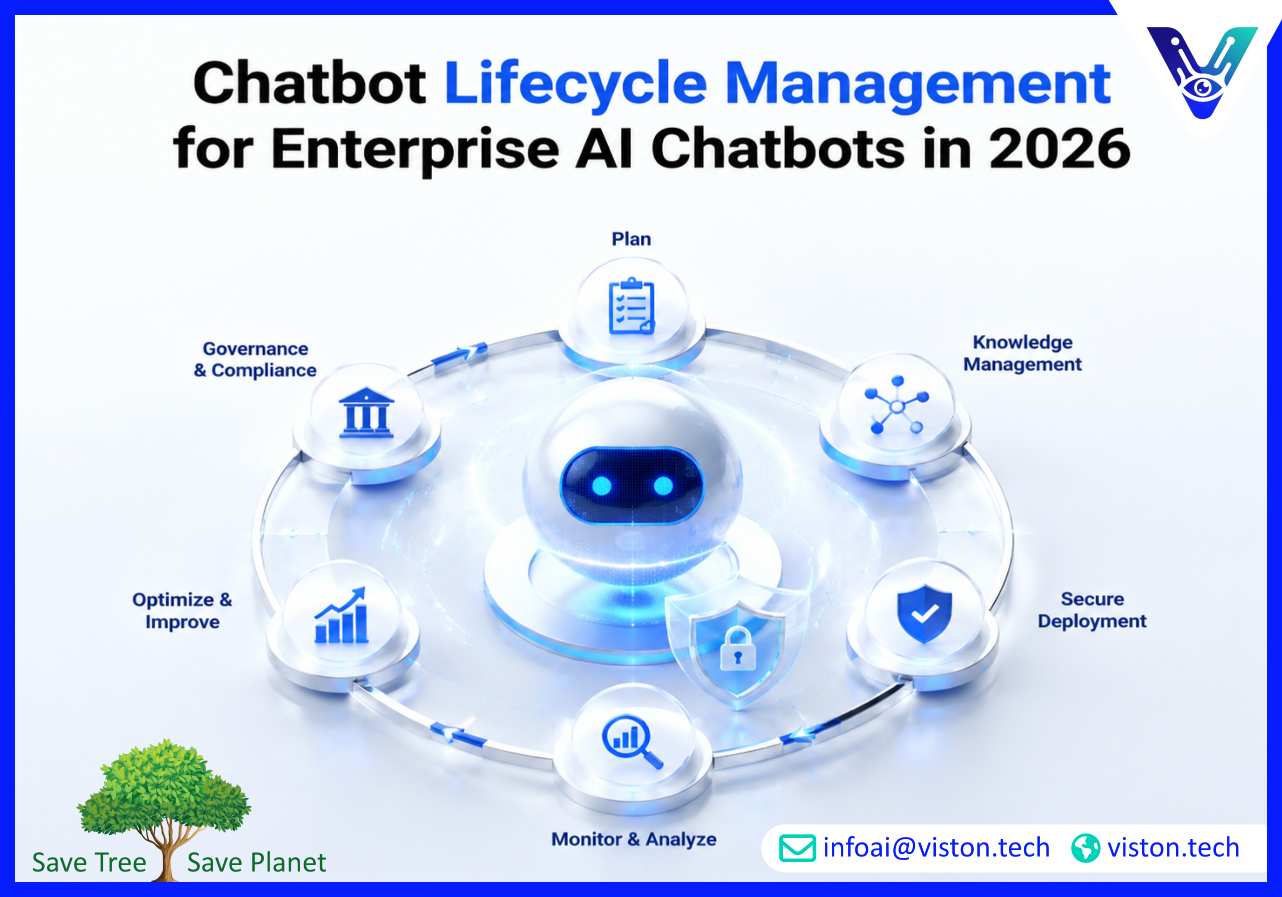
Chatbot lifecycle management enterprise teams need in 2026 is no longer a technical afterthought. For enterprise AI chatbots, lifecycle discipline determines whether automation remains accurate, secure, scalable, compliant, and useful after launch.
Chatbot lifecycle management is the structured process of planning, designing, deploying, monitoring, improving, securing, and retiring or replacing an enterprise chatbot over time. It covers every stage from initial use case discovery to long-term optimization and governance.
In enterprise environments, a chatbot is not just a conversation tool. It may connect with CRM platforms, ticketing systems, knowledge bases, ERP software, HR systems, payment tools, identity management platforms, analytics dashboards, and internal workflows. Because of this, chatbot lifecycle management must include business ownership, data quality, integration health, compliance controls, user experience review, performance measurement, and continuous training.
A chatbot that works well during launch can quickly become unreliable if product details change, policies are updated, APIs break, customer language shifts, or internal workflows evolve. Lifecycle management protects the chatbot from becoming outdated, inaccurate, or operationally risky.
For enterprise AI chatbots, the lifecycle should be treated as an operational program rather than a one-time development project. The more business-critical the chatbot becomes, the more disciplined its management model needs to be.
Enterprise AI chatbots are now expected to handle more complex responsibilities than simple FAQ responses. They support customer service, lead qualification, employee helpdesks, IT support, onboarding, claims handling, appointment scheduling, compliance workflows, order tracking, product guidance, and internal knowledge search.
In 2026, business buyers expect chatbots to be secure, integrated, multilingual, context-aware, measurable, and easy to improve. They also expect responsible AI controls, clear escalation paths, accurate knowledge retrieval, and transparent reporting. Without lifecycle management, these expectations become difficult to maintain.
Enterprise information is constantly changing. Pricing, product features, support policies, service levels, compliance rules, inventory data, HR processes, and customer workflows may all change regularly. If the chatbot is not updated with current information, it can provide outdated or misleading answers.
Lifecycle management creates ownership for content reviews, source validation, training updates, and version control. This helps ensure the chatbot continues to respond from approved and current business knowledge.
Enterprise AI chatbots often depend on APIs, CRM records, knowledge systems, authentication tools, databases, and workflow automation platforms. Even a minor integration failure can affect user experience. A chatbot may fail to create a support ticket, update a lead record, retrieve account details, schedule an appointment, or complete a transaction.
A strong lifecycle process monitors integration performance, API errors, workflow completion rates, response latency, and data synchronization quality. This is especially important when chatbots are used in customer-facing or revenue-supporting workflows.
As AI chatbots become more powerful, enterprises need stronger governance. Teams must define what the chatbot can answer, what it should refuse, when it must escalate, who can approve updates, how conversations are logged, how personal data is handled, and how performance is audited.
Governance is not only about risk reduction. It also improves consistency, trust, accountability, and long-term business value.
Effective chatbot lifecycle management enterprise teams can rely on starts with clear ownership. A chatbot should have business owners, technical owners, content owners, data owners, and support owners. Without defined responsibility, performance issues often go unnoticed until customers or employees complain.
The lifecycle begins with deciding what the chatbot should and should not do. A focused chatbot is usually more effective than one that attempts to answer every possible question. Enterprises should prioritize use cases by business value, user demand, automation readiness, risk level, and available data quality.
Examples of strong starting use cases include order status checks, appointment booking, internal IT support, HR policy lookup, lead qualification, customer onboarding, ticket creation, product recommendations, and account inquiry routing.
Conversation design should be reviewed throughout the chatbot lifecycle. User needs change, new objections appear, products evolve, and support patterns shift. Teams should regularly examine drop-off points, confusing prompts, repeated questions, fallback responses, and escalation triggers.
Good lifecycle management keeps chatbot conversations practical. It ensures the chatbot asks only necessary questions, provides concise answers, confirms important details, and hands over to a human agent when automation is no longer helpful.
Training data must be managed carefully. Enterprise chatbots may use FAQs, help center articles, policy documents, support tickets, sales scripts, CRM fields, product manuals, internal SOPs, and resolved conversation transcripts. These sources must be cleaned, approved, categorized, and maintained.
A strong knowledge governance process defines which sources are trusted, who owns each source, how often content is reviewed, and how outdated content is removed. It should also include access control so the chatbot does not expose internal or restricted information to the wrong audience.
Enterprise AI chatbots may process sensitive customer, employee, financial, health, contractual, or operational data. Lifecycle management must include data minimization, encryption, role-based access control, audit logs, retention policies, secure API handling, and escalation rules for sensitive requests.
Security review should not happen only before launch. It should continue whenever new data sources, channels, workflows, regions, or integrations are added.
Lifecycle management should include a clear KPI framework. Useful chatbot metrics include self-service resolution rate, fallback rate, escalation rate, customer satisfaction, intent recognition accuracy, completion rate, average response time, workflow success rate, ticket deflection, lead qualification rate, and human handover quality.
These metrics should be reviewed by use case and channel. A chatbot may perform well on a website but poorly on WhatsApp, mobile app, or internal portal. Channel-level insight helps teams improve experience based on user context.
Deployment is not the end of the chatbot lifecycle. It is the point where real learning begins. Once users interact with the chatbot, teams can identify knowledge gaps, unexpected intents, unclear wording, failed workflows, data quality issues, and user experience friction.
During the first weeks after launch, teams should review chatbot conversations frequently. Early monitoring helps identify high-impact issues before they scale. Common findings include missing intents, poor answer phrasing, weak routing rules, duplicate knowledge articles, unclear buttons, integration delays, and unnecessary escalation.
Post-launch reviews should involve both business and technical stakeholders. Support teams understand customer frustration. Sales teams understand buying intent. IT teams understand system reliability. Compliance teams understand risk. Lifecycle management brings these perspectives into one improvement process.
Enterprise AI chatbots need regular updates. Teams should use real conversation data, fallback logs, unresolved questions, new product information, policy updates, and agent feedback to improve chatbot performance.
A practical update cycle may include weekly reviews during rollout, monthly optimization after stabilization, and quarterly governance audits. Each update should be documented so teams know what changed, who approved it, and why it was made.
Even the best chatbot should not automate every interaction. Complex, emotional, regulated, high-value, or unclear situations often require human judgment. Lifecycle management should ensure that escalations are timely, contextual, and useful.
A good handoff includes the conversation history, user details, detected intent, attempted resolution, sentiment signals, priority level, and relevant CRM or ticketing data. This prevents users from repeating themselves and helps agents resolve issues faster.
As business needs grow, the chatbot may need new languages, channels, workflows, integrations, regions, or user roles. Lifecycle management helps teams scale in a controlled way. It also helps identify when a chatbot flow, knowledge source, model, or integration should be retired because it is outdated, inefficient, or no longer aligned with business goals.
This matters for enterprise teams because unmanaged expansion can create inconsistent answers, technical debt, compliance gaps, and poor user experience.
Viston AI is relevant to chatbot lifecycle management because its Enterprise AI Chatbots service focuses on building conversational AI for complex business environments. The company positions its chatbot capabilities around advanced natural language understanding, contextual memory, multi-turn dialogue management, enterprise-grade security, knowledge integration, omnichannel deployment, and integration with CRM, knowledge bases, and transactional systems.
This lifecycle perspective matters for enterprises that need more than a basic chatbot launch. A reliable chatbot program requires use case planning, domain-specific training, secure system integration, workflow automation, performance monitoring, retraining, compliance controls, and long-term optimization. Viston AI’s service offering also connects with related capabilities such as AI chatbot integration, multilingual support, voice-enabled assistants, NLP and text analysis, AI automation workflows, AI strategy, and MLOps/model monitoring.
For organizations using enterprise AI chatbots across customer support, sales operations, internal knowledge search, IT service desks, ecommerce, finance, healthcare, manufacturing, logistics, or employee support, this combination is valuable. It allows chatbot lifecycle management to be handled as an ongoing business capability rather than a disconnected technical task. With the right implementation model, businesses can improve response quality, reduce repetitive work, strengthen governance, and keep chatbot performance aligned with operational goals as needs evolve.
Chatbot lifecycle management is the process of managing an AI chatbot from planning and design through deployment, monitoring, optimization, governance, scaling, and retirement. For enterprises, it includes training data, integrations, security, compliance, analytics, and continuous improvement.
It helps enterprise AI chatbots remain accurate, secure, compliant, and useful after launch. Without lifecycle management, chatbot knowledge can become outdated, integrations can fail, user experience can decline, and automation risks can increase.
During launch, chatbot performance should be reviewed frequently, often weekly. After stabilization, monthly optimization and quarterly governance audits are practical for many enterprises. High-risk or regulated workflows may require more frequent review.
Important KPIs include resolution rate, fallback rate, escalation rate, customer satisfaction, intent recognition accuracy, completion rate, average response time, workflow success rate, human handoff quality, and integration error rate.
Ownership should be shared across business, technology, data, security, compliance, and customer experience teams. A single product or program owner should coordinate priorities, approvals, reporting, and ongoing improvements.
Yes. Viston AI’s Enterprise AI Chatbots service is aligned with chatbot lifecycle management because it covers chatbot development, NLP, system integration, knowledge connectivity, workflow automation, security considerations, multilingual support, and ongoing optimization.
Chatbot lifecycle management enterprise teams adopt in 2026 will decide whether enterprise AI chatbots deliver lasting business value or become unmanaged automation risks. A successful chatbot program requires clear scope, trusted data, secure integrations, measurable KPIs, strong governance, continuous training, and regular improvement. Businesses should view chatbot lifecycle management as a long-term operational discipline, not a launch checklist. For organizations investing in Enterprise AI Chatbots, Viston AI offers relevant capabilities to support planning, integration, optimization, and scalable chatbot performance across enterprise use cases.
