
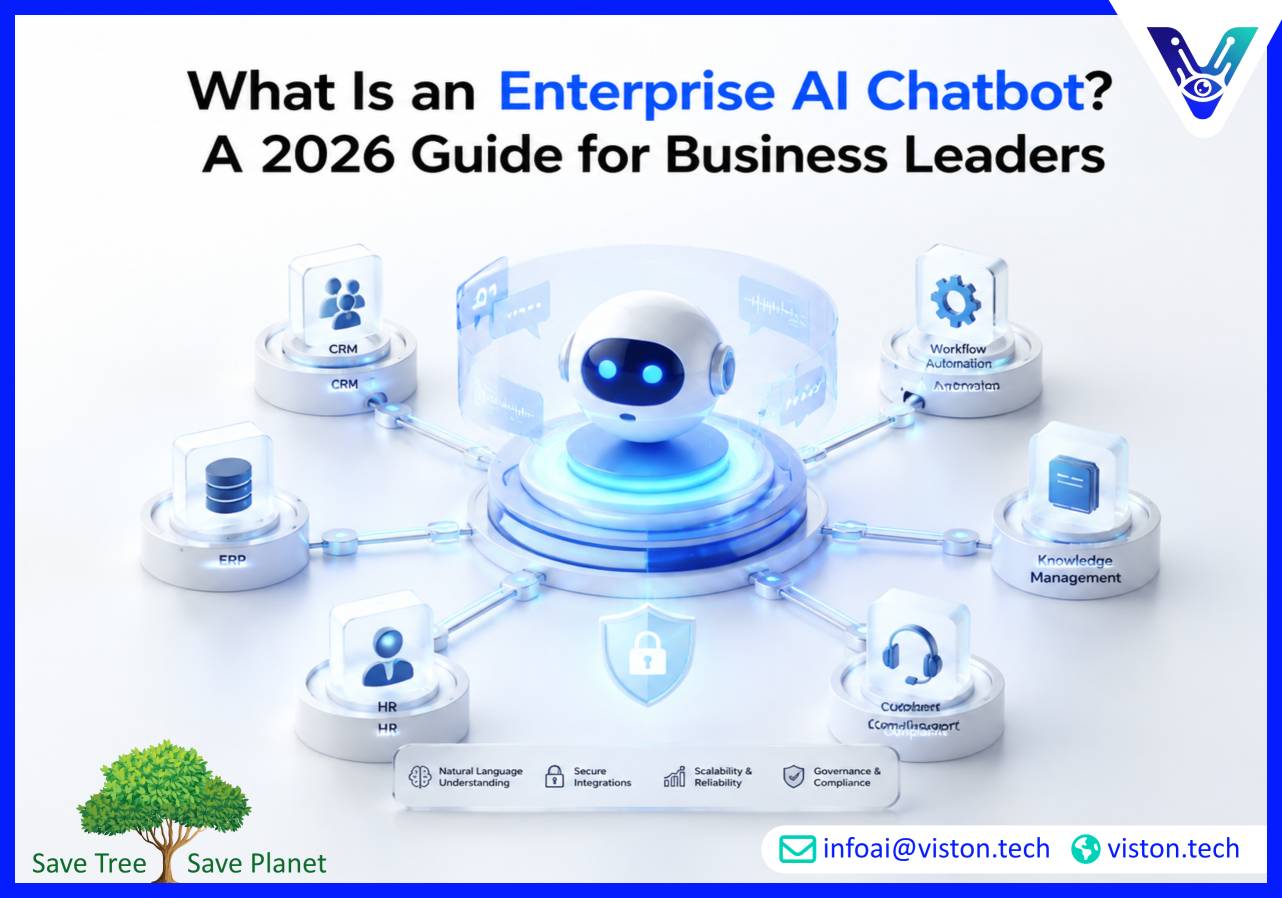
What is an enterprise AI chatbot? For business leaders, it is no longer just a website chat box. It is an intelligent conversational system designed to support customers, employees, workflows, data access, and service automation at enterprise scale.
An enterprise AI chatbot is a conversational AI system built for the complexity, scale, security, and operational needs of a business. Unlike a basic chatbot that follows fixed scripts, an enterprise AI chatbot can understand natural language, interpret user intent, retrieve information from approved business systems, automate workflows, and hand conversations to human teams when needed.
In 2026, enterprise AI chatbots are commonly used across customer support, sales, HR, IT service desks, operations, finance, healthcare, ecommerce, manufacturing, logistics, real estate, education, and internal knowledge management. Their purpose is not only to answer questions faster. Their real value comes from making business processes easier to access, more consistent, and more scalable.
A well-designed enterprise AI chatbot can help users check order status, submit support requests, qualify leads, schedule appointments, find policy information, troubleshoot technical issues, retrieve account details, guide onboarding, or trigger backend workflows. It acts as a conversational layer between people and business systems.
A basic chatbot usually depends on predefined buttons, simple rules, or limited FAQ responses. It may work for narrow use cases, but it struggles when users ask questions in different ways, need personalized answers, or require actions across multiple systems.
An enterprise AI chatbot is designed for more demanding environments. It may use natural language processing, natural language understanding, large language models, retrieval-augmented generation, workflow automation, API integrations, role-based access controls, analytics, and governance processes. This makes it suitable for businesses that need accuracy, reliability, compliance, and measurable outcomes.
Businesses are under pressure to respond faster, operate with leaner teams, improve customer experience, and make internal information easier to access. Traditional support models often depend on large teams, long queues, repeated questions, disconnected tools, and manual handoffs. Enterprise AI chatbots help reduce this pressure by automating repetitive interactions while keeping humans available for higher-value work.
The importance of enterprise AI chatbots has increased because customers and employees now expect instant, accurate, and personalized digital support. A buyer visiting a website may want product guidance immediately. A customer may want an order update without waiting for an agent. An employee may need HR or IT answers without searching through multiple portals. A manager may want operational data without opening several dashboards.
An enterprise AI chatbot gives businesses a practical way to serve these needs without rebuilding every system from scratch. Instead, the chatbot connects users to existing systems through a conversational interface.
Enterprise teams often handle large volumes of similar questions. These may include billing inquiries, password resets, refund policies, product availability, appointment scheduling, onboarding steps, internal policy questions, or technical troubleshooting. When handled manually, these requests consume valuable time.
An enterprise AI chatbot can manage high-volume, repeatable requests consistently. This improves response speed and helps support teams focus on complex, sensitive, or high-value issues that require human judgment.
In large organizations, different teams may answer the same question in different ways. This creates confusion for customers and operational risk for the business. Enterprise AI chatbots can use approved knowledge sources, predefined workflows, and controlled response guidelines to improve consistency.
This matters especially in industries where accuracy, privacy, compliance, and auditability are important. A chatbot should not guess, overpromise, expose restricted data, or provide guidance outside approved boundaries. Strong governance helps businesses keep automation useful and safe.
Many enterprises already have powerful systems, but users often struggle to navigate them. CRM platforms, helpdesk tools, ERP systems, HR portals, knowledge bases, and analytics dashboards can be difficult for non-technical users. A chatbot simplifies access by allowing users to ask questions or request actions conversationally.
For example, instead of opening multiple tools to check a customer’s account status, an authorized support agent could ask the chatbot for a summary. Instead of searching HR documents, an employee could ask about leave policy. Instead of manually creating a ticket, a customer could describe the issue and let the chatbot collect the required details.
An enterprise AI chatbot works by combining language understanding, business knowledge, system integrations, workflow rules, and monitoring. The exact architecture depends on the company’s use case, security needs, data environment, and preferred technology stack.
At a high level, the chatbot receives a user message, identifies intent, retrieves relevant context, generates or selects an appropriate response, performs any required action, and records the interaction for reporting and improvement.
Natural language understanding helps the chatbot identify what the user wants. A customer may say “I need help with my invoice,” “my bill looks wrong,” or “why was I charged twice?” These messages may all relate to billing support, but the chatbot must understand the difference between a general question, a payment issue, a dispute, or a refund request.
Enterprise AI chatbots are trained with business-specific language, product names, industry terms, customer phrases, internal abbreviations, and workflow examples. This helps them understand real conversations rather than only polished FAQ wording.
A reliable enterprise AI chatbot should answer from trusted information. This may include help center articles, product documentation, internal SOPs, service policies, pricing rules, compliance documents, CRM records, or transactional databases.
Many modern chatbots use retrieval-based methods to search approved content and generate grounded answers. This reduces the risk of inaccurate or unsupported responses. When the chatbot cannot verify an answer, it should ask a clarifying question, provide a safe response, or escalate to a human team.
Enterprise AI chatbots become more valuable when they are connected to business systems. Integration allows the chatbot to do more than answer questions. It can create tickets, update CRM records, check inventory, schedule meetings, verify order status, start approval workflows, send notifications, or route requests to the right department.
This is where enterprise AI chatbots differ strongly from simple chat widgets. The chatbot becomes part of business operations, not just a communication tool.
No enterprise AI chatbot should try to automate every conversation. Some situations require human review, empathy, legal judgment, clinical expertise, account approval, fraud investigation, or complex troubleshooting. A strong chatbot knows when to escalate.
Good handoff design includes the user’s issue, conversation history, detected intent, account context, attempted resolution, urgency, and recommended next step. This prevents users from repeating themselves and helps agents resolve issues faster.
Enterprise AI chatbots can support many business functions, but the best use cases are usually high-volume, repeatable, measurable, and connected to clear outcomes. Businesses should avoid deploying chatbots only because the technology is popular. The chatbot should solve a real operational problem.
Customer support is one of the most common use cases. An enterprise AI chatbot can answer FAQs, troubleshoot common issues, provide account or order information, collect support details, deflect simple tickets, and route complex cases to agents.
The benefit is not only faster response time. Businesses can improve service consistency, reduce repetitive workload, support customers outside office hours, and maintain better records of customer interactions.
Enterprise AI chatbots can engage website visitors, answer product questions, collect contact details, qualify leads, recommend services, and book meetings with sales teams. For B2B companies, the chatbot can ask structured qualification questions around company size, need, budget, timeline, and decision stage.
When connected to CRM, the chatbot can create or update lead records automatically. This helps sales teams prioritize serious opportunities and reduce manual data entry.
Many enterprises use AI chatbots internally to support HR, IT, operations, procurement, legal, and finance teams. Employees can ask questions about policies, benefits, software access, onboarding tasks, travel rules, expense processes, or internal documentation.
This improves productivity because employees spend less time searching across documents, portals, and email threads. It also helps organizations standardize internal support at scale.
Enterprise AI chatbots can be adapted to industry needs. In healthcare, they may support appointment scheduling, patient intake, and administrative questions while respecting privacy controls. In finance, they may assist with account inquiries, fraud routing, and service requests. In ecommerce, they may support product discovery, order tracking, returns, and personalized recommendations.
In manufacturing and logistics, chatbots can support equipment troubleshooting, shipment updates, parts inquiries, supplier communication, and operational reporting. The value depends on how well the chatbot understands industry terminology and integrates with the systems that hold live business data.
Viston AI is relevant to this topic because Enterprise AI Chatbots are part of its AI chatbot and virtual assistant service offering. The company’s capabilities align with the practical requirements businesses usually have when they move from a basic chatbot to a more scalable enterprise conversational AI system.
For organizations evaluating what an enterprise AI chatbot is, the important point is that successful delivery involves more than building a chat interface. It requires natural language understanding, business-specific conversation design, knowledge base integration, CRM or system connectivity, workflow automation, multilingual support, security controls, human escalation, analytics, and ongoing optimization.
Viston AI’s Enterprise AI Chatbots service is positioned around intelligent conversational AI for complex business environments. Its broader AI service portfolio includes AI chatbot development, AI chatbot integration, voice-enabled assistants, multilingual support, natural language processing, AI automation and workflow bots, agentic AI workflows, data strategy, MLOps, and model monitoring. These capabilities are useful for companies that need chatbots to support customer service, sales operations, internal helpdesks, knowledge search, and process automation.
For businesses across global markets, Viston AI can support enterprise chatbot projects that need practical implementation planning, integration with existing systems, scalable architecture, secure deployment, and continuous performance improvement. This makes its offering relevant for organizations that want enterprise AI chatbots to deliver operational value rather than remain a disconnected digital tool.
An enterprise AI chatbot is an AI-powered conversational assistant built for business use. It helps customers or employees get answers, complete tasks, access company systems, and move through workflows using natural language conversations.
A normal chatbot often follows fixed scripts or simple FAQ rules. An enterprise AI chatbot is built for larger business needs, including system integration, security, workflow automation, user context, analytics, compliance, and human escalation.
Enterprise AI chatbots can connect with CRM, ERP, helpdesk, HRIS, ecommerce, payment, inventory, knowledge base, ticketing, analytics, and internal workflow systems through APIs or secure integration layers.
Customer support, sales, HR, IT, operations, finance, procurement, marketing, and product teams can benefit. The best use case depends on where the business has repetitive questions, high request volume, slow response times, or manual workflow bottlenecks.
They can be secure when designed properly. Important controls include role-based access, encryption, audit logs, approved knowledge sources, data retention rules, compliance review, secure APIs, and clear escalation boundaries.
Yes. Viston AI’s Enterprise AI Chatbots service is aligned with business workflow automation, chatbot development, natural language understanding, system integration, multilingual support, and ongoing chatbot optimization.
Understanding what is an enterprise AI chatbot helps business leaders see the difference between basic chat automation and a scalable conversational AI capability. Enterprise AI Chatbots support customer service, sales, employee support, knowledge access, workflow automation, and operational efficiency when they are designed around real business needs. In 2026, the most effective chatbots are secure, integrated, measurable, and governed. They do not replace every human interaction, but they reduce repetitive work and make business systems easier to use. Viston AI is a relevant specialist for organizations exploring enterprise chatbot solutions that connect conversation, automation, and business outcomes.
