
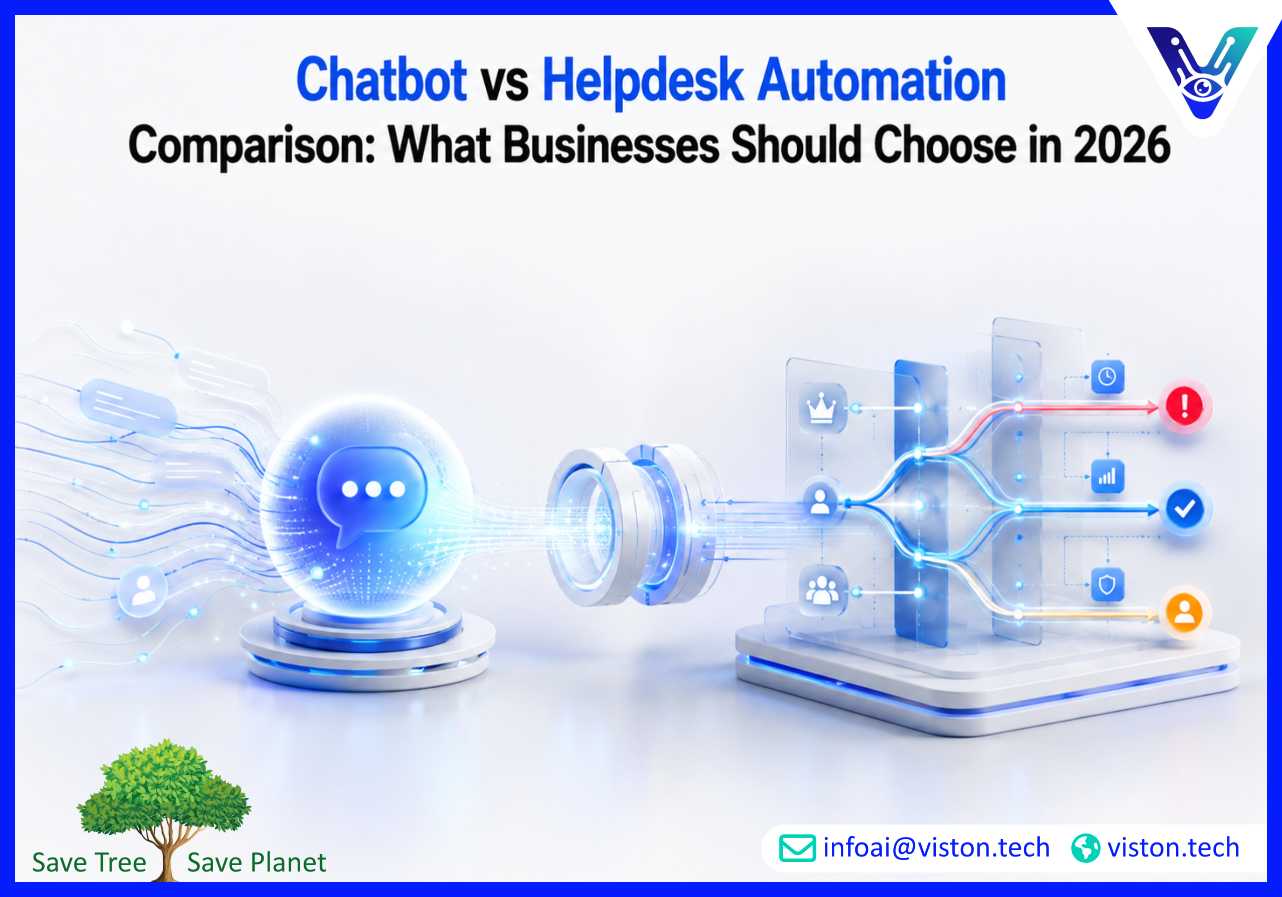
Chatbot vs helpdesk automation comparison matters because many businesses want faster support, lower manual workload, and better customer experiences, but they are not always choosing between the same type of solution. One improves conversations; the other improves service operations.
A chatbot is a conversational interface that interacts with users through text or voice. It can answer questions, guide users through steps, collect information, qualify leads, recommend products, check order status, or route users to the right team. Modern AI chatbots often use natural language processing, knowledge retrieval, generative AI, structured workflows, and business system integrations to deliver more useful responses.
Helpdesk automation is broader. It focuses on automating support operations behind the scenes. This includes ticket creation, categorization, assignment, priority routing, SLA reminders, escalation rules, status updates, knowledge base suggestions, internal notifications, and reporting. A helpdesk automation system may use AI, rules, workflow logic, or integrations with platforms such as CRM, ITSM, email, live chat, and customer support software.
The simplest way to compare them is this: a chatbot manages the front-end conversation, while helpdesk automation manages the support process. A chatbot can speak directly with customers or employees. Helpdesk automation ensures the request is logged, routed, tracked, and resolved efficiently.
The confusion happens because AI chatbots and helpdesk platforms now overlap. Many helpdesk tools include AI bots. Many chatbot solutions can create tickets, update CRM records, and trigger workflows. In 2026, the better question is not always “Which one should we buy?” It is “Which layer of the support experience do we need to improve first?”
If customers are struggling to get quick answers, a chatbot or virtual assistant may be the right starting point. If support teams are overwhelmed by messy inboxes, poor routing, missed SLAs, duplicate tickets, or weak reporting, helpdesk automation may be the stronger priority. For many growing businesses, the best result comes from combining both.
A useful chatbot vs helpdesk automation comparison should begin with use cases, not features. Both solutions can reduce manual work, but they solve different operational problems.
A chatbot is most useful when the business wants to handle repetitive conversations at scale. This includes answering common questions, guiding website visitors, helping customers find information, capturing leads, booking appointments, supporting ecommerce journeys, or assisting employees with internal knowledge search.
For example, a customer may ask about delivery status, refund policy, pricing, account access, appointment availability, or product compatibility. A well-designed chatbot can provide an immediate answer or collect enough details before escalating. This reduces waiting time and gives human agents more time for complex issues.
AI chatbot and virtual assistant development is especially valuable when the business needs:
Helpdesk automation is most useful when the business already receives support requests from multiple channels and needs stronger operational control. This includes email tickets, web forms, live chat, phone logs, social messages, IT requests, employee service requests, and customer complaints.
Instead of manually reviewing every request, automation can classify issues, assign tickets to the right team, set priority levels, notify agents, suggest knowledge articles, track SLA deadlines, and escalate unresolved cases. This helps managers improve service consistency and gives agents a cleaner workflow.
Helpdesk automation is usually the better starting point when a business struggles with:
The strongest support model often combines chatbot capability with helpdesk automation. The chatbot handles the first conversation, collects user details, answers known questions, and identifies intent. The helpdesk automation layer then creates or updates tickets, routes issues, tracks progress, and manages internal workflows.
For example, a chatbot can ask a customer for order number, issue type, preferred resolution, and contact details. Helpdesk automation can then create a ticket, assign it to the refunds team, set priority based on customer type, notify the agent, and send status updates. This creates a smoother experience for both the customer and support team.
Businesses should not choose based only on the phrase “AI-powered.” The right decision depends on support volume, customer expectations, team structure, data quality, integration needs, and operational maturity. A chatbot can fail if it has no accurate knowledge base. Helpdesk automation can fail if ticket categories, workflows, and ownership rules are poorly designed.
A chatbot directly affects the customer’s experience because users interact with it. The language, tone, accuracy, response speed, and escalation flow all matter. If the chatbot gives vague answers or refuses to escalate when needed, it can damage trust.
Helpdesk automation affects customer experience indirectly. Customers may not see the automation, but they feel the results through faster routing, clearer updates, fewer repeated questions, and more consistent resolutions.
Chatbots reduce repetitive front-line conversations. Helpdesk automation reduces repetitive support administration. If agents spend too much time answering the same questions, a chatbot can help. If agents spend too much time sorting, assigning, and updating tickets, helpdesk automation can help.
Both solutions become more valuable when integrated with business systems. A chatbot may need access to CRM records, product data, appointment calendars, inventory, order systems, policy documents, or ticket status. Helpdesk automation may need integrations with email, chat tools, CRM, ITSM, project management platforms, identity systems, analytics dashboards, and notification tools.
Without integration, both solutions can become limited. A chatbot that cannot access real account or order information may only answer generic questions. A helpdesk automation system that does not sync with CRM or internal systems may create incomplete records and manual follow-up work.
In 2026, businesses are more careful about how AI systems use customer, employee, financial, health, legal, or account data. Chatbots need guardrails around what they can answer, when they should escalate, which sources they can use, and what information they can collect. Helpdesk automation needs access controls, audit trails, retention policies, SLA visibility, and secure integrations.
For regulated or enterprise environments, the decision should include data minimization, permission controls, logging, encryption, human review, and clear ownership of workflows and knowledge content.
Chatbot performance should be measured through intent recognition accuracy, fallback rate, containment rate, escalation quality, satisfaction score, completion rate, and conversion rate. Helpdesk automation should be measured through ticket volume, first response time, resolution time, SLA compliance, reassignment rate, backlog size, and agent productivity.
If both systems are connected, businesses can measure more meaningful outcomes such as ticket deflection, first-contact resolution, cost per resolved issue, qualified lead routing, and customer effort reduction.
The best decision starts with the main problem the business is trying to solve. A company should not implement a chatbot simply because it looks modern, and it should not automate helpdesk workflows before understanding how requests actually move through the organization.
A chatbot should usually come first when customers or employees ask many repetitive questions and expect instant answers. This is common for ecommerce stores, SaaS companies, service providers, education platforms, healthcare appointment teams, real estate firms, financial service teams, travel businesses, and internal HR or IT departments.
In these situations, AI Chatbot & Virtual Assistant Development can help create a conversational layer that supports users before they submit a ticket. The goal is not to replace humans completely. The goal is to resolve simple needs quickly and move complex cases to humans with better context.
Helpdesk automation should usually come first when the business already has many support requests but lacks consistent routing, ownership, prioritization, and visibility. This is common when support teams rely heavily on shared inboxes, spreadsheets, manual tagging, or informal agent assignment.
In this case, adding a chatbot too early may create more requests without improving resolution. The business first needs a reliable service workflow so every request can be tracked, assigned, escalated, and measured.
Growing companies often need both. The chatbot handles the first interaction and self-service layer. Helpdesk automation manages the operational layer behind every unresolved or complex case. Together, they can improve response speed, reduce ticket volume, preserve context, and help support leaders measure service performance more accurately.
A practical rollout can begin with a limited set of high-volume use cases. For example, start with order tracking, appointment booking, password reset, lead qualification, refund status, or basic IT support. Once the chatbot and helpdesk workflows prove reliable, expand into more complex requests.
Viston AI is relevant to this comparison because AI Chatbot & Virtual Assistant Development often becomes the conversational layer that improves front-line support before, during, and after a helpdesk workflow. Viston AI lists AI Chatbot Development, Enterprise AI Chatbots, AI Chatbot Integration, Voice-Enabled Assistants, Multilingual Support, NLP solutions, AI Automation & Workflow Bots, and Strategic AI Consulting among its service areas.
For businesses comparing chatbots with helpdesk automation, this matters because the value of a chatbot depends on more than the chat window. It needs intent recognition, knowledge access, escalation logic, integration with CRM or ticketing systems, and workflow automation. Viston AI describes chatbot capabilities connected to advanced natural language processing, omnichannel deployment, fallback and escalation protocols, intent recognition, entity extraction, and integration with business systems.
Viston AI’s service positioning also connects conversational AI with enterprise systems such as CRM, ERP, customer service, and back-office platforms. Its AI Chatbot Integration service describes CRM synchronization, ERP workflow automation, multi-step process orchestration, and structured data extraction from conversations.
This makes Viston AI a relevant specialist for organizations that want AI virtual assistants to do more than answer FAQs. Its capabilities align with customer support automation, internal service assistance, lead handling, multilingual support, and integrated chatbot workflows that can complement existing helpdesk automation rather than compete with it.
A chatbot manages conversations with users, while helpdesk automation manages support workflows such as ticket creation, assignment, prioritization, escalation, SLA tracking, and reporting. A chatbot is user-facing; helpdesk automation is usually process-facing.
Usually, no. A chatbot can reduce repetitive tickets and answer common questions, but helpdesk automation is still needed for tracking unresolved issues, assigning cases, managing SLAs, reporting performance, and supporting agents with structured workflows.
It depends on the problem. A chatbot is better for instant self-service and repetitive conversations. Helpdesk automation is better for ticket management, routing, escalation, and operational control. Many businesses need both for scalable support.
AI chatbot and virtual assistant development supports helpdesk teams by answering common questions, collecting user details, identifying intent, suggesting solutions, creating tickets, and escalating complex cases with conversation history. This reduces repetitive work and improves agent context.
A small business with many repeated questions may start with a chatbot. A business with many unresolved requests, missed follow-ups, or scattered customer messages should start with a helpdesk system. If both issues exist, an integrated approach is better.
Viston AI’s AI Chatbot & Virtual Assistant Development and AI Chatbot Integration services are aligned with this need because they focus on conversational AI, business system integration, workflow automation, escalation, and customer support use cases.
Chatbot vs helpdesk automation comparison is not about choosing a winner. It is about understanding which part of the support experience needs improvement. Chatbots improve conversations, self-service, lead capture, and instant assistance. Helpdesk automation improves ticket flow, routing, accountability, SLA management, and reporting. In 2026, businesses get the strongest value when both work together through reliable integration and clear governance. For companies considering AI Chatbot & Virtual Assistant Development, Viston AI offers relevant capabilities for building conversational support experiences that can complement helpdesk automation and improve practical service outcomes.
