
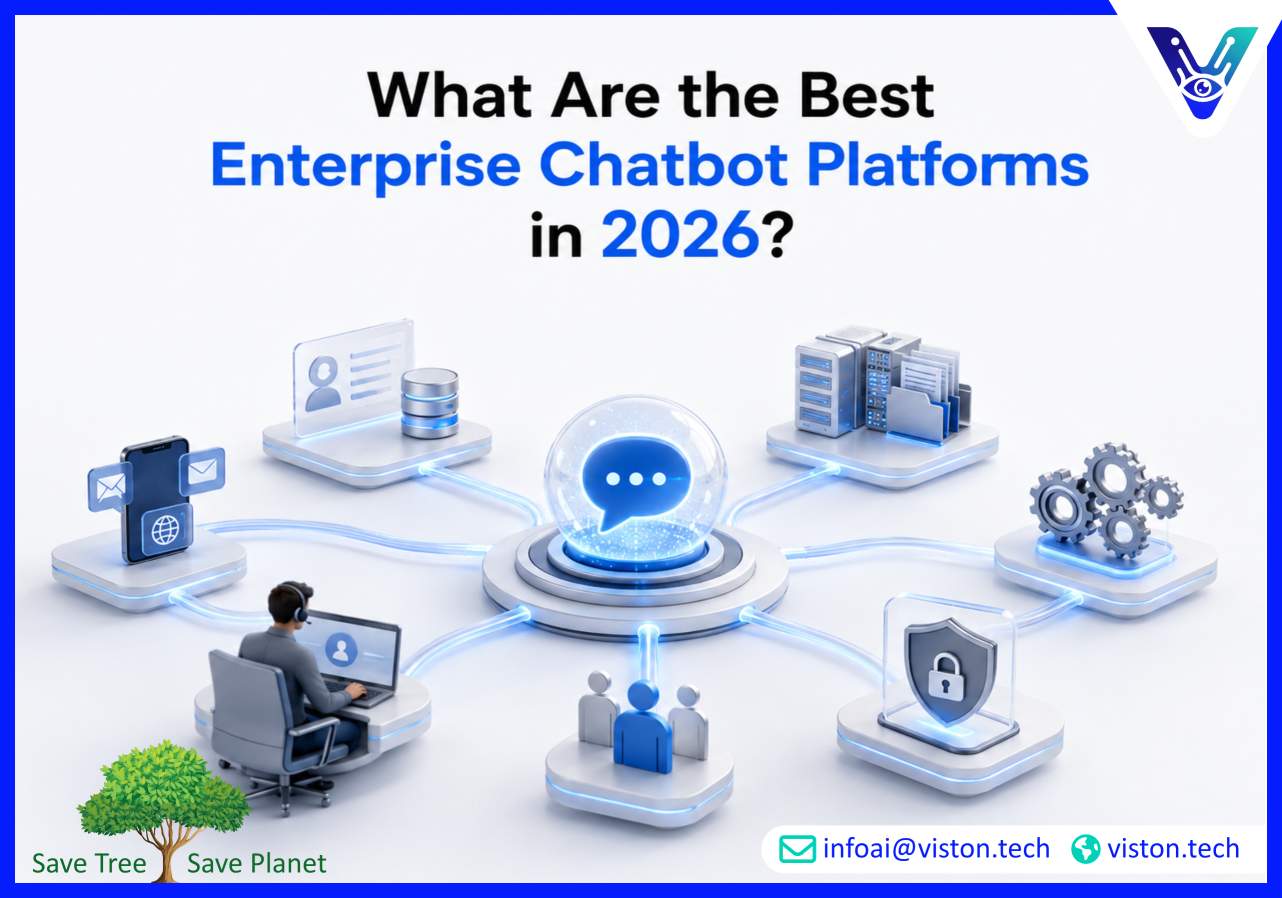
What are the best enterprise chatbot platforms? For most businesses, the answer depends on security needs, use cases, integrations, data quality, scalability, support workflows, and whether the chatbot must simply answer questions or complete real business tasks.
The best enterprise chatbot platforms in 2026 are not just chat windows added to a website. They are conversational AI systems designed to support customer service, sales, employee support, knowledge search, workflow automation, and business process execution across multiple channels.
Modern conversational AI platforms are commonly expected to support text, voice, visual content, low-code or pro-code development, generative AI, knowledge retrieval, enterprise integrations, and multi-channel deployment. Gartner describes conversational AI platforms as SaaS products used to build applications that simulate human conversation across channels and media, using composite AI, generative AI, and natural language technologies.
This matters because enterprises no longer evaluate chatbot platforms only by their ability to answer FAQs. Buyers now ask whether the platform can connect to CRM, ERP, helpdesk, ecommerce, HRIS, ticketing, document repositories, analytics dashboards, and internal workflow tools. A chatbot that cannot access trusted business data or trigger approved actions often becomes a limited support widget rather than a meaningful enterprise AI chatbot.
In practical terms, the best platform is the one that fits the organization’s operating model. A customer support team may prioritize ticket deflection, human handoff, multilingual responses, and service analytics. A sales team may need lead qualification, meeting booking, CRM updates, and campaign attribution. An internal IT or HR team may need secure knowledge search, identity-based access, approval workflows, and audit trails.
Choosing the best enterprise chatbot platform is less about finding the most popular tool and more about matching capability to business requirements. A platform can look impressive in a demo but fail in production if it cannot handle data permissions, integration complexity, regulatory expectations, multilingual support, or high-volume usage.
Enterprises should evaluate platforms based on fit, not hype. The right platform should support the chatbot’s intended role, whether that role is customer assistance, internal knowledge search, workflow automation, lead generation, account support, compliance guidance, or employee service delivery.
A strong enterprise chatbot platform should provide more than natural language responses. It should include the tools, controls, and technical foundation needed to design, launch, monitor, and improve chatbot experiences at business scale.
The platform should understand user intent, detect context, manage follow-up questions, and generate useful responses from approved content. In 2026, many businesses expect generative AI support, but this must be paired with retrieval, guardrails, confidence thresholds, and human escalation. A chatbot should not produce confident answers from uncertain sources.
Enterprise chatbot platforms should connect to approved knowledge sources such as help centers, product documentation, internal policies, SOPs, CRM notes, and document repositories. Retrieval-based responses help reduce unsupported answers by grounding the chatbot in trusted information.
This is especially important for companies with complex products, multiple departments, regional policies, or regulated information. The chatbot should know which source is authoritative, when content was last updated, and when it should ask for clarification or hand off to a human.
Enterprise AI Chatbots become more valuable when they connect to operational systems. Useful integrations may include CRM, helpdesk, ERP, ecommerce platforms, payment systems, order management tools, HR systems, identity providers, calendars, and marketing automation platforms.
Without integration, a chatbot can answer questions but cannot complete many business tasks. With integration, it can create tickets, qualify leads, update records, check order status, book appointments, trigger approvals, or provide role-specific information.
Enterprises often need chatbot experiences across websites, mobile apps, WhatsApp, Messenger, live chat, employee portals, contact centers, and internal collaboration platforms. The best enterprise chatbot platforms allow businesses to manage these channels without creating disconnected bot experiences.
Channel consistency matters. A customer should receive aligned answers whether they contact the business through a website, messaging app, or support portal. Internal teams should also be able to manage conversation history, escalation rules, and analytics across channels.
No enterprise chatbot should be designed to handle every conversation alone. The platform must support intelligent escalation when the user is frustrated, the query is sensitive, the confidence score is low, or the request requires approval, judgment, or human accountability.
Good handoff includes conversation history, detected intent, user details, attempted resolutions, sentiment signals, and suggested next steps. Poor handoff forces users to repeat themselves and weakens trust in automation.
The platform should provide reporting on conversation volume, intent accuracy, fallback rate, resolution rate, escalation rate, satisfaction, conversion rate, average response time, workflow success, and integration errors. These metrics help teams improve chatbot performance after launch.
Enterprise chatbot performance should be managed continuously. Platforms that make failed conversations, content gaps, and workflow issues visible are easier to optimize over time.
Choosing an enterprise chatbot platform should start with a clear business use case. A company should avoid buying technology before defining what the chatbot must achieve, who will use it, what systems it must connect to, and what risks must be controlled.
Before evaluating vendors or technologies, decide whether the chatbot is meant to reduce support tickets, improve lead capture, automate internal service requests, help employees search knowledge, assist account managers, onboard users, or support compliance workflows.
Each role requires different capabilities. A sales chatbot needs qualification logic and CRM integration. A support chatbot needs knowledge access, ticketing integration, and escalation controls. An internal enterprise assistant needs identity management, permissions, and secure access to company documents.
Many platforms claim to integrate with business systems, but enterprises should test how deep those integrations are. A basic connector may only push form data. A stronger integration may support real-time lookup, field validation, workflow triggers, record updates, permission checks, and audit logging.
Integration depth affects both user experience and operational reliability. If a chatbot gives an answer but fails to update the CRM or ticketing system, the business still has manual work and data quality issues.
Enterprise chatbot platforms should support data protection, access control, auditability, data retention rules, encryption, user authentication, role-based permissions, and safe handling of sensitive information. NIST’s Generative AI Profile was released to help organizations identify and manage risks specific to generative AI systems, including privacy, information security, integrity, human-AI configuration, and other risk areas.
Security evaluation should also consider prompt injection, unauthorized data exposure, unsafe tool use, and weak separation between public and internal knowledge. For enterprise AI chatbots, governance is not an optional extra. It is part of responsible production deployment.
Demos often use ideal examples. Enterprises should test platforms with real user questions, messy phrasing, incomplete requests, multilingual inputs, edge cases, sensitive topics, and failed workflow scenarios. This shows whether the chatbot can perform in actual business conditions.
A proof of concept should measure response quality, retrieval accuracy, escalation behavior, workflow completion, integration reliability, and reporting visibility. It should also include business users, not only technical teams.
A chatbot platform should be manageable after launch. Teams need to know who owns intents, prompts, knowledge updates, escalation rules, analytics, integrations, compliance reviews, and performance optimization. Low-code tools can help business teams manage content, while technical teams handle integrations and governance.
The best platforms make it practical to improve the chatbot without rebuilding everything. This includes version control, testing environments, approval workflows, conversation review, and safe rollout processes.
Instead of looking for one universal winner, enterprises should identify the platform category that matches their use case. Different chatbot platform types serve different needs, budgets, and operating models.
These platforms are useful for service teams that want to reduce repetitive tickets, answer customer questions, route requests, and improve response times. They often work best when connected to helpdesk systems, knowledge bases, customer profiles, and live agent tools.
They are a good fit for businesses with high support volume, repeat questions, product troubleshooting needs, and multi-channel customer service operations.
These platforms focus on qualifying prospects, capturing contact details, booking meetings, recommending products, routing inquiries, and updating CRM records. They are valuable for B2B companies, SaaS businesses, agencies, real estate firms, ecommerce brands, and service providers with inbound demand.
The strongest sales chatbots do more than collect emails. They identify intent, segment users, ask relevant qualification questions, and pass structured information to the right sales team.
These platforms help employees search policies, SOPs, IT guidance, HR documents, product documentation, and operational knowledge. They are useful for companies with large knowledge bases, distributed teams, complex internal processes, or frequent employee support requests.
For internal use, permission control is critical. Employees should only receive information they are authorized to access.
These platforms are built for action-based automation. They can create tickets, submit forms, trigger approvals, update systems, send notifications, summarize requests, and move work across departments.
This type is useful when the chatbot is expected to complete tasks, not just respond. It is especially relevant for operations, HR, finance, IT, procurement, logistics, and service delivery teams.
Some businesses need a custom solution because their workflows, data architecture, compliance requirements, or integration needs are too specific for an off-the-shelf chatbot. A custom enterprise AI chatbot can be designed around the company’s systems, user roles, data sources, escalation logic, reporting needs, and industry requirements.
Custom development is often more suitable when the chatbot must interact with proprietary platforms, handle complex permissions, support specialized terminology, or become part of a larger AI automation roadmap.
Viston AI is relevant to this topic because selecting the best enterprise chatbot platform often requires more than choosing software. Businesses need practical support with chatbot strategy, workflow design, knowledge preparation, integration planning, security controls, deployment, and continuous optimization.
Viston AI lists Enterprise AI Chatbots, AI Chatbot Integration, AI Chatbot Development, multilingual support, voice-enabled assistants, integration with business systems, NLP and text analysis, AI automation, workflow bots, MLOps, model monitoring, and AI strategy capabilities among its service areas.
This combination is useful for companies that want a chatbot platform aligned with real business processes rather than a disconnected conversational layer. Viston AI can support enterprise chatbot initiatives by helping define use cases, prepare knowledge sources, design conversation flows, connect chatbots with CRM or business systems, implement escalation rules, and create performance measurement practices.
For organizations comparing enterprise chatbot platforms, this service-led approach can reduce selection risk. Instead of choosing a platform based only on features, businesses can evaluate whether the chatbot will work with their data, systems, compliance expectations, customer journeys, and internal teams. That is where Enterprise AI Chatbots become a business capability rather than a technology experiment.
The best enterprise chatbot platforms are the ones that fit the business use case, integration needs, security requirements, channel strategy, and scalability expectations. A support chatbot, sales chatbot, internal assistant, and workflow automation bot may each require a different platform approach.
Enterprises should start by defining the chatbot’s role, required integrations, data sources, user groups, compliance needs, reporting requirements, and escalation process. A proof of concept using real business conversations is often the safest way to validate platform fit.
Custom enterprise AI chatbots are often better when a business has complex workflows, proprietary systems, strict permissions, specialized terminology, or unique reporting needs. Ready-made platforms may work well for standard support, lead capture, and FAQ use cases.
An enterprise chatbot platform should include natural language understanding, generative AI support, knowledge retrieval, business system integrations, omnichannel deployment, human handoff, analytics, access control, governance tools, and continuous optimization features.
They often fail because of unclear use cases, poor data quality, weak integrations, limited governance, lack of training, poor escalation design, or unrealistic expectations. Successful chatbot programs need ongoing ownership and performance improvement.
Yes. Viston AI’s Enterprise AI Chatbots service is aligned with chatbot strategy, development, integration, NLP, automation workflows, and ongoing optimization, making it relevant for businesses that need platform selection support or custom chatbot implementation.
What are the best enterprise chatbot platforms? The most practical answer is that the best platform is the one that fits your business goals, data environment, security expectations, integration needs, and user experience requirements. In 2026, Enterprise AI Chatbots should be evaluated as operational systems, not simple chat widgets. Businesses should look for strong knowledge retrieval, workflow automation, human handoff, analytics, governance, and scalable integration. Viston AI offers relevant capabilities for organizations that want to plan, build, integrate, and optimize enterprise chatbot solutions with a business-focused approach.
