
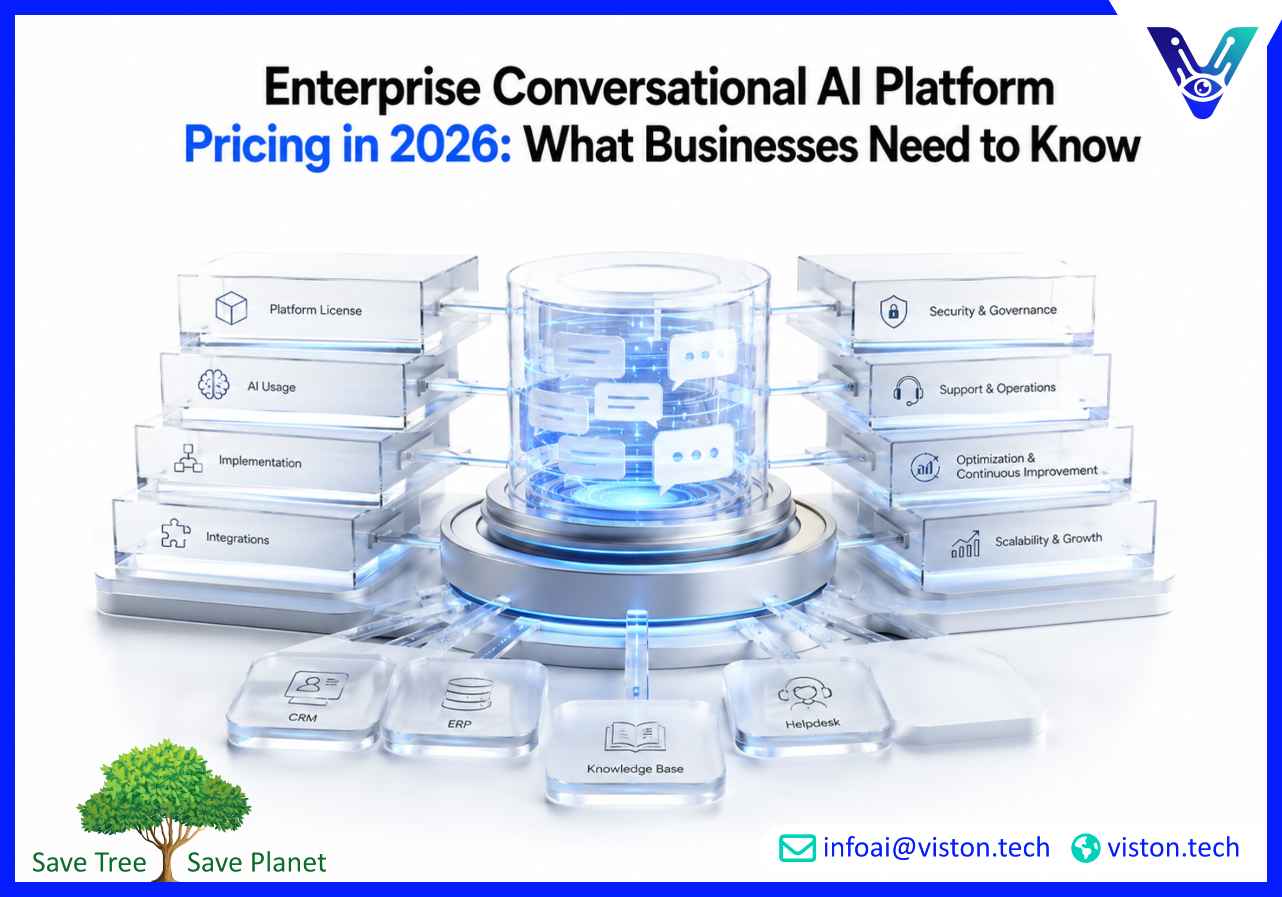
Enterprise conversational AI platform pricing matters because the lowest subscription rarely represents the real cost of chatbot success. In 2026, businesses need to evaluate platform fees, implementation work, integrations, security, usage volume, support, optimization, and measurable outcomes before choosing an enterprise AI chatbot solution.
Enterprise conversational AI platform pricing refers to the total cost of deploying, operating, maintaining, and improving an AI chatbot platform across business channels and workflows. It is not limited to a monthly software license. For enterprise use, pricing usually reflects the complexity of the chatbot, the number of users or conversations, the required integrations, the AI model architecture, the channels supported, the level of governance, and the amount of expert implementation needed.
A basic chatbot tool may offer a simple monthly plan, but enterprise AI chatbots typically need more than a chat window. They often connect to CRM systems, ticketing platforms, knowledge bases, ecommerce systems, ERP tools, internal databases, analytics dashboards, WhatsApp, mobile apps, websites, and live agent systems. Each connection affects cost because it requires planning, data access, workflow logic, testing, monitoring, and security controls.
Pricing is also shaped by how the conversational AI platform is expected to perform. A chatbot that only answers FAQs has a different cost structure from one that qualifies leads, retrieves customer records, creates support tickets, recommends products, handles multilingual conversations, supports voice interactions, or completes multi-step business processes.
In 2026, businesses are also paying closer attention to reliability, privacy, compliance, model governance, hallucination control, analytics, human handover quality, and responsible AI behavior. These requirements make enterprise pricing more strategic. The right question is not only, “How much does the platform cost?” but also, “What level of business capability, control, and long-term performance does this pricing support?”
Conversational AI vendors may use several pricing models. Some platforms charge by monthly subscription tier, while others charge by seat, conversation volume, resolution, usage, channel, feature bundle, or custom enterprise agreement. Many enterprise deployments combine software fees with implementation, integration, training, and ongoing optimization costs.
For business decision-makers, comparing these models requires more than checking the headline price. A lower monthly fee may become expensive if the platform charges heavily for usage, advanced integrations, support, or required add-ons. A higher enterprise package may be more cost-effective if it includes governance, scalability, analytics, security, and expert delivery support.
Enterprise conversational AI platform pricing is driven by scope. The more a chatbot needs to understand, access, automate, personalize, and report, the more planning and technical depth it requires. Businesses should evaluate pricing through the practical requirements of their use case rather than treating all chatbot platforms as interchangeable.
The first cost driver is the business problem the chatbot must solve. A customer support bot that answers common questions from a knowledge base is usually simpler than a chatbot that verifies users, checks account details, updates records, processes requests, or routes conversations based on customer value. Sales, support, HR, IT, operations, ecommerce, and onboarding use cases all require different workflows and success metrics.
Complexity increases when the chatbot must handle multiple user types, conditional paths, regulated content, sensitive data, custom business rules, or exception handling. Enterprises should expect pricing to rise when the chatbot moves from basic response automation to workflow execution.
Many platforms price according to monthly conversations, messages, AI resolutions, or model usage. This matters because an enterprise chatbot may handle thousands or millions of interactions across web, app, messaging, and internal channels. Usage-based pricing can be flexible, but it needs careful forecasting. A business should estimate current demand, seasonal spikes, expected adoption, and future expansion before choosing a pricing model.
It is also important to define what counts as a billable interaction. Some vendors charge per message, while others charge per completed conversation or successful resolution. These differences can significantly affect total cost, especially for businesses with long support conversations or high-volume customer service needs.
Pricing can increase when a chatbot must work across multiple channels. Website chat, WhatsApp, mobile apps, Messenger, Slack, Microsoft Teams, voice channels, email-to-chat workflows, and embedded product assistants each have different technical requirements. A consistent omnichannel experience requires shared context, unified reporting, and smooth escalation rules.
For enterprises, channel coverage is not only a feature decision. It affects customer experience, support operations, lead response speed, and internal productivity. A platform that works well on one channel but struggles across others may limit long-term value.
Integration is one of the biggest pricing factors for enterprise AI chatbots. A chatbot becomes more valuable when it can connect with CRM, ERP, helpdesk, payment, booking, ecommerce, marketing automation, HR, or internal knowledge systems. However, these integrations require API work, authentication, field mapping, workflow logic, error handling, and testing.
For example, a lead generation chatbot may need to push qualified prospects into a CRM, assign them to sales owners, trigger email sequences, and record consent. A support chatbot may need to check order status, create tickets, update customer profiles, and escalate with conversation history. These capabilities make the chatbot operationally useful, but they also influence implementation cost.
Enterprise pricing often includes security and governance requirements that smaller chatbot plans do not cover. These may include role-based access controls, audit logs, data retention settings, private knowledge bases, encryption, approval workflows, admin permissions, monitoring, escalation controls, and compliance-ready deployment practices.
Businesses in regulated or data-sensitive environments need to understand how the platform manages customer data, employee data, prompts, logs, integrations, and model outputs. Security reviews, vendor assessments, and compliance alignment can add time and cost, but they are essential for responsible enterprise deployment.
The real cost of an enterprise conversational AI platform includes both visible and hidden cost areas. A practical estimate should include platform licensing, implementation, integrations, AI configuration, content preparation, testing, training, support, and continuous improvement. A business that only budgets for software may underestimate the work required to launch a reliable chatbot.
Platform fees usually cover access to the conversational AI environment, admin tools, analytics, workflow builder, channels, and AI capabilities. The cost may depend on users, conversations, feature tier, model access, or enterprise package. Procurement teams should review what is included in the base price and what requires add-ons.
Important questions include whether the package includes advanced analytics, multilingual support, knowledge base connections, live chat handover, API access, custom branding, admin roles, security controls, and priority support. These features may be essential for enterprise use but optional in lower-tier plans.
Implementation cost covers the work needed to turn a platform into a working business solution. This may include discovery workshops, chatbot strategy, conversation design, intent mapping, knowledge base preparation, prompt configuration, workflow design, integration planning, testing, user acceptance review, and deployment support.
For enterprise AI chatbots, implementation should not be rushed. Poor planning can lead to inaccurate responses, weak adoption, failed handoffs, duplicate records, missed leads, and frustrated customers. A well-scoped implementation improves reliability and reduces expensive rework later.
A chatbot is only as useful as the information it can access and interpret. Businesses often need to clean, organize, update, and structure their knowledge sources before deployment. This may include FAQs, help center articles, product documentation, service policies, pricing information, internal SOPs, customer support scripts, and sales enablement content.
For generative AI chatbots, knowledge quality is especially important. The platform may use retrieval-augmented generation, controlled prompts, approved sources, confidence thresholds, and fallback rules to improve accuracy. Preparing these assets takes time, but it directly affects answer quality and user trust.
Enterprise chatbot cost should include ongoing improvement. After launch, teams need to review failed conversations, fallback queries, escalation reasons, satisfaction scores, conversion rates, and workflow errors. The chatbot should be refined based on real user behavior, not only initial assumptions.
Optimization may involve updating knowledge content, improving prompts, adding intents, changing handover logic, fixing integration errors, expanding language support, and improving analytics. A chatbot that is not monitored can become outdated as products, policies, customer expectations, and business processes change.
Total cost of ownership includes every cost required to keep the chatbot effective over time. This includes software fees, model usage, channel costs, implementation, integrations, support, training, governance, compliance reviews, analytics, maintenance, and optimization. For enterprise decision-makers, total cost of ownership is more useful than comparing monthly platform prices alone.
A strong pricing evaluation should connect cost to expected outcomes: reduced support tickets, faster response times, better lead qualification, improved agent productivity, higher self-service resolution, cleaner CRM data, and more consistent customer experience.
Businesses should compare enterprise conversational AI platform pricing by value, not only by cost. The cheapest option may work for a narrow use case, but it may not support enterprise-grade scale, integrations, governance, reporting, or customization. The most expensive option may also be unnecessary if the business only needs a focused chatbot for a limited workflow.
Before evaluating pricing, define the outcome the chatbot must support. Is the goal to reduce support workload, improve lead conversion, automate internal requests, support ecommerce customers, assist employees, or provide multilingual service? Each goal requires a different level of platform capability and implementation depth.
Clear outcomes also make vendor conversations more productive. Instead of asking for a general chatbot quote, businesses can request pricing based on conversation volume, channels, integrations, automation workflows, reporting needs, and support expectations.
When reviewing pricing, check what each platform includes. Some plans may advertise conversational AI but limit important enterprise features such as API access, role permissions, analytics, multilingual capabilities, advanced workflows, or human handover. Others may include enterprise features but require a longer implementation cycle.
Useful comparison criteria include:
Some costs appear after the initial purchase. These may include extra conversation volume, additional channels, more integrations, premium AI model usage, custom reports, advanced security features, language expansion, support upgrades, or professional services. Businesses should ask vendors to explain future cost triggers before signing a contract.
This is especially important for growing companies. A pricing model that looks affordable at launch may become expensive as chatbot adoption increases. The best pricing structure should support scale without creating unpredictable cost spikes.
Enterprise AI chatbot pricing should be considered alongside the vendor’s ability to deliver. A platform with strong features may still fail if implementation is weak. Businesses should assess whether the provider understands conversation design, AI model behavior, data preparation, integrations, security, testing, reporting, and continuous optimization.
A good provider should help translate business requirements into a practical chatbot roadmap. This includes identifying which use cases should be automated first, which require human review, how knowledge should be structured, where integrations are needed, and how success will be measured after launch.
Viston AI is relevant to enterprise conversational AI platform pricing because the company provides services aligned with enterprise AI chatbots, AI chatbot development, AI chatbot integration, multilingual chatbot support, voice-enabled assistants, NLP, agentic workflows, AI strategy, and related AI implementation capabilities. For businesses comparing pricing options, this matters because cost depends heavily on the practical scope of the chatbot, not only the software license.
Viston AI can support organizations that need conversational AI to do more than answer basic questions. Enterprise buyers often need chatbots that connect with business systems, automate customer support, qualify leads, assist internal teams, handle multilingual conversations, and operate with clear performance measurement. These requirements affect architecture, integration, governance, and long-term optimization.
A specialist delivery approach is useful when businesses need help defining the right platform scope, choosing the correct chatbot workflows, preparing business knowledge, integrating CRM or support systems, and building a roadmap for measurable outcomes. For companies evaluating enterprise conversational AI platform pricing, Viston AI’s service alignment can help clarify what should be included in the project, where costs are likely to arise, and how chatbot investment can be connected to business value.
Rather than treating pricing as a simple monthly fee, Viston AI’s enterprise AI chatbot focus supports a more complete view of cost: strategy, build, integration, automation, security considerations, testing, launch, and ongoing improvement.
Enterprise conversational AI platform pricing varies widely based on users, conversations, channels, integrations, AI model usage, security requirements, and implementation scope. Businesses should evaluate total cost of ownership rather than relying only on the monthly platform fee.
Enterprise AI chatbots usually require deeper integrations, stronger security, custom workflows, advanced analytics, multilingual support, human handover, governance controls, and ongoing optimization. These requirements add value but also increase cost compared with basic FAQ chatbots.
The best pricing model depends on usage patterns and business goals. High-volume support teams may prefer predictable enterprise pricing, while smaller deployments may benefit from subscription or usage-based pricing. The right model should match expected scale, workflow complexity, and support needs.
Common hidden costs include implementation, integrations, extra channels, premium AI model usage, data preparation, knowledge base cleanup, security reviews, support upgrades, training, and ongoing optimization. These should be included in the budget from the beginning.
Chatbot ROI can be estimated by measuring reduced ticket volume, faster response times, improved lead qualification, higher conversion rates, lower support workload, better self-service resolution, and cleaner operational data. ROI should be measured against both platform and implementation costs.
Viston AI’s Enterprise AI Chatbots and related AI chatbot development and integration services are aligned with businesses that need help planning, building, integrating, and optimizing conversational AI solutions for practical business outcomes.
Enterprise conversational AI platform pricing in 2026 should be evaluated through business value, not only software cost. The real investment includes platform access, implementation, integrations, AI configuration, knowledge preparation, security, testing, support, and continuous optimization. Businesses choosing Enterprise AI Chatbots should define clear goals, understand usage patterns, compare included capabilities, and calculate total cost of ownership before selecting a provider. For organizations that need scalable, integrated, and business-focused conversational AI, Viston AI offers relevant expertise in enterprise chatbot development, integration, and AI implementation planning.
