
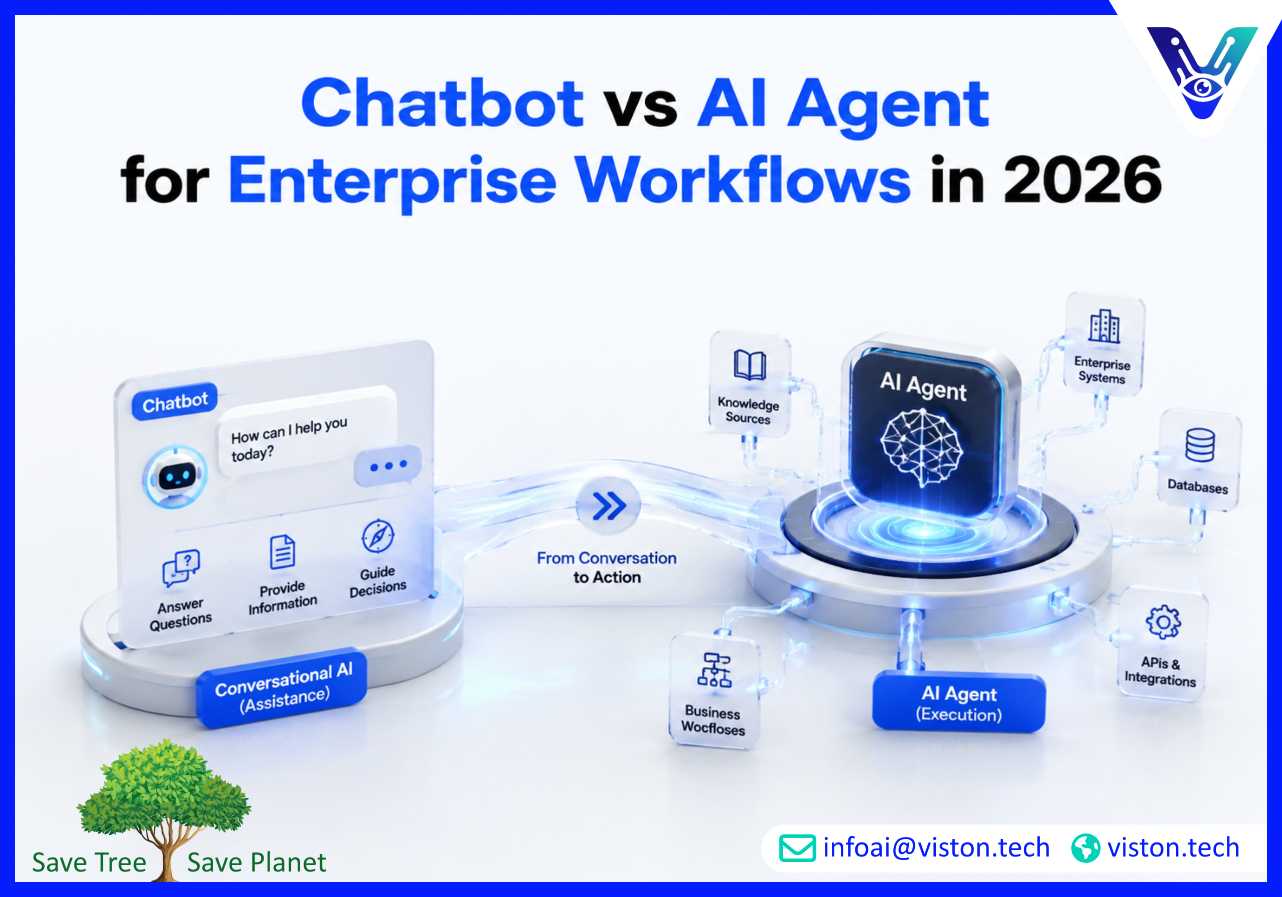
Understanding chatbot vs AI agent enterprise workflows is now a practical business decision, not just a technology discussion. Enterprises need to know when conversational automation is enough, when autonomous task execution is required, and how both can support customer service, internal operations, sales, and knowledge workflows.
A chatbot is usually designed to communicate with users, answer questions, collect information, guide conversations, and route requests. In enterprise environments, chatbots often support customer support, employee helpdesks, lead qualification, onboarding, service requests, and knowledge base access. Modern enterprise chatbots can connect with CRM, ticketing, ERP, HR, ecommerce, and internal data systems to provide more useful responses.
An AI agent goes further. It does not only respond to a user; it can plan steps, use tools, call APIs, retrieve data, trigger workflows, evaluate results, and complete defined tasks with different levels of human oversight. For example, a chatbot may tell a customer how to update billing details, while an AI agent may validate the customer, check account permissions, update the billing system, confirm the change, and create an audit log.
The distinction matters because enterprises are no longer asking whether AI can answer questions. They are asking whether AI can safely assist with operational work. Enterprise chatbots remain valuable for structured conversations, high-volume support, information retrieval, guided forms, and multilingual engagement. AI agents are more relevant when workflows require reasoning, system actions, task sequencing, tool use, and exception handling.
In 2026, the best decision is not always chatbot or AI agent. Many enterprises need both. A chatbot can act as the user-facing conversational layer, while AI agents operate behind the scenes to execute workflows, retrieve records, validate information, or coordinate multi-step actions. This combined model is especially useful where user experience must remain simple, but backend operations are complex.
A chatbot is best understood as a conversational interface. An AI agent is best understood as a task-oriented execution layer. A chatbot helps users ask, understand, choose, and submit. An AI agent helps systems act, verify, complete, and report. When these are designed together, enterprises can create workflows that are both easy for people to use and reliable for operations teams to manage.
Enterprise workflows are becoming more connected, data-heavy, and time-sensitive. Support teams need faster ticket resolution. Sales teams need cleaner qualification and routing. Operations teams need fewer manual handoffs. IT teams need automation that respects permissions, security, monitoring, and governance. This is why chatbot vs AI agent enterprise workflows has become an important evaluation topic for technology leaders.
A basic chatbot may work well when the process is predictable. Examples include answering FAQs, collecting contact details, checking order status, booking appointments, or guiding users through standard support categories. These workflows benefit from natural language understanding, clear conversation design, strong knowledge base content, and smooth escalation to human teams.
AI agents become more useful when workflows involve multiple systems, conditional decisions, changing context, or task completion. Examples include processing internal service requests, preparing account summaries, checking policy eligibility, drafting support responses, investigating failed payments, updating CRM stages, reviewing documents, or coordinating approvals. In these situations, the AI must do more than produce a message. It must interact with enterprise systems responsibly.
Industry expectations are also changing. Gartner has predicted that task-specific AI agents will be integrated into a significant share of enterprise applications by the end of 2026, showing how quickly agentic capabilities are moving into business software. At the same time, enterprise AI risk remains a serious concern, with organizations paying close attention to inaccuracy, cybersecurity, governance, and operational reliability.
This is why enterprises should avoid treating AI agents as upgraded chatbots. An agent that can act inside business systems needs stronger controls than a chatbot that only answers questions. It requires role-based permissions, human approval points, audit trails, monitoring, fallback rules, testing, and clear limits on what it can and cannot do.
Enterprise AI chatbots are still one of the most practical entry points for workflow automation. They reduce friction by giving employees, customers, partners, or sales teams a simple conversational way to complete tasks. Instead of navigating forms, portals, emails, and support queues, users can ask questions or provide details through a guided chat experience.
The value of an enterprise chatbot depends on how well it is connected to the business environment. A standalone chatbot that only answers general questions may improve convenience, but it will have limited operational impact. A connected chatbot can search knowledge bases, create tickets, qualify leads, check customer records, retrieve order details, trigger workflows, and pass structured information into business systems.
For customer support, chatbot workflows can reduce repetitive tickets, improve first response times, and help agents focus on complex cases. For sales, they can qualify visitors, capture buying intent, recommend next steps, and route leads into CRM. For HR and IT, they can answer policy questions, collect request details, assist onboarding, and escalate issues with the right context.
Enterprise chatbots are also easier to govern when the workflow is well-defined. Businesses can control approved answers, escalation triggers, data fields, conversation paths, and integration logic. This makes them suitable for workflows where accuracy, consistency, and brand tone matter. They are especially useful when automation should assist the user but not independently make complex decisions.
However, chatbots can become limited when the workflow requires deeper execution. If the system must compare records, call multiple tools, make a sequence of decisions, check permissions, wait for approvals, or adapt dynamically to exceptions, an AI agent architecture may be more appropriate. This is where chatbot strategy should evolve from conversation design into workflow design.
AI agents change the workflow conversation because they are designed to take action, not only respond. In enterprise settings, this can create major value when agents are limited to clearly scoped tasks and supported by strong governance. The goal is not uncontrolled autonomy. The goal is reliable task execution within business-approved boundaries.
An AI agent can gather information, determine the next step, use enterprise tools, ask for clarification, escalate when confidence is low, and document what happened. For example, in a finance workflow, an agent may collect invoice details, check vendor status, identify missing information, prepare a payment approval summary, and send it to a human reviewer. In a support workflow, an agent may investigate a technical issue, retrieve account history, check system logs, suggest a resolution, and update the ticket.
This makes AI agents useful for enterprise workflows that are too complex for rigid chatbot flows but too repetitive for fully manual handling. They can support claims intake, compliance review, sales research, internal IT triage, knowledge synthesis, procurement support, employee onboarding, and operations reporting.
The risk is that agents can also fail in more consequential ways. A chatbot may give a poor answer. An agent may take the wrong action if guardrails are weak. That is why enterprise AI agent workflows need controls such as tool permissioning, action limits, approval checkpoints, test environments, rollback processes, monitoring dashboards, and audit logs.
AI agents should also be evaluated by workflow outcomes, not demo quality. A polished demo may show an agent completing a task once, but enterprise buyers need to know whether it can perform consistently across edge cases, user roles, incomplete data, API failures, policy constraints, and real operational volume.
For most enterprises, the safest path is phased implementation. Start with a chatbot for high-volume and low-risk workflows. Add integrations that improve data access and workflow completion. Then introduce AI agents for bounded use cases where business rules, escalation paths, and success metrics are clear.
Viston AI is relevant to chatbot vs AI agent enterprise workflows because its service portfolio includes Enterprise AI Chatbots, AI Automation & Workflow Bots, Custom AI Agent Solutions, Agent Integration Services, Agentic AI Workflows, NLP, MLOps, model monitoring, and business system integration. Its official website presents Enterprise AI Chatbots as part of its core AI services, and its automation service information describes API-first workflow architecture, CRM and ERP integrations, auditability, compliance considerations, and scalable enterprise deployment.
For organizations comparing chatbots and AI agents, this combination matters. Many enterprises do not need a single isolated chatbot or an experimental agent. They need a practical architecture where conversation, workflow automation, system integration, monitoring, and human oversight work together. Viston AI’s positioning around enterprise AI chatbots and workflow automation makes it relevant for businesses that want customer-facing or employee-facing conversational systems connected to real operational processes.
The company’s capabilities align with common enterprise requirements such as CRM integration, ERP connectivity, automated workflow execution, multilingual support, data synchronization, performance monitoring, and controlled handoff between AI and human teams. For global B2B organizations, this supports a more realistic approach to AI adoption: start with clear workflow goals, identify where chatbots are sufficient, define where AI agents add value, and build the system with governance from the beginning.
Rather than treating agentic AI as a replacement for chatbots, enterprises can use a layered model. Viston AI’s service mix supports that model by connecting conversational AI, automation workflows, agentic execution, and enterprise integration into practical business solutions.
A chatbot mainly interacts with users through conversation. It answers questions, collects information, guides users, and routes requests. An AI agent can take actions across tools and systems, follow multi-step workflows, validate information, and complete defined tasks with appropriate controls.
No. AI agents are not replacing chatbots in every workflow. Chatbots remain useful for support, lead capture, service intake, knowledge access, and guided user experiences. AI agents are better suited for workflows that require action, reasoning, system integration, and task execution.
An enterprise should consider an AI agent when the workflow requires multiple steps, backend system access, data validation, decision support, approvals, or automated updates. If the main requirement is answering questions or collecting structured information, a chatbot may be enough.
Yes. A chatbot can serve as the conversational front end while one or more AI agents execute backend workflows. This approach keeps the user experience simple while allowing enterprise systems to handle complex tasks such as ticket updates, CRM changes, research, approvals, or reporting.
Enterprises should consider risks such as inaccurate actions, unauthorized system access, poor auditability, weak escalation logic, data exposure, API failures, and lack of human oversight. Strong governance, monitoring, role-based permissions, and approval checkpoints are essential.
Viston AI’s services are aligned with both areas. Its portfolio includes Enterprise AI Chatbots, AI Automation & Workflow Bots, Custom AI Agent Solutions, Agent Integration Services, and Agentic AI Workflows, making it relevant for organizations designing connected conversational and workflow automation systems.
Chatbot vs AI agent enterprise workflows is not a question of which technology is more advanced. It is a question of fit. Chatbots are effective for conversation, support, intake, and guided experiences. AI agents are valuable when workflows require action, reasoning, tool use, and system updates. In 2026, enterprises should evaluate both through the lens of business outcomes, integration needs, governance, security, and operational reliability. With the right Enterprise AI Chatbots strategy, businesses can start with practical conversational automation and extend into agentic workflows where the value and risk controls are clear.
