
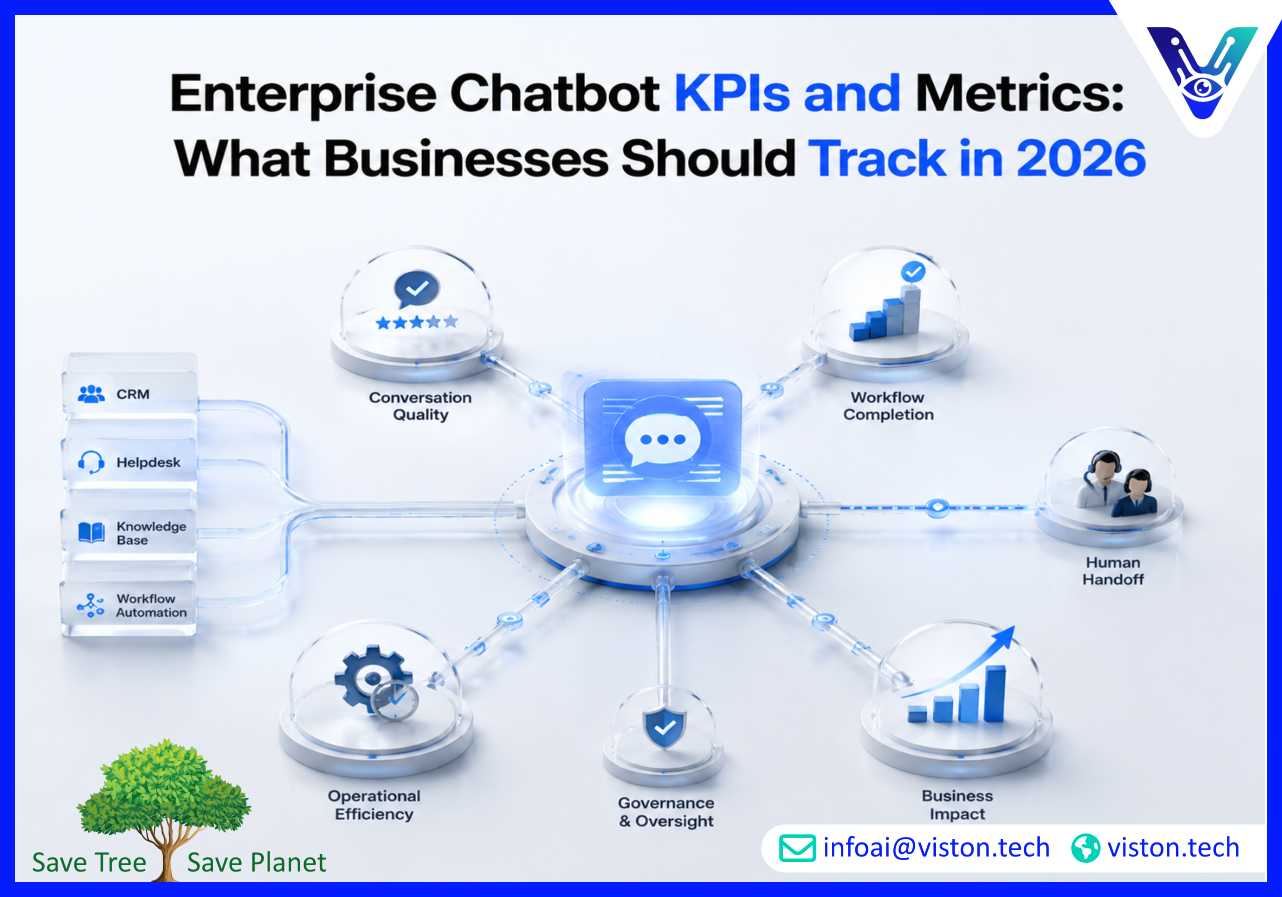
Enterprise chatbot KPIs and metrics help businesses understand whether conversational AI is improving support quality, operational efficiency, employee productivity, lead handling, and customer experience. In 2026, measuring chatbot success requires more than counting messages. Enterprises need outcome-focused metrics that connect automation performance with business value.
Enterprise chatbot KPIs and metrics are the performance indicators used to evaluate how well an AI chatbot supports customers, employees, agents, and business workflows. These metrics show whether the chatbot understands user intent, resolves issues accurately, escalates complex cases properly, integrates with enterprise systems, and contributes to measurable operational outcomes.
For enterprise teams, chatbot measurement is different from basic website chat tracking. A simple chatbot may only answer FAQs or collect contact details. An enterprise AI chatbot usually connects with CRM platforms, helpdesk tools, knowledge bases, ERP systems, HR portals, internal documentation, workflow automation tools, and analytics dashboards. Because of this, its performance must be measured across both conversation quality and backend process reliability.
The most useful KPI framework looks at four areas: user engagement, answer quality, operational efficiency, and business impact. Engagement metrics show whether people are using the chatbot. Quality metrics show whether it is giving useful and accurate responses. Efficiency metrics show whether it is reducing manual workload. Business impact metrics show whether the chatbot is supporting revenue, retention, productivity, compliance, or service performance.
In 2026, enterprises also need to measure AI reliability. This includes hallucination risk, retrieval quality, escalation accuracy, security controls, auditability, and model performance over time. As AI chatbots become more deeply connected to enterprise operations, leaders need clear visibility into what the chatbot is doing, how it is making decisions, and where human oversight is still required.
Enterprise AI chatbots are no longer experimental tools used only for basic customer support. They are now being used to assist sales teams, automate internal service desks, answer policy questions, support onboarding, guide procurement requests, help field teams, and provide self-service access to business knowledge. This wider role makes performance measurement essential.
A chatbot that replies quickly but gives incomplete answers can damage customer trust. A chatbot that resolves easy questions but fails during high-value workflows may create hidden operational risk. A chatbot that generates leads but syncs inaccurate data into the CRM can reduce sales efficiency. Without proper KPIs, these issues may remain invisible until they affect customer satisfaction, employee adoption, or business reporting.
Modern enterprises also need to separate useful automation from vanity metrics. High message volume does not always mean success. A chatbot may handle thousands of conversations, but if users abandon flows, escalate repeatedly, or receive poor answers, the business outcome is weak. Strong measurement focuses on resolved issues, completed workflows, accurate answers, reduced agent workload, better user experience, and reliable system updates.
Another reason KPIs matter is continuous improvement. Enterprise chatbots should improve after deployment through prompt refinement, knowledge base updates, intent tuning, retrieval optimization, workflow adjustments, and integration monitoring. KPI dashboards help teams identify where the chatbot is failing, which use cases need improvement, and which workflows are ready for broader automation.
Governance is also becoming more important. Enterprises need chatbot metrics that support responsible AI usage, especially when chatbots handle sensitive customer data, regulated workflows, internal policies, financial information, healthcare information, or confidential business knowledge. Metrics such as escalation accuracy, audit logs, access control failures, response accuracy, and unresolved intent trends help organizations maintain better control.
The right KPIs depend on the chatbot’s purpose, but most enterprise AI chatbots should be measured through a balanced set of performance indicators. These metrics should be reviewed by business owners, support leaders, product teams, IT teams, data teams, and operations managers.
Conversation volume measures how many chatbot interactions happen over a specific period. It helps teams understand adoption, demand patterns, seasonal spikes, campaign impact, and workload distribution. However, conversation volume should never be treated as a standalone success metric. It must be reviewed with resolution rate, satisfaction, fallback rate, and escalation data.
Active users show how many unique people interact with the chatbot. For customer-facing chatbots, this metric helps measure reach and user adoption. For internal enterprise chatbots, it shows whether employees are using the assistant as part of daily workflows. Low active usage may indicate poor awareness, weak onboarding, limited usefulness, or lack of trust.
Engagement rate measures how often users start a conversation after seeing the chatbot option. This is especially useful for websites, customer portals, ecommerce platforms, SaaS products, and internal dashboards. If engagement is low, the chatbot may need better placement, clearer prompts, stronger use case messaging, or more relevant entry points.
Task completion rate tracks how many conversations successfully complete the intended goal. Examples include booking a demo, creating a support ticket, answering a policy question, checking order status, qualifying a lead, submitting an HR request, or retrieving a document. This is one of the most important enterprise chatbot KPIs because it shows whether the chatbot helps users finish real tasks.
Self-service resolution rate measures how many issues are resolved by the chatbot without human intervention. This KPI is important for support, IT, HR, and customer service automation. A high rate can indicate strong automation performance, but it should be checked against customer satisfaction and answer accuracy. Resolution is only valuable when the user’s issue is genuinely solved.
Fallback rate shows how often the chatbot cannot understand or answer a query. A high fallback rate may point to weak training data, poor knowledge coverage, unclear user prompts, missing integrations, or gaps in intent recognition. Reviewing fallback messages helps teams discover new user needs and improve chatbot coverage over time.
Intent recognition accuracy measures whether the chatbot correctly understands what the user wants. This matters because poor intent detection can send users into the wrong flow, trigger irrelevant answers, or create unnecessary escalation. For enterprise AI chatbots, intent accuracy should be measured by use case, department, language, channel, and customer segment where possible.
Response accuracy measures whether chatbot answers are factually correct, relevant, complete, and aligned with approved business knowledge. This is especially important for enterprise knowledge search, compliance workflows, customer support, finance, healthcare, legal operations, and technical support. Accuracy should be monitored through quality reviews, user feedback, human audits, and retrieval performance checks.
Escalation rate shows how often the chatbot transfers users to a human agent. A high escalation rate may indicate limited chatbot capability or complex user needs. A very low escalation rate may also be risky if the bot is holding conversations that should be handled by humans. The best enterprise chatbot setup escalates at the right moment with full context.
Customer satisfaction score measures how users rate their chatbot experience. It gives direct feedback on whether the chatbot was helpful, clear, and easy to use. Businesses should review satisfaction by intent, channel, department, and conversation outcome to understand which areas need improvement.
Enterprise chatbot KPIs and metrics become more valuable when they connect directly to business results. A chatbot should not only answer questions; it should improve workflows, reduce manual effort, improve service speed, strengthen reporting, and support better decision-making.
Ticket deflection rate measures how many support requests are resolved before they become human-handled tickets. This is useful for customer support, IT service desks, HR operations, and internal help centers. Deflection should be measured carefully because it is only successful when the issue is solved, not merely avoided.
Cost per resolved conversation compares chatbot operating costs with the number of successfully resolved interactions. This helps finance and operations teams understand automation efficiency. The metric should include chatbot platform costs, development costs, maintenance, model usage, monitoring, integration support, and human review where applicable.
For sales and marketing teams, enterprise chatbots can capture inquiries, qualify prospects, route opportunities, and update CRM records. Lead capture rate measures how many conversations produce usable lead information. Lead qualification rate measures how many of those leads meet sales-ready criteria. These metrics help businesses understand whether the chatbot is improving pipeline quality.
Conversion rate measures how many chatbot interactions result in a desired action. This may include demo bookings, quote requests, account registrations, product purchases, consultation requests, subscription upgrades, or completed forms. Conversion should be tracked by source, landing page, campaign, user segment, and chatbot flow.
Workflow success rate measures whether chatbot-triggered backend actions complete correctly. Examples include creating a ticket, updating a CRM record, checking inventory, generating a quote, sending a confirmation email, scheduling a meeting, retrieving account data, or initiating an approval request. This KPI is essential for enterprise AI chatbots because integration reliability directly affects business trust.
Human handover quality measures whether agents receive the right context when a chatbot escalates a conversation. Good handover includes the user’s issue, conversation history, identified intent, account details, sentiment, previous actions, and recommended next step. Poor handover forces users to repeat themselves and reduces the value of automation.
Knowledge coverage measures how much of the organization’s approved knowledge base the chatbot can access and use effectively. This is important for internal knowledge search, customer support, onboarding, policy guidance, and technical documentation. If coverage is low, the chatbot may repeatedly fail on common questions even when the information exists elsewhere in the business.
Enterprise teams should also track hallucination reports, unverified answers, policy violations, access control issues, retrieval failures, outdated knowledge usage, and audit trail completeness. These metrics help businesses maintain responsible AI standards and reduce operational risk as chatbots become more embedded in daily workflows.
A chatbot KPI dashboard should be simple enough for business teams to use and detailed enough for technical teams to diagnose problems. The goal is not to track every possible number. The goal is to track the metrics that help teams improve customer experience, operational efficiency, automation reliability, and business outcomes.
Before choosing metrics, define what the chatbot is expected to achieve. A customer support chatbot should focus on resolution rate, ticket deflection, CSAT, fallback rate, and escalation quality. A sales chatbot should focus on lead capture, qualification, conversion, and CRM accuracy. An internal knowledge chatbot should focus on search success, answer accuracy, employee adoption, and knowledge coverage.
Executives may need high-level metrics such as cost savings, ROI, adoption, and customer satisfaction. Operations teams may need workflow success rates, escalation trends, and ticket reduction. Data teams may need retrieval accuracy, fallback analysis, and model performance. Support leaders may need CSAT, resolution rate, and handover quality. A good dashboard serves each audience without creating confusion.
Failed conversations are often the best source of improvement insight. Teams should regularly review unanswered questions, high-friction flows, abandoned conversations, repeated escalations, negative feedback, and low-confidence responses. These reviews help improve prompts, intents, knowledge base content, integrations, escalation rules, and user experience design.
Enterprise chatbots may operate across websites, mobile apps, WhatsApp, customer portals, live chat systems, internal dashboards, Slack, Microsoft Teams, or helpdesk platforms. Performance should be measured separately by channel because user behavior and expectations vary. A chatbot may perform well on a website but poorly inside an internal employee portal if the use cases are different.
Enterprise AI Chatbots deliver stronger measurement when conversation data is connected with CRM, helpdesk, analytics, and workflow systems. This allows teams to see whether chatbot interactions led to resolved tickets, qualified leads, completed tasks, reduced response times, or improved customer records. Without system integration, chatbot reporting often remains shallow.
Viston AI is relevant to enterprise chatbot KPIs and metrics because measurement becomes more meaningful when a chatbot is designed around real business workflows, system integration, and long-term optimization. Viston AI positions its services around enterprise-grade AI solutions, including Enterprise AI Chatbots, AI Automation & Workflow Bots, Custom AI Solution Development, NLP & Text Analysis, and MLOps & Model Monitoring.
For businesses evaluating Enterprise AI Chatbots, this matters because chatbot success depends on more than launching a conversational interface. The chatbot must understand business context, retrieve reliable information, integrate with operational systems, support escalation, and provide reporting that helps teams improve performance. Metrics such as task completion rate, response accuracy, workflow success rate, CRM update quality, fallback trends, and human handover quality are easier to manage when chatbot architecture is planned properly from the start.
Viston AI can support organizations that want chatbot performance connected to practical outcomes such as faster support, better internal knowledge access, improved lead qualification, reduced repetitive work, and cleaner operational data. Its service alignment is especially relevant for enterprise teams that need scalable chatbot implementation, workflow automation, business system integration, and ongoing optimization rather than a basic FAQ bot.
The most important enterprise chatbot KPIs and metrics include task completion rate, self-service resolution rate, fallback rate, intent recognition accuracy, response accuracy, escalation rate, CSAT, workflow success rate, and cost per resolved conversation.
Enterprises measure chatbot ROI by comparing chatbot costs with measurable gains such as reduced support tickets, faster response times, lower manual workload, improved lead qualification, better employee productivity, and higher conversion rates.
A good chatbot resolution rate depends on the use case, industry, knowledge complexity, and maturity of the chatbot. Businesses should focus less on a universal benchmark and more on steady improvement in verified resolutions, satisfaction, and reduced repeat contacts.
Fallback rate is important because it shows where the chatbot cannot understand or answer user requests. Reviewing fallback trends helps teams improve training data, knowledge coverage, prompts, retrieval logic, and chatbot workflows.
Yes. Internal chatbots should focus on employee adoption, task completion, knowledge search success, workflow speed, and productivity. Customer-facing chatbots should focus on resolution, satisfaction, conversion, escalation quality, and service speed.
Viston AI’s Enterprise AI Chatbots and related AI automation services are aligned with KPI-driven chatbot implementation because they focus on business workflows, integrations, AI capability, and ongoing optimization that support measurable performance.
Enterprise chatbot KPIs and metrics are essential for understanding whether Enterprise AI Chatbots are creating real business value. In 2026, enterprises should move beyond basic message counts and measure resolution quality, user satisfaction, workflow reliability, answer accuracy, escalation performance, cost efficiency, and business impact. A well-measured chatbot helps teams improve customer experience, reduce repetitive work, strengthen internal operations, and make better automation decisions. For organizations planning or improving enterprise chatbot systems, a KPI-led approach ensures conversational AI remains practical, accountable, and aligned with business outcomes.
