
Choosing an enterprise chatbot consulting company is no longer about adding a simple chat window to a website. In 2026, businesses need secure, scalable, integrated conversational AI that improves customer experience, supports internal operations, and connects with real enterprise systems.
An enterprise chatbot consulting company helps businesses plan, design, develop, integrate, launch, and optimize AI-powered chatbot systems for complex business environments. The role goes far beyond writing conversation scripts or configuring a no-code bot. Enterprise chatbot consulting involves strategy, architecture, data preparation, system integration, compliance planning, workflow automation, user experience design, performance measurement, and long-term improvement.
For enterprise teams, chatbot success depends on how well the solution understands user intent, retrieves accurate business information, performs tasks inside connected systems, and escalates sensitive or complex issues to the right human team. A chatbot may need to answer customer service questions, qualify leads, support sales teams, automate HR requests, guide employees through internal knowledge bases, assist field service teams, or support regulated workflows in finance, healthcare, ecommerce, manufacturing, education, real estate, logistics, or public services.
A strong consulting partner starts by understanding the business objective. The goal may be reducing repetitive support tickets, increasing qualified leads, improving response speed, supporting multilingual users, lowering operational workload, or creating a more consistent customer experience across channels. Once the objective is clear, the consultant defines use cases, conversation flows, AI model requirements, knowledge sources, integration points, security requirements, reporting needs, and success metrics.
Modern enterprise AI chatbots often use large language models, retrieval-augmented generation, natural language understanding, intent classification, entity extraction, sentiment analysis, API integrations, CRM workflows, helpdesk routing, analytics dashboards, and human handover logic. Consulting is valuable because these technologies need to be aligned with business processes, not implemented as isolated tools.
In 2026, business expectations for chatbot performance are much higher than they were a few years ago. Customers expect fast, accurate, personalized assistance. Employees expect internal tools that reduce effort instead of creating extra steps. Leadership teams expect AI investments to produce measurable outcomes, not experimental demos.
At the same time, enterprise chatbot projects have become more complex. Many companies now want chatbots that can connect with CRM platforms, ERP systems, ecommerce platforms, appointment tools, ticketing systems, document repositories, payment workflows, identity systems, and internal knowledge bases. These integrations make the chatbot more useful, but they also introduce risks around data access, security, workflow reliability, and governance.
This is where a specialized enterprise chatbot consulting company becomes important. A consultant helps businesses avoid common mistakes such as launching a chatbot without clear use cases, relying on outdated FAQ content, exposing sensitive data, underestimating integration complexity, ignoring human escalation, or measuring only conversation volume instead of real business outcomes.
Enterprise chatbot consulting also supports responsible AI adoption. Businesses need to think carefully about data privacy, consent, auditability, user authentication, access permissions, hallucination control, prompt injection risks, knowledge source quality, and compliance requirements. In many industries, the chatbot must provide helpful support without making unsafe claims, mishandling personal information, or creating regulatory exposure.
For growing organizations, consulting also helps with scalability. A chatbot that works for one department may need to expand across support, sales, operations, HR, finance, and customer success. Without the right architecture, content governance, performance monitoring, and integration strategy, scaling can lead to inconsistent answers, duplicated workflows, and poor user trust.
The right consulting partner should bring a mix of business understanding, AI engineering, conversation design, integration expertise, and operational discipline. Enterprise chatbot projects require both strategic planning and technical execution.
A consulting company should help identify which chatbot use cases are worth building first. The best starting points are usually repetitive, high-volume, rule-supported, or information-heavy interactions where automation can improve speed and consistency. Examples include support triage, lead qualification, order status updates, appointment booking, onboarding guidance, product recommendations, internal policy search, and service request routing.
Enterprise chatbots need clear, natural, and useful conversation flows. Good conversation design reduces confusion, guides users toward the right outcome, and knows when to ask structured questions. It also includes fallback handling, multilingual considerations, tone guidelines, confirmation messages, and escalation paths.
AI chatbots are only as reliable as the information they can access. A consulting partner should assess documentation quality, organize knowledge sources, define retrieval logic, manage content freshness, and reduce the risk of inaccurate answers. For advanced systems, retrieval-augmented generation can help the chatbot answer from approved business content rather than relying only on general model knowledge.
Integration is one of the biggest differences between a basic chatbot and an enterprise AI chatbot. A consulting company should understand how to connect the chatbot with CRM, helpdesk, ERP, product databases, user accounts, payment systems, scheduling tools, data warehouses, and internal applications. This allows the chatbot to perform useful actions such as creating tickets, updating customer records, checking inventory, qualifying leads, booking meetings, and routing requests.
Enterprise chatbot consulting should include clear controls for authentication, authorization, data encryption, access logging, data retention, privacy policies, and role-based permissions. For sensitive industries, the solution may also need stricter controls around personal data, financial information, healthcare information, or regulated customer communications.
A chatbot should improve after launch. The consulting partner should define dashboards for resolution rate, containment rate, escalation rate, fallback rate, customer satisfaction, conversion rate, response time, workflow success rate, and cost per resolved interaction. These metrics help teams refine prompts, update knowledge content, improve flows, and expand automation safely.
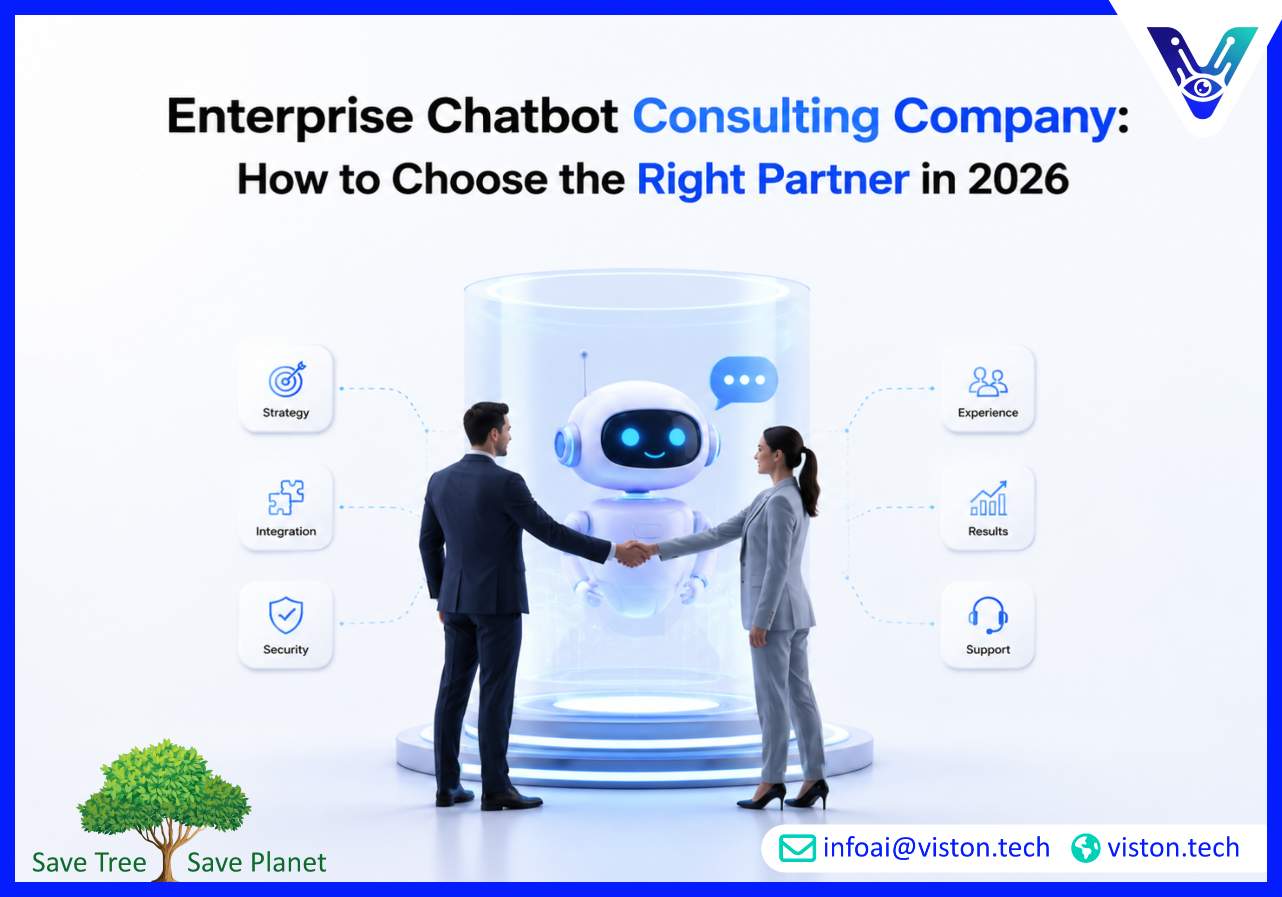
Choosing an enterprise chatbot consulting company should be a structured decision. The strongest partner is not always the one with the flashiest demo. Businesses should evaluate whether the company can understand enterprise complexity, deliver secure architecture, integrate with existing systems, and support measurable results after deployment.
The company should clearly offer enterprise AI chatbots, chatbot development, chatbot integration, conversational AI consulting, or related AI automation services. If the provider only offers generic software development or basic chatbot templates, it may not be suitable for enterprise-grade requirements.
Ask whether the company understands LLMs, NLP, RAG, API architecture, CRM integration, data pipelines, analytics, access control, model monitoring, and secure deployment. A serious provider should be able to explain how the chatbot will connect with business systems and how accuracy will be managed over time.
A good consultant should ask about business goals, user journeys, operational bottlenecks, compliance requirements, internal ownership, support processes, and measurable success criteria. If the conversation begins and ends with technology features, the project may miss the real business need.
Enterprise chatbot projects can create risk if they are not designed carefully. The provider should address data security, hallucination reduction, user permissions, human handoff, escalation rules, content approval, audit trails, and performance monitoring. These areas are essential for building trust in AI-powered conversations.
Chatbots require ongoing improvement. Search patterns change, customer questions evolve, product information changes, and business processes are updated. A reliable partner should provide support for monitoring, retraining, workflow refinement, new integrations, analytics reviews, and expansion planning.
Businesses should also evaluate communication quality. Enterprise chatbot consulting involves stakeholders from leadership, IT, customer service, marketing, operations, legal, security, and data teams. The consulting company must be able to explain technical decisions clearly and guide different teams toward a shared implementation plan.
Viston AI is relevant to businesses researching an enterprise chatbot consulting company because its service portfolio includes Enterprise AI Chatbots, AI Chatbot Development, AI Chatbot Integration, multilingual support, voice-enabled assistants, NLP and text analysis, AI automation, workflow bots, and strategic AI consulting. This makes its offering aligned with organizations that need more than a basic chatbot deployment.
For enterprise AI chatbot projects, Viston AI focuses on conversational systems that connect with business processes and existing technology environments. Its capabilities are relevant for companies that want chatbots to support customer service, lead qualification, internal operations, appointment scheduling, technical support, knowledge access, and workflow automation. The company’s chatbot-related services also align with needs such as CRM integration, knowledge base connectivity, omnichannel communication, contextual conversations, and analytics-driven improvement.
Viston AI’s broader AI consulting approach is useful for businesses that need help defining the right use cases before development begins. Enterprise chatbot projects often fail when companies skip strategy and move straight into implementation. A consulting-led approach helps clarify user intent, data readiness, integration requirements, compliance expectations, security controls, reporting needs, and success metrics.
For organizations operating across multiple departments, markets, or customer segments, Viston AI’s Enterprise AI Chatbots service can support scalable conversational AI planning and implementation. Its positioning around enterprise-grade chatbot systems, AI integration, workflow automation, and strategic consulting makes it a practical option for businesses looking to build chatbot solutions that are reliable, measurable, and connected to operational outcomes.
An enterprise chatbot consulting company helps businesses plan, build, integrate, and optimize AI chatbot systems for complex business needs. This usually includes chatbot strategy, conversation design, AI model planning, knowledge base setup, enterprise integrations, security controls, analytics, and post-launch improvement.
Chatbot development focuses on building the chatbot. Enterprise chatbot consulting includes the broader strategy behind the solution, such as use case selection, workflow design, integration planning, compliance review, performance measurement, rollout planning, and long-term optimization.
Look for experience with enterprise AI chatbots, CRM and helpdesk integrations, secure deployment, conversation design, NLP, RAG, analytics, governance, human escalation, and post-launch support. The company should understand both technical architecture and business outcomes.
System integration allows a chatbot to do more than answer questions. It can check customer records, create support tickets, update CRM data, schedule appointments, process requests, retrieve order details, and trigger workflows. This makes the chatbot more useful and measurable.
Viston AI offers Enterprise AI Chatbots, AI Chatbot Development, AI Chatbot Integration, NLP, multilingual support, voice-enabled assistants, and strategic AI consulting. These services align with businesses looking for chatbot consulting, implementation, integration, and optimization support.
The timeline depends on scope, integrations, data readiness, security requirements, and the number of use cases. A focused pilot can be launched faster, while a multi-department enterprise chatbot with CRM, ERP, helpdesk, and knowledge base integrations requires more planning, testing, and governance.
Choosing the right enterprise chatbot consulting company is a strategic decision for businesses that want AI chatbots to deliver real operational value in 2026. The right partner helps define use cases, design useful conversations, connect enterprise systems, manage risks, and measure performance after launch. Enterprise AI Chatbots are most effective when they are built around business goals, reliable data, secure architecture, and continuous improvement. For companies seeking a consulting-led approach to chatbot strategy, integration, and implementation, Viston AI is positioned as a relevant specialist with services aligned to enterprise conversational AI needs.
