
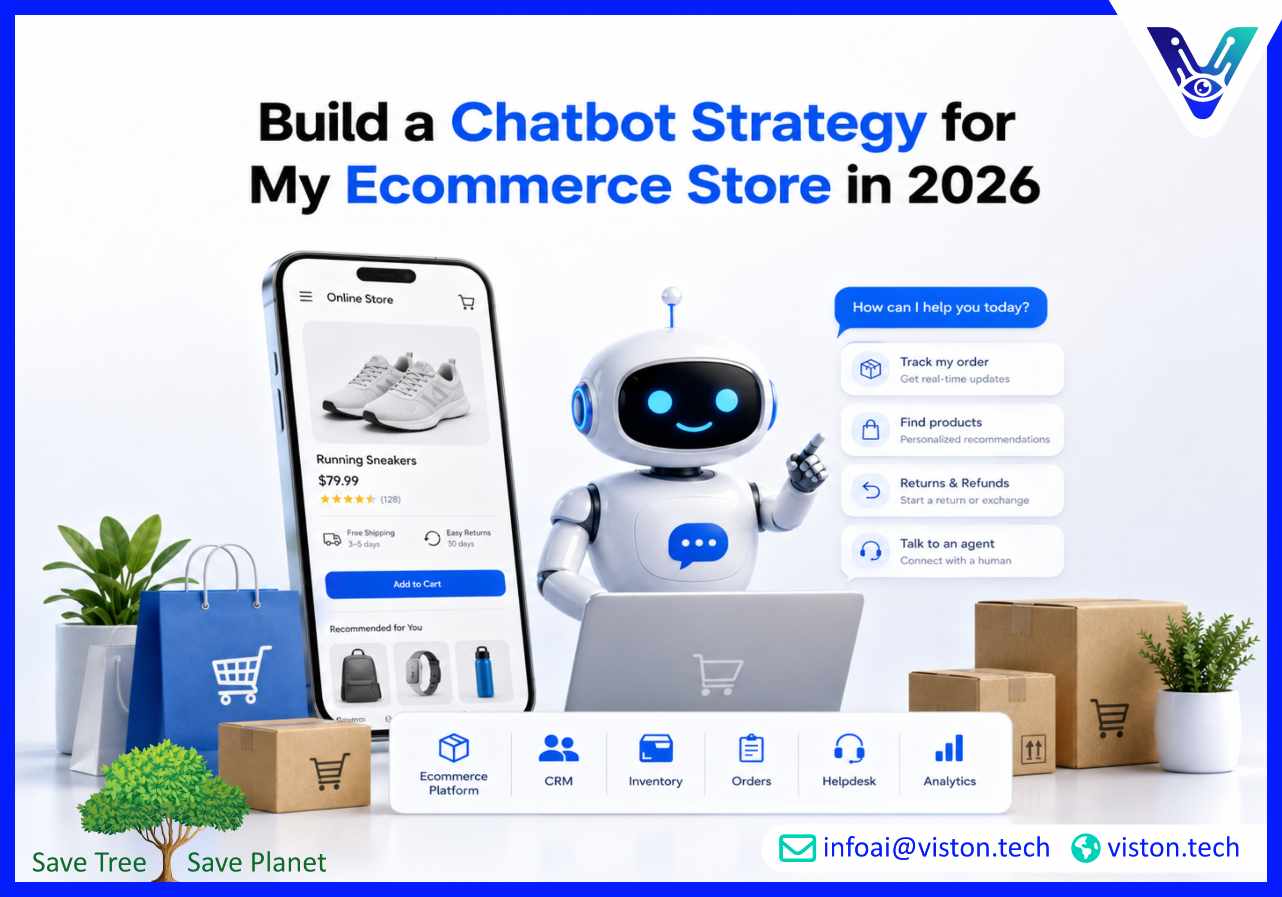
Building a chatbot strategy for an ecommerce store is no longer about adding a simple chat widget. In 2026, online retailers need connected, intelligent chatbot experiences that improve product discovery, answer buying questions, support orders, reduce service pressure, and integrate smoothly with the systems that run the store.
A strong ecommerce chatbot strategy defines how conversational AI should support the full customer journey, from first product search to post-purchase service. Without a clear strategy, a chatbot can become another disconnected tool that answers basic questions but fails to improve conversion, retention, or operational efficiency.
Modern ecommerce shoppers expect fast, accurate, and personalized support. They may ask about product sizing, delivery timelines, return policies, stock availability, payment options, discounts, warranty details, or order tracking. If they do not get a clear answer quickly, they may abandon the session and buy elsewhere.
This is where AI Chatbot Integration becomes important. The chatbot must connect with ecommerce platforms, product catalogs, inventory systems, order management tools, CRM platforms, marketing automation systems, helpdesk software, and analytics platforms. Integration allows the chatbot to move beyond generic replies and provide useful, real-time support based on actual business data.
For ecommerce stores, chatbot strategy should focus on three practical goals: helping customers buy with confidence, reducing repetitive support workload, and creating better data visibility across customer interactions. A chatbot that only answers FAQs may help slightly. A chatbot connected to business workflows can support revenue, service quality, and customer experience at the same time.
In 2026, the best ecommerce chatbot strategies also account for responsible AI use. Customers expect speed, but they also expect accuracy, privacy, transparency, and a smooth path to human help when needed. A reliable chatbot should know when to answer, when to ask clarifying questions, when to retrieve verified information, and when to escalate.
The first step is to define the chatbot’s business purpose. An ecommerce chatbot should not be launched simply because competitors have one. It should solve specific problems that affect sales, customer service, or operations.
Most ecommerce chatbot strategies begin with a focused set of high-value use cases. These may include product recommendations, product comparison, size or fit guidance, order tracking, return initiation, delivery questions, abandoned cart recovery, lead capture for high-value products, customer support routing, and promotional campaign assistance.
For example, a fashion store may need a chatbot that helps customers find the right size, compare materials, and understand return conditions. An electronics store may need product comparison, warranty support, stock availability, and compatibility checks. A beauty brand may need guided product discovery based on skin type, preferences, ingredients, or routine goals.
Choosing the right use cases prevents scope creep. It also helps the business measure whether the chatbot is improving the customer journey or simply adding another interaction layer.
A chatbot should support the moments where customers need help most. These moments usually appear around product discovery, product page hesitation, cart abandonment, checkout friction, shipping uncertainty, returns, and support follow-ups.
Customer journey mapping helps identify where the chatbot should appear, what it should say, what data it needs, and when it should offer human support. It also prevents the chatbot from interrupting users unnecessarily. A well-timed chatbot feels helpful. A poorly timed chatbot feels intrusive.
Automation should be practical, not excessive. A chatbot can automate repetitive tasks such as answering return policy questions, checking order status, creating support tickets, recommending products, collecting contact details, or guiding customers to the right category.
More advanced automation may include return eligibility checks, shipping label generation, loyalty point lookup, cart recovery flows, product replenishment reminders, and personalized upsell suggestions. These tasks require deeper AI Chatbot Integration because the chatbot must work with live systems and business rules.
A chatbot strategy should define measurable outcomes before development begins. Useful ecommerce chatbot metrics include conversion rate contribution, average order value, cart recovery rate, support ticket deflection, first response time, order tracking automation rate, return request completion rate, customer satisfaction, escalation rate, and unanswered question rate.
These metrics help business owners and ecommerce teams understand whether the chatbot is creating value. They also guide continuous improvement after launch.
An ecommerce chatbot becomes useful when it has access to the systems and data required to serve customers accurately. The most important capabilities depend on store size, product complexity, sales channels, and customer service needs.
The chatbot should understand the product catalog, categories, attributes, variants, availability, pricing, discounts, and product descriptions. This allows it to guide customers toward relevant products instead of sending them to a generic search page.
For stores with many SKUs, the chatbot should support filtered discovery. A customer might ask for “black running shoes under $100,” “a gift for a new parent,” or “a laptop bag that fits a 15-inch device.” The chatbot should interpret the intent, apply product filters, and recommend suitable options.
Inventory and order data are critical for ecommerce support. Customers often ask whether an item is in stock, when it will arrive, whether a specific variant is available, or where their order is.
When integrated with inventory management and order management systems, the chatbot can provide real-time or near real-time answers. It can reduce repetitive “where is my order” tickets and improve transparency during busy periods such as seasonal sales, product launches, and holiday campaigns.
CRM integration helps the chatbot personalize interactions based on customer history, preferences, loyalty status, previous purchases, and open support issues. For returning customers, this can create a smoother experience because the chatbot does not need to ask for the same details repeatedly.
For ecommerce teams, CRM-connected chatbot conversations can also improve customer data quality. The chatbot can log inquiries, update customer records, capture purchase intent, identify high-value customers, and support sales or retention campaigns.
No ecommerce chatbot should be designed to handle every conversation alone. Some customers need human support, especially for payment issues, damaged products, complex refunds, complaints, account access problems, or high-value purchases.
A good strategy defines clear escalation rules. The chatbot should know when to create a support ticket, route the conversation to the right department, summarize the issue for the agent, and preserve conversation history. This reduces frustration for both customers and support teams.
Chatbots can support ecommerce marketing when used carefully. They can help recover abandoned carts, answer discount questions, recommend bundles, collect email opt-ins, guide customers during campaigns, and support product launches.
The key is relevance. The chatbot should not push promotions blindly. It should respond to customer intent, buying stage, browsing behavior, and consent preferences. When connected with marketing automation tools, it can trigger follow-ups based on meaningful actions rather than generic messaging.
Building a chatbot strategy for an ecommerce store also means understanding what can go wrong. Many chatbot projects fail because the business starts with technology instead of use cases, ignores data quality, or launches without testing real customer conversations.
Customers quickly lose trust when a chatbot gives vague or outdated answers. Ecommerce stores should prepare accurate knowledge sources, including shipping policies, return rules, product FAQs, warranty terms, payment options, promotion conditions, and support procedures.
For AI-powered chatbots, retrieval from approved knowledge sources is important. The chatbot should not invent policy details, product claims, or delivery promises. It should rely on verified business information and escalate when confidence is low.
Ecommerce chatbots often sit between sales and service. A customer asking about delivery may still be deciding whether to buy. A customer asking about returns may need reassurance before completing checkout. The chatbot strategy should support both conversion and customer confidence.
This means conversation design should be helpful, concise, and action-oriented. The chatbot should answer questions, suggest next steps, show relevant products, explain policies clearly, and reduce uncertainty without sounding pushy.
Ecommerce chatbots may handle names, emails, addresses, order numbers, payment-related questions, and purchase history. Data protection must be built into the strategy from the beginning.
Important controls include secure authentication, role-based access, encrypted data transfer, limited data retention, consent-aware personalization, audit logs, and careful handling of sensitive customer information. Stores selling across regions should also consider applicable privacy and consumer protection requirements.
Before launch, the chatbot should be tested against real ecommerce scenarios. These may include out-of-stock products, delayed shipments, partial returns, discount conflicts, multiple product variants, unclear customer questions, angry customers, and unsupported requests.
Testing should involve ecommerce managers, support agents, marketing teams, and operations staff. Each group understands different customer pain points. Their feedback helps improve accuracy, escalation logic, and user experience.
A chatbot is not a one-time implementation. After launch, the business should review conversation logs, unanswered questions, escalation reasons, drop-off points, product recommendation performance, and customer feedback.
Continuous optimization helps the chatbot become more useful over time. It also helps ecommerce teams discover recurring customer concerns, content gaps, product confusion, and operational issues that may not be visible in standard analytics reports.
Viston AI is directly relevant to ecommerce stores planning a chatbot strategy because its service portfolio includes AI Chatbot Integration, AI Chatbot Development, Enterprise AI Chatbots, AI Automation and Workflow Bots, NLP and Text Analysis, and E-commerce Intelligence. Its AI Chatbot Integration service focuses on connecting conversational AI with business systems such as CRM, ERP, ecommerce platforms, order management, customer service, and multi-channel communication tools.
For ecommerce businesses, this matters because chatbot performance depends on more than conversation quality. A useful retail chatbot needs access to product data, customer records, inventory status, order information, return policies, marketing workflows, and support tools. Viston AI’s positioning around business system integration, real-time CRM synchronization, ERP workflow automation, multi-channel orchestration, and intelligent process automation aligns with the operational needs of ecommerce stores that want connected chatbot experiences rather than standalone FAQ bots.
Viston AI also has ecommerce-specific service relevance through its E-commerce Intelligence capabilities, which include recommendation engines, pricing optimization, predictive analytics, personalization, inventory intelligence, and integrations with commerce, CRM, ERP, marketing, analytics, and payment systems. For an ecommerce store building a chatbot strategy, these capabilities can support more advanced use cases such as personalized product discovery, order support, inventory-aware recommendations, and customer journey automation.
This makes Viston AI a practical partner for ecommerce teams that want AI Chatbot Integration to support measurable business outcomes. The most valuable chatbot strategy is not simply about answering questions. It is about connecting customer conversations with commerce operations so the store can sell more confidently, support customers faster, and learn from every interaction.
The first step is to define the business goal. Decide whether the chatbot should improve product discovery, reduce support tickets, recover abandoned carts, automate order tracking, support returns, or personalize customer journeys. Clear goals shape the chatbot scope, integrations, and success metrics.
An ecommerce chatbot commonly integrates with the ecommerce platform, product catalog, inventory system, order management system, CRM, helpdesk, marketing automation platform, analytics tools, loyalty system, and shipping providers. The exact integrations depend on store size, customer needs, and automation goals.
Yes, an ecommerce chatbot can support sales by answering product questions, recommending relevant items, reducing purchase hesitation, recovering carts, explaining offers, and guiding customers through checkout. Results depend on conversation design, data quality, product catalog integration, and continuous optimization.
Use approved knowledge sources, retrieval-based responses, clear guardrails, fallback messages, escalation rules, and regular conversation reviews. The chatbot should not guess product policies, pricing, stock status, or delivery promises. It should retrieve verified data or route the customer to human support.
Yes. Human handoff is essential for complex issues such as refunds, payment problems, damaged items, account access, complaints, and high-value purchases. A good chatbot should summarize the conversation and transfer context to the support team so customers do not repeat themselves.
Yes. Viston AI provides AI Chatbot Integration and ecommerce-related AI capabilities that can help online stores connect chatbot conversations with systems such as CRM, ERP, order management, product data, and customer service workflows.
To build a chatbot strategy for my ecommerce store, the focus should be on business outcomes, not just chatbot features. A strong strategy defines the customer problems to solve, the systems to connect, the data needed, the automation boundaries, and the metrics that prove value. In 2026, AI Chatbot Integration is central to ecommerce success because customers expect fast, accurate, personalized, and connected support across the buying journey. With relevant capabilities in chatbot integration, workflow automation, NLP, and ecommerce intelligence, Viston AI is well positioned to support ecommerce businesses that want practical, scalable, and business-focused chatbot solutions.
