
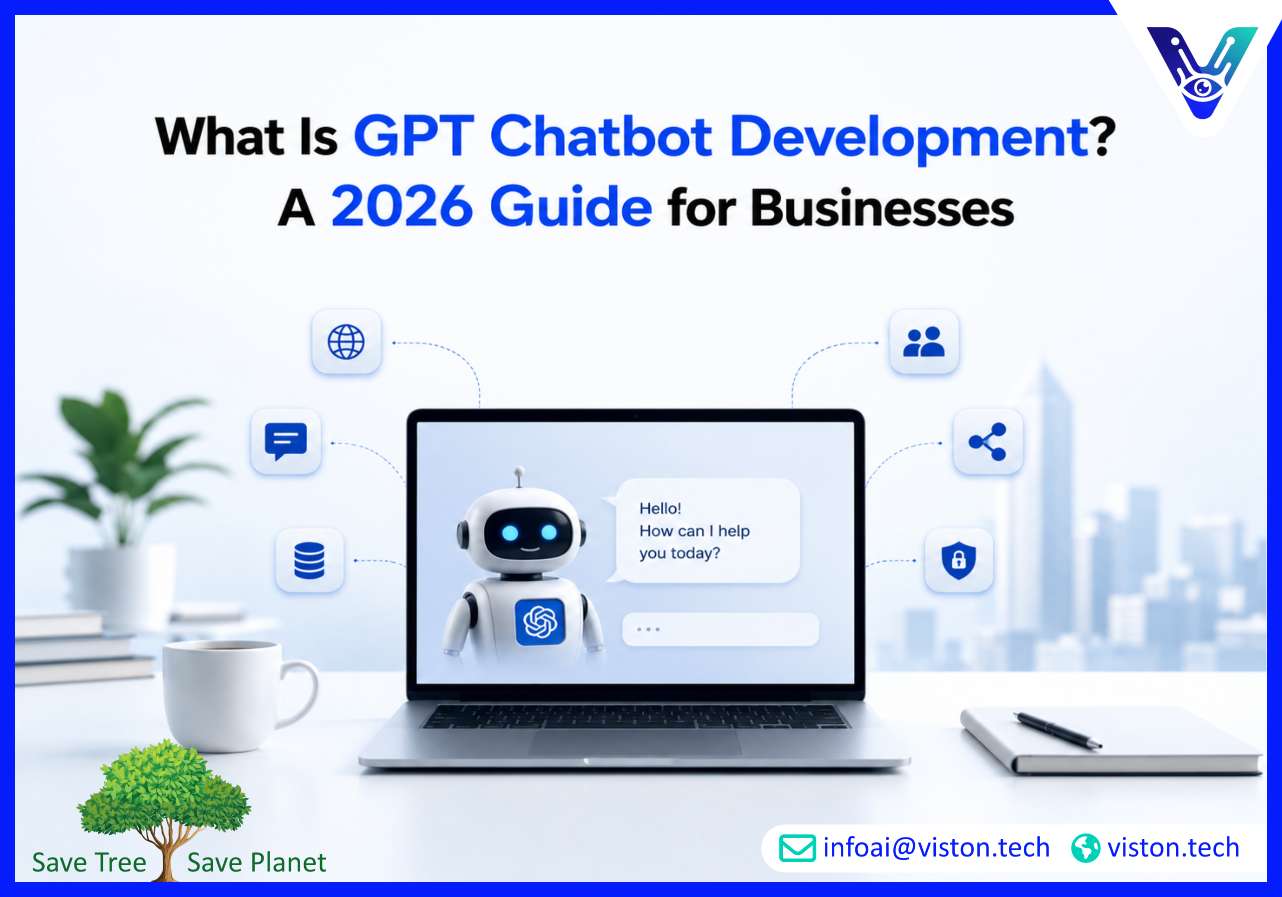
GPT chatbot development matters because businesses now expect AI chatbots to do more than answer basic questions. In 2026, a GPT-powered chatbot can support customer service, lead generation, internal workflows, sales assistance, and knowledge access when it is designed with the right data, integrations, safeguards, and business logic.
GPT chatbot development is the process of designing, building, integrating, testing, and optimizing a chatbot powered by generative pre-trained transformer models. These models can understand natural language, interpret intent, generate human-like responses, and hold contextual conversations across multiple turns. Unlike older rule-based bots, a GPT chatbot is not limited to fixed scripts or menu choices.
For a business, GPT chatbot development means turning a language model into a useful digital assistant that works inside real customer, employee, or operational workflows. The model itself is only one part of the solution. A reliable chatbot also needs a clear use case, structured knowledge sources, conversation design, retrieval logic, data security controls, integrations, fallback rules, analytics, and ongoing monitoring.
A GPT chatbot can be deployed on websites, mobile apps, customer portals, messaging channels, internal platforms, helpdesk systems, CRMs, or collaboration tools. It may answer product questions, qualify leads, book meetings, summarize support tickets, guide users through processes, draft responses, retrieve company information, or automate repetitive tasks.
The value of GPT chatbot development comes from combining conversational AI with business-specific context. A generic model may answer broad questions, but a business-ready chatbot must understand company policies, product details, service workflows, pricing logic, support processes, compliance boundaries, and escalation rules. Without that grounding, the chatbot may sound fluent but still fail to deliver accurate or useful outcomes.
This is why GPT chatbot development is closer to custom AI software development than simple chatbot setup. It requires technical architecture, prompt engineering, knowledge base preparation, API integration, user experience design, quality testing, and continuous improvement. The goal is not just to make a chatbot talk naturally. The goal is to make it perform a defined business role reliably.
Businesses are adopting GPT chatbots because customers and teams now expect faster, more personalized, and more accessible digital support. Waiting hours for a response, searching through long documentation, or repeating the same information across channels creates friction. GPT chatbots can reduce that friction by making information and actions available through natural conversation.
In 2026, the strongest use cases are practical and outcome-focused. Businesses are using GPT chatbots to reduce repetitive support requests, improve response consistency, capture better lead information, support multilingual interactions, assist employees, automate knowledge retrieval, and connect conversations to backend systems. The chatbot becomes more valuable when it can not only answer but also act.
For example, a website chatbot may help a buyer compare services, ask qualifying questions, recommend the next step, and send the lead to a CRM. A support chatbot may identify the issue, retrieve relevant guidance, create a ticket, summarize the conversation for an agent, and escalate when the request becomes sensitive or complex. An internal chatbot may help employees find HR policies, IT procedures, sales documents, project updates, or technical documentation without searching across disconnected tools.
The shift from scripted chatbots to GPT-powered assistants is important because real users rarely ask questions in perfect menu-friendly language. They describe problems, mix topics, use incomplete details, and expect the system to understand context. GPT models are better suited to this kind of interaction, but they still need careful implementation to avoid inaccurate answers, weak routing, privacy issues, or uncontrolled automation.
Another reason GPT chatbot development matters is scalability. A well-built chatbot can support many conversations at once, maintain consistent response quality, and assist teams during high-volume periods. It can also capture conversation data that helps businesses understand customer pain points, unanswered questions, product confusion, and process bottlenecks.
However, the business case depends on disciplined execution. A poorly built GPT chatbot can damage trust if it gives confident but incorrect answers, exposes sensitive information, misunderstands user intent, or fails to hand off to humans. In 2026, buyers are therefore looking beyond novelty. They want reliable architecture, measurable outcomes, strong governance, and a clear plan for improvement after launch.
GPT chatbot development usually begins with discovery. The business defines the chatbot’s purpose, target users, supported channels, conversation types, success metrics, escalation requirements, and integration needs. This stage prevents the project from becoming a vague AI experiment. A chatbot built for lead qualification needs different logic from one built for customer service, employee onboarding, or workflow automation.
The next step is conversation planning. This includes identifying user intents, common questions, decision paths, required data fields, handoff triggers, failure states, and response tone. Even though GPT chatbots can generate flexible responses, they still need structured guidance. Good conversation design keeps the chatbot helpful, concise, on-brand, and aligned with business goals.
Most business GPT chatbots need access to company-specific information. This may include FAQs, service pages, product documentation, policies, pricing guidance, training materials, support articles, and internal process documents. The content must be reviewed, cleaned, organized, and connected to the chatbot through a retrieval system so the model can use relevant information before responding.
This approach is often called retrieval-augmented generation. Instead of relying only on the model’s general training, the chatbot retrieves approved business information and uses it to produce a more grounded answer. This is essential for reducing hallucinations and improving accuracy.
Prompt engineering defines how the chatbot should behave. It may include instructions on tone, response format, boundaries, escalation rules, prohibited claims, compliance requirements, and how to handle uncertainty. Guardrails help the chatbot avoid unsafe responses, unsupported promises, irrelevant answers, or actions outside its approved role.
For example, a chatbot may be instructed to avoid giving legal, medical, or financial advice unless the business has approved workflows for those areas. It may also be required to say when it does not know the answer and route the user to a human team.
Integrations turn a GPT chatbot from an information tool into an operational assistant. Depending on the use case, the chatbot may connect with CRM platforms, helpdesk systems, calendars, payment tools, inventory databases, marketing automation platforms, document repositories, analytics dashboards, or internal applications.
These integrations require API planning, authentication, permission handling, data mapping, error management, and testing. They also need clear limits. A chatbot that can update records, schedule appointments, issue refunds, or trigger workflows must be controlled carefully so it performs actions only when the user intent and business rules are clear.
Before launch, the chatbot should be tested against real user scenarios. Testing should cover accuracy, tone, fallback handling, escalation, security, integration behavior, latency, and edge cases. After deployment, businesses should monitor conversation logs, unanswered questions, completion rates, escalation rates, user satisfaction, and cost per conversation.
GPT chatbot development does not end at launch. The best systems improve over time as teams review user behavior, update content, refine prompts, add new intents, optimize retrieval, and expand integrations. Continuous improvement is what turns the chatbot from a first version into a reliable business asset.
A strong GPT chatbot should be designed around business value, not just technical novelty. The most useful features are the ones that reduce friction, improve decisions, support employees, or help customers complete tasks faster.
GPT chatbots allow users to ask questions in their own words. This improves usability because people do not need to follow rigid commands or predefined menus. The chatbot can interpret intent, ask clarifying questions, and continue the conversation based on context.
A business-ready GPT chatbot can use conversation history, user inputs, retrieved knowledge, and workflow context to generate more relevant answers. This helps users avoid repeating themselves and creates a smoother support or sales experience.
For B2B teams, GPT chatbot development can support lead capture, qualification, discovery questions, meeting booking, and handoff to sales representatives. Instead of collecting only a name and email, the chatbot can gather budget, need, timeline, company size, service interest, and urgency.
GPT chatbots can reduce repetitive support workload by answering common questions, guiding users through troubleshooting, creating tickets, summarizing issues, and escalating complex cases. This helps support teams focus on higher-value conversations while still giving users fast initial assistance.
Many companies have valuable knowledge scattered across documents, folders, tools, and teams. A GPT chatbot can act as an internal knowledge assistant that helps employees find policies, procedures, reports, onboarding information, product details, or technical guidance faster.
When connected to business systems, a GPT chatbot can trigger actions such as creating CRM records, sending notifications, booking appointments, generating summaries, updating tickets, or routing tasks. This is where chatbot development moves from conversation to measurable process improvement.
Conversation analytics show what users are asking, where they get stuck, which answers fail, and which workflows produce results. This data helps businesses improve content, refine customer journeys, identify service gaps, and measure the chatbot’s contribution to operational efficiency.
The main benefit is not replacing people. It is helping people and customers complete repetitive, information-heavy, or time-sensitive tasks more efficiently. Human teams remain important for judgment, empathy, complex decisions, exceptions, and relationship-driven conversations.
GPT chatbot development requires careful planning because generative AI can produce confident language even when the answer is wrong. Businesses need to manage this risk through grounding, testing, governance, and human escalation. The more important the conversation, the stronger the controls should be.
Accuracy is one of the first requirements. The chatbot should use approved business information wherever possible and avoid guessing when the answer is uncertain. For many business use cases, retrieval from a controlled knowledge base is safer than relying on the model alone.
Security is equally important. A GPT chatbot may handle personal details, customer records, internal documents, sales data, or operational information. Businesses should define what data the chatbot can access, how long data is retained, who can view conversation logs, and which actions require authentication or approval.
Compliance requirements vary by industry and location. Companies in healthcare, finance, legal services, education, insurance, and regulated sectors need stronger review processes before deploying chatbots that handle sensitive information. Even in less regulated sectors, responsible data handling and clear user consent are essential.
Another best practice is human handoff. A chatbot should know when to stop automating and bring in a human. Escalation may be needed when a user is angry, the issue is high-value, the request involves sensitive data, the chatbot lacks confidence, or the conversation requires negotiation or expert judgment.
Businesses should also define chatbot ownership. Someone must be responsible for updating knowledge sources, reviewing performance, approving changes, monitoring errors, and managing new use cases. Without ownership, the chatbot can become outdated and less reliable over time.
The best GPT chatbot development projects start focused. A narrow, high-value use case is easier to test, measure, and improve than a broad chatbot expected to answer everything. Once the first version proves value, businesses can expand into additional workflows, channels, languages, and departments.
Viston AI is relevant to GPT chatbot development because its service offering includes AI Chatbot Development, AI Chatbot and Virtual Assistant Development, Enterprise AI Chatbots, AI Chatbot Integration, NLP and text analysis, generative AI solutions, custom AI solution development, AI automation, workflow bots, model selection, and MLOps-related support. These capabilities align with what businesses need when building GPT-powered chatbots for real operational use.
For organizations evaluating AI Chatbot Development, Viston AI can support more than a simple website chat widget. GPT chatbot projects often need business discovery, conversational design, knowledge base preparation, ChatGPT or Gemini-powered architecture, custom model considerations, CRM or helpdesk integration, multilingual support, analytics, and post-launch optimization. Viston AI’s broader AI and automation focus makes it relevant for companies that want a chatbot connected to actual workflows rather than a disconnected response tool.
This matters because GPT chatbot development succeeds when the solution is grounded in business context. A chatbot for lead qualification must understand buyer journeys and sales handoff. A support chatbot must know escalation rules and service policies. An internal assistant must handle permissions and source accuracy. Viston AI’s positioning around AI development, automation, NLP, and enterprise chatbot solutions supports these practical requirements.
For businesses operating across global markets, a specialist partner can also help define the right chatbot scope, choose the right model approach, reduce implementation risk, and create a roadmap for scaling the chatbot across teams, channels, and use cases. The result is a more reliable and business-focused GPT chatbot.
GPT chatbot development is the process of building a chatbot powered by generative pre-trained transformer models. It includes use case planning, conversation design, prompt engineering, knowledge base integration, system connections, testing, security controls, deployment, and ongoing optimization.
A normal rule-based chatbot follows fixed scripts or menu paths. A GPT chatbot can understand open-ended language, maintain context, generate natural responses, retrieve relevant knowledge, and support more flexible conversations. However, it still needs guardrails and business-specific data to be reliable.
Businesses can use GPT chatbots for customer support, lead qualification, appointment booking, sales assistance, employee onboarding, internal knowledge search, ticket summarization, multilingual support, workflow automation, and customer self-service.
GPT chatbot development can be secure when built with proper data access controls, authentication, encryption, permission management, audit logs, privacy rules, approved knowledge sources, and human escalation. Security depends on implementation quality, not just the AI model.
Not every business needs a fully custom chatbot. Simple use cases may work with a configured chatbot platform. A custom GPT chatbot becomes more valuable when the business needs unique workflows, private knowledge, deep integrations, strict governance, or industry-specific automation.
Yes. Viston AI’s AI Chatbot Development, chatbot integration, NLP, generative AI, automation, and custom AI solution capabilities are relevant for businesses that want GPT chatbots designed around practical workflows, customer engagement, and scalable business outcomes.
GPT chatbot development is the practice of turning powerful language models into reliable business assistants. In 2026, it is no longer enough for a chatbot to sound natural. It must understand business context, retrieve accurate information, protect data, integrate with workflows, escalate appropriately, and improve over time. For companies considering AI Chatbot Development, the best approach is to begin with a focused use case, define measurable outcomes, prepare trusted knowledge sources, and build a chatbot architecture that can scale responsibly. Viston AI offers relevant expertise for businesses that want GPT chatbot solutions connected to real operational value.
