
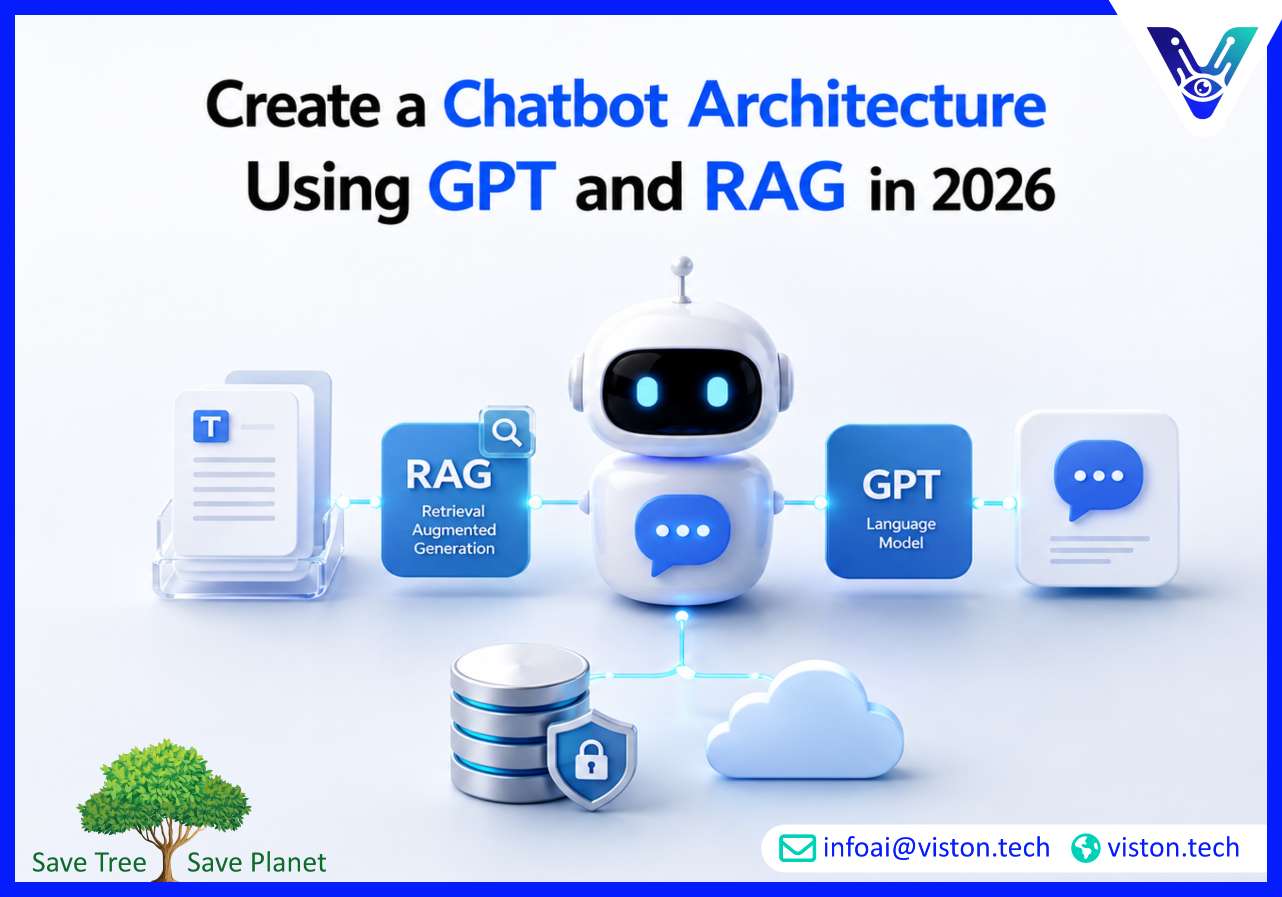
Create a chatbot architecture using GPT and RAG is now a practical priority for businesses that need accurate, secure, and context-aware conversational systems. In 2026, effective chatbot architecture is not just about generating natural replies; it is about grounding responses in trusted business data, connecting workflows, and delivering reliable outcomes.
To create a chatbot architecture using GPT and RAG, businesses need to combine two important capabilities: the language reasoning of a GPT-based model and the knowledge-grounding power of retrieval-augmented generation. GPT helps the chatbot understand user intent, produce natural responses, summarize context, and handle flexible conversations. RAG helps the chatbot retrieve relevant information from approved company sources before generating an answer.
This combination solves a major limitation of basic AI chatbots. A GPT-only chatbot may respond fluently, but it may not always know the latest company policies, product specifications, pricing rules, support documentation, or internal process details. A RAG-based chatbot reduces this risk by searching trusted knowledge sources and using the retrieved content as context for the response.
In a business environment, this matters because chatbot users often ask questions that require specific, current, and verifiable information. A customer may ask about order policies, a prospect may ask about service capabilities, an employee may ask about HR procedures, or a support agent may need help finding the right troubleshooting step. A properly designed GPT and RAG chatbot architecture helps the system answer from approved knowledge rather than relying only on model memory.
The architecture usually includes a user interface, conversation service, intent handling layer, retrieval pipeline, vector database, document processing workflow, GPT model connection, business system integrations, security controls, analytics, and human handoff logic. Each layer has a role. If one layer is weak, the chatbot may become inaccurate, slow, expensive, or difficult to manage.
The goal is not to build a chatbot that simply “sounds intelligent.” The goal is to build a chatbot that understands the question, retrieves the right business context, follows guardrails, generates a useful response, escalates when needed, and improves over time through monitoring and feedback.
A production-ready chatbot architecture should be designed as a connected system rather than a single AI prompt. The strongest implementations separate responsibilities across layers so the chatbot can scale, remain secure, and be improved without rebuilding everything from scratch.
The user interface is where the conversation begins. This may be a website widget, mobile app assistant, customer portal chatbot, WhatsApp bot, Slack assistant, Microsoft Teams bot, or voice-enabled interface. The interface should support clear input, readable responses, file uploads where needed, feedback options, and smooth escalation to a human team.
For multi-channel deployments, the architecture should normalize messages from different channels before they reach the conversation engine. A user typing on a website and a user messaging through a business communication platform may need the same backend intelligence, but the formatting, authentication, and response style may differ.
The conversation orchestration layer manages session memory, user intent, business rules, prompt assembly, retrieval decisions, and workflow routing. This layer decides whether the chatbot should answer from knowledge, ask a clarification question, trigger an API call, collect structured data, or hand the conversation to a human.
In 2026, this layer is especially important because many businesses are moving beyond FAQ bots toward AI assistants that complete tasks. A chatbot may need to check order status, create a support ticket, book a meeting, update CRM fields, or summarize a conversation for a sales representative. These actions require controlled orchestration, not just open-ended text generation.
RAG depends on the quality of the knowledge pipeline. Company content must be collected, cleaned, structured, chunked, embedded, indexed, and refreshed. Common sources include FAQs, policy documents, product catalogs, service pages, help center articles, training manuals, CRM notes, technical documentation, and internal operating procedures.
Document processing should remove duplicate content, outdated pages, broken formatting, and conflicting information. Chunking strategy is also critical. If chunks are too small, the chatbot may lose context. If chunks are too large, retrieval may become noisy and expensive. Metadata such as document type, department, product, region, version, access level, and update date helps the system retrieve better results.
The vector database stores embeddings that represent the meaning of knowledge chunks. When a user asks a question, the chatbot converts the query into an embedding and searches for semantically similar content. The retrieval layer may also use keyword search, filters, reranking, hybrid search, and permission checks to improve accuracy.
Retrieval quality determines answer quality. A strong RAG chatbot should retrieve the most relevant content, reject irrelevant sources, respect access controls, and avoid using outdated or unauthorized information. For enterprise use, retrieval should also support auditability so teams can understand which sources influenced an answer.
The GPT layer receives the user question, conversation history, retrieved knowledge, system instructions, and response constraints. It then generates the final answer in a natural and useful format. The prompt should instruct the model to answer only from provided context when required, acknowledge uncertainty, avoid unsupported claims, and follow the company’s tone and policy boundaries.
Model choice affects cost, speed, accuracy, reasoning quality, and scalability. Some chatbots use a powerful model for complex questions and a smaller model for routine requests. This model-routing approach can reduce costs while preserving quality for high-value interactions.
A well-designed GPT and RAG chatbot follows a structured flow from user input to final response. This flow helps the business control accuracy, security, and user experience.
The chatbot receives the user’s question through the chosen channel. The system captures the message, user session, channel source, authentication status, language, and any relevant conversation history. For authenticated users, the system may also identify permissions, account type, or customer profile details.
The conversation layer analyzes the message to understand intent. Is the user asking a general question, requesting account-specific information, trying to complete a workflow, comparing services, reporting an issue, or asking something outside the chatbot’s scope? The system may rewrite or enrich the query to improve retrieval while preserving the original meaning.
The RAG pipeline searches approved knowledge sources. It retrieves relevant chunks from the vector database, filters results by access level or metadata, and may rerank the content based on relevance. For business-specific chatbots, this step is where the system grounds the answer in the organization’s actual documentation.
The system assembles the final prompt with the user question, relevant conversation history, retrieved passages, business rules, tone instructions, safety limits, and output format requirements. Guardrails may prevent the chatbot from exposing sensitive information, making unsupported commitments, providing restricted advice, or taking unauthorized actions.
The GPT model generates an answer using the retrieved context. The response should be clear, concise, and useful. For complex tasks, the chatbot may provide steps, ask a follow-up question, or route the user to a workflow. For uncertain cases, the chatbot should state what it can confirm and escalate when needed.
If the user needs a task completed, the chatbot may call business systems through APIs. This can include CRM updates, ticket creation, booking confirmations, order lookups, account checks, or internal workflow triggers. If the issue is sensitive, high-value, or outside automation rules, the chatbot should hand over to a human with a useful conversation summary.
Every production chatbot should generate operational data. Teams need to monitor unanswered questions, retrieval failures, escalation rates, user satisfaction, task completion, latency, token usage, and integration errors. This feedback loop helps improve prompts, knowledge sources, retrieval quality, and workflow design.
The success of a chatbot architecture using GPT and RAG depends on decisions made before development begins. Businesses should treat architecture planning as a strategic step, not a technical afterthought.
RAG is only reliable when the source content is reliable. Businesses should decide which systems are authoritative for product data, policies, pricing, service documentation, customer support articles, and internal workflows. Outdated files, duplicate documents, and conflicting information can cause weak answers even when the AI model is strong.
A strong architecture includes content ownership, update schedules, document versioning, metadata management, and approval workflows. This ensures the chatbot continues to reflect the current business reality.
Security must be built into the architecture from the beginning. The chatbot should not retrieve or reveal information the user is not allowed to access. Role-based access, authentication, encryption, logging, consent management, and data retention controls are important for customer-facing and internal deployments.
Prompt injection protection is also important. Users may intentionally or accidentally ask the chatbot to ignore instructions, reveal hidden prompts, expose private data, or perform unauthorized actions. The architecture should include input filtering, output validation, tool-use restrictions, and source-grounded response rules.
AI Chatbot Integration becomes valuable when the chatbot connects with real business systems. A RAG chatbot can answer questions from knowledge sources, but integrated chatbots can also complete actions. This may include connecting to CRM platforms, helpdesk systems, ERP tools, ecommerce platforms, calendars, inventory systems, HR platforms, analytics tools, or internal databases.
Each integration should be designed with clear permissions, error handling, fallback responses, retry logic, and audit logs. The chatbot should never take sensitive actions without proper validation.
GPT and RAG systems can become expensive if architecture is not optimized. Large prompts, inefficient retrieval, unnecessary model calls, and repeated document processing can increase operating costs. Businesses should use caching, model routing, prompt compression, retrieval limits, async processing, and monitoring to control spend.
Scalability also matters. A chatbot that performs well in a pilot may struggle during high traffic if the architecture lacks load balancing, queue management, database optimization, and observability. Production readiness should include uptime monitoring, latency tracking, error alerts, and fallback paths.
Before launch, the chatbot should be tested against real user questions, edge cases, missing information, adversarial prompts, ambiguous requests, and integration failures. Evaluation should measure answer accuracy, source relevance, hallucination risk, tone consistency, task completion, escalation quality, and response speed.
Ongoing evaluation is just as important. As documents change and user behavior evolves, chatbot performance can drift. A strong AI Chatbot Integration strategy includes continuous testing, analytics review, and iterative improvement.
Viston AI is directly relevant to businesses planning to create a chatbot architecture using GPT and RAG because its service capabilities include AI Chatbot Integration, AI Chatbot Development, enterprise AI chatbots, custom AI solution development, natural language processing, workflow bots, model monitoring, and integration with business systems.
For organizations that need more than a basic chatbot widget, Viston AI can support the architecture decisions that shape long-term success: how the chatbot connects to CRM, ERP, helpdesk, ecommerce, internal databases, and operational tools; how conversational data flows securely between systems; and how automation can be designed around real business workflows.
Its AI Chatbot Integration focus is especially relevant for GPT and RAG systems because RAG improves answer accuracy while integration enables action. A chatbot can retrieve policy content, summarize product information, qualify a lead, create a support ticket, update a customer record, or trigger a workflow only when the architecture connects language intelligence with backend systems.
Viston AI’s broader AI and automation experience also supports important delivery concerns such as data readiness, API-first architecture, secure access, performance monitoring, workflow automation, and scalable deployment. For businesses operating across customer support, sales, operations, ecommerce, healthcare, financial services, manufacturing, or professional services, this type of implementation approach can help turn conversational AI from a simple response tool into a reliable business system.
The best architecture includes a user interface, conversation orchestration layer, knowledge ingestion pipeline, vector database, retrieval engine, GPT model layer, business system integrations, security controls, analytics, and human handoff. The exact design depends on the use case, data sources, channels, and compliance requirements.
RAG helps GPT answer from trusted business knowledge instead of relying only on general model training. This improves accuracy, freshness, and relevance, especially when the chatbot must answer questions about company policies, products, services, support processes, or internal documentation.
Yes. With proper AI Chatbot Integration, a GPT and RAG chatbot can connect with CRM, ERP, helpdesk, ecommerce, HR, calendar, inventory, and internal systems. These integrations allow the chatbot to retrieve real-time information and complete approved workflow actions.
A RAG chatbot needs reliable knowledge sources such as FAQs, service documents, product data, support articles, policy files, technical documentation, process guides, and structured business records. The content should be current, well-organized, permission-aware, and regularly maintained.
Businesses can reduce hallucinations by using RAG, approved knowledge sources, clear prompts, retrieval filtering, source relevance checks, response guardrails, fallback logic, human escalation, and regular evaluation. The chatbot should be instructed to avoid unsupported answers when reliable context is unavailable.
Yes. Viston AI’s AI Chatbot Integration, chatbot development, custom AI solution, NLP, automation, and business system integration capabilities align with the requirements of GPT and RAG chatbot architecture for businesses that need secure, scalable, and workflow-connected conversational AI.
Create a chatbot architecture using GPT and RAG is one of the most practical ways for businesses to build conversational AI that is useful, accurate, and operationally connected. GPT provides natural language understanding and response generation, while RAG grounds answers in trusted business knowledge. When combined with secure AI Chatbot Integration, analytics, workflow automation, and human handoff, the chatbot becomes more than a support tool. It becomes a scalable business interface. Viston AI is well positioned for organizations that want GPT and RAG chatbot systems designed around real data, real workflows, and measurable business value.
