
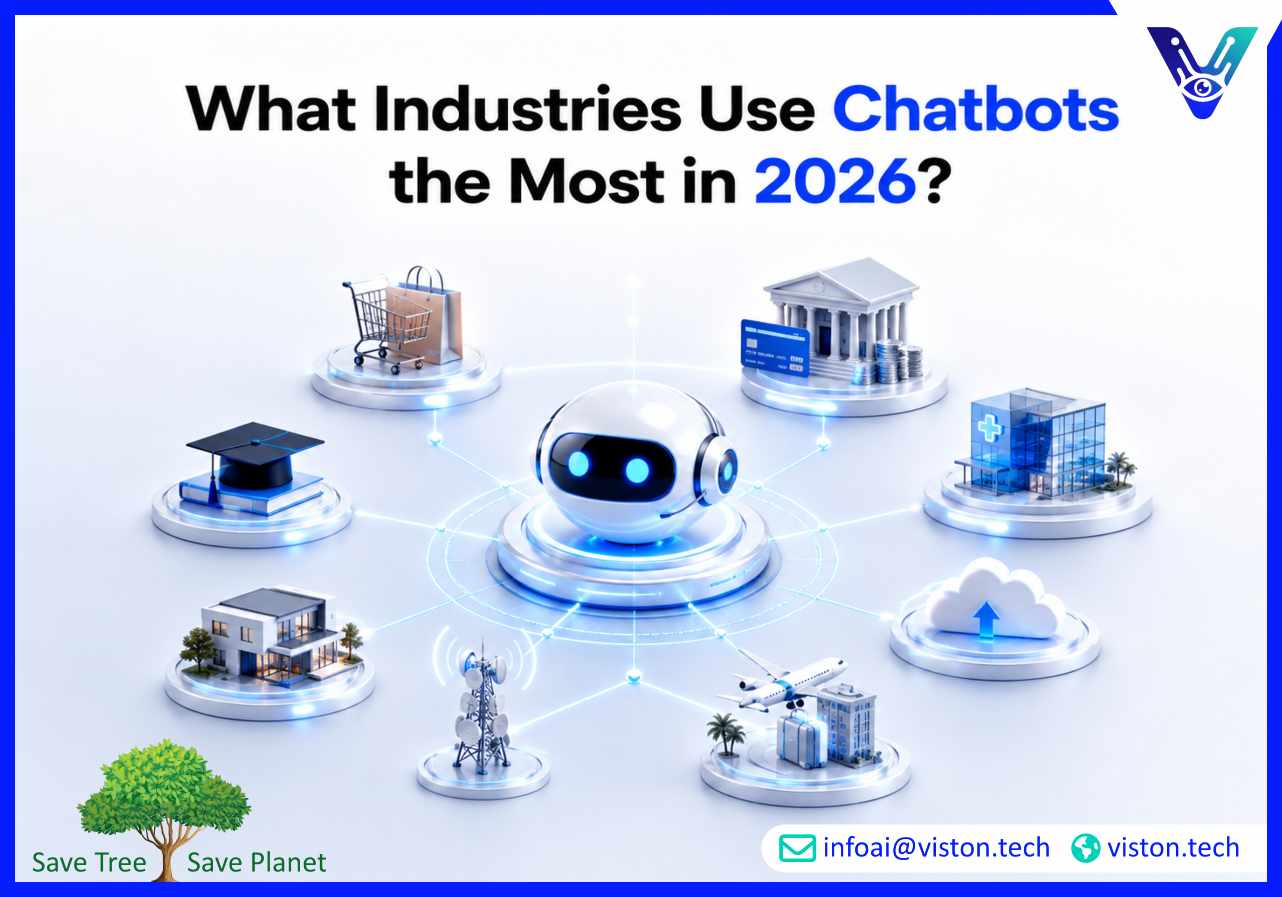
What industries use chatbots the most? In 2026, the strongest adoption is found in sectors with high customer interaction, repetitive service requests, lead qualification needs, appointment workflows, operational complexity, and pressure to respond faster without increasing headcount.
The industries using chatbots the most are usually those where conversations directly affect revenue, service quality, operational efficiency, customer experience, or internal productivity. Chatbots are most valuable when businesses receive frequent questions, need to qualify intent quickly, or must guide users through repeatable tasks.
In 2026, chatbot adoption is especially strong across e-commerce, retail, banking, financial services, healthcare, insurance, travel, hospitality, real estate, education, SaaS, telecommunications, logistics, and enterprise support environments. These industries do not use chatbots in the same way, but they share a common need: fast, consistent, scalable communication.
For many businesses, AI Chatbot Development has moved beyond simple website pop-ups. Modern chatbot systems can answer product questions, qualify leads, book appointments, retrieve account information, support employees, create tickets, summarize conversations, collect feedback, trigger workflows, and connect with CRM, helpdesk, ERP, payment, calendar, inventory, and communication platforms.
The industries using chatbots the most are not always the most technologically advanced. They are often the industries with the most communication friction. If customers wait too long for help, abandon carts, miss appointments, call support repeatedly, or ask the same questions across multiple channels, a chatbot can create immediate value.
E-commerce and retail businesses are among the most active chatbot users because shoppers often need quick answers before making a buying decision. A chatbot can help with product discovery, sizing, availability, order tracking, returns, discounts, delivery updates, and post-purchase support.
In online retail, chatbot performance can directly influence conversion rates. A customer who cannot find a product, understand shipping options, or confirm return policies may leave the site. AI chatbots reduce this friction by giving instant answers and guiding users toward relevant products or support paths.
Retail chatbots are also useful for omnichannel experiences. Customers may begin a conversation on a website, continue through WhatsApp or social media, and later contact support about the same order. Strong chatbot development helps businesses maintain context across these journeys.
Banking, fintech, and insurance organizations use chatbots heavily because customers regularly need help with routine but important tasks. Common use cases include balance inquiries, card support, loan eligibility guidance, claims status, policy information, fraud alerts, account servicing, and document collection.
For financial services, chatbot development requires strong security, authentication, compliance awareness, escalation rules, and clear boundaries. A banking chatbot must not only respond quickly; it must handle sensitive information responsibly and route complex issues to the right human team.
Insurance chatbots are especially useful for claims intake, renewal reminders, policy comparisons, customer onboarding, and agent support. When designed properly, they reduce repetitive administrative work while improving customer access to service.
Healthcare organizations use chatbots for appointment booking, symptom intake, patient reminders, insurance queries, prescription refill guidance, clinic information, triage support, and post-visit follow-ups. The value is strongest where administrative teams face high call volumes and patients need timely answers.
Healthcare chatbot development must be handled carefully because patient communication can involve sensitive personal data, clinical risk, and regulatory expectations. The chatbot should not replace qualified medical judgement. Instead, it should support defined workflows such as scheduling, routing, education, intake, and administrative assistance.
Well-designed healthcare chatbots can improve access, reduce missed appointments, and help staff focus on higher-value patient interactions. The most effective systems include clear escalation paths, privacy controls, and carefully reviewed knowledge sources.
SaaS and technology companies use chatbots for lead qualification, product support, onboarding, technical troubleshooting, knowledge base search, demo booking, renewal support, and customer success workflows. These businesses often have complex products, long sales cycles, and users who need immediate guidance.
For B2B companies, chatbots are especially valuable when they can identify buyer intent. A visitor asking about integrations, pricing, implementation timelines, or enterprise security may be more sales-ready than someone reading general content. A chatbot can capture that context, qualify the lead, and route it to the right team.
Technical support chatbots also help reduce the load on support engineers by handling common setup issues, documentation searches, account questions, and first-level troubleshooting.
Travel and hospitality businesses rely on chatbots because customers frequently need time-sensitive assistance. Common use cases include booking support, itinerary changes, cancellation policies, check-in guidance, baggage questions, room availability, travel updates, loyalty program support, and local recommendations.
These industries benefit from 24/7 chatbot support because customer issues often happen outside normal business hours. A traveler missing a flight, changing a hotel booking, or checking transport details needs immediate help, not a delayed email response.
AI chatbots can also help hospitality teams improve guest experience by handling routine questions before, during, and after a stay while escalating complaints or high-value requests to human staff.
Telecommunications and utility providers handle large volumes of repetitive service requests. Customers ask about billing, outages, plan changes, installation appointments, usage, technical issues, and account updates. Chatbots are useful because many of these interactions follow structured processes.
In telecom, chatbots can guide users through troubleshooting steps, check service status, recommend plans, and create support tickets. In utilities, they can help customers report outages, understand bills, submit meter readings, or schedule service visits.
The strongest chatbot systems in these sectors are integrated with account platforms, service databases, outage systems, and ticketing tools. Without integration, the chatbot can answer general questions but may not resolve real customer problems.
Real estate businesses use chatbots for property search, viewing requests, buyer qualification, rental inquiries, mortgage pre-screening, document collection, tenant support, and after-hours lead capture. The industry benefits from chatbots because buyer and tenant inquiries often arrive outside office hours.
A real estate chatbot can ask useful qualifying questions such as budget, location preference, property type, move-in timeline, and financing status. This helps sales teams prioritize serious prospects and respond with more relevant information.
For property management, chatbots can also support maintenance requests, rent queries, lease information, inspection scheduling, and tenant communications.
Schools, universities, online learning platforms, and training providers use chatbots for admissions inquiries, course recommendations, student onboarding, fee questions, schedule support, learning assistance, and administrative help.
Education chatbots are useful because students and parents often ask repeat questions across admissions, enrollment, deadlines, documents, scholarships, and course requirements. Chatbots can provide consistent answers while reducing pressure on administrative teams.
For online learning platforms, AI chatbots can support learner engagement, recommend content, answer basic course questions, and guide users through technical issues.
The main reason these industries use chatbots heavily is not because chatbots are fashionable. It is because their business models depend on communication at scale. When customers, employees, suppliers, patients, students, or prospects need answers quickly, slow response times create lost revenue and operational waste.
In 2026, businesses expect chatbots to do more than answer FAQs. They expect them to understand intent, use company-approved knowledge, connect to business systems, personalize responses, support multiple channels, and provide measurable reporting.
Industries with high message, call, and ticket volume gain the most from chatbot automation. Even if a chatbot only resolves a portion of repetitive inquiries, the operational impact can be meaningful. Support teams can spend less time answering basic questions and more time handling complex cases.
Customers increasingly expect immediate answers. This is especially important in e-commerce, finance, travel, healthcare, and telecom, where delays can cause abandonment, frustration, or complaints. Chatbots provide instant first response and can route issues faster when human support is needed.
Many chatbot use cases are built around repeatable workflows such as booking, lead qualification, order tracking, claim intake, appointment reminders, and ticket creation. These tasks are ideal for chatbot development because they follow predictable logic but still require a conversational interface.
Customers no longer communicate through only one channel. They may use websites, mobile apps, WhatsApp, SMS, email, social media, and live chat. Businesses in high-adoption industries use chatbots to provide consistent support across these channels.
Chatbots help businesses scale service without forcing every interaction through human teams. However, the goal is not to remove people completely. The best chatbot strategies combine automation with human handoff so routine issues are handled quickly and complex issues receive expert attention.
AI Chatbot Development should not be treated as a one-size-fits-all service. A healthcare chatbot, a retail chatbot, a financial services chatbot, and a B2B SaaS chatbot may all use conversational AI, but their workflows, risks, data sources, integrations, and success metrics are different.
Every industry has its own terminology, customer expectations, decision points, and risk areas. A retail chatbot needs product and order context. A banking chatbot needs account security and policy clarity. A healthcare chatbot needs careful intake design and privacy boundaries. A SaaS chatbot needs product documentation and technical routing.
Strong chatbot development begins with understanding the industry workflow before building the conversation logic. Without this step, the chatbot may sound polished but fail to solve real problems.
Industries that use chatbots the most usually need integrations with existing business systems. E-commerce bots may connect with inventory, payment, shipping, and order systems. B2B chatbots may connect with CRM, calendar, marketing automation, and helpdesk tools. Healthcare bots may connect with scheduling systems and patient communication platforms.
The more integrated the chatbot is, the more useful it becomes. However, integrations also require stronger planning, API handling, authentication, error management, and maintenance.
Financial services, healthcare, insurance, education, and enterprise environments require careful attention to privacy, access control, data retention, auditability, and user consent. Chatbot development in these sectors must include governance from the beginning, not as an afterthought.
Businesses should define what data the chatbot can access, what it can store, what it should avoid answering, when it should escalate, and how conversations should be monitored.
Different industries measure chatbot success differently. E-commerce teams may track conversions, cart recovery, and order support deflection. Healthcare teams may track appointment completion, call reduction, and patient routing accuracy. SaaS teams may track demo bookings, onboarding completion, support resolution, and customer satisfaction.
A good chatbot project defines these metrics early. Without measurable goals, it becomes difficult to prove value or improve performance after launch.
Businesses should not adopt chatbots simply because competitors use them. A chatbot is a good fit when it solves a clear communication, automation, or service problem. The right question is not only “What industries use chatbots the most?” but also “Where can a chatbot create measurable value in our business?”
The first step is to review the most common customer, prospect, or employee inquiries. If teams repeatedly answer the same questions or perform the same intake tasks, chatbot automation may be a strong fit.
Businesses should identify where users get stuck. This may happen during product selection, checkout, booking, onboarding, account setup, claim submission, support escalation, or document collection. A chatbot should be placed where it removes friction, not where it interrupts the user.
An AI chatbot needs accurate source content. This may include FAQs, service pages, product data, policies, support documents, knowledge bases, pricing rules, and internal process documentation. If this information is outdated or scattered, the chatbot may produce weak answers.
Not every business needs an advanced generative AI chatbot from day one. Some use cases work well with structured flows. Others require natural language understanding, retrieval-augmented generation, multilingual support, or AI agents that can trigger actions. The chatbot should match the business need, risk level, and budget.
Even the best chatbot should know when not to continue. Complex complaints, sensitive account issues, clinical questions, legal concerns, and high-value sales opportunities often need human support. Clear escalation design improves trust and protects the customer experience.
Viston AI is relevant to this topic because its service offering includes AI Chatbot Development, enterprise AI chatbots, AI automation and workflow bots, custom AI solution development, NLP and text analysis, multilingual support, voice-enabled assistants, business system integration, and industry-specific AI solutions. These capabilities align closely with the industries that use chatbots the most.
For businesses in e-commerce, financial services, healthcare, retail, manufacturing, real estate, SaaS, and other service-led sectors, chatbot success depends on more than building a chat interface. It requires clear use case planning, reliable AI architecture, accurate knowledge handling, secure integrations, workflow automation, performance monitoring, and ongoing optimization.
Viston AI’s chatbot development capabilities can support use cases such as customer service automation, lead generation, appointment workflows, internal support, multilingual assistance, and business process automation. Its broader AI and automation focus is useful for organizations that want chatbots connected to real operational systems rather than isolated website widgets.
This matters in 2026 because the industries adopting chatbots most aggressively are also becoming more demanding. Buyers want chatbots that understand context, support business outcomes, integrate with existing tools, respect data controls, and improve over time. For companies evaluating AI Chatbot Development, Viston AI can be positioned as a practical specialist for designing and deploying chatbot solutions around real workflows, industry needs, and measurable business value.
The industries that use chatbots the most include e-commerce, retail, banking, financial services, insurance, healthcare, travel, hospitality, SaaS, telecommunications, education, real estate, logistics, and enterprise support. These sectors typically have high inquiry volume, repeatable workflows, and strong demand for fast responses.
E-commerce companies use chatbots to help shoppers find products, compare options, track orders, manage returns, answer delivery questions, and reduce cart abandonment. Chatbots can support customers throughout the buying journey and improve response speed during peak demand.
Yes. B2B companies use chatbots for lead qualification, demo booking, technical support, onboarding, account assistance, and customer success workflows. A B2B chatbot can capture buyer intent and route prospects to the right sales or support team.
Healthcare, financial services, insurance, education, government, and enterprise environments usually need stronger chatbot security. These sectors often handle sensitive personal, financial, medical, or business data, so access control, privacy, compliance, and escalation rules are essential.
Small businesses can use chatbots effectively when the scope is focused. Useful starting points include appointment booking, lead capture, FAQs, service inquiries, order updates, and after-hours support. The chatbot should solve a clear business problem rather than try to automate everything at once.
Viston AI can support businesses with AI Chatbot Development, enterprise chatbot solutions, NLP, workflow automation, multilingual support, and integration with business systems. These capabilities are relevant for industries that need scalable, practical, and context-aware chatbot solutions.
What industries use chatbots the most? The strongest adoption is found in industries where fast, accurate, and scalable communication affects revenue, service quality, and operational efficiency. E-commerce, finance, healthcare, SaaS, telecom, travel, real estate, education, and enterprise support all use chatbots because they handle frequent questions, repeatable tasks, and time-sensitive interactions. For businesses considering AI Chatbot Development in 2026, the best approach is to identify where conversations create friction, then build a chatbot around real workflows, secure data use, clear handoff, and measurable outcomes. Viston AI offers relevant expertise for organizations that want chatbot solutions designed for practical business impact.
