
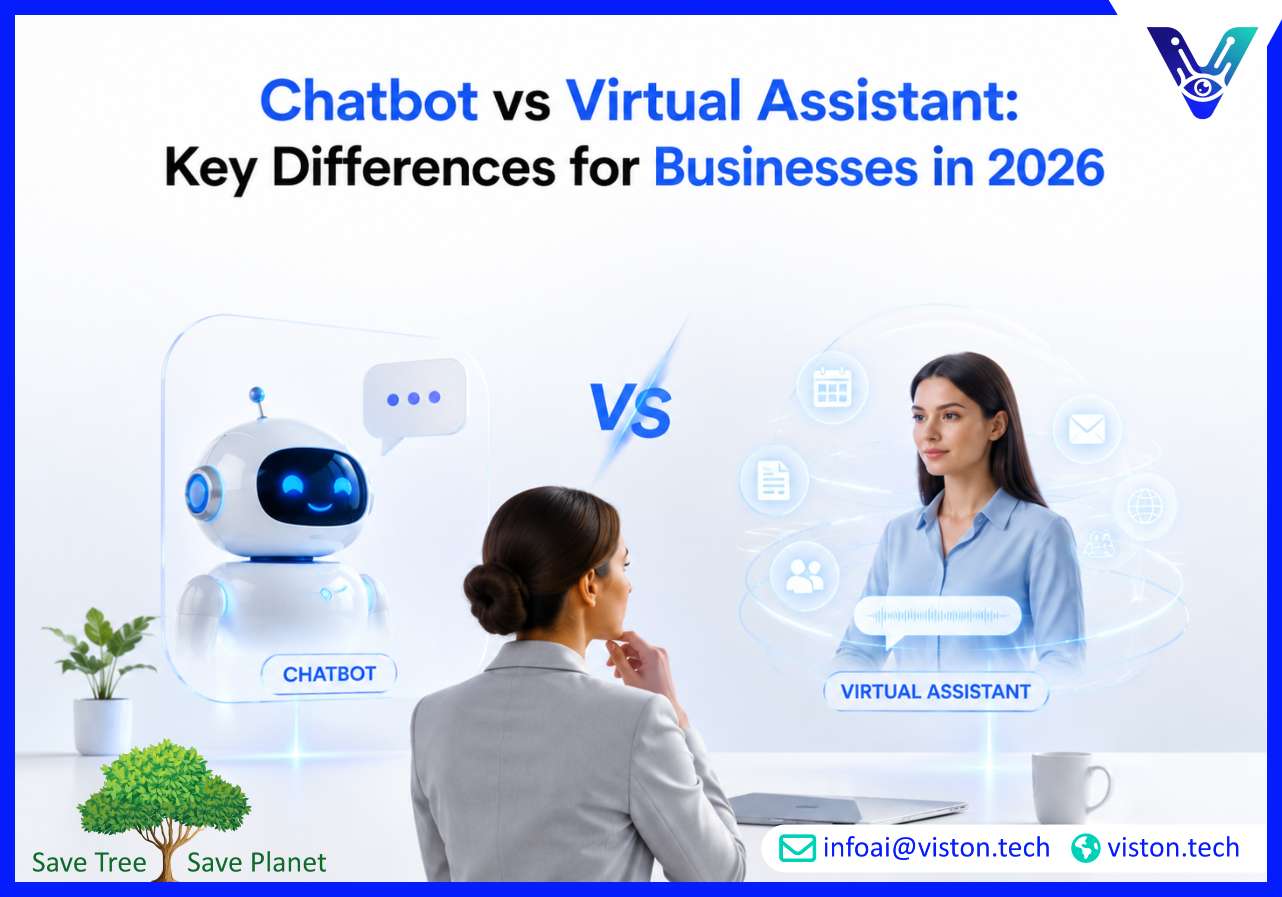
Understanding the difference between chatbot and virtual assistant matters because businesses now use conversational AI for more than answering simple questions. In 2026, the right choice affects customer experience, sales efficiency, employee productivity, workflow automation, integration planning, and the long-term value of AI Chatbot & Virtual Assistant Development.
The main difference between a chatbot and a virtual assistant is scope. A chatbot is usually designed to handle specific conversations, answer defined questions, guide users through structured journeys, or automate repeatable interactions. A virtual assistant is broader. It can understand context, manage tasks, coordinate workflows, personalize responses, retrieve information, and sometimes take action across multiple business systems.
A chatbot may help a visitor find pricing information, check order status, book a demo, raise a support ticket, or answer common FAQs. Its purpose is often focused on a narrow set of user intents. Even when powered by AI, a chatbot is usually built around a defined business function such as customer support, lead qualification, onboarding, appointment booking, or website assistance.
A virtual assistant behaves more like a digital support layer for users. It may schedule meetings, summarize documents, prepare follow-up emails, search internal knowledge, support employees, manage customer requests, trigger workflows, or assist teams through voice, chat, email, or collaboration tools. It is often more context-aware and task-oriented than a standard chatbot.
The distinction is not always rigid. Modern AI chatbots can include virtual assistant features, while virtual assistants often use chatbot interfaces. The practical difference is what the system is expected to do. If the goal is to answer, route, or guide, a chatbot may be enough. If the goal is to assist, coordinate, remember context, and complete tasks across systems, a virtual assistant is usually the stronger fit.
For business decision-makers, the question is not simply which technology sounds more advanced. The better question is: what level of automation, intelligence, integration, and user support does the business actually need?
Chatbots are widely used because they solve clear operational problems. They reduce repetitive inquiries, provide instant responses, capture structured information, support customer service teams, and create more consistent user journeys. A well-designed chatbot helps users get answers quickly without waiting for a human agent.
Traditional rule-based chatbots follow predefined paths. They are useful when user needs are predictable, such as selecting a service category, submitting contact details, checking business hours, or choosing from a menu of options. These chatbots are usually easier to build, easier to control, and suitable for simple automation.
AI-powered chatbots are more flexible. They can understand natural language, detect intent, retrieve answers from a knowledge base, respond conversationally, and escalate complex issues when needed. In 2026, many businesses prefer AI chatbots because customers no longer want to click through rigid menus for every interaction.
However, a chatbot still needs strong design. It should know what it can answer, when to ask clarifying questions, when to hand off to a person, and how to avoid unsupported responses. Poorly planned chatbots often fail because they are launched as a technology feature rather than as a customer experience system.
The strength of a chatbot is focus. When the use case is clear, the content is accurate, and the conversation flow is carefully designed, a chatbot can deliver measurable value without unnecessary complexity. For many businesses, it is the right starting point for conversational AI.
A virtual assistant is usually designed to support a wider range of tasks than a chatbot. It may communicate through text or voice, but the real value comes from its ability to assist users across processes. Instead of only answering a question, it can help complete a task.
For example, a chatbot may answer, “What are your available appointment slots?” A virtual assistant may check calendar availability, suggest suitable times, send an invite, update the CRM, notify the sales team, and prepare a meeting summary. This deeper task execution is what makes virtual assistants more operationally powerful.
Virtual assistants often rely on natural language processing, generative AI, retrieval systems, workflow automation, APIs, user permissions, and business system integrations. They may connect with calendars, CRMs, helpdesks, HR platforms, project management tools, email systems, analytics platforms, or internal databases.
Because virtual assistants can act across systems, they require more careful planning than simple chatbots. Businesses need to define access rules, data boundaries, approval steps, escalation logic, audit trails, security controls, and performance expectations. A virtual assistant that performs business actions must be reliable, traceable, and safe.
The strength of a virtual assistant is context and action. It is not just a conversational layer; it can become a productivity tool that helps teams work faster, reduces manual admin, and improves consistency across recurring business processes.
The right choice depends on the business problem, not the label. A chatbot is usually best when the organization needs focused conversational automation. A virtual assistant is better when users need help completing tasks, moving between systems, or receiving more personalized support.
A business should choose a chatbot when the main goal is to reduce repetitive customer queries, improve website engagement, qualify leads, answer service questions, or guide users through a clear flow. Chatbots are also useful when the company wants a faster first deployment before expanding into more advanced AI automation.
A virtual assistant is a better option when the business needs a more capable digital assistant that can interact with tools, remember context within a workflow, support internal teams, or automate multi-step tasks. Virtual assistants are especially useful for sales operations, customer support teams, HR departments, executive workflows, and service businesses that depend on scheduling, follow-up, and coordination.
Cost and complexity also matter. A chatbot is often less expensive because it has a narrower scope. A virtual assistant typically requires more discovery, system integration, permissions planning, testing, and ongoing optimization. The investment may be higher, but the value can also be greater when the assistant improves productivity across several workflows.
In many cases, businesses start with a chatbot and evolve toward a virtual assistant. This phased approach works well because it allows teams to validate common user intents, clean up knowledge sources, measure demand, and then add integrations or task automation once the business case is clear.
For 2026 planning, the strongest solutions are not defined by whether they are called chatbots or virtual assistants. They are defined by accuracy, usability, security, integration quality, measurable outcomes, and the ability to support real business workflows without creating new operational risk.
Viston AI is relevant to this topic because its service offering includes AI Chatbot & Virtual Assistant Development, AI chatbot development, enterprise AI chatbots, voice-enabled assistants, multilingual chatbot support, chatbot integration, custom AI solution development, NLP and text analysis, AI automation, workflow bots, and AI agent-related capabilities.
For businesses comparing chatbot vs virtual assistant solutions, this range of capabilities matters. A basic chatbot may only need conversation design and knowledge base setup, while a virtual assistant may require deeper system integration, workflow automation, secure data access, model selection, prompt design, and ongoing monitoring. Viston AI’s positioning across conversational AI, business automation, NLP, and custom AI development makes it relevant for organizations that need more than a simple scripted widget.
Its capabilities can support customer-facing use cases such as lead qualification, customer service automation, multilingual support, appointment handling, and website engagement. They can also support internal use cases where virtual assistants help employees find information, summarize content, route tasks, or automate repetitive workflows.
For companies planning conversational AI in 2026, the important value is not just launching a bot. It is designing a reliable assistant that understands business context, integrates with existing systems, works across relevant channels, and improves measurable outcomes. Viston AI can be positioned as a practical development partner for organizations that want chatbot and virtual assistant solutions built around real operational needs rather than generic automation.
A chatbot usually handles specific conversations, answers questions, or guides users through defined flows. A virtual assistant is broader and can help complete tasks, manage context, connect with systems, and support users across more complex workflows.
In many business cases, yes. A virtual assistant typically has wider capabilities, deeper integrations, and more task-oriented functionality. However, an advanced AI chatbot can include some virtual assistant features depending on how it is designed.
Yes. Many businesses begin with a chatbot for FAQs, lead capture, or support routing, then add AI capabilities, workflow automation, integrations, memory, voice support, and task execution to evolve it into a virtual assistant.
A chatbot is often enough for common support questions, ticket routing, and order updates. A virtual assistant is better when support requires account context, multi-step resolution, system updates, personalized recommendations, or internal team coordination.
A virtual assistant is usually better for internal workflows because it can help employees with tasks such as searching knowledge bases, summarizing information, updating systems, scheduling meetings, and automating repetitive admin work.
Yes. Viston AI’s services align with both chatbot and virtual assistant development, including AI chatbot development, enterprise chatbot solutions, voice-enabled assistants, multilingual support, integrations, NLP, workflow automation, and custom AI solution development.
The difference between chatbot and virtual assistant comes down to business purpose, intelligence level, and task depth. A chatbot is best for focused conversations, user guidance, lead capture, and support automation. A virtual assistant is better when users need contextual help, workflow support, system actions, and broader productivity assistance. For companies investing in AI Chatbot & Virtual Assistant Development in 2026, the best decision starts with clear goals, reliable data, practical integrations, security planning, and measurable outcomes. Viston AI offers relevant capabilities for businesses that want conversational AI solutions designed around real customer, employee, and operational needs.
