
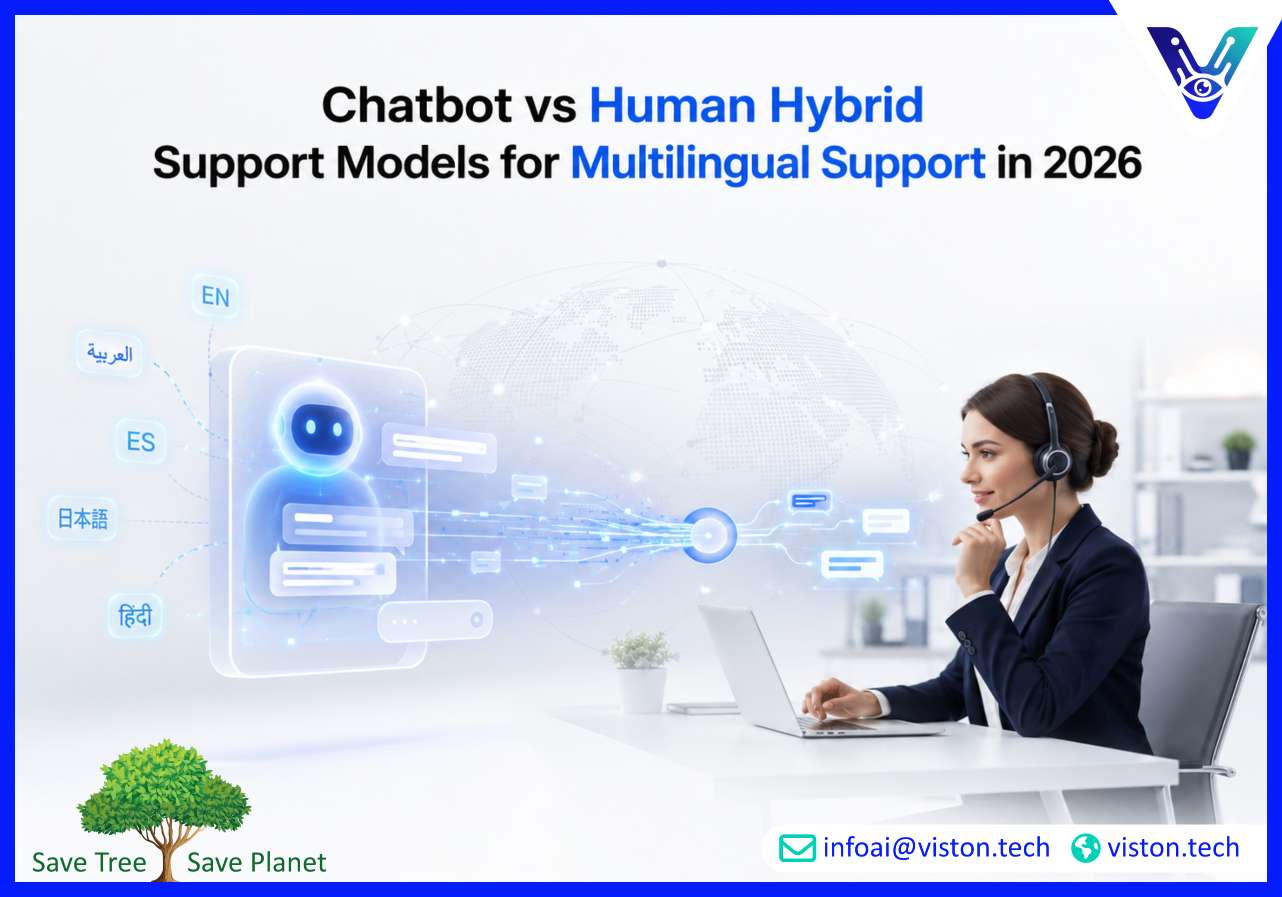
Chatbot vs human hybrid support models matter because global customers expect fast, accurate, language-aware service without losing access to real human help. For businesses serving multilingual audiences, the right support model can reduce friction, protect customer trust, and make service operations more scalable.
A chatbot-only support model relies primarily on automation to answer customer questions, guide users through workflows, collect information, and resolve repeatable requests. In multilingual support, this can include language detection, translated responses, localized knowledge base answers, and automated routing across channels such as web chat, mobile apps, WhatsApp, social messaging, and customer portals.
A human-only model depends on support agents to handle every customer interaction manually. This can deliver empathy and judgment, but it becomes difficult to scale when customers speak different languages, contact volumes fluctuate, or businesses operate across time zones.
A hybrid support model combines both. AI chatbots handle high-volume, predictable, and structured conversations, while human agents step in for complex, sensitive, emotional, high-risk, or revenue-critical situations. The model is not about replacing people. It is about designing a support system where automation and human expertise work together.
For multilingual support, hybrid models are especially valuable because language is not only a translation problem. Customers may use local phrases, mixed-language sentences, regional terminology, cultural references, spelling variations, or industry-specific vocabulary. A well-designed chatbot can manage common multilingual queries quickly, but human agents remain essential when context, nuance, judgment, or negotiation is required.
The strongest hybrid support models define clear boundaries. They identify what should be automated, what should be escalated, what requires agent review, and how the conversation history should move between AI and people. This prevents customers from repeating themselves and helps support teams maintain consistency across languages.
Chatbots are most effective when the request is frequent, rule-based, searchable, or workflow-driven. Examples include order status, appointment booking, password reset guidance, return policy questions, billing explanations, basic troubleshooting, product availability, document collection, and FAQs.
In multilingual support, chatbots also help customers access help in their preferred language at any time. This is valuable for businesses with customers in different regions, tourists, international buyers, distributed employees, or global partner networks.
Human support is still critical for complaints, account exceptions, urgent risks, emotional conversations, technical diagnosis, enterprise negotiations, regulated decisions, and cases involving unclear customer intent. Humans bring empathy, accountability, and practical judgment that automation cannot fully replicate.
The right question is not whether a chatbot or a human agent is better. The right question is which parts of the support journey should be automated and which parts should be handled by trained specialists.
In 2026, customer support expectations are shaped by speed, personalization, privacy, and global accessibility. Customers do not want to wait for office hours or switch languages to get help. They expect brands to understand them instantly and provide consistent answers regardless of channel or region.
This makes chatbot vs human hybrid support models a practical decision for businesses that want to scale multilingual support without sacrificing customer experience. A hybrid model can reduce pressure on human teams while keeping expert help available when it matters most.
Modern multilingual support is also becoming more operationally complex. Businesses need support systems that can connect with CRM platforms, helpdesk tools, ticketing systems, order management software, knowledge bases, analytics dashboards, identity systems, and internal workflows. A chatbot that only gives generic answers is no longer enough. Buyers now expect AI support systems that can understand intent, retrieve accurate information, complete tasks, escalate intelligently, and produce useful reporting.
Hybrid models also help manage risk. Fully automated support can frustrate customers when the bot misunderstands the issue, gives incomplete information, or refuses to escalate. Fully manual support can become expensive, slow, and inconsistent across languages. A hybrid model balances automation efficiency with human accountability.
Global businesses often receive support requests outside standard working hours. Hiring full human teams for every language and time zone can be expensive and difficult to manage. A multilingual chatbot can provide first-line support at any hour, answer routine questions, collect case details, and route urgent issues to the right team.
Human agents may interpret policies differently, especially when support documentation is fragmented across regions. A centralized multilingual chatbot can use approved knowledge sources to provide consistent responses. When paired with human review and escalation, this improves both speed and quality.
Hybrid support reduces repetitive workloads. Instead of answering the same questions all day, human agents can focus on complex, sensitive, or high-value conversations. This improves support quality and can also reduce burnout in multilingual service teams.
Customers value speed, but they also want to feel understood. A hybrid model gives them both: instant automated assistance for simple issues and human support when their needs become more complex. This is especially important when customers are communicating in their native language and expect the brand to respect both meaning and tone.
A successful hybrid support model starts with service design, not technology selection. Businesses need to map customer journeys, identify repetitive support issues, define language requirements, review risk areas, and decide where AI can safely create value.
The first step is to classify support queries by complexity and impact. Low-risk, high-volume requests are usually suitable for automation. Medium-complexity requests may need AI assistance with optional human escalation. High-risk requests should move quickly to trained agents.
For example, a chatbot can answer delivery status questions in multiple languages, but a lost shipment involving a high-value enterprise customer may need human intervention. A chatbot can guide a user through account setup, but a billing dispute may require an agent who can review account history and make a judgment.
Escalation rules are the foundation of a strong hybrid model. They determine when the chatbot should transfer the customer to a human agent. Triggers may include negative sentiment, repeated misunderstanding, legal or financial language, urgent complaints, VIP customer status, failed authentication, complex technical issues, or direct customer requests for a person.
In multilingual support, escalation should also consider language availability. If a customer asks a complex question in Spanish, German, Arabic, French, Hindi, Japanese, or another language, the system should route the case to the most suitable agent, team, or translation-assisted workflow.
A chatbot is only as reliable as the content it can access. Businesses need structured, approved, and regularly updated knowledge sources. This may include FAQs, policy documents, product documentation, troubleshooting guides, compliance instructions, onboarding materials, and region-specific support rules.
For multilingual use cases, content should not rely only on direct translation. Some terms need localization. Policies may vary by country. Product names, measurements, legal wording, payment methods, and support expectations may change across markets. A hybrid support model should include content governance so automated answers stay accurate.
Modern chatbot vs human hybrid support models work best when they are integrated with business systems. A chatbot should be able to retrieve order data, check ticket status, create support cases, update customer records, schedule appointments, collect documents, and pass structured information to agents.
Without integration, the chatbot becomes a conversational FAQ. With integration, it becomes part of the service workflow. This is where multilingual support becomes more valuable, because customers can complete real tasks in their preferred language rather than simply receiving translated instructions.
Businesses should not evaluate multilingual support using one blended performance number. A chatbot may perform well in English but struggle in another language. A workflow may work smoothly on web chat but fail on WhatsApp. A hybrid model needs reporting by language, region, intent, channel, resolution rate, escalation rate, customer satisfaction, containment quality, and agent handover success.
This level of reporting helps teams identify which languages need better training data, which topics require clearer content, and which escalation paths need improvement.
Hybrid support models can deliver strong results, but only when they are implemented carefully. Poor design can create confusion, inconsistent answers, customer frustration, and operational blind spots.
One common risk is over-automation. Businesses sometimes try to make the chatbot handle too much too soon. This can damage trust, especially when customers are dealing with urgent problems or emotional situations. The chatbot should know its limits and escalate gracefully.
Another risk is weak language quality. Multilingual support requires more than machine translation. The system must understand customer intent, tone, terminology, regional differences, and context. If a chatbot translates words but misses meaning, customers may receive inaccurate or awkward responses.
Data privacy is also important. Support conversations may include personal information, payment details, health information, account records, or confidential business data. Hybrid systems must be designed with access controls, secure integrations, retention rules, audit logs, and compliance-aware workflows.
When comparing chatbot vs human hybrid support models, decision-makers should assess both technical capability and operational fit. Important evaluation criteria include:
The best model is usually not the most automated model. It is the model that resolves common issues quickly, escalates complex issues intelligently, protects customer trust, and gives the business clear visibility into support performance.
Hybrid multilingual support can reduce support pressure, but businesses should plan beyond the initial chatbot build. Ongoing costs may include content updates, workflow changes, model monitoring, integration maintenance, language improvements, analytics review, agent training, and compliance checks.
Scalability depends on architecture. A business may start with two or three priority languages, then expand to additional markets. It may begin with FAQ automation, then add ticket creation, account lookup, order management, appointment scheduling, or voice-based support. A good hybrid model should support phased growth rather than requiring a complete rebuild every time the business expands.
Viston AI is relevant to chatbot vs human hybrid support models because its service offering includes Multilingual Support, AI chatbot development, enterprise AI chatbots, NLP, chatbot integration, language translation services, AI automation, and workflow bots. These capabilities align closely with the needs of businesses that want to combine automated multilingual conversations with human support escalation.
For organizations building multilingual support operations, Viston AI can help design chatbot systems that understand customer intent, support conversations across languages, connect with business workflows, and route complex cases to human teams. This is especially useful for companies serving customers across multiple regions, channels, and time zones.
A practical hybrid support model requires more than a chatbot interface. It needs knowledge management, integration planning, escalation design, analytics, optimization, and governance. Viston AI’s broader AI and automation capabilities make it suitable for businesses that want multilingual support to become part of a larger customer experience and operations strategy.
Its service positioning is particularly relevant for companies that need scalable support infrastructure, multilingual customer engagement, AI-powered triage, and workflow automation without removing human agents from important conversations. By focusing on both automation and business process fit, Viston AI can support organizations that want faster response times, more consistent multilingual answers, and better use of human support expertise.
Chatbot support relies mainly on automation to handle customer conversations. Hybrid support combines chatbots with human agents, allowing AI to manage routine requests while people handle complex, sensitive, or high-value cases.
Hybrid support helps businesses serve customers in multiple languages while maintaining quality. Chatbots provide fast first-line assistance, and human agents step in when language nuance, empathy, judgment, or complex problem-solving is required.
A chatbot can reduce repetitive work, but it should not fully replace multilingual human agents in most business environments. Human support remains important for escalations, complaints, regulated issues, technical complexity, and relationship-sensitive conversations.
Businesses should start with high-volume, low-risk queries such as FAQs, order tracking, appointment scheduling, account guidance, return instructions, onboarding help, and basic troubleshooting. These use cases are easier to standardize across languages.
Viston AI provides services connected to Multilingual Support, AI chatbot development, chatbot integration, NLP, and automation. This makes it relevant for businesses that want to build multilingual chatbot systems with structured escalation to human teams.
Key metrics include resolution rate, escalation rate, customer satisfaction, first response time, language-specific accuracy, chatbot containment quality, agent handover success, average handling time, repeat contact rate, and knowledge base gap trends.
Chatbot vs human hybrid support models are becoming essential for businesses that need scalable, reliable, and customer-friendly multilingual support. Chatbots bring speed, consistency, and 24/7 availability, while human agents provide empathy, judgment, and deeper problem-solving. The best approach is not to choose one over the other, but to design clear workflows where each performs the right role. For companies building multilingual service operations in 2026, Viston AI offers relevant capabilities across chatbot development, multilingual support, NLP, integration, and automation to help create practical support systems that serve customers better across languages and channels.
