
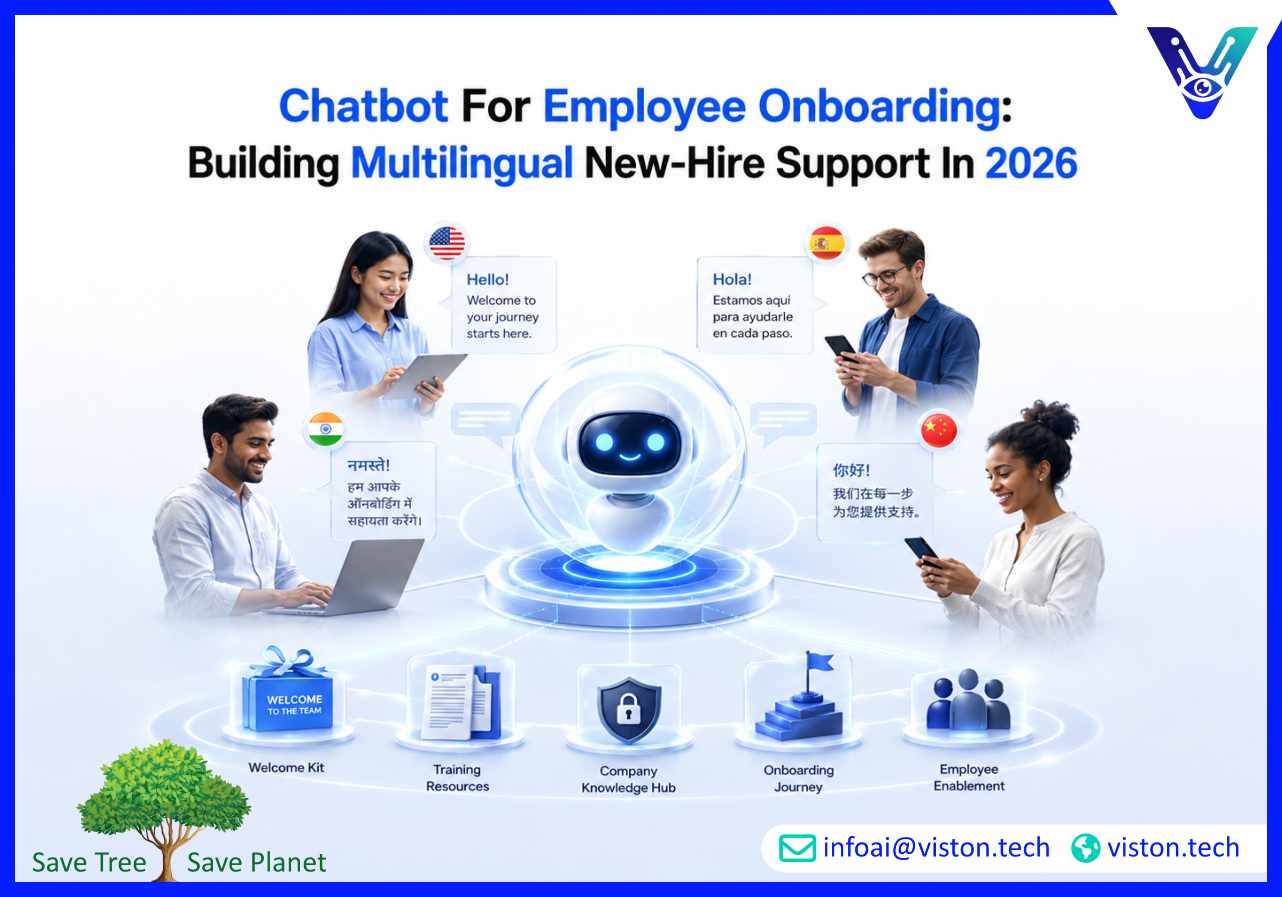
A chatbot for employee onboarding helps businesses give new hires fast, consistent, and accessible guidance from day one. For global and distributed teams, multilingual support is no longer optional. In 2026, companies need onboarding experiences that reduce confusion, support different languages, and help employees become productive without depending on HR teams for every repeated question.
A chatbot for employee onboarding is an AI-powered conversational assistant designed to help new employees understand company policies, complete joining tasks, access training materials, find documents, and ask role-specific questions. Instead of searching through long PDFs, waiting for HR replies, or asking managers for basic information, new hires can receive guided answers through a simple chat interface.
In a multilingual workplace, the value becomes even stronger. Employees may join from different regions, speak different first languages, and need onboarding materials explained in a way they can clearly understand. A multilingual onboarding chatbot can support language detection, translated answers, localized content, and culturally appropriate responses while maintaining consistency across the organization.
This matters because onboarding is not only an HR process. It affects productivity, employee confidence, compliance understanding, IT readiness, manager efficiency, and retention. When onboarding is slow or unclear, new employees often feel disconnected before they have fully started contributing. A chatbot helps close that gap by giving immediate access to relevant information.
For businesses in 2026, a strong onboarding chatbot should do more than answer generic questions. It should understand context, guide employees through steps, integrate with HR systems where appropriate, escalate sensitive issues to human teams, and keep responses aligned with approved company knowledge. This is where multilingual support becomes a strategic part of employee experience rather than a simple translation feature.
Workforces are increasingly distributed across countries, time zones, and language groups. Even companies with one headquarters often hire remote employees, contractors, offshore teams, and regional specialists. When onboarding content is available only in one language, businesses create friction for employees who may understand the language technically but miss important nuance around benefits, compliance, policies, systems, or role expectations.
Multilingual support helps make onboarding more inclusive, practical, and scalable. New hires can ask questions in their preferred language and receive clear guidance without waiting for local HR availability. This improves confidence during the early employment period, especially for employees who may hesitate to ask repeated questions in a second language.
A chatbot can support onboarding before the employee’s first day, during the first week, and throughout the first 30, 60, or 90 days. For example, it can explain joining documents, guide new hires through IT setup, point them to learning paths, answer company policy questions, and remind them of pending onboarding tasks.
In 2026, businesses also need to consider accuracy, privacy, and governance. Employee onboarding content often includes internal policies, employment procedures, compensation-related guidance, security practices, and compliance obligations. A multilingual chatbot must therefore be built on trusted knowledge sources, with clear escalation rules and controlled access to sensitive information.
The strongest business case for a chatbot for employee onboarding is not replacing HR teams. It is helping HR teams deliver better support at scale while giving new employees a smoother experience. HR professionals should focus on people, culture, complex situations, and strategic workforce priorities. A chatbot can handle repetitive, process-driven questions that consume time but do not always require human judgment.
New employees often need answers immediately. They may be setting up devices, joining training sessions, completing forms, or trying to understand internal tools. A chatbot can provide instant responses to approved questions, reducing delays that interrupt onboarding momentum.
Human explanations can vary. One manager may explain a policy differently from another. A chatbot uses approved knowledge, helping organizations maintain consistent messaging across locations, departments, and languages. This is especially useful for HR policies, security rules, code of conduct guidance, and benefits information.
Multilingual support allows employees to receive onboarding guidance in the language they are most comfortable using. This is important for international teams, regional operations, customer support centers, manufacturing units, technology teams, and businesses with cross-border hiring models.
Many onboarding questions are predictable. New hires ask where to submit documents, how to access systems, whom to contact for payroll, where training modules are stored, and how probation reviews work. Automating these answers gives HR teams more time for high-value employee support.
A well-designed chatbot can help businesses understand what new hires struggle with most. Conversation analytics can reveal common content gaps, unclear policies, repeated system access issues, and regional onboarding problems. These insights help HR and operations teams improve the onboarding journey over time.
Not every chatbot is suitable for employee onboarding. A basic website chatbot may answer simple questions, but onboarding requires deeper business context, secure information handling, structured workflows, and multilingual accuracy. Businesses should evaluate solutions based on practical delivery needs rather than only interface design.
The chatbot should support employee questions across relevant languages and understand intent, not just translate words. Good multilingual support considers phrasing, context, terminology, and the difference between casual employee questions and formal HR policy language.
The chatbot should connect to reliable onboarding content such as HR policies, training guides, IT setup documents, employee handbooks, internal FAQs, role-based learning paths, and compliance materials. This reduces the risk of inaccurate or outdated answers.
A new sales employee, engineer, support agent, or operations manager may need different onboarding guidance. The chatbot should support segmentation based on role, department, location, seniority, employment type, or business unit where appropriate.
Some questions should not be fully automated. Topics involving disputes, sensitive HR matters, legal interpretation, compensation exceptions, performance concerns, or personal employee data should be escalated to the right human contact. A reliable onboarding chatbot includes safe handoff workflows.
For stronger business value, a chatbot may connect with HRIS platforms, learning management systems, ticketing tools, IT service desks, document repositories, collaboration platforms, and identity access workflows. Integration helps move the chatbot from simple Q&A to guided onboarding support.
Employee onboarding involves personal and internal information. Businesses should consider access control, data handling, auditability, content approval workflows, response monitoring, and compliance with applicable data protection expectations. The chatbot must be useful without exposing sensitive information unnecessarily.
Building a chatbot for employee onboarding should begin with a clear understanding of the onboarding journey. The business needs to identify what new hires ask, which processes create delays, which documents are most important, and which languages require support. Without this foundation, the chatbot may become another tool employees ignore.
The first step is usually content preparation. HR, IT, compliance, operations, and department managers should review onboarding materials and decide which content is suitable for chatbot responses. Outdated PDFs, scattered documents, and inconsistent policy wording should be cleaned up before automation.
Next, the business should define chatbot scope. A useful first phase may focus on frequently asked HR questions, document guidance, IT setup support, and training navigation. More advanced phases can include personalized onboarding journeys, task reminders, system integrations, analytics dashboards, and automated ticket creation.
Testing is especially important for multilingual support. Translated answers should be reviewed for clarity, tone, policy accuracy, and cultural appropriateness. A technically correct translation can still confuse employees if it does not match local workplace terminology. Businesses should also test different question styles, spelling variations, and mixed-language queries.
Ongoing optimization is just as important as launch. Onboarding content changes when policies, tools, benefits, teams, and compliance expectations change. The chatbot should be monitored, improved, and retrained or updated as company knowledge evolves. In 2026, buyers should look for chatbot partners that understand implementation, governance, integrations, and continuous improvement rather than only chatbot deployment.
Viston AI is relevant to businesses exploring a chatbot for employee onboarding because its service offering includes Multilingual AI Chatbot Support, AI Chatbot Development, Natural Language Processing solutions, Language Translation Services, Integration with Business Systems, and AI Automation & Workflow Bots. These capabilities connect directly with the requirements of multilingual onboarding, where organizations need accurate conversational support, language flexibility, reliable knowledge handling, and practical integration with existing business workflows.
For employee onboarding use cases, Viston AI can support the design of chatbot experiences that help new hires access approved information, ask questions in different languages, navigate onboarding resources, and receive consistent guidance across teams or regions. Its broader AI service portfolio also supports important implementation needs such as model selection, NLP-based understanding, workflow automation, system integration, monitoring, and knowledge transfer.
This makes the company a suitable specialist for organizations that do not want a generic chatbot but need a business-focused multilingual support layer for employees. For companies with distributed workforces, multilingual teams, or cross-border hiring operations, Viston AI’s capabilities can help structure onboarding assistance around clarity, scalability, and operational usefulness. The value is not only in answering questions, but in helping businesses build a more consistent, accessible, and manageable onboarding support experience.
A chatbot for employee onboarding is a conversational assistant that helps new hires complete joining tasks, understand company policies, find documents, access training resources, and ask onboarding-related questions through a chat interface.
Multilingual support allows employees to ask questions and receive onboarding guidance in their preferred language. This reduces confusion, improves accessibility, and helps global teams deliver a more consistent new-hire experience.
Yes. A well-designed onboarding chatbot can integrate with HRIS platforms, learning systems, IT ticketing tools, document repositories, collaboration platforms, and internal knowledge bases depending on the organization’s requirements.
A chatbot can answer approved general HR questions, but sensitive topics should have escalation paths to human HR teams. Businesses should define clear rules for privacy, access control, and human handoff.
Businesses should prepare updated onboarding documents, HR policies, IT setup guides, training resources, language requirements, user journeys, escalation rules, and success metrics before implementation.
Viston AI offers multilingual AI chatbot support, AI chatbot development, NLP, translation services, and business system integration, making it relevant for organizations planning multilingual onboarding chatbot solutions.
A chatbot for employee onboarding can make the new-hire journey faster, clearer, and more consistent, especially when multilingual support is required. In 2026, businesses need onboarding systems that support distributed teams, reduce repeated HR workload, protect information accuracy, and help employees feel confident from the beginning. The most effective solutions combine conversational AI, approved knowledge, workflow integration, human escalation, and continuous improvement. For organizations seeking multilingual chatbot support connected to real business processes, Viston AI offers relevant capabilities across chatbot development, NLP, translation, and AI-powered workflow support.
