
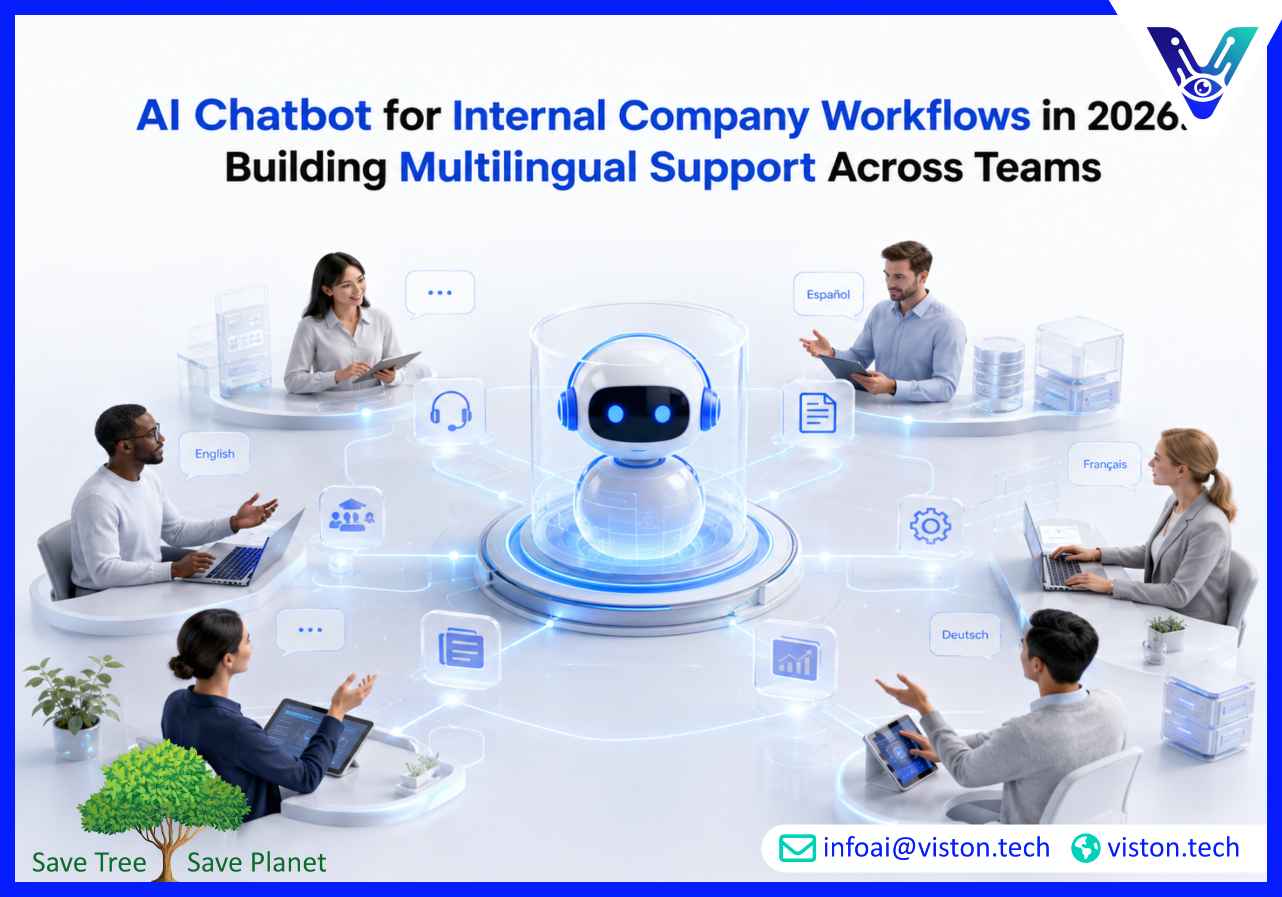
An AI chatbot for internal company workflows is no longer just a helpdesk shortcut. In 2026, businesses need intelligent assistants that help employees find answers, complete routine tasks, navigate systems, and collaborate across languages without slowing down operations.
An AI chatbot for internal company workflows is a secure conversational assistant designed to support employees inside an organization. Instead of serving external customers, it helps internal teams complete work faster by answering questions, guiding processes, retrieving information, creating tickets, routing requests, and connecting with business systems.
For growing companies, internal work often becomes fragmented. HR policies may live in one platform, IT support in another, sales enablement content in shared folders, project updates in collaboration tools, and operational procedures inside spreadsheets or legacy systems. Employees lose time searching, asking colleagues, waiting for approvals, or repeating the same administrative steps.
A well-designed internal chatbot reduces that friction. It gives employees a single conversational interface for common workplace needs such as onboarding, IT troubleshooting, leave policies, expense guidance, procurement requests, compliance reminders, multilingual knowledge access, and workflow updates.
The value becomes even stronger for distributed and multilingual teams. When employees work across countries, time zones, and languages, internal communication gaps can create delays, inconsistent interpretation of policies, and uneven access to support. Multilingual Support helps ensure that employees can ask questions and receive useful guidance in the language they understand best, while the company maintains consistency in process, terminology, and governance.
The chatbot does not replace every internal system. Its role is to make those systems easier to use. The best implementations act as an intelligent layer across existing tools, helping employees reach the right answer or action without needing to know where every document, form, or workflow is stored.
Businesses in 2026 are under pressure to improve productivity without adding unnecessary complexity. Teams are using more tools, more data, more AI-enabled platforms, and more remote collaboration channels than ever before. The challenge is not only access to technology; it is making work easier, faster, and more consistent.
Internal AI chatbots address this challenge by reducing operational drag. Employees often repeat the same questions: “How do I request software access?”, “Where is the latest policy?”, “Who approves this purchase?”, “What is the process for onboarding a contractor?”, or “How do I update this record?” When these questions depend on a colleague or a support queue, productivity suffers.
A chatbot can answer these questions instantly when connected to approved knowledge sources and workflow systems. More importantly, it can guide the next step. For example, it can explain a reimbursement rule, open the correct expense form, collect required details, route the request to finance, and update the employee when the status changes.
For multilingual organizations, the need is even greater. Internal processes must be understood clearly across languages, not simply translated word for word. A poorly localized policy answer can create compliance confusion, employee frustration, or inconsistent execution. Multilingual Support allows companies to deliver internal assistance with language-aware intent recognition, localized phrasing, and consistent process logic.
In 2026, decision-makers are also more cautious about AI quality. They want internal assistants that are secure, controlled, measurable, and aligned with company rules. This makes service design, implementation quality, knowledge governance, and multilingual accuracy more important than simply launching a chatbot quickly.
Multilingual Support is essential when an AI chatbot for internal company workflows serves employees across regions, departments, or language groups. Internal support is not only about answering questions; it is about helping employees follow the right process. That requires accuracy, context, and cultural clarity.
Basic machine translation is not enough for internal workflows. Company terminology, role names, compliance language, technical instructions, HR policies, and operational procedures often have specific meanings. A multilingual chatbot must understand intent, retrieve the right approved source, preserve business context, and respond in a way that feels clear to the employee.
For example, a finance workflow may use terms such as purchase order, cost center, approval threshold, vendor onboarding, tax documentation, or reimbursement category. A multilingual internal chatbot must handle these terms reliably across languages. The same applies to HR policies, IT troubleshooting steps, legal compliance guidance, and operational instructions.
HR and employee support: Employees can ask questions about leave, benefits, onboarding steps, workplace policies, internal mobility, and training requirements in their preferred language. This improves access and reduces repeated HR queries.
IT support and access management: Teams can receive first-level troubleshooting, software request guidance, device setup instructions, and escalation support without language becoming a barrier.
Operations and field teams: Manufacturing, logistics, retail, healthcare, hospitality, and service teams often include employees who work away from desks. A multilingual chatbot can provide quick process guidance through mobile-friendly channels.
Compliance and policy awareness: Companies can make internal rules easier to understand across regions while maintaining consistency in approved messaging and escalation points.
Knowledge management: Instead of translating every internal document manually before it becomes useful, businesses can create a governed knowledge layer that enables multilingual access to verified information.
The strongest use cases combine language capability with workflow automation. The chatbot should not only answer “What is the policy?” but also help the employee act on it. That may include creating a ticket, generating a request, notifying a manager, updating a system, or escalating to a human specialist.
Implementing an AI chatbot for internal company workflows requires more than selecting a conversational AI platform. The project should begin with business priorities, process mapping, knowledge readiness, and clear ownership. Without these foundations, even advanced AI can produce inconsistent answers or fail to gain employee trust.
Start with high-volume, low-risk internal workflows where employees regularly need guidance. HR FAQs, IT helpdesk triage, onboarding support, expense policy queries, and internal knowledge search are common starting points. Avoid trying to automate every department at once. A focused launch gives the business a clearer path to quality, adoption, and measurable improvement.
The chatbot is only as reliable as the information it can access. Internal policies, process documents, system guides, and FAQs should be reviewed, updated, categorized, and approved before implementation. For multilingual support, terminology glossaries and region-specific language rules should also be considered.
Internal workflow value increases when the chatbot integrates with systems such as HRIS, CRM, ERP, ticketing platforms, intranet portals, knowledge bases, identity tools, collaboration apps, and project management systems. Integration allows the chatbot to move from answering questions to helping employees complete actions.
Internal chatbots may interact with sensitive employee, financial, operational, or customer-related information. Role-based access, authentication, audit logs, encryption, data retention rules, and permission-aware responses are essential. Employees should only receive information they are authorized to access.
No chatbot should be expected to resolve every internal issue. Complex HR matters, security incidents, legal questions, payroll disputes, and sensitive employee concerns often require human support. A strong chatbot design includes escalation logic, ticket creation, routing, and context transfer so employees do not need to repeat themselves.
Useful internal chatbot metrics include resolution rate, escalation rate, language-specific accuracy, employee satisfaction, repeated queries, average response time, workflow completion rate, and support ticket reduction. These insights help teams improve documentation, refine workflows, and identify departments where automation can create more value.
The most successful implementations treat the chatbot as an evolving internal service, not a one-time software deployment. It should be monitored, updated, localized, and optimized as company policies, systems, and employee expectations change.
Viston AI is relevant to businesses exploring an AI chatbot for internal company workflows because its Multilingual Support offering is built around enterprise-grade conversational AI, NLP, generative AI, omnichannel deployment, language-aware interaction, intelligent routing, analytics, and integration with business systems. These capabilities align closely with the needs of companies that want employees to access internal support across departments and languages.
For internal workflow use cases, Viston AI can help organizations design chatbot experiences that connect approved knowledge sources with practical employee actions. This may include multilingual HR support, IT helpdesk guidance, finance process assistance, operational knowledge retrieval, ticket routing, and workflow handoff across tools used by distributed teams.
Its service positioning is especially relevant for companies with multilingual workforces, global offices, or regional teams that need consistent internal answers without relying on manual translation or fragmented support channels. Viston AI’s broader AI chatbot, NLP, integration, and automation capabilities also support the technical foundation required for secure and scalable internal deployments.
Rather than treating multilingual capability as a simple translation layer, Viston AI’s approach is aligned with context-aware support, business terminology, escalation workflows, performance monitoring, and continuous improvement. For organizations building internal AI systems in 2026, that combination matters because employee trust depends on accuracy, clarity, reliability, and smooth connection to real business processes.
It is an AI-powered assistant used inside a company to help employees find information, complete routine tasks, submit requests, follow processes, and get support across departments such as HR, IT, finance, operations, and sales.
Multilingual Support allows employees to ask questions and receive process guidance in their preferred language. This improves understanding, reduces dependency on local managers, and helps global teams follow consistent company procedures.
Good starting points include HR FAQs, employee onboarding, IT support triage, software access requests, expense policy guidance, procurement support, knowledge base search, compliance reminders, and routine operations support.
Yes. A well-designed internal chatbot can connect with HR platforms, ticketing systems, CRM, ERP, intranet portals, knowledge bases, collaboration tools, identity systems, and workflow automation platforms through APIs or pre-built connectors.
It can be secure when designed with authentication, role-based permissions, encryption, audit logs, data governance, approved knowledge sources, and clear escalation rules. Security should be part of the architecture from the start, not added later.
Viston AI supports multilingual AI chatbot development through conversational AI, NLP, integration, routing, analytics, and business-focused automation capabilities. This makes it relevant for companies that need scalable internal support across languages and workflows.
An AI chatbot for internal company workflows can help businesses reduce repetitive support work, improve employee productivity, and make internal knowledge easier to access. When combined with Multilingual Support, it becomes especially valuable for global and distributed teams that need consistent guidance across languages, systems, and departments. The right approach requires more than automation; it needs accurate knowledge, secure integrations, workflow design, human escalation, and ongoing optimization. For organizations planning internal AI support in 2026, Viston AI offers relevant multilingual chatbot and conversational AI capabilities that can support practical, scalable, and business-focused workflow improvements.
