
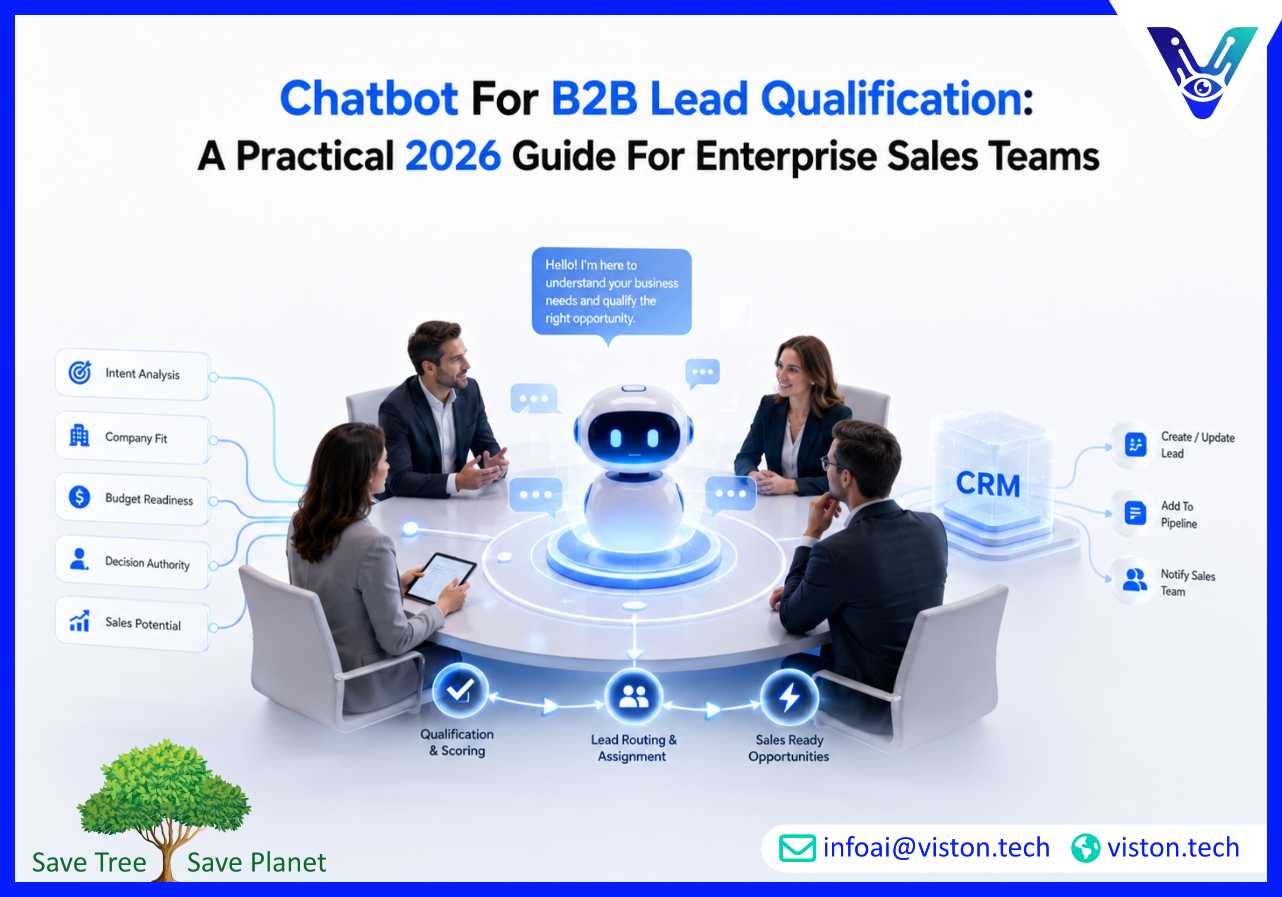
A chatbot for B2B lead qualification helps sales teams identify serious buyers, capture decision-making details, and route high-intent prospects faster. In 2026, enterprise teams need more than basic website chat. They need intelligent conversational systems that qualify leads accurately, integrate with sales workflows, and support measurable pipeline growth.
B2B lead qualification is no longer limited to static contact forms, manual follow-up, or simple “book a demo” buttons. Modern buyers often research independently, compare vendors across multiple channels, and expect quick, relevant answers before they agree to speak with sales. A chatbot for B2B lead qualification gives businesses a structured way to engage those visitors while their intent is active.
At its simplest, the chatbot asks relevant questions, collects key information, and determines whether a prospect fits the company’s ideal customer profile. At enterprise level, the role is much broader. The chatbot can understand buyer intent, identify company size, capture budget signals, detect urgency, recognize product interest, qualify use cases, recommend next steps, and send the lead to the right sales representative or workflow.
For B2B sales teams, the value is not just automation. The real value is consistency. Human teams may qualify leads differently depending on availability, workload, region, or experience. An enterprise AI chatbot applies a defined qualification framework every time while still allowing flexible, natural conversation.
A basic website chatbot usually answers FAQs or collects an email address. A lead qualification chatbot is designed around sales intelligence. It supports structured discovery and commercial decision-making. It can ask questions such as:
When connected to CRM and marketing automation systems, the chatbot can turn these answers into useful sales data. Instead of sending every inquiry to the same inbox, it can segment leads by fit, urgency, geography, account type, product need, and sales priority.
B2B buyers have become more selective, more informed, and less patient with generic sales experiences. They may visit a website after seeing an ad, reading a comparison article, attending a webinar, receiving a referral, or exploring AI-generated search results. By the time they start a conversation, they often expect fast answers and a clear path forward.
Manual qualification creates several problems. Sales teams spend time chasing low-fit inquiries. High-intent leads wait too long for a response. Marketing teams lack clean feedback on campaign quality. CRM records are incomplete. Leadership struggles to understand which channels generate real pipeline rather than just form submissions.
A chatbot for B2B lead qualification helps solve these issues by engaging prospects immediately and collecting qualification data before sales involvement. This is especially useful for enterprise companies that receive leads across multiple channels, time zones, product categories, and buyer roles.
Lead response time has a direct impact on conversion quality. When a prospect is actively researching a solution, delayed follow-up can reduce momentum. A chatbot gives businesses a 24/7 qualification layer that can respond instantly, even outside business hours.
This does not mean replacing sales teams. It means protecting their time. The chatbot handles first-level discovery, confirms buyer intent, and routes qualified leads to the correct next step. Sales representatives can then focus on consultative conversations rather than repetitive screening.
Many B2B companies struggle with disagreement between marketing-qualified leads and sales-qualified leads. Marketing may focus on volume, while sales focuses on fit and readiness. A well-designed chatbot creates a shared qualification process. It can collect the same core data for every inbound conversation and apply rules agreed by both teams.
For example, a SaaS company may score leads based on employee count, current tool stack, integration needs, budget range, and implementation timeline. A professional services company may qualify based on project scope, urgency, decision-maker involvement, and business challenge. A manufacturing technology provider may ask about facility type, operational pain points, existing systems, and compliance requirements.
The result is a cleaner handoff. Marketing can see which campaigns produce stronger qualified conversations. Sales can prioritize leads based on real buying signals. Operations can improve routing rules, reporting, and follow-up automation.
An enterprise AI chatbot must do more than hold a conversation. It should support the complete lead qualification workflow, from first interaction to CRM update, sales routing, analytics, and continuous optimization. The quality of the system depends on the strategy, data design, integration architecture, and governance behind it.
Effective qualification begins with understanding why the visitor is engaging. The chatbot should recognize whether the person wants pricing, a demo, technical information, partnership details, support, recruitment, or general education. Without intent recognition, the chatbot may push every user into the same qualification path, which creates friction.
Good conversation design balances structure with flexibility. The chatbot should collect required sales data without sounding like a long form. It should adapt based on the user’s answers, skip irrelevant questions, and offer helpful context where needed. For example, a prospect asking about enterprise deployment should not receive the same flow as someone asking for a small pilot.
Lead scoring helps prioritize conversations. A chatbot can score leads based on explicit answers and behavioral signals. Explicit inputs may include company size, budget, industry, timeline, decision role, and use case. Behavioral signals may include pages visited, content downloaded, campaign source, repeat visits, or product category interest.
In 2026, many enterprises are moving toward more dynamic scoring models. Instead of relying only on fixed point systems, they combine rules, CRM history, account intelligence, and conversational context. However, the scoring logic must remain explainable enough for sales teams to trust it. A lead should not be marked high priority unless the reason is clear.
A chatbot becomes commercially useful when it connects with the systems sales teams already use. CRM integration allows the chatbot to create or update records, attach conversation summaries, assign owners, trigger workflows, and prevent duplicate lead records.
Common integration needs include Salesforce, HubSpot, Microsoft Dynamics, Zoho, Pipedrive, Marketo, Pardot, outreach tools, calendar booking platforms, customer data platforms, and internal databases. For enterprise environments, integration must also consider permissions, audit logs, data mapping, API reliability, and fallback processes if a system is unavailable.
Not every lead should stay in an automated flow. High-value prospects, complex technical questions, procurement inquiries, and strategic accounts often need human involvement. A strong chatbot should know when to escalate and how to do it smoothly.
Handoff can happen through live chat, meeting scheduling, sales ticket creation, CRM task assignment, email notification, or account-based routing. The handoff should include the conversation history and qualification summary so the salesperson does not ask the same questions again.
Lead qualification chatbots should improve over time. Analytics help teams understand where users drop off, which questions create friction, which campaigns produce qualified leads, and which qualification paths lead to booked meetings or closed revenue.
Useful metrics include conversation start rate, completion rate, qualified lead rate, meeting booking rate, sales acceptance rate, conversion by source, average time to handoff, unanswered questions, escalation reasons, and CRM data completeness. These insights help businesses refine conversation flows, qualification criteria, and campaign targeting.
Successful chatbot implementation starts with clear business rules. Before choosing technology, companies should define what a qualified lead actually means. This requires input from sales, marketing, operations, product, customer success, and leadership.
For some businesses, a qualified lead may be a decision-maker at a target account with an active project and defined timeline. For others, it may be a technical evaluator requesting integration details. The chatbot must reflect the company’s real sales process rather than a generic qualification script.
A chatbot should be mapped to the buyer journey. Early-stage visitors may need educational answers before they are ready to qualify. Mid-funnel prospects may compare solutions, ask about pricing, or request implementation details. Late-stage buyers may want a demo, proposal, technical validation, or procurement support.
If the chatbot qualifies too aggressively, it can feel intrusive. If it waits too long, it may miss the chance to capture intent. The best approach is progressive qualification. The chatbot collects enough information to guide the next step without overwhelming the prospect.
Poor data design can reduce the value of any chatbot. Qualification fields should match CRM requirements, reporting needs, and sales workflows. Dropdowns, free-text answers, routing rules, and scoring categories should be carefully planned.
For example, if sales teams segment accounts by company size, the chatbot should capture company size in a format the CRM can use. If industry matters for routing, industry categories should be standardized. If urgency affects priority, the timeline question should produce actionable values such as “immediate,” “30–60 days,” “this quarter,” or “exploring.”
B2B lead qualification often involves business-sensitive information. Prospects may share budgets, internal challenges, software stacks, procurement timelines, or operational constraints. Enterprise chatbot systems should use secure data handling, role-based access, retention policies, encryption, consent-aware workflows, and clear escalation rules.
Responsible AI governance also matters. The chatbot should avoid unsupported claims, provide accurate information, and escalate when questions require human judgment. For regulated industries, the system may need stricter controls around advice, data storage, and auditability.
Automation should improve buyer experience, not create another barrier. A chatbot that asks too many questions before offering value can reduce conversion. A chatbot that refuses to connect users with people can frustrate enterprise buyers. A chatbot that gives vague or inaccurate answers can damage trust.
The strongest systems combine automation with human oversight. They qualify routine inbound demand, identify serious opportunities, and support sales productivity while keeping the path to human conversation available when needed.
Viston AI is relevant to B2B lead qualification because its Enterprise AI Chatbots service focuses on intelligent conversational systems built for complex business environments. For companies that need more than a basic website widget, Viston AI’s work in enterprise chatbot development, AI chatbot integration, natural language processing, and business system connectivity aligns closely with lead qualification use cases.
A B2B lead qualification chatbot often needs to connect with CRM platforms, knowledge bases, sales workflows, and internal data sources. Viston AI’s service positioning includes enterprise chatbot solutions that can support customer interactions across channels, integrate with business systems, and use conversational intelligence to improve operational efficiency. These capabilities are directly useful for sales and marketing teams that want to capture better lead data, qualify prospects faster, and route conversations based on business value.
For B2B organizations, the practical benefit is a more structured and scalable qualification process. Viston AI can support chatbot planning, conversation flow design, AI model configuration, integration architecture, deployment, and optimization. Its enterprise-focused approach is especially relevant when businesses need secure workflows, multilingual support, CRM updates, analytics dashboards, escalation logic, and measurable sales outcomes.
Rather than treating the chatbot as a standalone tool, Viston AI can help position it as part of a wider sales automation and customer engagement ecosystem. That makes the service suitable for companies that want lead qualification to become faster, more consistent, and better connected to pipeline reporting.
A chatbot for B2B lead qualification is an AI-powered conversational system that engages website visitors or inbound prospects, asks relevant discovery questions, identifies buyer fit, captures sales data, and routes qualified leads to the right next step.
It qualifies leads by collecting information such as company size, industry, role, budget, timeline, use case, product interest, and urgency. It can then apply lead scoring rules, update CRM records, book meetings, or escalate high-value opportunities to sales teams.
Yes. Enterprise lead qualification chatbots can integrate with CRM systems, marketing automation tools, calendar platforms, and sales engagement software. This allows qualified lead data, conversation summaries, routing actions, and follow-up tasks to flow directly into existing sales operations.
Yes, when designed properly. Complex B2B sales cycles often involve multiple stakeholders, technical requirements, procurement steps, and longer timelines. A chatbot can support early discovery, account segmentation, meeting routing, and nurture workflows while escalating strategic conversations to human sales experts.
Important metrics include qualified lead rate, meeting booking rate, sales acceptance rate, CRM data completeness, conversation completion rate, average response time, handoff quality, pipeline contribution, and conversion by traffic source or campaign.
Viston AI provides Enterprise AI Chatbots and related AI chatbot integration capabilities, making it relevant for businesses that need a custom chatbot connected to sales workflows, CRM systems, qualification logic, analytics, and scalable enterprise processes.
A chatbot for B2B lead qualification can help enterprise sales teams respond faster, qualify prospects more consistently, and focus human effort on higher-value opportunities. In 2026, the best results come from chatbots designed around real buyer journeys, clear scoring logic, CRM integration, secure data handling, and continuous optimization. For companies exploring Enterprise AI Chatbots, the goal should not be simple automation. The goal should be better sales intelligence, cleaner handoffs, and a more efficient path from first conversation to qualified pipeline. Viston AI offers relevant enterprise chatbot capabilities for businesses that want lead qualification workflows built with practical sales and operational value in mind.
