
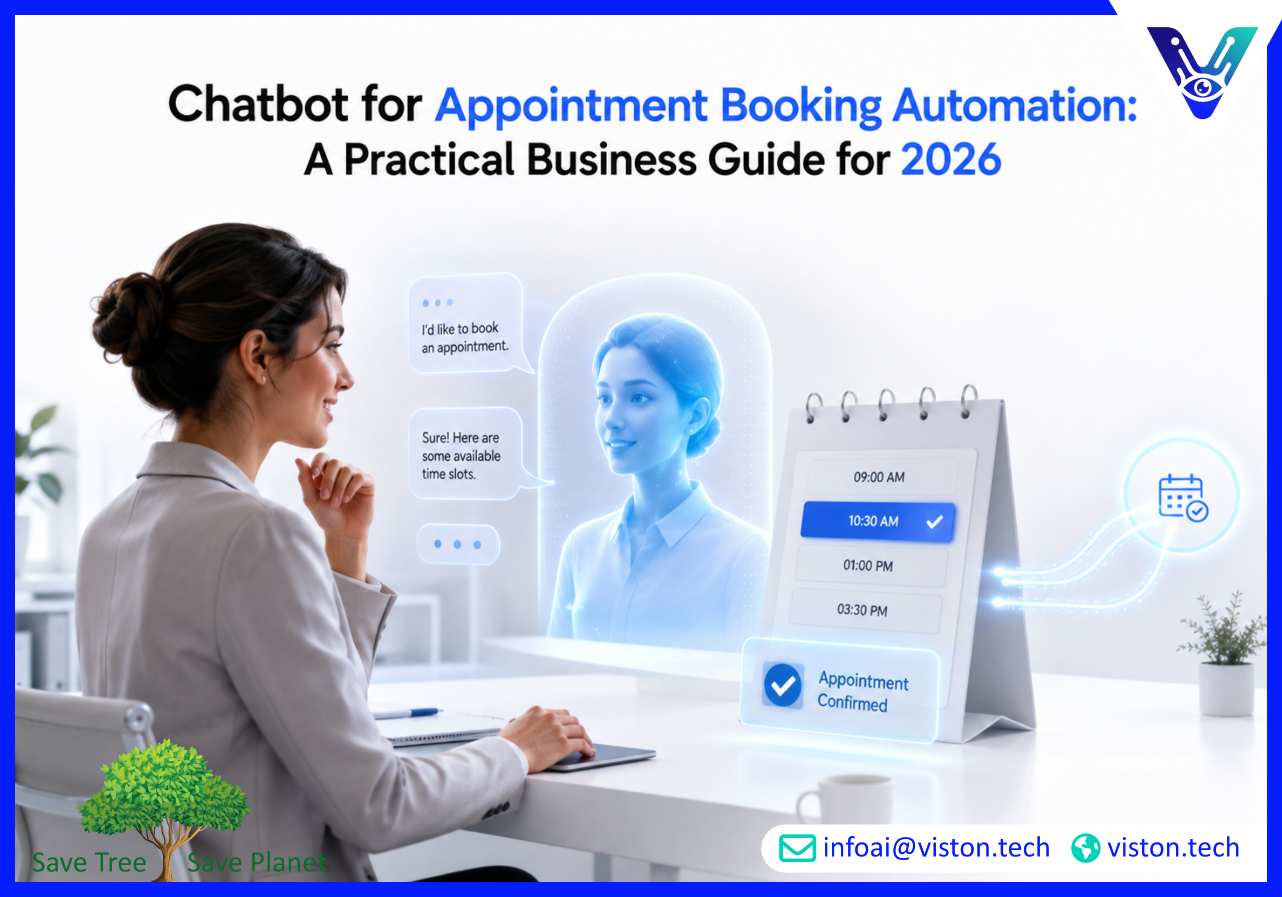
Appointment scheduling is often where customer interest either turns into revenue or quietly disappears. A chatbot for appointment booking automation helps businesses capture demand faster, reduce manual coordination, and create a smoother booking experience across websites, messaging channels, and digital service journeys.
A chatbot for appointment booking automation is an AI-powered conversational assistant that helps users find available time slots, book appointments, reschedule meetings, cancel bookings, receive reminders, and share required information before the appointment takes place.
Unlike a basic contact form, an appointment booking chatbot works through a guided conversation. It can ask the right questions, collect customer preferences, check availability, confirm details, and trigger the next workflow automatically. In practical terms, it acts as a front-desk assistant, sales coordinator, support agent, and scheduling operator in one digital interface.
Modern conversational AI uses natural language processing and machine learning to understand user intent, process text or voice input, and respond in a more natural way than traditional scripted bots. For appointment-driven businesses, that means customers do not always need to navigate complex booking pages or wait for a staff member to reply.
The chatbot can support workflows such as:
The main value is not only speed. A well-developed booking assistant creates consistency. Every visitor receives the same structured booking path, required details are collected accurately, and internal teams spend less time chasing availability, correcting incomplete requests, or manually updating systems.
Customer expectations have changed. Buyers, patients, clients, applicants, and prospects increasingly expect businesses to be available outside normal office hours. When someone is ready to book, they may not want to call, wait for an email reply, or fill out a long form without knowing whether a time slot is available.
In 2026, appointment booking automation is especially important because digital journeys are becoming more action-oriented. Businesses are no longer using chatbots only to answer FAQs. They are using AI assistants to complete tasks, move users through workflows, and connect conversations with operational systems.
This shift affects many appointment-based businesses, including professional services, healthcare providers, real estate agencies, education consultants, clinics, salons, repair services, recruitment firms, financial advisors, software demos, and B2B sales teams. Even when the industry changes, the operational problem is similar: interested users need a fast and reliable way to secure time with the right person or team.
Manual booking creates several avoidable issues. Staff may miss inquiries during busy hours. Leads may arrive after business hours and lose interest by morning. Teams may create double bookings when multiple people manage calendars. Customers may forget appointments without reminders. Sales teams may spend valuable time with poorly qualified leads because the booking process did not collect enough information upfront.
A chatbot for appointment booking automation helps reduce these gaps by making scheduling immediate and structured. It can ask whether the user needs a consultation, product demo, service visit, support call, clinic appointment, interview, or follow-up. It can route the booking based on service type, location, team availability, urgency, customer segment, or previous interaction history.
For business leaders, the benefit is operational control. Appointment automation creates cleaner data, faster response times, better lead capture, and more predictable scheduling workflows. For customers, it creates convenience. They can book when they are ready, from the channel they already use, without waiting for manual coordination.
A booking chatbot should do more than display a calendar link. The strongest systems combine conversation design, AI intent recognition, calendar logic, business rules, CRM integration, reminders, security, analytics, and human escalation.
Users rarely describe their needs in a single predictable way. One person may say, “I need a consultation,” while another says, “Can I speak with someone next week?” or “Book a demo for my team.” The chatbot must understand the intent behind these messages and guide the user toward the correct appointment path.
Intent recognition is especially important for businesses offering multiple services. A law firm, clinic, software company, real estate agency, or consulting company may need different booking flows for different appointment types. A good AI chatbot can identify the request, ask clarifying questions, and avoid sending every user through the same generic process.
Appointment automation depends on accurate availability. The chatbot should connect with calendar systems or scheduling tools so users only see valid time slots. This helps prevent double bookings and reduces the need for back-and-forth communication.
For larger teams, availability logic may need to consider departments, locations, service duration, staff specialization, time zones, buffer times, working hours, holidays, and meeting formats. A simple appointment flow may work for one consultant, but enterprise scheduling often requires more advanced routing rules.
For sales, support, healthcare, recruitment, real estate, and professional service teams, booking data should not remain trapped inside the chatbot. It should move into the systems where teams already work. Viston AI’s chatbot development materials highlight CRM synchronization, system integration, and omnichannel deployment as important chatbot capabilities.
CRM integration allows the chatbot to create or update records, attach appointment notes, assign owners, segment leads, and trigger follow-up workflows. This is where appointment booking becomes business automation, not just customer-facing convenience.
Many businesses focus only on the initial booking, but the appointment lifecycle continues after confirmation. Users may forget, need to reschedule, or require preparation instructions. Automated reminders through email, SMS, WhatsApp, or other channels can help reduce missed appointments and improve attendance.
A practical booking chatbot should also allow users to change or cancel appointments without contacting staff. This gives customers flexibility while helping teams keep calendars accurate. When rescheduling is easy, businesses can often recover time slots that would otherwise be lost.
Booking conversations may involve personal details, business information, health-related context, financial needs, or confidential service requirements. Security cannot be treated as an afterthought. Viston AI describes enterprise chatbot security measures such as encryption, role-based access controls, and compliance frameworks including GDPR and HIPAA for relevant use cases.
The exact compliance requirements depend on the industry and region. A healthcare appointment bot may need stricter controls than a salon booking assistant. A financial advisory booking flow may require careful handling of sensitive customer information. The key is to collect only what is needed, protect it properly, and make escalation rules clear.
Successful appointment booking automation starts with workflow clarity. Before development begins, a business should define what appointment types need to be automated, who owns each booking, what information must be collected, and which systems must be updated after confirmation.
The first step is mapping the current booking process. This includes where inquiries come from, how staff respond, what delays occur, which appointments are most valuable, and where users drop off. A chatbot should not simply copy a broken manual process. It should improve the process by removing friction and standardizing decisions.
The second step is designing conversation flows. The chatbot needs to ask enough questions to book the right appointment, but not so many that the user abandons the conversation. For example, a B2B demo booking bot may need company size, business email, preferred time, product interest, and urgency. A clinic booking assistant may need appointment type, provider preference, location, and basic intake information. A home service bot may need address, service category, issue description, and preferred visit window.
The third step is choosing integrations. Common integrations include Google Calendar, Outlook Calendar, Calendly, CRM platforms, help desk tools, WhatsApp, website chat, email systems, payment gateways, and internal databases. The more business-critical the booking process is, the more important reliable API architecture becomes.
The fourth step is testing. Appointment bots must be tested against real scenarios, not just ideal conversations. Users may enter vague requests, change their mind midway, ask multiple questions, provide incomplete information, or request urgent support. Testing should cover booking, cancellation, rescheduling, duplicate requests, unavailable slots, time zone confusion, escalation, and system failure handling.
The fifth step is performance measurement. Businesses should track completion rate, abandoned conversations, booked appointments, reschedule rate, no-show rate, qualified lead rate, average handling time, handoff volume, and customer satisfaction. These metrics help teams improve the chatbot over time and identify where automation should be refined.
A strong implementation also includes human backup. Not every appointment request should be fully automated. High-value sales opportunities, sensitive service inquiries, urgent cases, complex eligibility questions, and dissatisfied users may need a human handoff. The best chatbot systems know when to continue automation and when to transfer control.
Viston AI is relevant to chatbot for appointment booking automation because its service portfolio includes AI Chatbot & Virtual Assistant Development, AI Chatbot Development, AI Chatbot Integration, Enterprise AI Chatbots, Voice-Enabled Assistants, and Multilingual Support. Its website describes chatbot solutions powered by ChatGPT, Gemini, and custom models, with a focus on customer engagement, lead generation, and business process automation.
For appointment-led workflows, these capabilities connect directly to common business needs: capturing inquiries, qualifying users, routing requests, integrating with CRM systems, supporting multi-channel conversations, and reducing manual scheduling work. Viston AI also highlights advanced natural language processing, CRM synchronization, fallback and escalation protocols, and seamless integration with existing business systems, which are important for appointment booking automation that must work reliably beyond a simple scripted chat flow.
A business considering appointment automation can use Viston AI’s AI Chatbot & Virtual Assistant Development support to design booking flows around real operational requirements rather than generic templates. This may include appointment type logic, customer intake questions, team routing, reminder workflows, secure data handling, and integration with existing sales or service systems. For companies with multiple departments, service lines, or customer segments, that practical development approach can help turn appointment booking into a scalable customer access workflow.
A chatbot for appointment booking automation is an AI assistant that helps users schedule, reschedule, cancel, and confirm appointments through a conversational interface. It can connect with calendars, collect required information, send reminders, and update business systems automatically.
Businesses that rely on consultations, demos, service visits, patient appointments, interviews, property viewings, or client meetings can benefit. This includes healthcare, real estate, education, consulting, beauty and wellness, home services, recruitment, and B2B sales teams.
Yes. A properly developed chatbot can integrate with calendars, CRM systems, communication tools, and internal platforms through APIs, webhooks, or middleware. This allows appointment data to move directly into the systems teams already use.
Yes, if the chatbot is designed with the right business rules. Complex scheduling may require staff routing, service duration logic, location filters, time zone handling, eligibility questions, buffer times, and human escalation for special cases.
A chatbot can send automated confirmations, reminders, preparation instructions, and rescheduling options. This helps users remember their appointment and gives them an easier way to change the time instead of missing it completely.
Viston AI provides AI Chatbot & Virtual Assistant Development and related chatbot integration services. Its capabilities in conversational AI, CRM synchronization, omnichannel deployment, and business process automation make it relevant for companies planning appointment booking chatbot workflows.
A chatbot for appointment booking automation is no longer just a convenience feature. In 2026, it is a practical way to improve customer access, reduce manual coordination, capture more qualified inquiries, and create a more reliable scheduling process. The best results come from combining strong conversation design with calendar integration, CRM synchronization, reminders, analytics, security, and human escalation. For businesses evaluating AI Chatbot & Virtual Assistant Development, Viston AI offers relevant chatbot development and integration capabilities that can support appointment-led workflows with a more scalable and business-focused approach.
