
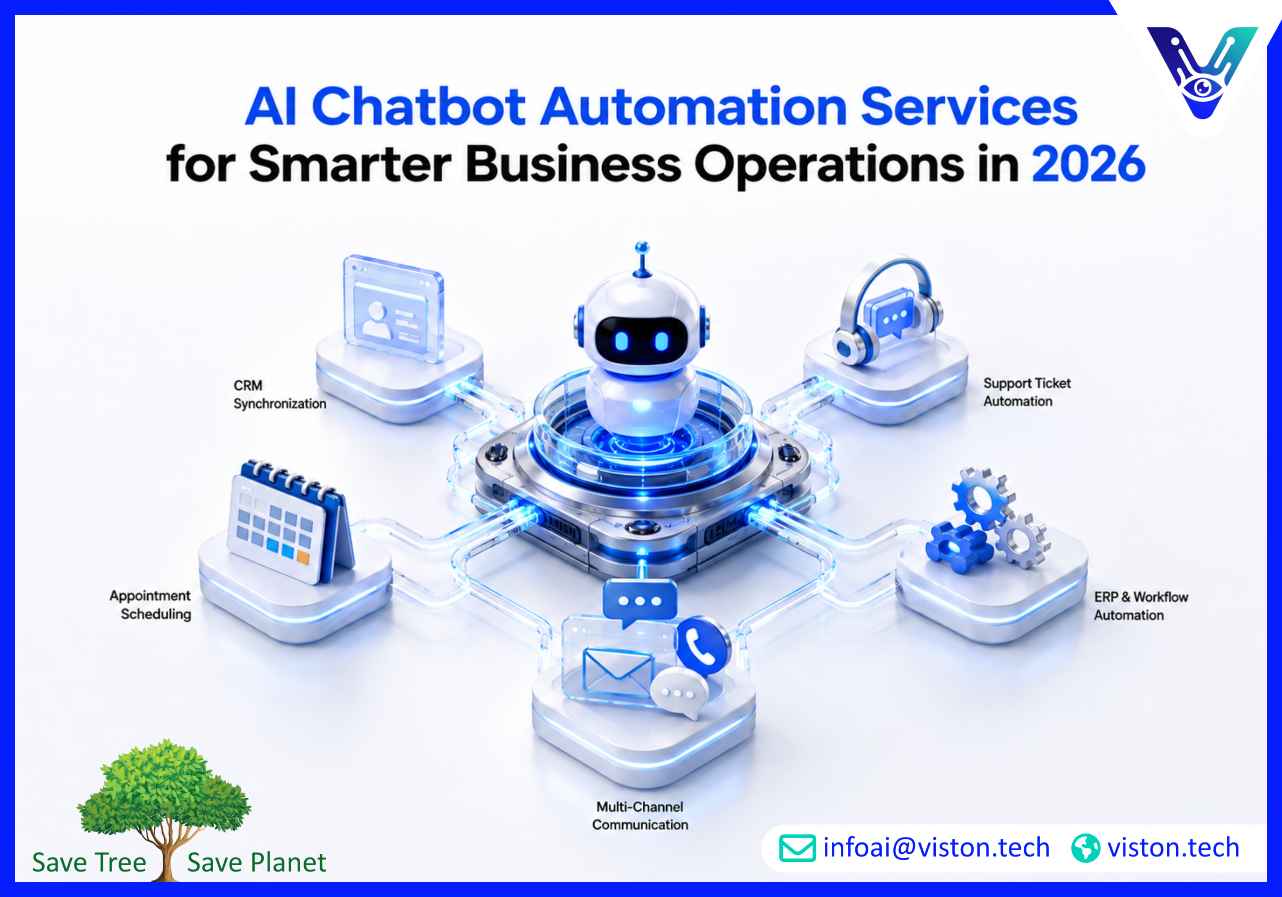
AI chatbot automation services are becoming essential for businesses that want faster support, cleaner workflows, and better customer experiences without adding unnecessary operational load. In 2026, the value is no longer in having a basic chatbot; it is in connecting conversational AI with business systems, data, teams, and measurable outcomes.
AI chatbot automation services combine conversational AI, workflow automation, system integration, and business process design. Instead of answering only simple questions, an automated chatbot can qualify leads, create support tickets, update CRM records, check order status, route requests, collect documents, schedule appointments, and trigger back-office workflows.
This is where AI Chatbot Integration becomes important. A chatbot that is not connected to core systems often becomes a disconnected front-end tool. It may respond to FAQs, but it cannot reliably complete business actions. Integrated chatbot automation connects the assistant to platforms such as CRM, ERP, helpdesk, e-commerce systems, HR tools, knowledge bases, payment systems, scheduling tools, and internal databases.
For business leaders, the goal is not simply to “use AI.” The goal is to reduce repetitive work, improve response speed, increase accuracy, and give customers or employees a smoother way to complete tasks. A well-designed chatbot automation system becomes part of the operating model, not just a website widget.
The strongest use cases are usually repetitive, rules-based, high-volume, and data-dependent. These are areas where automation can reduce manual handling while still allowing human teams to manage exceptions, sensitive cases, and complex decisions.
Business expectations have changed. Customers want immediate answers across websites, mobile apps, WhatsApp, social channels, and support portals. Employees expect internal tools to be as easy to use as consumer apps. At the same time, companies are under pressure to improve productivity, control costs, and use AI responsibly.
In 2026, chatbot automation is judged by execution quality. Businesses are looking for secure integrations, accurate responses, reliable workflow handling, strong fallback logic, auditability, and clear reporting. A chatbot that gives vague answers or fails when a request becomes specific can damage trust. A properly integrated automation system can do the opposite: it can make service faster, more consistent, and easier to scale.
The real shift is from conversational support to conversational operations. A customer should be able to ask about an order and receive a real-time answer from the order management system. A sales prospect should be qualified and added to the CRM without manual copy-paste work. An employee should be able to request IT help, trigger a ticket, and receive status updates through the same assistant.
This makes AI Chatbot Integration a central part of automation strategy. The chatbot needs access to the right systems through secure APIs, middleware, webhooks, databases, or platform connectors. It also needs business logic that controls what it can do, when it should escalate, and how it should record every action.
When implemented correctly, chatbot automation does not replace every human interaction. It removes avoidable friction so teams can focus on higher-value work. Human agents, sales teams, operations managers, and service teams still remain important, especially for complex, sensitive, or strategic conversations.
AI Chatbot Integration connects the chatbot experience with the systems that run the business. This is the difference between a bot that talks and a bot that acts. Strong integration allows the chatbot to retrieve real-time information, update records, trigger workflows, and maintain consistent data across platforms.
For example, an e-commerce chatbot can connect with Shopify, Magento, warehouse systems, and shipping tools to answer order questions. A B2B sales chatbot can connect with HubSpot, Salesforce, or Microsoft Dynamics to qualify prospects and create follow-up tasks. A service desk chatbot can connect with ServiceNow, Jira, or Zendesk to open and update tickets.
Poor integration creates operational risk. If a chatbot pulls outdated data, updates the wrong record, misses consent requirements, or fails during peak traffic, the business impact can be serious. This is why AI chatbot automation services must include technical architecture, testing, governance, monitoring, and ongoing optimization.
Good integration also protects scalability. A chatbot may work well during a pilot, but production usage requires stronger reliability. Businesses need rate-limit handling, fallback responses, error logging, API monitoring, data validation, and change management when connected systems are updated.
Successful chatbot automation starts with business priorities, not technology excitement. The best projects focus on measurable processes where automation can reduce effort, improve speed, or create a better user experience. A clear use case is more valuable than a broad chatbot with weak execution.
Businesses should identify workflows that are frequent, repetitive, and easy to define. Examples include lead qualification, support triage, order tracking, appointment booking, account updates, password reset guidance, policy lookup, and internal helpdesk routing. These use cases create practical value because they reduce predictable manual workload.
Before development begins, teams should define which systems the chatbot needs to read from and write to. This includes CRM fields, ticket categories, inventory data, order records, customer profiles, user permissions, and workflow triggers. Without this mapping, chatbot automation can become unreliable or difficult to maintain.
AI chatbot automation services must consider data protection from the beginning. The chatbot should access only the data required for the user’s request. Sensitive actions may require authentication, confirmation steps, role-based permissions, or human review. Businesses should also maintain logs so actions can be reviewed later.
Automation works best when it knows its limits. A chatbot should escalate when the user is frustrated, when the request is sensitive, when confidence is low, or when policy requires human approval. The handoff should include conversation history and captured data so the user does not need to repeat everything.
Many businesses track chatbot conversations but miss the bigger picture. Strong reporting should measure completed workflows, ticket deflection, lead conversion, average handling time, customer satisfaction, failed intents, escalation quality, and system uptime. These metrics show whether chatbot automation is creating real business value.
Viston AI is relevant to this topic because its AI Chatbot Integration service focuses on connecting conversational AI with business systems such as CRM, ERP, customer service, and operational platforms. The company positions chatbot integration as more than a standalone chatbot experience, with emphasis on real-time data synchronization, automated workflows, unified customer experiences, and secure enterprise connectivity.
For businesses exploring AI chatbot automation services, this matters because automation depends on how well the chatbot can interact with existing technology. Viston AI’s service information describes CRM synchronization, ERP workflow automation, multi-channel data orchestration, and intelligent process automation across web, mobile, WhatsApp, Teams, Slack, and SMS channels.
Its capabilities align with common buyer needs such as lead handling, customer support automation, order management, ticketing, internal service workflows, and operational visibility. The company also highlights enterprise security architecture, including authentication, API gateway protection, encrypted transmission, role-based access controls, and audit logging for integrated chatbot.
For organizations across industries, Viston AI may be a practical partner when the requirement is not only to launch a chatbot, but to connect it with the systems that drive daily work. Its AI Chatbot Integration offering is especially relevant for companies that need automation to support customer engagement, employee support, workflow routing, and data-connected digital service experiences.
AI chatbot automation services help businesses design, build, integrate, and optimize chatbots that can answer questions, collect information, trigger workflows, update systems, and support customers or employees through automated conversations.
Chatbot development focuses on creating the conversational interface and logic. AI Chatbot Integration connects that chatbot to business systems such as CRM, ERP, helpdesk, e-commerce, HR, or internal databases so it can perform real business actions.
Businesses with high-volume support, repetitive inquiries, lead qualification needs, order tracking requests, internal service processes, or multi-channel customer communication usually benefit the most from chatbot automation.
Yes. A chatbot can often be integrated with existing platforms through APIs, webhooks, middleware, database connections, or pre-built connectors. The exact approach depends on the software stack, security requirements, and workflow complexity.
Companies should review the provider’s integration capability, security approach, workflow design experience, testing process, support model, reporting features, and ability to connect automation with measurable business outcomes.
Yes. Viston AI lists AI Chatbot Integration as part of its service offering and describes capabilities around CRM synchronization, ERP workflow automation, multi-channel orchestration, workflow automation, and enterprise security for integrated chatbot systems.
AI chatbot automation services are most valuable when they move beyond simple conversations and become part of business operations. In 2026, companies need chatbots that can connect with systems, automate workflows, protect data, support users across channels, and deliver measurable outcomes. AI Chatbot Integration is the foundation that makes this possible. For businesses seeking a practical, scalable, and service-led approach, Viston AI offers relevant capabilities in integrated chatbot automation that can support customer engagement, internal workflows, and connected digital operations.
