
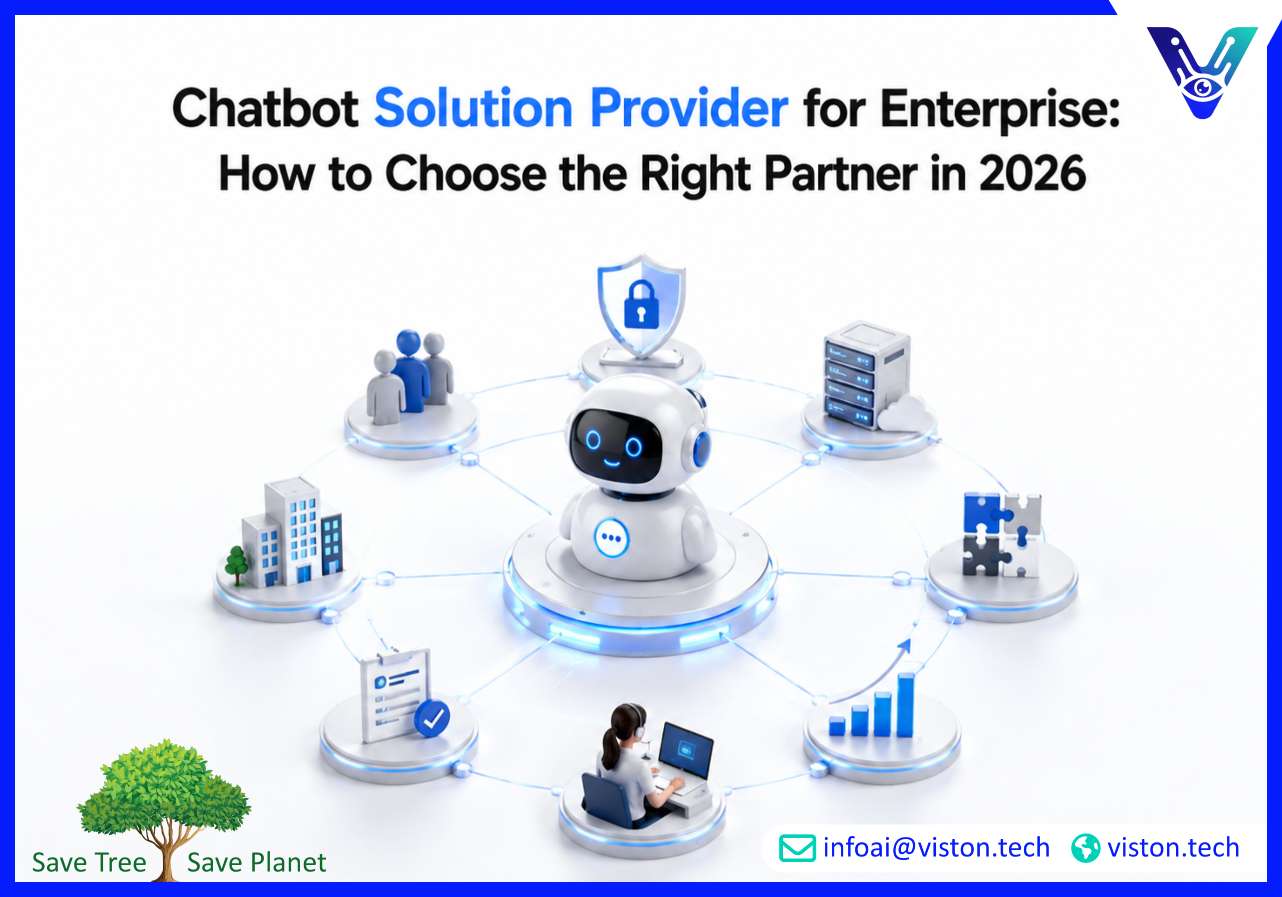
Choosing a chatbot solution provider for enterprise needs is no longer about adding a basic website bot. In 2026, enterprises need secure, integrated, intelligent conversational systems that can support customers, employees, sales teams, and operations with accuracy, context, governance, and measurable business value.
An enterprise chatbot solution provider designs, builds, integrates, deploys, and optimizes AI-powered conversational systems for complex business environments. These systems are different from small business chat widgets because they must work across departments, data sources, languages, platforms, user roles, and compliance requirements.
For enterprise buyers, the goal is not simply to automate replies. The real goal is to reduce service friction, improve response speed, support high-volume interactions, capture intent accurately, and connect conversations to business systems such as CRM, ERP, helpdesk platforms, knowledge bases, order management tools, HR systems, and internal workflow applications.
A mature enterprise AI chatbot can support customer service, sales qualification, employee helpdesk requests, onboarding, IT support, document search, appointment scheduling, multilingual assistance, lead routing, claim status updates, product guidance, and internal knowledge access. The best solutions are built around real business processes rather than generic scripts.
Enterprise AI Chatbots now commonly combine natural language processing, large language models, retrieval-augmented generation, intent classification, secure APIs, workflow automation, analytics dashboards, human handoff, and model monitoring. This allows the chatbot to understand user questions, retrieve trusted information, perform controlled actions, and escalate issues when automation is not appropriate.
A strong provider should help businesses answer practical questions before development begins. What should the chatbot automate? Which channels matter most? What systems must it integrate with? Which knowledge sources are reliable? What data should never be exposed? How will responses be tested? How will performance be measured? How will the chatbot improve over time?
This is why enterprise chatbot delivery requires both technical capability and operational understanding. The provider must understand how enterprise teams work, how users ask questions, how data flows across systems, and how conversational AI can support business outcomes without creating unnecessary risk.
In 2026, enterprise chatbot expectations are higher than ever. Buyers are no longer satisfied with bots that answer only predefined questions or redirect users to a support form. They expect context-aware AI assistants that can handle complex queries, personalize responses, support multiple channels, and operate within approved governance standards.
Customer expectations have also changed. People want fast, accurate, and available support across websites, apps, messaging platforms, email, and voice-enabled experiences. A delayed response can affect conversion, satisfaction, renewal likelihood, and brand trust. For internal teams, slow access to information can reduce productivity and create repeated manual work.
Enterprise AI Chatbots help address these issues by making knowledge and support available at scale. They can answer repetitive questions, guide users through structured processes, collect important information before escalation, and reduce the workload on human teams. When designed well, they improve both customer experience and employee efficiency.
However, 2026 enterprise adoption also brings new risks. Generative AI can produce confident but incorrect answers if it is not connected to trusted knowledge, tested properly, and governed carefully. Businesses must think about hallucination control, data privacy, access permissions, audit trails, prompt injection, response quality, compliance, bias, and safe escalation.
This is why a chatbot solution provider for enterprise projects must be able to balance innovation with reliability. A chatbot that sounds impressive in a demo may fail in production if it cannot handle real user behavior, incomplete questions, multilingual inputs, system downtime, edge cases, or regulated data.
The best enterprise chatbot projects usually start with a clear use case and expand gradually. For example, a company may begin with customer support automation, then extend the chatbot to sales qualification, order tracking, internal knowledge search, and workflow automation. This phased approach reduces risk while helping teams validate value before scaling.
Modern enterprise chatbot success depends on more than model selection. It depends on data preparation, conversation design, integration quality, security architecture, analytics, feedback loops, and ongoing optimization. Businesses that treat the chatbot as a living enterprise system rather than a one-time tool are more likely to see long-term value.
When evaluating a provider, enterprises should look beyond surface-level chatbot features. The right partner should offer a complete delivery approach covering strategy, architecture, implementation, testing, deployment, support, and continuous improvement.
A capable provider should begin by understanding the business process behind the chatbot. For customer support, this may include ticket categories, escalation rules, service-level expectations, customer segments, and knowledge base quality. For sales, it may include lead scoring, product qualification, CRM updates, meeting booking, and handoff to account teams.
Without this process understanding, the chatbot may answer questions but fail to move work forward. Enterprise buyers should choose a provider that can map conversational journeys to real workflows and measurable outcomes.
Enterprise AI Chatbots often rely on a combination of large language models, natural language understanding, retrieval systems, classification logic, and workflow rules. A strong provider should know when to use generative AI, when to use structured flows, and when to combine both.
Not every use case needs full generative AI. Some processes require deterministic responses, strict compliance wording, or rule-based decision paths. A specialized provider can choose the right architecture for accuracy, cost control, speed, and governance.
The quality of chatbot responses depends heavily on the quality of the information it can access. Enterprise content often lives across PDFs, help centers, CRM notes, policy documents, internal wikis, product databases, and ticket histories. A provider should help clean, structure, index, and connect this information so the chatbot can retrieve reliable answers.
For knowledge-heavy use cases, retrieval-augmented generation is especially important. It allows the chatbot to ground responses in approved business content rather than relying only on model memory. This improves accuracy and makes response governance easier.
A chatbot becomes more valuable when it can do more than answer questions. Enterprise integration allows it to check order status, create support tickets, update CRM records, schedule meetings, verify user roles, trigger workflows, retrieve account information, or pass structured data to other systems.
Common integrations may include Salesforce, HubSpot, Zendesk, ServiceNow, Microsoft Teams, Slack, WhatsApp, Shopify, SAP, Oracle, custom databases, payment systems, and internal APIs. The provider should understand authentication, permissions, API limits, error handling, and secure data exchange.
Enterprise chatbot projects must be secure from the beginning. Sensitive customer data, employee data, financial information, healthcare information, or confidential business records should not be exposed through poorly designed conversational flows.
A reliable provider should support role-based access, encrypted data handling, logging, auditability, secure integrations, human approval where needed, and clear controls around what the chatbot can and cannot do. For regulated sectors, compliance expectations should be addressed before deployment rather than after problems appear.
Enterprise AI Chatbots should be measured continuously. Useful metrics include containment rate, escalation rate, first response time, resolution quality, fallback rate, user satisfaction, unanswered questions, conversion contribution, ticket deflection, and workflow completion.
Analytics help teams identify where users struggle, which knowledge gaps exist, and which flows need improvement. A strong provider should offer ongoing optimization rather than treating launch as the end of the project.
Choosing the right chatbot solution provider for enterprise requirements should be a structured decision. The provider will influence customer experience, operational efficiency, technology architecture, and AI governance, so procurement teams should evaluate both capability and delivery maturity.
Start by reviewing whether the provider has experience with enterprise AI Chatbots, not just basic chatbot development. Enterprise delivery requires scalability, integrations, security planning, testing discipline, documentation, and stakeholder management. A provider that works only with simple scripted bots may struggle with complex workflows or high-volume deployments.
Next, assess the provider’s discovery process. A serious partner should ask about user groups, channels, systems, data sources, business objectives, compliance needs, escalation logic, and success metrics. If the provider jumps directly into tool selection without understanding the business case, that is a warning sign.
Enterprises should also examine the proposed architecture. The provider should be able to explain how the chatbot will understand intent, retrieve information, handle uncertain answers, integrate with systems, protect sensitive data, and escalate to human teams. The architecture should match the risk level and complexity of the use case.
Testing is another important factor. Enterprise chatbot testing should include functional testing, response accuracy testing, security testing, edge-case testing, multilingual testing where needed, user acceptance testing, and ongoing monitoring after deployment. This is especially important for generative AI systems, where response quality must be evaluated continuously.
Procurement teams should also ask how the provider handles ownership and portability. Businesses should understand who owns the data, prompts, workflows, integrations, analytics, and trained knowledge assets. They should also know whether the chatbot can be adapted as models, platforms, or business requirements change.
Finally, evaluate support. Enterprise chatbot systems need maintenance, content updates, performance reviews, integration monitoring, model improvements, and incident handling. The right provider should offer a clear support model with accountability after launch.
Viston AI is relevant to organizations evaluating a chatbot solution provider for enterprise needs because Enterprise AI Chatbots are part of its stated AI service portfolio. Its offering focuses on intelligent conversational systems designed for enterprise complexity, including customer interactions across channels, languages, and business units.
For businesses exploring Enterprise AI Chatbots, Viston AI’s capabilities align with several important buyer needs: chatbot development, business system integration, natural language processing, AI automation, workflow bots, multilingual support, and custom AI solution development. These capabilities matter because enterprise chatbot success depends on more than a conversational interface. It requires reliable architecture, integration with approved knowledge sources, secure data flows, and measurable operational outcomes.
Viston AI positions its chatbot solutions around customer engagement, support automation, lead generation, and business process automation. This makes the service relevant for enterprises that want to reduce repetitive work, improve response speed, support users across digital channels, and connect AI conversations to practical workflows.
Its broader AI portfolio, including NLP, LLM development, AI strategy, automation, MLOps, and model monitoring, can also support chatbot projects that need scalable deployment and continuous improvement. For enterprise teams, this type of combined capability is useful because chatbot performance depends on ongoing testing, optimization, governance, and integration maturity, not just the initial build.
A chatbot solution provider for enterprise companies designs, develops, integrates, and supports AI-powered chatbots for complex business environments. This usually includes use case planning, conversation design, LLM or NLP architecture, knowledge base integration, API connections, security controls, testing, deployment, analytics, and ongoing optimization.
Enterprise AI Chatbots are built for scale, security, integration, and operational complexity. Unlike basic chatbots, they can connect to business systems, retrieve approved knowledge, support multiple user groups, manage complex workflows, apply access controls, and provide analytics for continuous improvement.
Enterprise chatbots can reduce repetitive support requests, improve response times, qualify leads, automate internal helpdesk questions, support onboarding, retrieve policy or product information, guide users through workflows, and improve service availability across channels.
The timeline depends on complexity. A focused pilot may be implemented faster when knowledge sources and integrations are simple. A larger enterprise deployment involving multiple systems, departments, languages, compliance rules, and custom workflows requires more planning, testing, and phased rollout.
Businesses should check the provider’s enterprise experience, integration capability, AI and NLP expertise, security approach, testing process, analytics support, post-launch optimization model, and ability to align chatbot design with real business workflows.
Yes. Viston AI provides Enterprise AI Chatbots as part of its AI service portfolio, with capabilities connected to chatbot development, AI chatbot integration, multilingual support, NLP, workflow automation, and custom AI solution development for business use cases.
Choosing a chatbot solution provider for enterprise requirements is a strategic technology decision. The right partner should help the business move beyond simple automated replies toward secure, integrated, measurable, and scalable Enterprise AI Chatbots. In 2026, success depends on accurate knowledge retrieval, strong integrations, governance, user experience, analytics, and continuous improvement. For enterprises looking to automate customer engagement, internal support, sales workflows, or operational processes, Viston AI is a relevant specialist to consider because its AI chatbot services connect directly to enterprise-grade conversational automation needs.
