
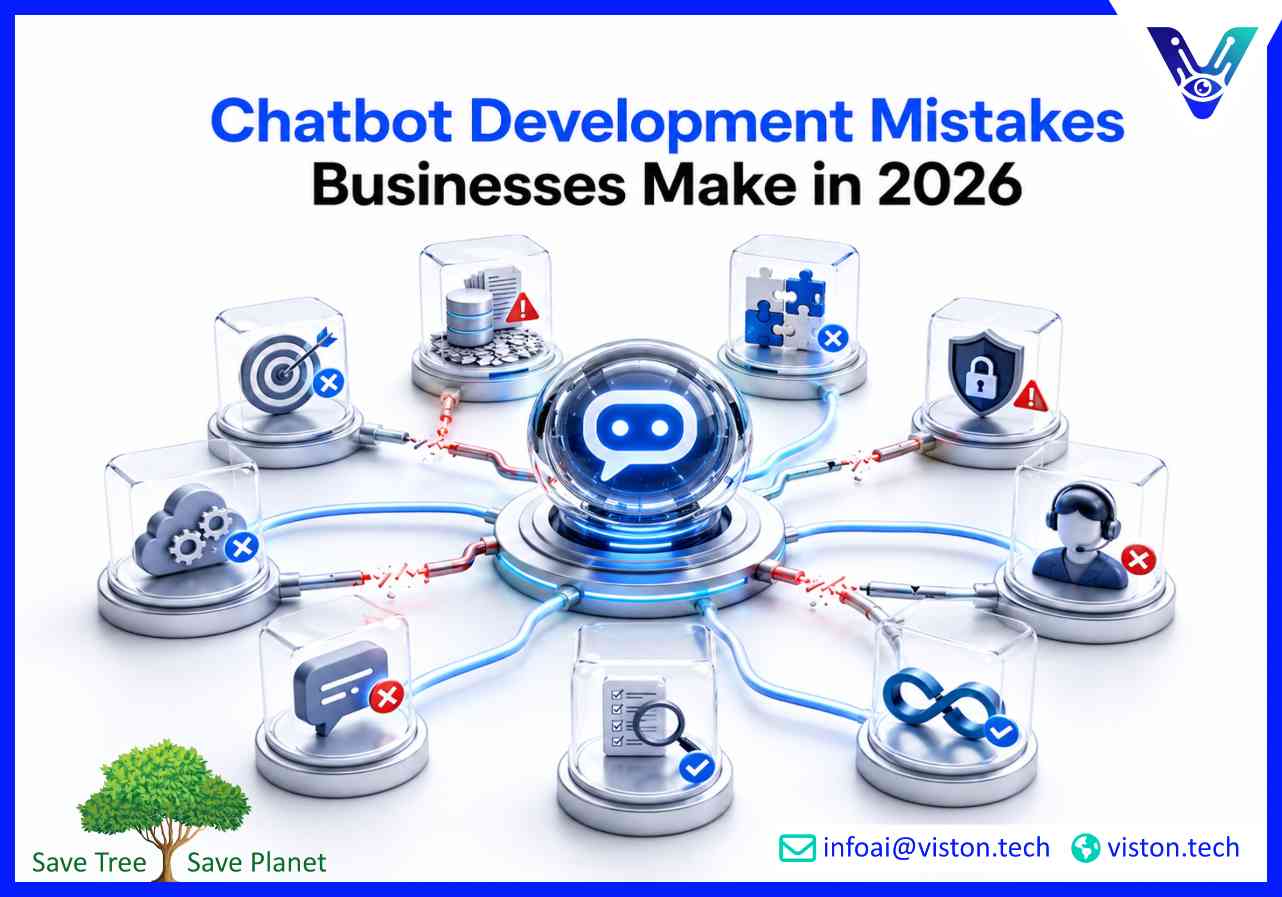
Chatbot development mistakes businesses make can turn a promising automation project into a costly customer experience problem. In 2026, buyers expect AI chatbots to be accurate, secure, integrated, measurable, and useful across real business workflows—not just scripted pop-ups that answer basic questions.
AI chatbots have moved beyond simple website widgets. Businesses now use them for customer support, lead qualification, sales assistance, employee helpdesks, appointment booking, onboarding, document search, internal knowledge access, and workflow automation. This makes chatbot quality a business-critical issue.
When a chatbot gives vague answers, misunderstands intent, exposes sensitive information, or fails to connect with core systems, the damage is not limited to one poor interaction. It can affect customer trust, sales conversion, support efficiency, brand perception, and operational reliability.
The rise of large language models has also changed expectations. Customers are no longer impressed by a bot that simply recognizes keywords. They expect conversational accuracy, context awareness, fast resolution, and smooth escalation to a human agent when needed. Internal users expect AI assistants that understand company knowledge, policies, tools, and workflows.
This is why AI Chatbot Development must be approached as a strategic product initiative, not a quick technical add-on. A good chatbot requires discovery, conversation design, data preparation, integration planning, testing, security controls, analytics, governance, and continuous improvement.
The most common mistakes usually happen before development even begins. Businesses often rush into tools, models, or platforms without defining the problem clearly. They may choose technology before understanding user journeys, data quality, compliance needs, or operational ownership. The result is a chatbot that looks modern but fails to deliver consistent business value.
One of the biggest chatbot development mistakes businesses make is building a chatbot because competitors have one. A chatbot needs a specific purpose. It may be designed to reduce repetitive support queries, improve lead response time, guide users through product selection, automate internal requests, or support multilingual customer engagement.
Without a clear objective, the chatbot becomes unfocused. It tries to answer everything and performs nothing particularly well. Teams then struggle to measure success because they never defined what success should look like.
A strong chatbot project begins with questions such as: What problem should the chatbot solve? Which users will interact with it? Which tasks should it handle independently? Which tasks require human escalation? What business metric should improve after launch?
Many businesses design chatbot flows based on internal assumptions instead of real customer or employee behavior. They map the company’s preferred process, not the user’s actual questions, frustrations, or decision points.
Effective chatbot development starts with intent research. This includes support tickets, sales conversations, website search queries, call center transcripts, CRM notes, product documentation, and common objections raised during buyer journeys. These inputs reveal what users truly ask and how they phrase their needs.
If a chatbot is trained only around company terminology, it may fail when users ask questions in everyday language. A business may call something “subscription modification,” while customers simply ask, “How do I change my plan?” Good chatbot design bridges that gap.
Not every business needs the same chatbot architecture. Some use cases work well with structured flows. Others need retrieval-augmented generation, natural language understanding, generative AI, API-based workflow automation, or a hybrid model.
A basic FAQ bot may be enough for simple website questions. A support automation chatbot may need CRM, helpdesk, order management, and knowledge base integration. An enterprise AI assistant may require role-based access, document retrieval, audit logs, secure deployment, and approval workflows.
Selecting the wrong chatbot type leads to poor performance. A scripted bot may feel too limited for complex questions, while an overly open generative chatbot may introduce accuracy and governance risks if not properly controlled.
A chatbot is only as reliable as the information it can access. Many businesses connect AI chatbots to outdated FAQs, inconsistent documents, duplicated policy files, or poorly organized help content. The chatbot then produces incomplete or conflicting answers.
For AI Chatbot Development, knowledge preparation is not optional. Businesses need clean content, clear ownership, structured documentation, version control, metadata, and regular review cycles. If the chatbot uses retrieval-augmented generation, source quality becomes even more important because the system must retrieve the right information before generating an answer.
Good knowledge design includes separating public and internal content, removing outdated documents, tagging content by topic and audience, defining approved answers for sensitive areas, and creating fallback rules when the answer is uncertain.
Another frequent mistake is treating the chatbot as a standalone interface. In reality, useful chatbots often need to connect with business systems. These may include CRM platforms, helpdesk software, eCommerce systems, booking tools, payment systems, HR platforms, ERP software, analytics platforms, and internal databases.
Without integrations, the chatbot can only provide general guidance. It cannot check order status, create tickets, qualify leads properly, update customer records, schedule appointments, or trigger workflow actions.
Integration planning should happen early. Teams must define what data the chatbot can access, which actions it can perform, what permissions are required, how errors are handled, and when human approval is needed. This prevents the chatbot from becoming a conversational dead end.
Generative AI has made chatbots more flexible, but flexibility must be balanced with control. Businesses sometimes launch AI chatbots without clear guardrails around what the bot can answer, when it should refuse, how it should cite internal knowledge, and when it should escalate.
This can create serious risks. A chatbot may provide inaccurate pricing, make unsupported promises, answer outside approved policy, or generate advice that should require expert review.
Modern chatbot development should include intent boundaries, confidence thresholds, escalation rules, controlled knowledge retrieval, prompt injection protection, restricted topics, testing datasets, and answer evaluation. The goal is not to make the chatbot answer everything. The goal is to make it answer the right things reliably.
Security is often underestimated during early chatbot projects. A chatbot may collect names, emails, phone numbers, support issues, order details, employee questions, or sensitive business information. If this data is not handled properly, the chatbot can become a compliance and privacy risk.
Businesses should consider data minimization, consent, encryption, access control, retention policies, audit trails, secure APIs, role-based permissions, and compliance requirements relevant to their market. Internal AI assistants also need strict access controls so employees only retrieve information they are authorized to see.
Security should not be added after launch. It should shape the chatbot architecture from the beginning.
A chatbot should make tasks easier, not force users through unnecessary steps. Some businesses overload the chatbot with long menus, excessive choices, unclear prompts, or rigid conversation paths.
Users prefer direct assistance. They want to ask a question, complete a task, or reach the right person quickly. A good chatbot experience uses simple language, short responses, clear options, and helpful follow-up prompts.
The best chatbot conversations feel guided but not restrictive. They allow users to express intent naturally while still keeping the interaction focused on resolution.
No chatbot can handle every scenario. One of the most damaging chatbot development mistakes businesses make is failing to design a smooth human escalation process.
When users are frustrated, repeating information to a human agent makes the experience worse. The chatbot should pass conversation history, user details, intent, sentiment, and relevant context to the support or sales team.
Human handoff should be triggered when the chatbot lacks confidence, detects urgency, receives repeated negative feedback, handles sensitive topics, or identifies a high-value sales opportunity. Escalation is not a failure. It is part of a well-designed service experience.
Businesses often build a chatbot for one channel and later realize customers expect support across website chat, mobile apps, WhatsApp, social messaging platforms, customer portals, and internal collaboration tools.
Each channel has different behavior. A website visitor may need product guidance. A WhatsApp user may expect quick support. An internal employee may need secure access to policy documents. A returning customer may expect personalized service.
AI Chatbot Development should account for channel-specific context, user authentication, message length, response timing, escalation options, and data access. A one-size-fits-all bot rarely delivers the same quality across every channel.
Many chatbot problems appear only when real users begin asking unpredictable questions. That is why testing must go beyond checking whether the chatbot works technically.
Businesses should test common intents, edge cases, ambiguous questions, spelling variations, multilingual inputs, sensitive topics, escalation triggers, integration failures, and unsupported requests. For generative chatbots, answer quality should be reviewed against approved knowledge sources and business rules.
Testing should involve business teams, support agents, sales teams, compliance reviewers, and actual users where possible. This helps identify practical issues that developers may not see in a controlled environment.
A chatbot is not finished at launch. User behavior changes, products change, policies change, and new questions appear over time. Businesses that fail to review chatbot analytics often miss opportunities to improve automation quality.
Useful chatbot metrics include containment rate, escalation rate, resolution rate, misunderstood intents, fallback frequency, conversation drop-off, lead quality, customer satisfaction, response accuracy, and task completion rate.
However, metrics should be interpreted carefully. A high containment rate is not valuable if users are receiving poor answers. A low escalation rate is not always good if the bot is blocking users from reaching support. The focus should be meaningful resolution, not vanity automation numbers.
Chatbot success requires ongoing ownership. Businesses sometimes assume the development team will manage everything after launch, but chatbot performance depends on content, operations, customer experience, compliance, analytics, and system maintenance.
A strong operating model defines who owns the knowledge base, who reviews failed conversations, who approves new intents, who monitors security, who manages integrations, and who decides when the chatbot should expand into new use cases.
Without ownership, chatbot quality slowly declines. Content becomes outdated, errors go unresolved, and users lose trust.
Viston AI supports businesses that want AI Chatbot Development to be practical, scalable, and aligned with real operational goals. For a topic such as chatbot development mistakes businesses make, this matters because most failures come from weak planning, poor data structure, limited integrations, and unclear post-launch improvement processes.
Viston AI’s approach is relevant for organizations that need more than a basic scripted bot. Its chatbot development work can support use cases such as customer service automation, lead qualification, website engagement, internal assistance, workflow support, and knowledge-based conversational experiences. The value comes from treating the chatbot as a business system rather than a simple front-end widget.
A well-built chatbot requires clear intent mapping, conversational design, secure architecture, integration readiness, testing, analytics, and optimization. Viston AI can help businesses think through these requirements before development begins, reducing the risk of launching a chatbot that looks functional but fails in real usage.
For companies operating in competitive digital markets, this type of structured delivery is important. It helps teams move from basic automation to reliable conversational AI that supports customers, employees, and business processes with greater consistency.
The most common mistakes include starting without a clear goal, using poor knowledge sources, ignoring integrations, weak human handoff, limited testing, lack of security planning, and failing to optimize the chatbot after launch.
AI chatbot projects often fail because businesses focus too much on the technology and not enough on user intent, data quality, conversation design, workflow integration, governance, and measurable business outcomes.
Accuracy improves when the chatbot uses clean knowledge sources, clear intent mapping, retrieval controls, approved response rules, confidence thresholds, regular testing, and continuous review of real conversation data.
Not always. Generative AI is useful for flexible conversations and knowledge-based answers, but some use cases are better served by structured flows or hybrid chatbot models. The right choice depends on complexity, risk, data quality, and business goals.
Viston AI helps businesses plan and build AI chatbot solutions around practical use cases, conversation quality, integrations, scalability, and ongoing improvement, making it relevant for companies that want reliable chatbot development support.
Businesses should evaluate discovery process, AI expertise, integration capability, security approach, testing standards, knowledge base strategy, analytics support, post-launch optimization, and experience with business-focused chatbot use cases.
Chatbot development mistakes businesses make usually come from treating chatbot projects as quick automation experiments instead of structured digital service systems. In 2026, a successful chatbot must understand user intent, use reliable data, connect with business tools, protect sensitive information, escalate smoothly, and improve over time. AI Chatbot Development works best when strategy, technology, content, security, and operations are planned together. For businesses that want dependable conversational automation, Viston AI offers relevant expertise in building chatbot solutions that support practical workflows, better user experiences, and long-term business value.
