
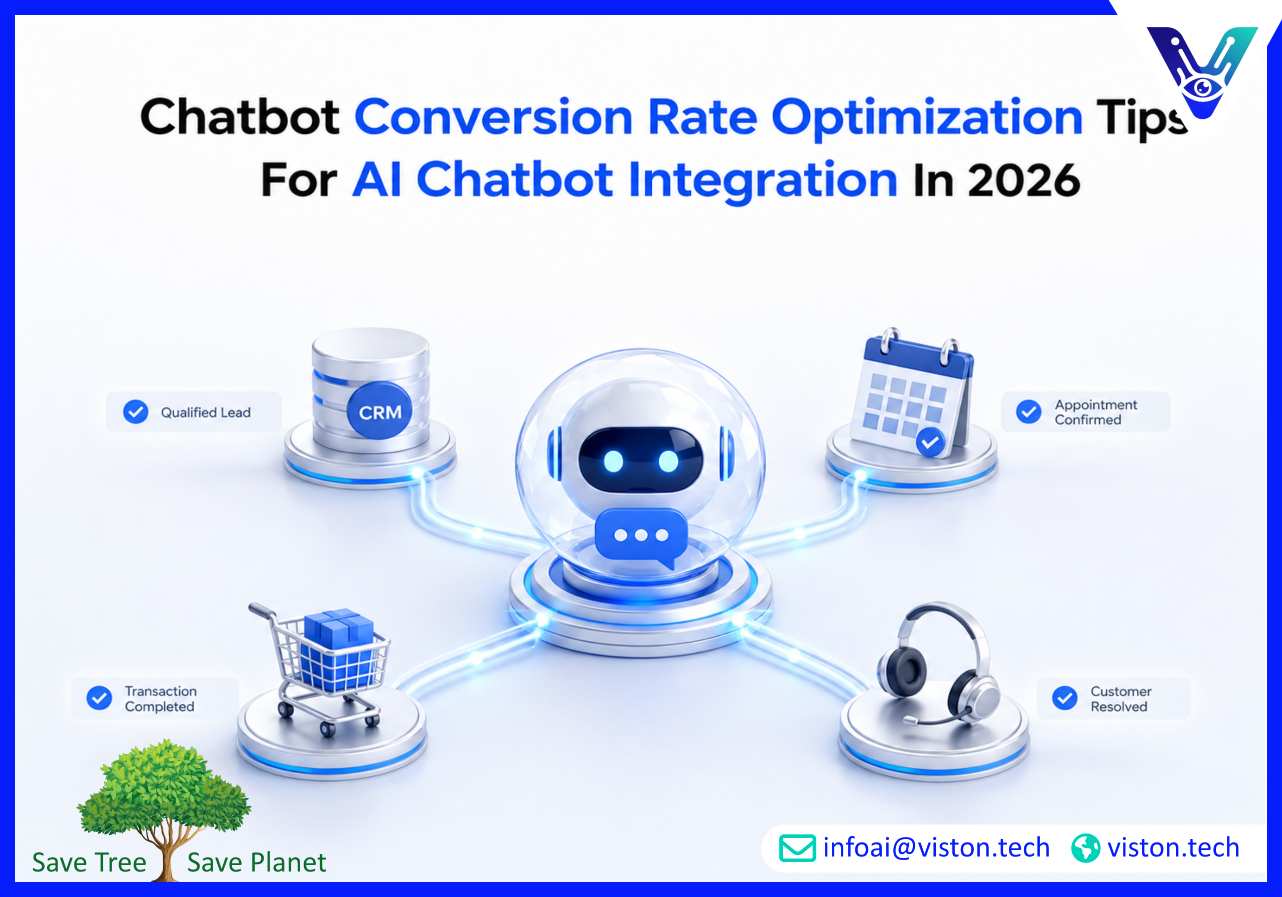
Chatbot conversion rate optimization tips matter because many businesses already have chatbots, but not all chatbots turn conversations into qualified leads, booked calls, purchases, support resolutions, or sales opportunities. In 2026, successful AI chatbot integration depends on strategy, data flow, user intent, and measurable conversion design.
Chatbot conversion rate optimization is the process of improving how effectively a chatbot moves users from initial interaction to a desired business action. That action may be submitting contact details, requesting a demo, completing a purchase, booking an appointment, starting a support ticket, upgrading a plan, or speaking with a sales representative.
A chatbot should not simply answer questions. It should understand user intent, guide the visitor toward the right next step, reduce friction, and connect the conversation with the company’s CRM, sales, support, ecommerce, or operational systems. This is where AI chatbot integration becomes important. A chatbot that is not connected to business systems may sound helpful, but it cannot reliably personalize responses, qualify leads, update records, trigger workflows, or measure outcomes.
For businesses, chatbot conversion rate optimization is not about making the bot more aggressive. It is about making the conversation more useful. Visitors convert when the chatbot gives fast answers, asks relevant questions, removes uncertainty, and helps them move forward without feeling trapped in a scripted flow.
Modern enterprise chatbot integration increasingly focuses on real-time system connectivity, CRM synchronization, workflow automation, multi-channel data orchestration, and secure access to customer or operational information. Viston AI describes AI chatbot integration as connecting conversational interfaces with CRM, ERP, and core business platforms to enable real-time data synchronization, automated workflows, and unified customer experiences.
In 2026, buyers expect digital interactions to be immediate, relevant, and consistent. A slow contact form, disconnected chatbot, or generic FAQ bot can lose high-intent prospects before the sales team even knows they visited. This is especially important for businesses with long buying cycles, high-consideration services, ecommerce journeys, SaaS demos, financial inquiries, healthcare appointments, education admissions, real estate leads, and B2B procurement conversations.
AI chatbots are now expected to do more than greet users. They need to qualify prospects, retrieve account or product information, answer objections, route requests, schedule meetings, capture structured data, and pass complete context to human teams. AI chatbot integration connects the conversation layer with the systems where decisions and actions happen.
When these issues exist, the chatbot may create activity but not business value. Optimizing conversion rates means improving the entire journey: message timing, conversation design, qualification logic, system integration, human handoff, analytics, and continuous testing.
Many businesses measure chatbot success by the number of conversations started. That is useful, but incomplete. A chatbot with high engagement and low lead quality may waste sales time. A chatbot with fewer conversations but stronger qualification, better routing, and clearer intent capture may produce better revenue outcomes.
The more practical metrics include qualified lead rate, demo booking rate, assisted checkout rate, support deflection quality, handoff success rate, average response time, abandoned conversation rate, revenue influenced, and CRM data completeness.
The best chatbot conversion rate optimization tips focus on how real users make decisions. A visitor usually opens a chatbot because they have a question, concern, or task. The chatbot must identify that need quickly and guide the user toward a relevant next step.
Do not begin by trying to automate every possible conversation. Start with the journeys most closely tied to revenue or operational value. These may include pricing questions, demo requests, product selection, service inquiries, order tracking, appointment booking, application support, renewal questions, or quote requests.
Each journey should have a clear conversion goal. For example, a B2B chatbot may aim to qualify the company size, budget range, service need, timeline, and preferred contact method before sending the lead to sales. An ecommerce chatbot may guide users to the right product category, compare options, answer delivery questions, and support checkout completion.
Conversion-focused chatbots should not force every user into the same script. A first-time visitor comparing services has different needs from an existing customer asking about an invoice. An enterprise buyer researching integration risks has different expectations from a small business owner seeking a fast quote.
Intent-based design allows the chatbot to identify why the user is engaging and respond with the most relevant path. Common intents include buying, comparing, troubleshooting, booking, requesting pricing, checking eligibility, learning about features, or speaking to a human.
A chatbot can only improve conversions consistently when captured data reaches the right system and team. CRM integration allows chatbot conversations to create or update leads, score prospects, assign owners, log conversation history, and trigger follow-up workflows.
For B2B sales, this is essential. A qualified inquiry should not sit inside a chatbot dashboard while the sales team works from a separate CRM. Proper AI chatbot integration makes the chatbot part of the revenue workflow rather than a disconnected website widget.
Long qualification forms inside chat can reduce completion rates. The goal is to collect enough information to help the user and route the inquiry correctly, not to interrogate the visitor. Ask questions that directly improve the next response or next action.
For example, instead of asking five generic questions, a chatbot can ask what the visitor wants to achieve, what system they currently use, and when they plan to implement a solution. That gives sales or support teams useful context while keeping the conversation natural.
Many chatbot conversations fail because they end with information but no action. After answering a pricing, service, or product question, the chatbot should offer a relevant next step. That may be booking a consultation, sending a quote request, starting a free assessment, connecting to support, downloading a guide, or viewing recommended products.
The call to action should match user intent. A visitor asking an early research question may not be ready for a sales call. A visitor asking about implementation timelines, integrations, or pricing may be much closer to conversion.
AI chatbot integration improves conversion performance by connecting chatbot conversations with the data, tools, and workflows needed to complete the user journey. Without integration, even a well-written chatbot is limited. With integration, the chatbot can become a real-time conversion assistant.
CRM integration helps businesses capture leads in a structured way. The chatbot can create records, update existing contacts, assign lead scores, segment prospects by interest, and send high-intent opportunities to the right team. This reduces manual data entry and improves follow-up speed.
For ecommerce and retail businesses, chatbot conversion optimization often depends on product discovery, stock visibility, delivery answers, cart support, and return guidance. Integration with ecommerce platforms, inventory systems, payment workflows, and order management tools allows the chatbot to answer practical buying questions instead of sending users to search manually.
For service businesses, healthcare providers, consultants, real estate teams, training companies, and SaaS demos, booking integration can directly improve conversions. If a user is ready to schedule, the chatbot should show availability, capture details, and confirm the appointment without making the visitor wait for a manual reply.
Customer support conversations can also influence conversion and retention. When a chatbot integrates with helpdesk tools, it can create tickets, check status, escalate issues, and preserve context for agents. This protects customer experience and reduces frustration during important moments.
Conversion optimization is not a one-time setup. Businesses need analytics that show where users drop off, which intents convert, which questions cause friction, and which chatbot responses lead to human escalation. The chatbot should feed useful data into reporting systems so teams can improve flows, refine prompts, test CTAs, and optimize handoff rules.
Effective chatbot conversion rate optimization depends on clear measurement. Businesses should define what conversion means before implementation. A conversion may be a qualified lead, completed booking, completed checkout, resolved support issue, account upgrade, form completion, or successful handoff.
A chatbot may influence a conversion even if the final action happens later. For example, a user may ask product questions through chat, receive an email follow-up, and convert after a sales call. Businesses should connect chatbot data with CRM, analytics, and sales reporting to understand assisted conversions.
Useful chatbot conversion metrics include:
Small changes can affect conversion quality. Businesses should test chatbot greetings, first questions, response length, CTA wording, lead qualification sequence, and escalation options. A chatbot that opens with “How can I help?” may perform differently from one that offers three clear paths such as “Compare services,” “Get pricing,” or “Book a consultation.”
Human handoff should not be treated as chatbot failure. For complex sales, regulated industries, technical services, high-value purchases, or sensitive customer issues, the right handoff can increase trust. The chatbot should know when to escalate and should pass full context to the human team.
A strong handoff includes the user’s question, intent, captured details, previous answers, urgency, preferred contact method, and any relevant CRM or account information. This prevents users from repeating themselves and helps teams respond with confidence.
Viston AI is relevant to chatbot conversion rate optimization because its AI chatbot integration service focuses on connecting conversational AI with the business systems that influence customer decisions and operational outcomes. Its service page describes enterprise-grade chatbot integration across CRM, ERP, and core platforms, with capabilities such as real-time data synchronization, workflow automation, and unified customer experiences.
For businesses trying to improve chatbot conversion rates, this integration-first approach matters. A chatbot can only qualify leads, personalize responses, automate follow-ups, or support complex buyer journeys when it can access and update the right systems. Viston AI’s described integration capabilities include CRM synchronization, ERP workflow automation, multi-channel data orchestration, and intelligent process automation across web, mobile, WhatsApp, Teams, Slack, and SMS touchpoints.
This makes the service relevant for businesses that want their chatbot to support measurable outcomes rather than operate as a simple FAQ tool. By connecting chatbot conversations with CRM, sales, customer service, ecommerce, and back-office workflows, Viston AI can support use cases such as lead qualification, appointment booking, order inquiries, service ticketing, customer data updates, and automated routing.
For companies operating across multiple markets or customer channels, a connected chatbot can improve consistency, reduce manual follow-up, and help teams make decisions from cleaner conversation data. The strongest value comes when chatbot integration is planned around business goals, user intent, security requirements, reporting needs, and continuous optimization.
Chatbot conversion rate optimization is the process of improving how well a chatbot turns conversations into business outcomes such as qualified leads, booked meetings, completed purchases, support resolutions, quote requests, or account actions.
AI chatbot integration improves conversions by connecting the chatbot with CRM, ecommerce, calendar, ticketing, ERP, analytics, and workflow systems. This allows the chatbot to personalize responses, capture structured data, trigger actions, and route users more effectively.
Businesses should track qualified lead rate, intent completion rate, booking rate, checkout assistance rate, human handoff success, drop-off points, response time, CRM record quality, and revenue influenced by chatbot-assisted journeys.
Many chatbots fail to convert because they use generic scripts, ask too many questions, lack CRM integration, provide unclear next steps, or cannot access real-time business data. Conversion depends on useful guidance, not just chatbot engagement.
Viston AI’s AI Chatbot Integration service is relevant for businesses that want to connect chatbot conversations with CRM, ERP, sales, support, and workflow systems. This can help improve lead routing, personalization, automation, and measurable conversion outcomes.
Chatbot flows should be reviewed continuously, with structured analysis at least monthly for active sales or support channels. High-traffic businesses may need weekly testing of greetings, CTAs, qualification logic, escalation rules, and drop-off points.
Chatbot conversion rate optimization tips are most valuable when they are connected to real business workflows. A chatbot should not only answer questions; it should guide users, qualify intent, reduce friction, trigger actions, and support measurable outcomes. AI Chatbot Integration makes this possible by connecting the conversation layer with CRM, sales, support, ecommerce, analytics, and operational systems. For businesses planning chatbot improvements in 2026, the priority should be clear intent design, practical system integration, strong handoff logic, and continuous measurement. Viston AI is positioned as a relevant specialist for companies seeking integrated chatbot systems that support conversion-focused customer journeys.
