
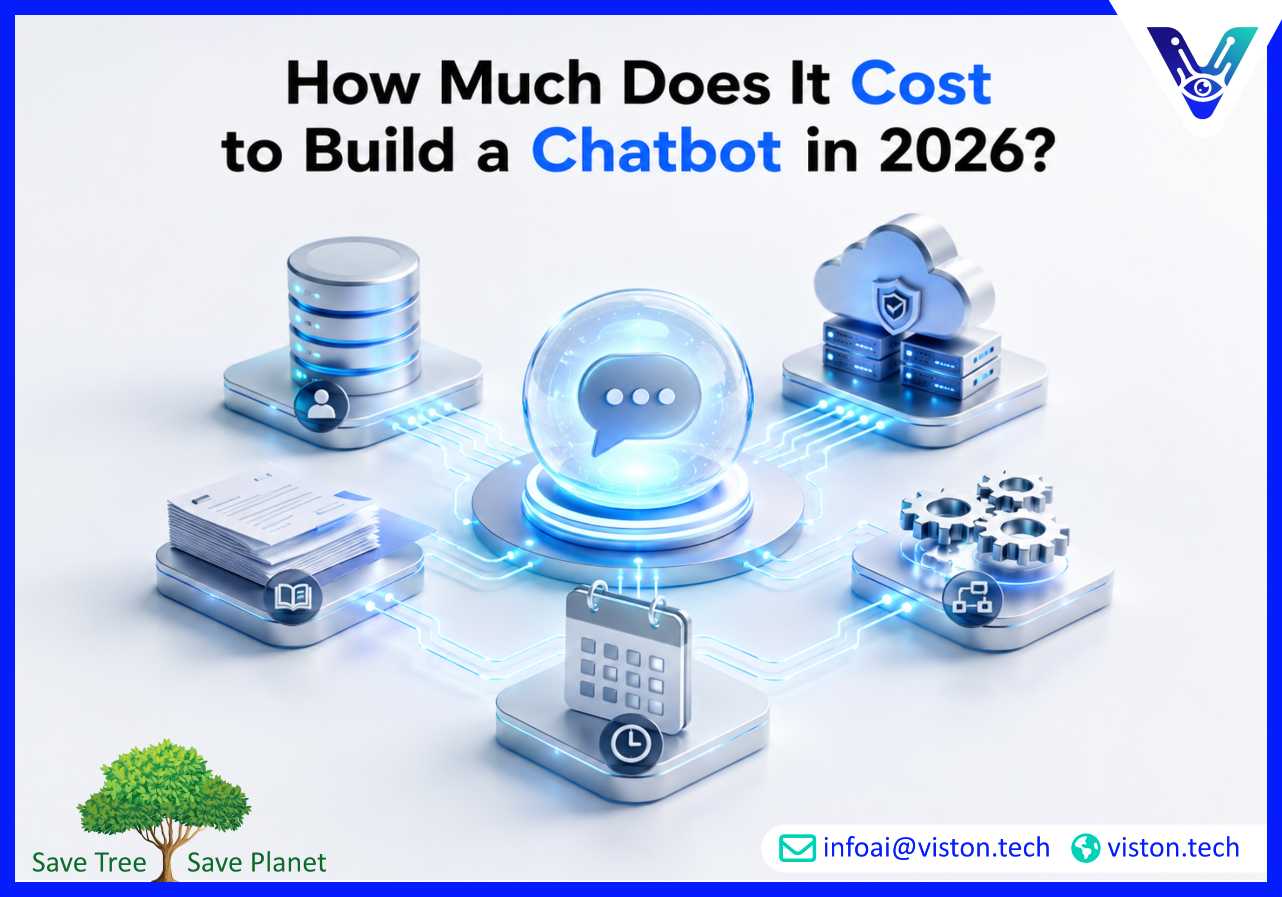
How much does it cost to build a chatbot? For most businesses, the answer depends on far more than the chat window itself. In 2026, chatbot pricing is shaped by AI capability, integrations, data quality, security requirements, automation depth, and the level of business value the chatbot is expected to deliver.
Building a chatbot is no longer limited to creating a scripted FAQ tool that answers a few common questions. Modern chatbot development can involve conversational AI, natural language understanding, large language model integration, workflow automation, customer data access, backend system connectivity, reporting dashboards, compliance controls, and continuous optimization.
A basic chatbot may simply guide users through fixed choices such as “book a demo,” “track an order,” or “contact support.” This type of solution is useful when the conversation path is predictable and the business only needs limited automation. It usually costs less because the logic, testing, and integrations are simpler.
An AI chatbot is more advanced. It can understand open-ended questions, interpret intent, generate natural responses, retrieve information from knowledge bases, summarize conversations, qualify leads, support agents, and hand over complex issues to human teams. For businesses that need scalable customer engagement, internal support, sales assistance, or operational automation, AI chatbot development requires deeper planning and stronger technical execution.
The cost also depends on whether the chatbot is built as a standalone website assistant, a customer service bot, a lead qualification tool, a virtual sales assistant, an internal workflow assistant, or a multi-channel AI agent connected to CRM, ERP, helpdesk, calendar, payment, inventory, or communication systems.
In practical terms, chatbot development cost is the cost of designing a reliable conversational system that can serve users accurately, safely, and efficiently. The more business-critical the chatbot becomes, the more investment is required in discovery, conversation design, integrations, testing, monitoring, and ongoing improvement.
The cost to build a chatbot in 2026 can range from a few thousand dollars for a simple rule-based chatbot to hundreds of thousands of dollars for an enterprise-grade AI chatbot with advanced automation, custom integrations, governance, and high-volume usage support.
For a small business chatbot with limited functionality, a realistic budget may begin around $5,000 to $15,000. This usually covers simple flows, basic FAQs, contact capture, website deployment, and light customization. These bots are suitable for straightforward use cases where the main goal is to reduce repetitive inquiries or collect leads.
A mid-level AI chatbot often costs between $20,000 and $75,000. This type of chatbot may include natural language processing, custom knowledge base training, CRM integration, human handoff, analytics, multilingual capability, and more advanced conversation design. It is a common range for businesses that want a production-ready chatbot with measurable operational value.
An enterprise AI chatbot can cost from $75,000 to $250,000 or more. The price increases when the chatbot needs to support multiple departments, high traffic, secure authentication, regulated data, complex workflows, custom LLM orchestration, role-based access, omnichannel deployment, or integrations with core business systems.
Highly advanced AI assistants or agentic chatbot systems may exceed $250,000, especially when they perform multi-step tasks, connect to several internal tools, use custom models, require strict compliance controls, or operate across global teams and customer segments. These projects are less like a simple chatbot build and more like a custom AI software development initiative.
A useful way to think about chatbot pricing is to separate the upfront build cost from the ongoing operating cost. The build cost includes strategy, design, development, integrations, testing, and deployment. The operating cost includes hosting, AI model usage, API fees, maintenance, content updates, monitoring, security reviews, analytics, and optimization.
This distinction matters because a chatbot may look affordable at launch but become expensive if token usage, support requirements, or integration maintenance are not planned properly. In 2026, buyers are paying closer attention to total cost of ownership rather than only the initial development quote.
The biggest reason chatbot development prices vary is that no two business requirements are exactly the same. A chatbot that answers 20 website FAQs is very different from an AI assistant that qualifies leads, books appointments, checks customer records, creates support tickets, and sends follow-up messages automatically.
Rule-based chatbots are the most affordable because they follow predefined logic. AI-powered chatbots cost more because they require language understanding, prompt engineering, model selection, training data preparation, guardrails, and response quality testing.
Generative AI chatbots cost more than traditional NLP bots when they use large language models to generate contextual answers. They may deliver better flexibility, but they also require stronger controls to prevent inaccurate, unsafe, or off-brand responses.
A chatbot must be easy to use, not just technically functional. Good conversation design defines intents, user journeys, fallback responses, escalation rules, tone of voice, data capture points, and completion goals. Poorly designed chatbots create frustration and increase support workload instead of reducing it.
For business-critical use cases, conversation design can take a meaningful share of the budget because the chatbot must guide users clearly, ask the right questions, avoid dead ends, and hand over to humans when needed.
Integrations are often one of the largest cost drivers in AI chatbot development. A chatbot that only displays answers from a static knowledge base is simpler to build. A chatbot that connects with Salesforce, HubSpot, Zendesk, Shopify, Microsoft Teams, Slack, Google Calendar, payment systems, inventory tools, or internal databases requires more backend engineering.
Each integration adds planning, authentication, API mapping, error handling, testing, security review, and maintenance. The value can be significant, but the cost must be estimated carefully.
An AI chatbot is only as useful as the information it can access. Businesses often underestimate the effort required to prepare FAQs, product data, policy documents, support articles, pricing logic, internal process documentation, and escalation rules.
If the source content is outdated, inconsistent, or incomplete, the chatbot may produce weak or inaccurate responses. Data cleanup, structuring, tagging, retrieval setup, and ongoing content governance can increase the project cost, but they are essential for reliable performance.
Chatbots that handle personal data, financial information, healthcare queries, employee records, or customer account details require stronger security controls. This may include encryption, access control, audit logs, data retention policies, role-based permissions, secure hosting, compliance review, and controlled model usage.
Security requirements can increase costs, but they also reduce business risk. For enterprise buyers, this is often non-negotiable.
A website chatbot is usually simpler than a chatbot deployed across web, mobile app, WhatsApp, SMS, email, voice, Slack, Microsoft Teams, and customer portals. Multi-channel deployment requires consistent experience design, channel-specific formatting, routing logic, and monitoring.
The wider the deployment scope, the more testing and support are required.
A useful chatbot should provide insight into user behavior. Analytics may include conversation volume, completion rates, unanswered questions, lead quality, escalation frequency, resolution time, customer satisfaction, and conversion contribution.
Human handoff also affects cost. The chatbot may need to transfer conversations to live agents, create tickets, summarize user intent, or route inquiries by department. These features improve business value but require more development effort.
A realistic chatbot budget should begin with business goals, not features. Before asking for a quote, decision-makers should define what the chatbot needs to achieve. Is the goal to reduce support tickets, qualify B2B leads, book appointments, support employees, automate internal workflows, or improve customer response times?
Once the goal is clear, the next step is to define the chatbot’s scope. This includes target users, conversation types, supported channels, required integrations, languages, escalation process, reporting needs, compliance requirements, and expected monthly conversation volume.
For a lean first version, businesses can start with a focused chatbot that solves one high-value problem. For example, a B2B company may begin with lead qualification and meeting booking before expanding into customer support. A service business may start with appointment scheduling before adding payment, reminders, and CRM workflows.
This phased approach helps control cost and reduces implementation risk. It also allows the business to validate real user behavior before investing in more advanced AI capabilities.
Another important budgeting consideration is ongoing improvement. Chatbots should not be treated as one-time projects. After launch, teams need to review failed conversations, improve prompts, update knowledge sources, refine flows, add new intents, monitor model performance, and adjust automation rules.
Businesses should also budget for AI model usage. Generative AI chatbots may incur usage-based costs depending on conversation volume, response length, model choice, retrieval complexity, and tool usage. Without monitoring, these costs can become difficult to predict.
A strong chatbot development quote should explain what is included in the build, what is billed separately, what assumptions are being made, and what ongoing support will cost. Buyers should look for clarity around discovery, design, development, testing, deployment, training, maintenance, integrations, hosting, AI usage, and optimization.
The cheapest quote is not always the best option. A low-cost chatbot that fails to understand users, creates support issues, or exposes sensitive data can become more expensive than a properly planned solution. The right investment level depends on business impact, risk, and scalability needs.
Viston AI is relevant to businesses evaluating the cost to build a chatbot because its service portfolio includes AI chatbot development, custom AI solution development, NLP and text analysis, workflow automation, model monitoring, and AI consulting capabilities. These areas align closely with the practical requirements behind modern chatbot projects.
For businesses that need more than a basic scripted bot, Viston AI’s approach can support the planning and delivery of conversational AI systems powered by technologies such as ChatGPT, Gemini, and custom models. This is important because chatbot cost is not only determined by interface design; it is shaped by how well the solution understands context, connects with business workflows, retrieves information, and supports measurable outcomes.
Viston AI’s broader AI and automation capabilities are also relevant when a chatbot needs to qualify leads, support customer service, automate repetitive tasks, summarize conversations, trigger actions, or connect with internal tools. Instead of treating chatbot development as a standalone widget, a specialist AI development partner can help businesses think through architecture, data readiness, integration needs, governance, and long-term scalability.
For organizations planning AI chatbot development in 2026, this type of capability is useful because the strongest chatbot investments are usually those that balance cost control with reliability, security, usability, and business value. Viston AI can be positioned as a practical partner for companies that want a chatbot built around real operational goals rather than generic automation.
A small business chatbot may cost around $5,000 to $15,000 for a basic rule-based solution. If the chatbot needs AI responses, CRM integration, appointment booking, or lead qualification, the cost may move into the $20,000 to $50,000 range.
AI chatbots cost more because they require model selection, prompt design, knowledge base preparation, testing, guardrails, analytics, and often API or LLM usage costs. They can handle more flexible conversations, but they need stronger quality control.
Ongoing costs may include hosting, AI model usage, API fees, maintenance, bug fixes, content updates, analytics review, conversation optimization, security monitoring, and technical support. These costs should be included in the total chatbot budget.
Chatbot software can be cheaper at the beginning, especially for simple use cases. A custom chatbot may cost more upfront but can be more suitable when a business needs ownership, deeper integrations, tailored workflows, data control, or industry-specific automation.
A basic chatbot may take a few weeks. A mid-level AI chatbot can take two to four months. Enterprise chatbot development may take four to nine months or longer depending on integrations, compliance requirements, testing, and deployment complexity.
Yes. Viston AI’s AI chatbot development and consulting capabilities can help businesses define scope, identify required integrations, assess AI readiness, and estimate a practical budget based on business goals, complexity, and long-term scalability needs.
How much does it cost to build a chatbot? In 2026, the answer depends on intelligence level, integrations, data readiness, security, channels, automation depth, and ongoing support. A simple chatbot may be affordable, while an enterprise AI chatbot requires a larger investment because it must operate reliably inside real business workflows. The best approach is to define the business outcome first, then build a chatbot scope that supports that outcome without unnecessary complexity. For companies considering AI Chatbot Development, Viston AI offers relevant expertise for planning, building, and scaling chatbot solutions designed around practical business value.
