
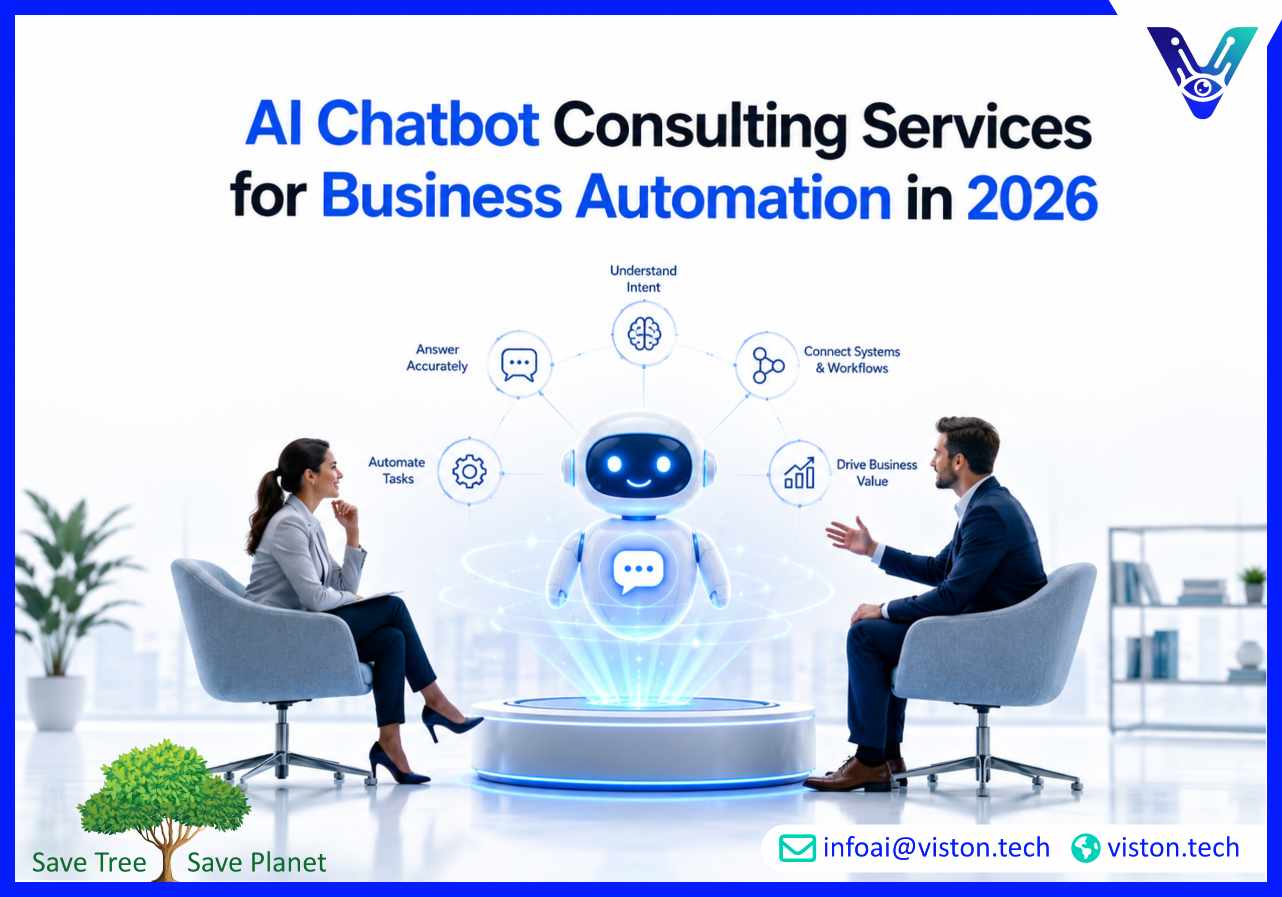
AI chatbot consulting services help businesses move beyond basic chat widgets and build conversational systems that solve real operational problems. In 2026, companies need chatbots that understand intent, connect with business systems, support customers accurately, and create measurable value across sales, service, operations, and internal teams.
AI chatbot consulting services are professional advisory, strategy, design, development, and implementation services that help organizations plan and deploy intelligent chatbot and virtual assistant solutions. The goal is not simply to add automation to a website. The goal is to build a reliable conversational experience that can answer questions, qualify leads, guide users, automate workflows, and support human teams.
Many businesses start with a chatbot because they want faster response times, lower support pressure, or better lead capture. However, successful chatbot projects depend on much more than selecting a tool. A consultant must understand the business process, customer journey, data sources, escalation rules, compliance needs, language requirements, and technology environment.
A strong consulting engagement usually begins with discovery. This includes reviewing existing support tickets, customer questions, website journeys, CRM data, internal knowledge bases, and team workflows. The consultant then identifies where conversational AI can create value without creating unnecessary complexity.
AI chatbot consulting services may include:
The consulting layer is important because chatbot success depends on business fit. A chatbot that works well for e-commerce product discovery may not work for healthcare intake, financial service support, manufacturing operations, or enterprise HR queries. Each environment has different risks, tone requirements, data dependencies, and success metrics.
In 2026, businesses are no longer evaluating chatbots as experimental technology. They are evaluating them as part of customer experience, revenue operations, support automation, and digital transformation. Customers expect faster answers, but they also expect accuracy, privacy, context, and smooth handoff to human teams when needed.
The rise of large language models has made chatbot experiences more flexible, but it has also increased the need for careful planning. A modern AI chatbot can summarize information, understand natural language, retrieve knowledge, personalize responses, and trigger business actions. Without proper consulting, the same flexibility can create risks such as inaccurate answers, poor escalation, inconsistent brand tone, weak data governance, or disconnected workflows.
Good consulting helps businesses answer practical questions before development begins:
These questions matter because chatbot development is not only a technical project. It affects customer trust, employee workflows, brand experience, compliance posture, and operational efficiency. A poorly planned chatbot can frustrate users and increase support workload. A well-planned chatbot can reduce repetitive tasks, improve availability, qualify enquiries, guide users to the right information, and help teams focus on higher-value work.
For enterprise environments, the consulting role becomes even more important. Large organizations often need multilingual support, role-based access, auditability, analytics, secure integrations, and governance controls. They may also need separate chatbot experiences for customer support, employee helpdesk, sales enablement, onboarding, or internal knowledge search.
AI Chatbot & Virtual Assistant Development addresses several business challenges that traditional support channels and static websites often struggle to solve. The value comes from combining conversational design, automation, natural language processing, integrations, and continuous improvement.
Support teams often spend a large portion of their time answering repeat questions about pricing, availability, account access, order status, policies, appointments, documentation, or service requests. An AI chatbot can handle routine enquiries, collect context, recommend resources, and escalate complex cases to the right team.
This does not replace the need for human support. Instead, it helps support teams use their time more effectively. Customers receive immediate help for common issues, while agents receive better context when a conversation requires human attention.
Many website visitors leave without filling out a form because they cannot quickly find the right information. A chatbot can ask qualifying questions, recommend relevant services, collect contact details, and route leads into a CRM. For B2B companies, this can support sales teams by filtering enquiries based on budget, timeline, company size, service need, and buying intent.
Consulting is valuable here because lead qualification flows must be designed carefully. A chatbot should not feel intrusive or generic. It should guide the buyer naturally and provide useful answers before asking for information.
Virtual assistants are not limited to customer-facing use cases. Businesses can deploy internal assistants for HR policies, IT support, onboarding, training, finance queries, document search, project support, or knowledge management. These assistants help employees find information faster and reduce dependency on manual back-and-forth communication.
For internal use cases, consultants must pay close attention to permissions, data access, source reliability, and workflow ownership. An internal assistant must provide accurate answers and respect access boundaries.
The most useful AI chatbots do more than answer questions. They connect with systems such as CRM platforms, ticketing tools, booking systems, payment workflows, inventory systems, analytics dashboards, or enterprise applications. This allows the chatbot to perform actions such as creating support tickets, booking appointments, checking order status, updating records, or routing requests.
Integration planning is one of the most important parts of AI chatbot consulting services. Without it, a chatbot remains isolated. With the right integrations, it becomes part of the business workflow.
Choosing the right AI chatbot consulting partner requires more than comparing development packages. Businesses should evaluate whether the provider understands strategy, engineering, user experience, security, and long-term optimization.
A credible consultant should not begin by promising a universal chatbot. They should first identify the highest-value use cases. For some companies, the best starting point may be customer support automation. For others, it may be sales qualification, appointment scheduling, internal knowledge search, or workflow automation.
The best use cases are usually high-volume, repeatable, measurable, and supported by reliable information. Starting with a focused use case helps reduce risk and creates a stronger foundation for future expansion.
AI chatbot performance depends heavily on conversation design. The chatbot must understand user intent, ask clear follow-up questions, avoid unnecessary complexity, and provide useful answers. It must also know when not to answer and when to escalate.
Businesses should look for consultants who consider tone, response structure, fallback handling, multilingual needs, accessibility, and channel-specific behavior. A chatbot on a website may need a different experience from one used in WhatsApp, Slack, Microsoft Teams, or a mobile app.
An AI chatbot is only as useful as the information it can access. Many organizations discover that their knowledge base is outdated, scattered, duplicated, or poorly structured. Consulting should include data readiness review, content gap analysis, and knowledge organization.
For retrieval-based AI chatbots, source quality matters. The system must retrieve information from approved documents, FAQs, policies, product data, help articles, or internal resources. This helps reduce inaccurate responses and improves trust.
Security cannot be added at the end of a chatbot project. It must be part of the design. Businesses should consider what data the chatbot collects, where that data is stored, which systems it connects to, how users are authenticated, and how sensitive requests are handled.
Governance also includes human review processes, analytics monitoring, conversation logs, escalation policies, and model behavior controls. For regulated industries, compliance requirements may affect data retention, consent, audit trails, and access control.
A chatbot should be measured after launch. Useful metrics may include containment rate, escalation rate, user satisfaction, response accuracy, lead conversion, ticket reduction, average handling time, task completion rate, and unresolved query patterns.
Consultants should help define success metrics before development begins. This makes it easier to prove value, identify improvement areas, and expand the chatbot responsibly over time.
Viston AI is relevant to AI chatbot consulting services because its service portfolio includes AI Chatbot & Virtual Assistant Development, Enterprise AI Chatbots, Voice-Enabled Assistants, Multilingual Support, AI Chatbot Integration, AI Readiness Assessment, AI Strategy Development, and AI & ML Strategic Consulting.
For businesses exploring chatbot projects, this combination matters because successful delivery requires both consulting and implementation capability. Viston AI’s chatbot development offering focuses on intelligent conversational systems powered by technologies such as ChatGPT, Gemini, and custom models, with applications across customer service, lead generation, and business process automation.
In practical terms, Viston AI can support organizations that need to move from a broad automation idea to a structured chatbot roadmap. This may include identifying suitable use cases, planning integrations, designing conversation flows, developing custom chatbot experiences, and supporting operational adoption. Its related services in NLP, AI automation, workflow bots, MLOps, model monitoring, and custom AI solution development also align with the broader needs of businesses building scalable conversational AI systems.
For companies in global markets, this type of service alignment is useful when chatbot projects require more than a plug-and-play setup. Businesses often need secure integration, reliable knowledge handling, multilingual support, performance monitoring, and a roadmap for future improvement. Viston AI’s positioning across AI strategy, chatbot development, and business automation makes it a relevant specialist for organizations considering AI Chatbot & Virtual Assistant Development.
AI chatbot consulting services help businesses plan, design, develop, integrate, and optimize chatbot or virtual assistant solutions. The service usually includes use case discovery, conversation strategy, data readiness, platform selection, integration planning, security review, and performance improvement.
Consulting focuses on strategy, requirements, feasibility, user journeys, risks, and implementation planning. Chatbot development focuses on building and deploying the solution. Strong projects usually need both because a chatbot must fit the business process before it can be developed effectively.
Businesses with high enquiry volume, repetitive support tasks, lead qualification needs, internal knowledge challenges, or workflow automation goals can benefit from AI Chatbot & Virtual Assistant Development. This includes B2B services, e-commerce, healthcare, finance, education, SaaS, manufacturing, and customer support operations.
A company should prepare its main use cases, customer questions, support data, knowledge base, CRM or helpdesk requirements, escalation rules, compliance needs, and success metrics. Clear business goals help consultants design a chatbot that solves the right problems.
Yes. Modern AI chatbots can integrate with CRM platforms, ticketing tools, websites, messaging apps, ERP systems, booking platforms, payment workflows, and internal databases. Integration quality depends on API availability, security requirements, data structure, and workflow design.
Viston AI’s service portfolio includes AI Chatbot & Virtual Assistant Development, Enterprise AI Chatbots, AI Chatbot Integration, AI Strategy Development, and AI & ML Strategic Consulting, making it relevant for businesses planning chatbot consulting and implementation projects.
AI chatbot consulting services help businesses build conversational AI solutions with a clear purpose, reliable structure, and measurable business value. In 2026, success depends on more than launching a chatbot. Companies need strong use case planning, secure integrations, accurate knowledge handling, thoughtful conversation design, and continuous optimization. AI Chatbot & Virtual Assistant Development can improve support, sales, operations, and internal productivity when it is aligned with real workflows. For organizations evaluating a specialist partner, Viston AI offers relevant capabilities across chatbot development, AI strategy, integration, and automation support.
