
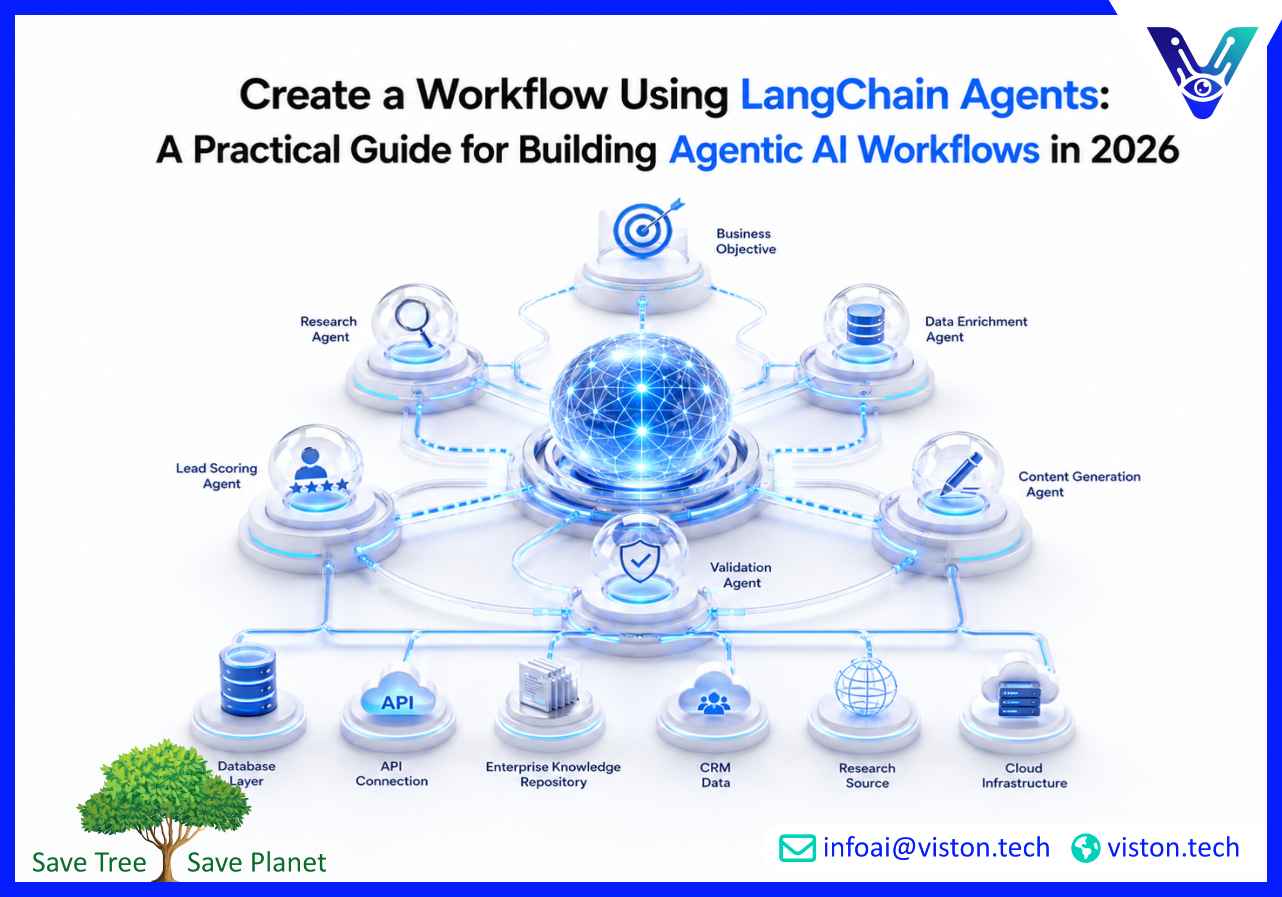
As businesses continue adopting AI-driven automation, traditional workflows are no longer enough to handle complex decision-making, dynamic data processing, and multi-step business operations. This is where LangChain agents have emerged as a powerful foundation for creating agentic AI workflows. Organizations looking to automate knowledge work, customer interactions, data analysis, and operational processes are increasingly using LangChain-based architectures to build intelligent systems capable of reasoning, planning, and executing tasks autonomously.
LangChain is an open-source framework designed to simplify the development of applications powered by large language models (LLMs). While basic AI applications can generate responses from prompts, LangChain agents extend these capabilities by allowing AI systems to make decisions, use tools, retrieve information, interact with APIs, and execute multi-step workflows.
Unlike conventional automation systems that follow predefined rules, LangChain agents dynamically determine actions based on objectives, available tools, context, and real-time information.
A LangChain agent typically consists of:
These components work together to create intelligent workflows capable of adapting to changing business requirements.
Businesses are moving beyond simple chatbots and basic automation. Modern organizations require systems that can:
LangChain agents enable these capabilities by introducing autonomous reasoning into workflow automation.
Several factors are driving adoption:
Organizations can automate workflows that previously required human intervention at multiple stages.
Agents can evaluate information and determine the next best action without requiring constant oversight.
Multiple agents can collaborate to handle increasing workloads without proportional increases in staffing.
Agents can continuously gather, analyze, and interpret information from multiple sources.
Complex tasks that previously required hours or days can often be completed within minutes.
Before building an agentic workflow, it is important to understand the major architectural layers.
The workflow begins with a user request, business trigger, API event, or system-generated task.
Examples include:
The planning agent interprets objectives and determines:
This layer transforms user intent into executable actions.
LangChain agents connect with:
The agent selects and invokes the appropriate tools based on workflow requirements.
Memory enables context retention throughout workflow execution.
Different memory types include:
Results are evaluated before final delivery.
This step reduces hallucinations, verifies accuracy, and improves reliability.
Final results are delivered through:
Consider a lead generation workflow for a B2B organization.
The objective is to identify qualified prospects, enrich contact data, prioritize leads, and generate personalized outreach messages.
Instead of using one large agent, businesses often deploy multiple specialized agents.
Each agent receives access to specific tools.
Research Agent:
Data Enrichment Agent:
Content Agent:
The workflow executes sequentially:
The workflow continuously learns from:
This information improves future agent decisions.
Assign specific responsibilities to individual agents rather than building a single monolithic agent.
Critical business decisions should include approval checkpoints.
Proper memory handling improves workflow accuracy and continuity.
Agents should recover gracefully from failures and continue execution where possible.
Track:
Agents can classify tickets, retrieve knowledge, suggest solutions, and escalate issues when required.
Multi-agent systems can identify prospects, enrich records, score opportunities, and generate outreach campaigns.
Research agents continuously collect competitive intelligence and industry insights.
Organizations use LangChain workflows to analyze contracts, policies, reports, and regulatory documents.
AI agents can transform raw operational data into actionable insights.
Enterprise knowledge bases become searchable and actionable through agent-driven retrieval systems.
While LangChain provides significant advantages, successful implementation requires addressing several challenges.
Poor-quality data can negatively impact workflow decisions.
Validation layers remain essential for ensuring accuracy.
Organizations must implement:
Agent interactions, API usage, and model inference costs should be monitored carefully.
Workflows should be designed for growth from the beginning.
As organizations increasingly adopt intelligent automation, building reliable and scalable agentic systems requires more than simply connecting large language models. Successful implementation depends on workflow architecture, agent orchestration, integration design, security controls, monitoring frameworks, and business alignment.
Viston AI specializes in Agentic AI Workflows that help organizations automate complex business processes using modern AI agent architectures. By combining AI orchestration frameworks, workflow automation strategies, API integrations, retrieval systems, and enterprise-grade governance practices, businesses can move beyond experimental AI deployments toward production-ready intelligent systems.
Whether organizations are developing customer support automation, lead generation pipelines, document intelligence platforms, operational assistants, or decision-support systems, well-designed agentic workflows can improve efficiency while maintaining business control and transparency.
A structured approach to workflow design ensures that AI agents operate reliably, integrate effectively with existing business systems, and deliver measurable operational value. This is increasingly important as enterprises seek scalable AI solutions capable of supporting long-term digital transformation initiatives.
Several developments are shaping the future of agentic systems:
These innovations are expected to further enhance the capabilities of enterprise AI automation.
A LangChain agent is an AI-powered component that can reason, select tools, access data, and perform actions autonomously to accomplish specific tasks.
They enable dynamic decision-making, tool usage, multi-step task execution, and workflow orchestration beyond traditional rule-based automation.
Yes. LangChain agents can connect with CRMs, databases, APIs, ERP systems, cloud platforms, and enterprise applications.
They can be secure when implemented with proper governance, authentication, encryption, monitoring, and access control mechanisms.
Technology, healthcare, finance, manufacturing, logistics, retail, professional services, and customer support organizations are among the leading adopters.
Viston AI helps organizations design, implement, integrate, and optimize Agentic AI Workflows that align AI capabilities with practical business objectives and operational requirements.
Creating a workflow using LangChain agents enables businesses to move beyond traditional automation and build intelligent systems capable of reasoning, planning, and executing complex tasks. As organizations continue investing in Agentic AI Workflows throughout 2026, LangChain remains one of the most flexible frameworks for developing scalable, enterprise-ready AI solutions. By combining specialized agents, structured workflows, robust integrations, and effective governance, businesses can unlock significant operational efficiencies while maintaining control, reliability, and business value. Organizations seeking long-term AI adoption strategies can benefit from a thoughtful approach to agent-based workflow design and implementation.
