
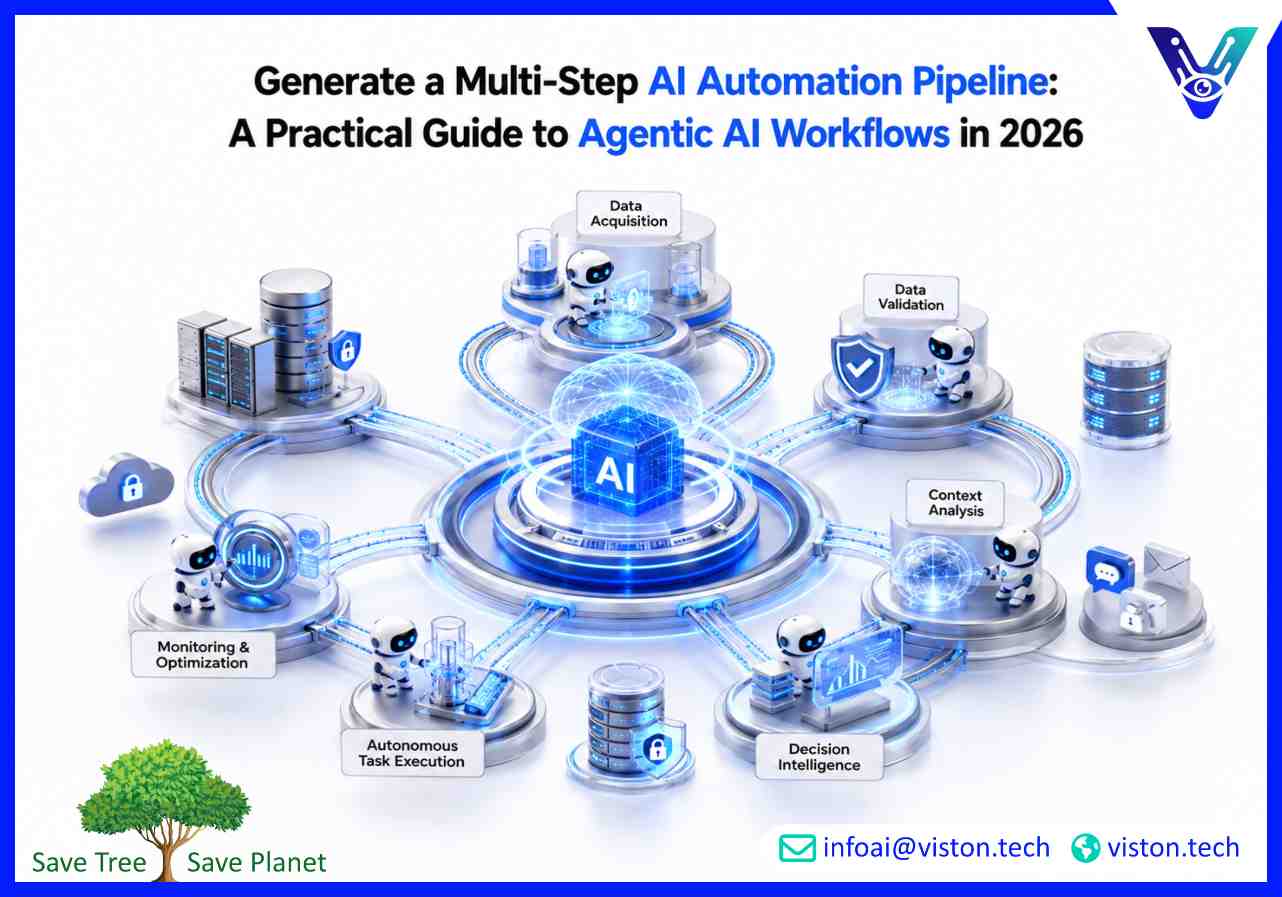
Businesses are under constant pressure to improve efficiency, reduce operational costs, and make faster decisions. Traditional automation can streamline repetitive tasks, but modern organizations increasingly require systems that can reason, adapt, collaborate, and execute complex workflows autonomously. This is where multi-step AI automation pipelines powered by agentic AI workflows are transforming business operations in 2026.
A multi-step AI automation pipeline is a structured workflow where multiple AI agents, systems, tools, and business applications work together to complete a process from start to finish with minimal human intervention.
Unlike conventional automation, which follows predefined rules, agentic AI workflows can analyze information, make decisions, coordinate actions, and dynamically adapt to changing business conditions.
A typical AI automation pipeline consists of several interconnected stages:
Each stage may involve specialized AI agents performing distinct responsibilities while communicating with other agents and enterprise systems.
Organizations are generating more data than ever before. Managing customer interactions, operations, compliance requirements, sales activities, and internal processes manually has become increasingly difficult.
Modern businesses require automation systems that can:
Agentic AI workflows address these challenges by creating intelligent automation systems capable of coordinating multiple tasks simultaneously.
Instead of automating one task, businesses can automate entire processes from initiation to completion.
The first stage of any automation pipeline focuses on gathering relevant information from various sources.
Data sources may include:
AI agents continuously collect and organize incoming information to ensure downstream processes have accurate and timely data.
Raw data often contains inconsistencies, duplicates, missing values, or outdated records.
Validation agents perform tasks such as:
This stage ensures decision-making agents receive high-quality information.
After validation, AI agents analyze business context.
This includes:
Context-aware automation significantly improves decision accuracy compared to static workflows.
This layer represents the intelligence core of agentic workflows.
Decision agents evaluate:
Based on these inputs, agents determine the most appropriate action path.
Execution agents perform the required tasks.
Examples include:
These actions occur automatically without requiring constant human oversight.
Successful AI automation pipelines continuously monitor performance.
Monitoring agents track:
The collected feedback enables continuous optimization.
Consider a lead generation and qualification process.
The workflow may proceed as follows:
The entire process can operate autonomously while maintaining business rules and oversight.
Organizations can automate repetitive and time-consuming workflows, enabling employees to focus on strategic work.
AI agents reduce human errors by consistently following predefined objectives and validation standards.
Real-time analysis enables businesses to respond quickly to opportunities and challenges.
Automation pipelines can process significantly larger workloads without proportional increases in staffing.
Faster responses, personalized interactions, and consistent service improve customer satisfaction.
Continuous monitoring creates valuable intelligence for future business optimization.
AI agents depend heavily on accurate and reliable data sources.
Many organizations operate numerous disconnected systems requiring seamless integration.
Proper controls are necessary to ensure responsible AI deployment.
Automation systems often handle sensitive business information and must follow strong security practices.
Successful implementation requires employee adoption and operational alignment.
Define measurable outcomes before selecting technologies.
Understand current workflows and identify bottlenecks.
Each agent should perform a specific responsibility efficiently.
Critical decisions should include review mechanisms where necessary.
Ensure agents can communicate with enterprise platforms effectively.
Track performance continuously to identify optimization opportunities.
Protect business data through encryption, access controls, and compliance frameworks.
As organizations move toward intelligent automation, building reliable multi-step AI automation pipelines requires more than deploying individual AI tools. Success depends on workflow orchestration, agent collaboration, system integration, governance, scalability, and ongoing optimization.
Viston AI specializes in Agentic AI Workflows that help businesses automate complex operational processes from end to end. By combining intelligent agents, workflow orchestration frameworks, enterprise integrations, and automation best practices, organizations can create systems capable of handling dynamic business scenarios efficiently.
Whether businesses need customer service automation, lead management workflows, operational process optimization, document intelligence systems, or enterprise-grade decision automation, agentic workflows provide a structured approach to delivering measurable business outcomes.
A practical implementation strategy includes identifying automation opportunities, designing specialized AI agents, integrating business systems, establishing governance controls, and continuously monitoring workflow performance to ensure long-term value.
As AI technologies continue to mature, organizations that invest in scalable automation architectures will be better positioned to improve efficiency, reduce operational costs, and accelerate growth.
Traditional automation follows predefined rules, while agentic AI workflows can analyze situations, make decisions, adapt to changing conditions, and coordinate multiple tasks autonomously.
The number depends on business requirements. Enterprise workflows often involve multiple specialized agents handling validation, analysis, execution, monitoring, and reporting tasks.
Yes. Small businesses can automate customer service, lead generation, scheduling, reporting, and operational workflows using scalable AI architectures.
Implementation timelines vary based on complexity, integrations, data readiness, governance requirements, and workflow scope.
Organizations seeking tailored Agentic AI Workflow solutions can leverage Viston AI’s expertise to design, integrate, and optimize automation systems aligned with specific business objectives.
Generating a multi-step AI automation pipeline is no longer a futuristic concept. In 2026, agentic AI workflows enable organizations to automate entire business processes while improving accuracy, efficiency, scalability, and decision-making capabilities. By combining intelligent agents, workflow orchestration, real-time analytics, and enterprise integrations, businesses can transform operations and unlock significant productivity gains. Organizations that strategically adopt Agentic AI Workflows today will be better prepared to compete in increasingly data-driven and automated markets. Viston AI helps businesses build practical, scalable, and business-focused automation ecosystems designed for long-term operational success.
