
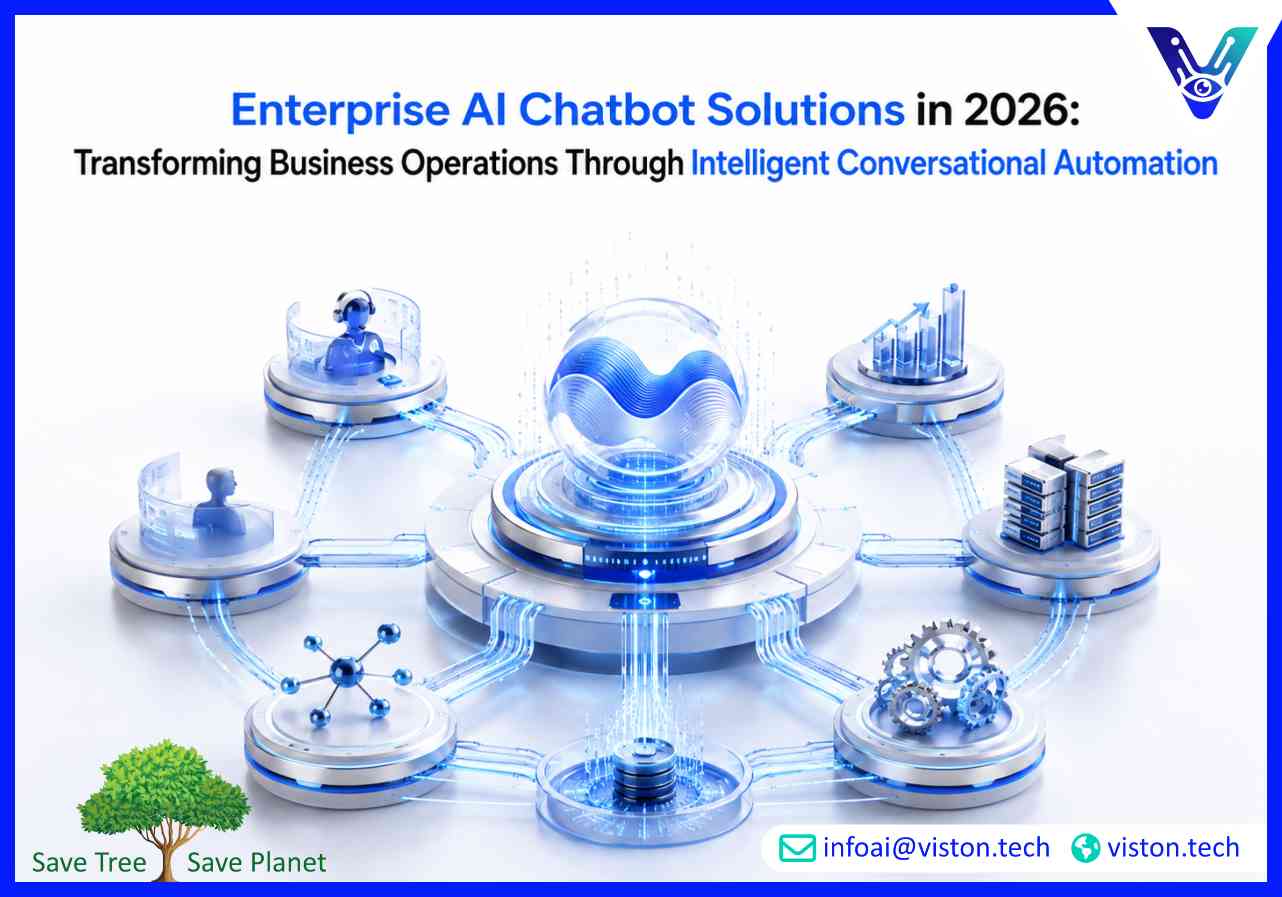
As businesses continue to accelerate digital transformation initiatives, enterprise AI chatbot solutions have evolved from simple customer support tools into strategic business assets. Organizations across industries are leveraging advanced AI-powered conversational systems to improve customer experiences, automate repetitive processes, increase operational efficiency, and provide round-the-clock support. In 2026, enterprise AI chatbots are becoming an essential component of modern business infrastructure, enabling companies to scale interactions while maintaining high service quality.
Enterprise AI chatbot solutions are sophisticated conversational AI systems designed specifically for large organizations and complex business environments. Unlike basic chatbots that rely on predefined scripts, enterprise-grade AI chatbots utilize advanced natural language processing (NLP), machine learning, generative AI, and contextual understanding to engage in intelligent, human-like conversations.
These solutions can interact across multiple channels, including websites, mobile applications, customer portals, messaging platforms, social media channels, internal communication tools, and voice-based systems.
Modern enterprise AI chatbots are capable of:
As AI technology continues to mature, enterprises increasingly view chatbots as strategic tools that contribute directly to customer satisfaction, revenue growth, and operational excellence.
The business landscape has changed dramatically in recent years. Customers expect immediate responses, personalized experiences, and seamless support regardless of the time or communication channel. At the same time, organizations face growing pressure to reduce operational costs while maintaining service quality.
Enterprise AI chatbot solutions address these challenges by enabling businesses to deliver scalable and intelligent customer interactions without significantly increasing human resource requirements.
Modern customers expect businesses to provide instant answers and support. Delayed responses can lead to dissatisfaction, reduced trust, and lost revenue opportunities. AI chatbots help enterprises maintain responsiveness at scale.
Many organizations struggle with high volumes of repetitive inquiries. AI chatbots automate routine interactions, allowing employees to focus on higher-value activities that require human expertise.
Global businesses operate across multiple time zones. Enterprise AI chatbots ensure continuous support availability, improving customer experience and reducing dependency on large support teams.
AI chatbot interactions generate valuable business intelligence. Organizations can analyze conversations to identify trends, customer pain points, product feedback, and operational improvement opportunities.
Organizations implementing enterprise AI chatbot solutions often experience benefits across multiple business functions.
AI-powered chatbots deliver faster response times and personalized support experiences. By understanding customer intent and context, they can provide accurate answers and relevant recommendations.
Benefits include:
Employees frequently spend significant time handling repetitive questions and administrative tasks. Enterprise chatbots automate these activities, improving workforce productivity.
Common automated tasks include:
Customer support operations can be expensive to scale manually. AI chatbot solutions reduce support costs by handling large interaction volumes while minimizing staffing requirements for routine requests.
Unlike human teams that require additional hiring during growth periods, enterprise AI chatbots can manage thousands of simultaneous conversations without compromising service quality.
Human responses may vary based on experience, training, or workload. AI chatbots provide standardized responses aligned with organizational policies and procedures.
Enterprise chatbot solutions in 2026 incorporate advanced capabilities that extend far beyond traditional automation.
Modern AI chatbots can interpret customer intent, sentiment, context, and conversational nuances. This enables more natural and effective interactions.
Generative AI allows chatbots to create dynamic, contextually relevant responses rather than relying solely on predefined scripts.
Enterprise solutions support deployment across:
AI chatbots can access enterprise documentation, FAQs, policies, product information, and internal knowledge repositories to provide accurate responses.
Enterprise chatbots integrate with critical business systems, including:
Enterprise environments require robust security measures, including:
Customer support remains one of the most common chatbot applications. AI assistants handle routine inquiries while escalating complex issues to human agents when necessary.
Examples include:
Enterprise chatbots assist sales teams by qualifying leads, collecting prospect information, scheduling meetings, and guiding buyers through purchasing journeys.
Internal AI assistants provide employees with quick access to organizational information and support services.
Common HR-related use cases include:
AI chatbots can automate routine IT support requests, reducing helpdesk workloads and improving issue resolution speed.
Organizations increasingly use AI chatbots as intelligent knowledge assistants that help employees locate relevant information across large document repositories.
Digital transformation initiatives often involve process automation, data utilization, customer experience enhancement, and operational optimization. Enterprise AI chatbots contribute significantly to these objectives.
By serving as conversational interfaces for enterprise systems, chatbots simplify user interactions while increasing access to information and services.
Organizations implementing AI chatbots frequently achieve:
As AI technologies continue evolving, chatbots increasingly function as intelligent business assistants rather than standalone support tools.
As organizations seek scalable conversational AI capabilities, selecting the right implementation partner becomes critical. Viston AI specializes in Enterprise AI Chatbots designed to address complex business requirements while supporting long-term scalability and operational efficiency.
Enterprise chatbot implementation requires more than deploying a conversational interface. Successful solutions must integrate with existing business systems, support organizational workflows, maintain security standards, and deliver measurable business outcomes.
Viston AI focuses on developing intelligent chatbot ecosystems that combine advanced natural language understanding, generative AI capabilities, workflow automation, and enterprise-grade integrations. These solutions are designed to support customer service, sales operations, employee assistance, knowledge management, and process automation initiatives.
Organizations often require customized implementations tailored to specific operational goals. Viston AI helps businesses design, develop, deploy, and optimize enterprise AI chatbots that align with business objectives while supporting future growth.
From chatbot strategy and architecture planning to integration, deployment, monitoring, and continuous optimization, the company emphasizes practical implementation approaches that help organizations maximize the value of conversational AI investments.
As enterprise AI adoption accelerates, businesses increasingly require partners capable of delivering secure, scalable, and intelligent chatbot solutions that can evolve alongside changing operational needs.
AI chatbot effectiveness depends heavily on the quality of available data and knowledge sources. Organizations should ensure information is accurate, current, and structured appropriately.
Enterprise environments often involve numerous systems and applications. Successful chatbot implementation requires careful integration planning.
Businesses handling sensitive information must ensure chatbot platforms meet relevant security and compliance standards.
Organizations should establish governance frameworks to monitor chatbot performance, maintain response quality, and manage ongoing improvements.
An enterprise AI chatbot is an advanced conversational system designed to support business operations through intelligent automation, customer engagement, workflow integration, and knowledge management.
Enterprise AI chatbots use advanced AI technologies such as natural language understanding, machine learning, and generative AI to provide contextual, dynamic, and intelligent responses, whereas traditional chatbots often rely on predefined scripts.
Yes. Modern enterprise chatbot platforms can integrate with CRM systems, ERP platforms, customer support software, HR tools, knowledge bases, and other business applications through APIs and connectors.
Enterprise-grade solutions typically include advanced security features such as encryption, access controls, audit logging, authentication mechanisms, and compliance support to protect sensitive business information.
Industries including healthcare, finance, retail, manufacturing, education, logistics, telecommunications, and professional services frequently benefit from enterprise chatbot implementations.
Viston AI provides Enterprise AI Chatbot solutions that support conversational automation, workflow integration, customer engagement, and operational efficiency while addressing enterprise scalability and business requirements.
Enterprise AI chatbot solutions have become a critical component of modern business strategy in 2026. They enable organizations to improve customer experiences, automate routine processes, enhance productivity, and support scalable growth. As AI technologies continue advancing, chatbots are evolving into intelligent business assistants capable of driving meaningful operational improvements across departments. Businesses evaluating Enterprise AI Chatbots should focus on solution quality, integration capabilities, security standards, scalability, and long-term business value. With specialized expertise in Enterprise AI Chatbots, Viston AI helps organizations implement conversational AI solutions that align with operational goals while supporting future innovation and growth.
