
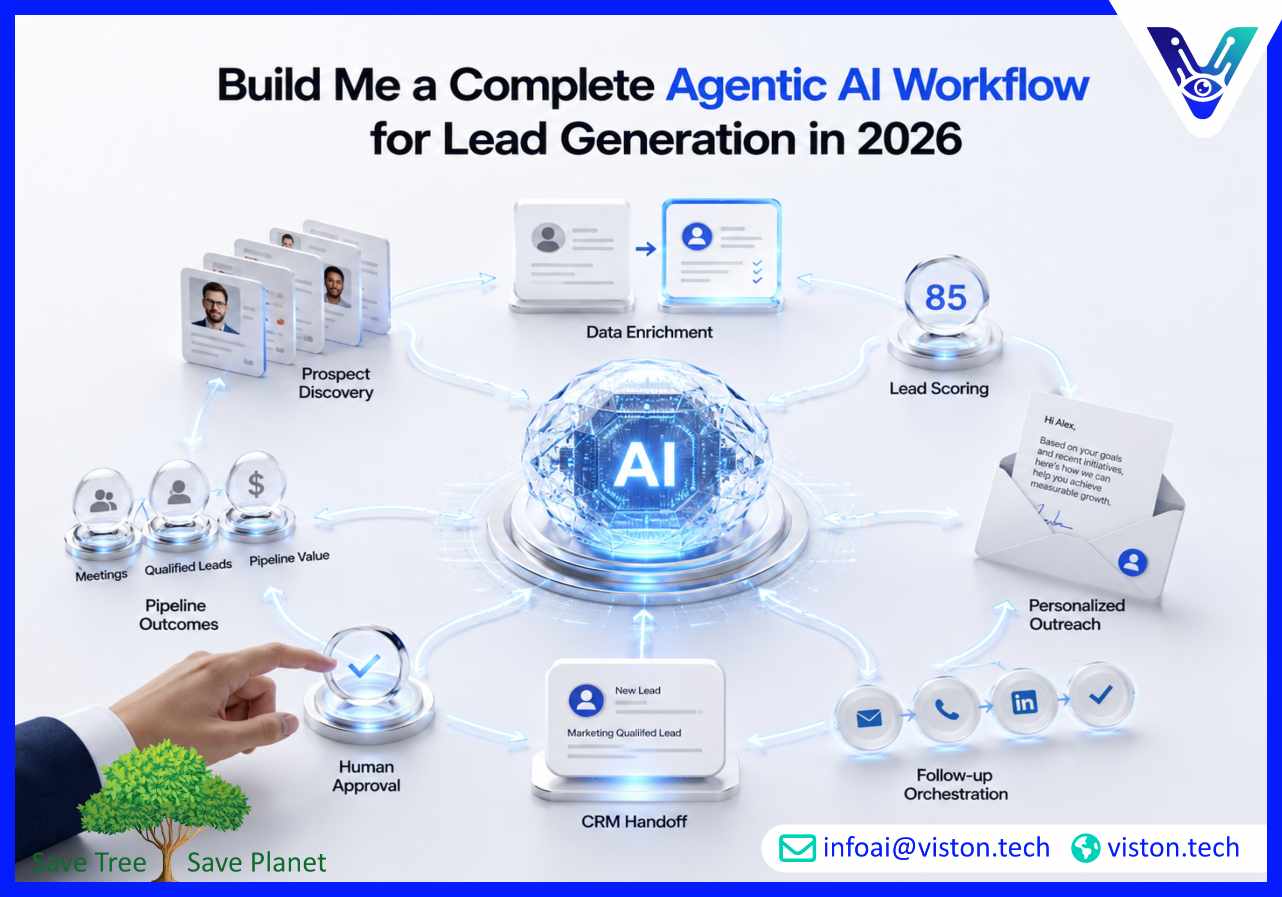
A complete agentic AI workflow for lead generation helps businesses identify prospects, enrich data, qualify buyers, personalize outreach, trigger follow-ups, and measure pipeline outcomes with less manual effort. In 2026, the strongest lead generation systems combine AI agents, CRM data, automation rules, human approval, and clear performance controls.
An agentic AI workflow for lead generation is a coordinated system where AI agents perform connected sales and marketing tasks toward a defined pipeline goal. Unlike a simple automation that follows fixed rules, an agentic workflow can analyze context, make decisions, use tools, prioritize leads, and adapt next steps based on data
For lead generation, this means AI can support the full journey from prospect discovery to sales-ready handoff. A well-built workflow may research target accounts, identify decision-makers, enrich contact records, score leads, draft outreach, schedule follow-ups, update CRM fields, and alert sales teams when a prospect becomes qualified.
The goal is not to replace sales strategy. The goal is to remove repetitive work, improve response speed, increase personalization, and help teams focus on conversations with the highest commercial potential.
The workflow becomes more valuable when each step is connected. If an AI agent researches a company but does not update the CRM, the workflow remains incomplete. If it writes outreach but does not track replies, the system cannot learn from results. Complete design matters.
A practical lead generation workflow should begin with business rules, not tools. Before adding AI agents, the company must define who it wants to reach, what counts as a qualified lead, what data is required, and when a human should approve an action.
The first AI agent should work from a clear ideal customer profile. This includes industry, company size, location, technology usage, budget signals, pain points, buying triggers, decision-maker roles, and disqualification criteria.
Without this foundation, AI may generate large lead lists that look impressive but fail commercially. A strong ICP helps the workflow focus on relevance instead of volume.
The workflow should connect to approved lead sources such as CRM records, website forms, webinar registrations, LinkedIn research, industry directories, newsletter signups, event lists, and intent data platforms where available.
An agent can classify each source by reliability, freshness, and conversion potential. This prevents the sales team from wasting time on outdated or low-quality records.
Lead generation depends on accurate data. An enrichment agent can add missing company information, job titles, website details, industry categories, employee size, funding signals, technology stack indicators, and public business context.
A validation layer should check email formats, duplicate records, incomplete fields, bounced addresses, and mismatched company names. This protects deliverability and CRM quality.
A qualification agent can score leads based on fit, intent, engagement, urgency, and account value. For example, a lead from a target industry with recent buying signals should receive a higher priority than a generic contact with no engagement.
Segmentation may include:
This allows outreach to match the buyer’s context instead of sending the same message to everyone.
Once leads are validated and scored, the workflow should move into personalized engagement. This is where agentic AI can provide major value, but it also requires careful control. Poorly governed outreach can damage brand trust, reduce email deliverability, and create compliance concerns.
The outreach agent should generate messages based on verified lead data, not assumptions. It can reference business context such as company category, role-specific challenges, relevant service needs, recent public signals, and known pain points.
Good personalization is specific but not intrusive. The message should clearly explain why the outreach is relevant, what business problem it addresses, and what next step makes sense.
Lead generation rarely happens through one channel. A coordinated workflow may include email, LinkedIn, website retargeting, CRM tasks, phone reminders, and calendar booking links.
A channel coordination agent can decide which action should happen next based on lead type and engagement history. For example, if a prospect opens two emails but does not reply, the workflow may create a sales task instead of sending another automated message.
Most lead generation value comes from consistent follow-up. A follow-up agent can monitor replies, classify sentiment, detect objections, identify buying intent, and recommend next steps.
Common reply categories include:
Each category should trigger a different action. High-intent replies should go to sales quickly. Low-intent contacts should move into nurture. Opt-out requests should be handled immediately.
The sales handoff agent prepares qualified leads for human follow-up. It can summarize the account, explain why the lead is qualified, list previous interactions, highlight potential pain points, and recommend conversation angles.
This gives sales teams useful context instead of just another CRM notification.
A complete agentic AI workflow for lead generation must include governance, integrations, and performance measurement. Without these layers, the system may produce activity but not reliable business outcomes.
Integrations should be designed around business logic. The AI workflow should know where to read data, where to write updates, and which actions require human approval.
For lead generation, not every task should be fully autonomous. Human review is useful for high-value accounts, sensitive industries, executive outreach, unusual replies, and any action that could affect brand reputation.
A practical model is to let AI handle research, drafting, scoring, and routing while humans approve strategic messaging, enterprise outreach, and final sales conversations.
The workflow should be measured by business outcomes, not just automation volume. Useful metrics include:
These metrics help teams improve the workflow over time. Agentic AI should be monitored, tested, and refined continuously.
Viston AI supports businesses with Agentic AI Workflows that connect intelligent automation with practical business execution. For lead generation teams, this means designing AI-powered systems that can research prospects, organize lead data, qualify opportunities, support personalized outreach, and improve sales handoff processes.
A reliable lead generation workflow requires more than a chatbot or isolated automation. It needs well-defined agents, clean data flows, CRM integration, approval logic, reporting, and continuous optimization. Viston AI’s service focus aligns with these needs by helping organizations build structured workflows that combine rule-based automation with generative AI capabilities.
For businesses focused on lead generation, Viston AI can help translate sales and marketing requirements into operational AI workflows. This may include mapping the buyer journey, defining lead qualification rules, integrating tools, building agent roles, setting workflow triggers, and creating monitoring processes that make AI activity measurable.
The value comes from building workflows that are useful for real teams, not just technically impressive. A strong implementation should reduce manual research, improve lead quality, speed up follow-ups, and give sales teams clearer context before they engage with prospects.
It is an AI-driven workflow where agents research prospects, enrich data, score leads, personalize outreach, manage follow-ups, and support sales handoff with limited manual effort.
It can automate many repetitive tasks, but human oversight is still important for strategy, brand-sensitive messaging, high-value prospects, and final sales conversations.
Common tools include a CRM, email platform, data enrichment source, marketing automation system, analytics dashboard, calendar tool, and AI orchestration layer.
AI improves lead quality by filtering prospects against ICP rules, enriching missing data, identifying buying signals, scoring fit, and prioritizing leads most likely to convert.
Yes. It can support account research, contact discovery, segmentation, message drafting, follow-up timing, reply classification, and CRM updates for outbound campaigns.
Viston AI helps design and deploy Agentic AI Workflows that connect lead research, automation, CRM processes, outreach support, reporting, and optimization into a practical business system.
A complete agentic AI workflow for lead generation should connect strategy, data, outreach, qualification, follow-up, and reporting into one reliable operating system. The best workflows do not simply generate more leads; they improve lead relevance, reduce manual work, accelerate response times, and give sales teams better context. In 2026, businesses adopting Agentic AI Workflows should focus on clean data, responsible automation, CRM integration, human approval, and measurable pipeline outcomes. Viston AI is well positioned to support organizations that want practical, scalable lead generation workflows built around real sales and marketing needs.
