
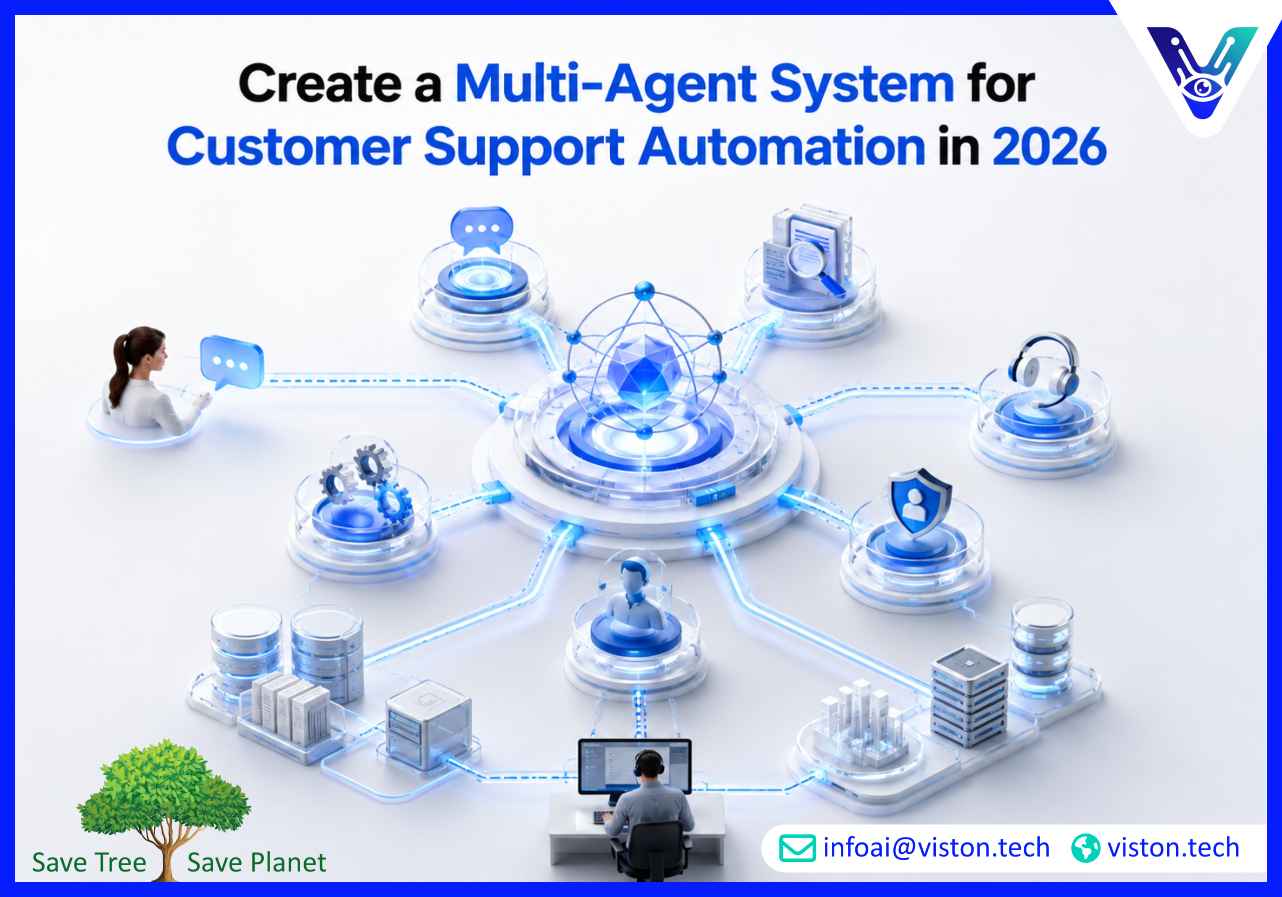
Customer support expectations continue to rise as businesses face increasing volumes of inquiries across email, chat, social media, websites, mobile applications, and customer portals. Traditional automation tools can handle repetitive tasks, but modern customer service requires intelligent systems capable of understanding context, collaborating across functions, and resolving complex issues efficiently.
This is where multi-agent systems are becoming a significant advantage. Organizations are increasingly adopting multi-agent orchestration frameworks to automate customer support workflows while maintaining service quality, operational efficiency, and scalability. In 2026, businesses seeking intelligent support automation are turning to coordinated AI agents that work together rather than relying on a single chatbot.
A multi-agent system consists of multiple AI agents designed to perform specialized tasks while collaborating toward a common business objective. Instead of using one generalized support bot, businesses deploy multiple intelligent agents that handle different responsibilities within the customer support process.
Each agent focuses on a specific function such as:
Through multi-agent orchestration, these agents communicate, exchange information, and coordinate actions to deliver seamless customer experiences.
Rather than treating support interactions as isolated conversations, a multi-agent architecture creates an interconnected support ecosystem capable of managing end-to-end customer journeys.
Customer service teams face several challenges that traditional automation struggles to solve.
As businesses expand, support requests increase significantly. Human teams alone often struggle to maintain response times while ensuring quality interactions.
Modern support requests frequently involve multiple systems, departments, and knowledge sources. Customers expect quick resolutions regardless of complexity.
Global customers expect assistance outside standard business hours. Providing round-the-clock support using human teams alone can become costly.
Support quality often varies between agents, shifts, and locations. Businesses need standardized service delivery while maintaining personalization.
Support leaders are under pressure to reduce costs while improving customer satisfaction and first-contact resolution rates.
Multi-agent systems address these challenges by distributing responsibilities among specialized AI agents that can operate continuously and collaboratively.
Successful customer support automation requires more than deploying several AI models. Businesses need a structured architecture that enables coordination, governance, and workflow management.
This agent serves as the first point of contact. It handles incoming conversations across channels and gathers relevant customer information.
Responsibilities include:
Once information is collected, this agent determines the nature of the request.
Examples include:
Accurate classification ensures customers are routed through the most appropriate workflow.
This agent accesses company documentation, FAQs, product manuals, internal knowledge bases, and support articles.
It identifies the most relevant information required to solve customer problems quickly.
For technical issues, a dedicated troubleshooting agent guides customers through diagnostic steps and recommended solutions.
This agent can adapt responses based on customer feedback during the interaction.
Not every issue can be resolved automatically. The escalation agent identifies situations requiring human intervention and transfers cases accordingly.
Examples include:
This agent updates customer records, support histories, case statuses, and interaction summaries across connected business systems.
Quality assurance remains critical even in automated environments. Monitoring agents evaluate conversation quality, policy compliance, and resolution effectiveness.
The true value of multi-agent systems comes from orchestration rather than individual automation capabilities.
Specialized agents process information simultaneously rather than sequentially. Customers receive answers faster because multiple tasks occur in parallel.
By combining knowledge retrieval, troubleshooting, and contextual understanding, multi-agent systems can solve more issues during the initial interaction.
Automation decreases repetitive workload for human teams, allowing support professionals to focus on high-value activities.
Organizations can handle significant increases in support volume without proportionally increasing staffing costs.
Customers receive consistent, accurate, and personalized assistance regardless of channel or time zone.
Multi-agent systems mirror organizational workflows, enabling smoother coordination between departments involved in support delivery.
Start by identifying measurable goals.
Examples include:
Document existing customer service processes to identify automation opportunities and agent responsibilities.
Each agent should have clearly defined responsibilities, decision boundaries, and communication protocols.
Customer support automation depends heavily on accurate information sources.
Organizations should consolidate:
Agents must share context and coordinate effectively through orchestration platforms and workflow engines.
Support agents often require access to:
Organizations should implement monitoring, auditing, approval workflows, security policies, and escalation rules to maintain reliability and compliance.
Automated onboarding support, technical troubleshooting, subscription management, and feature guidance.
Order tracking, returns management, product recommendations, shipping inquiries, and refund processing.
Account support, transaction inquiries, compliance-related assistance, fraud detection workflows, and customer verification.
Appointment scheduling, patient communication, insurance inquiries, and administrative support workflows.
Service activation, network troubleshooting, billing support, and customer retention programs.
As organizations explore advanced customer support automation, the effectiveness of a multi-agent system depends heavily on orchestration design, integration strategy, workflow architecture, and operational governance.
Viston AI specializes in Multi-Agent Orchestration solutions that help businesses design, deploy, and optimize intelligent agent ecosystems for real-world business operations. Rather than focusing solely on conversational AI, the company supports the development of coordinated agent networks that automate complex workflows across customer support environments.
Its approach aligns agent capabilities with business objectives, ensuring that individual agents can collaborate effectively while maintaining security, reliability, and operational transparency. This includes workflow orchestration, system integration, agent communication frameworks, knowledge management strategies, monitoring capabilities, and scalable deployment architectures.
For organizations seeking to modernize customer support operations, multi-agent orchestration can provide a structured framework for reducing manual workload, improving customer experiences, and supporting long-term scalability. By combining intelligent automation with business process expertise, Viston AI helps organizations build practical solutions that align with evolving customer service expectations in 2026 and beyond.
A multi-agent customer support system uses multiple specialized AI agents that collaborate to handle customer service tasks such as inquiry management, troubleshooting, knowledge retrieval, and escalation.
A chatbot typically operates as a single conversational interface, while a multi-agent system consists of multiple specialized agents working together to manage complex workflows and decision-making processes.
Yes. By automating repetitive tasks, improving efficiency, and increasing resolution rates, businesses can reduce operational costs while maintaining service quality.
Most implementations integrate with CRM systems, ticketing platforms, knowledge bases, communication tools, analytics platforms, and customer databases.
Yes. Human agents remain essential for complex cases, sensitive issues, strategic decisions, and situations requiring empathy or specialized expertise.
Viston AI provides Multi-Agent Orchestration expertise that helps businesses design coordinated AI agent ecosystems, integrate business systems, automate workflows, and scale intelligent customer support operations effectively.
Creating a multi-agent system for customer support automation is no longer a future concept—it is becoming a strategic necessity for organizations seeking scalable, efficient, and intelligent service operations in 2026. By combining specialized AI agents with robust Multi-Agent Orchestration frameworks, businesses can improve response times, enhance customer experiences, reduce operational costs, and support growing service demands. Organizations that invest in well-designed multi-agent architectures today will be better positioned to deliver consistent, high-quality customer support while maintaining the flexibility needed for future growth.
