
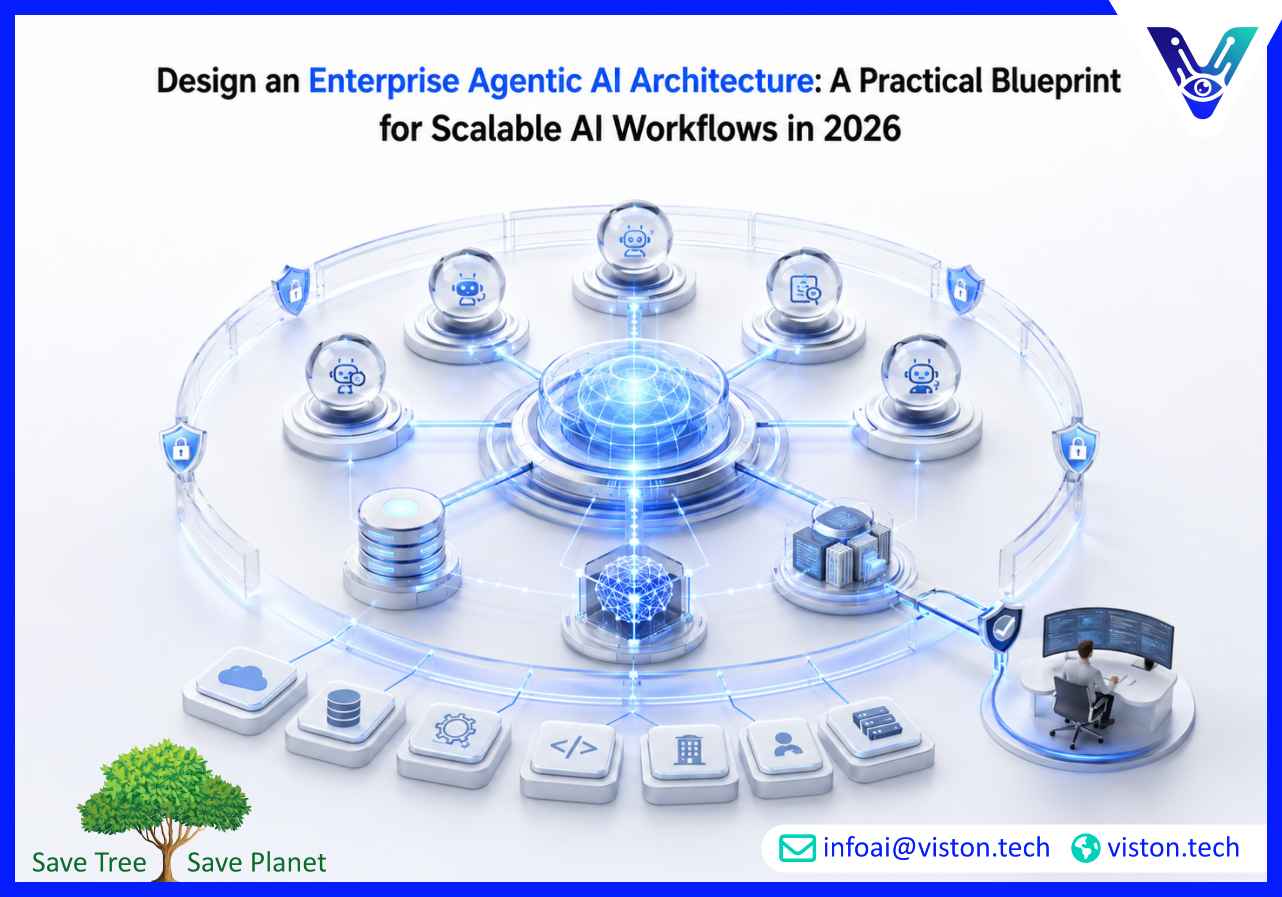
As organizations move beyond traditional automation and basic AI assistants, enterprise leaders are increasingly exploring agentic AI architectures to create autonomous, adaptive, and scalable business systems. Designing an enterprise agentic AI architecture requires more than connecting large language models to workflows. It involves governance, orchestration, security, observability, integrations, and specialized AI agents working together toward business objectives. In 2026, enterprises are investing in agentic AI workflows to improve operational efficiency, decision-making, customer experiences, and enterprise-wide automation.
An enterprise agentic AI architecture is a structured framework that enables multiple AI agents to collaborate, reason, make decisions, execute tasks, and interact with business systems while operating within organizational policies and governance requirements.
Unlike traditional workflow automation, which follows predefined rules and static processes, agentic AI systems can dynamically determine actions based on goals, context, available tools, and real-time information.
A typical enterprise agentic AI architecture consists of:
The objective is not simply automation but intelligent orchestration of business processes at scale.
Enterprise AI adoption has evolved significantly over the past few years. Organizations are no longer satisfied with standalone chatbots or isolated automation initiatives. They want systems capable of coordinating complex business activities across departments.
Several factors are driving the adoption of enterprise agentic AI architectures:
Modern enterprises operate across numerous platforms, databases, communication tools, customer systems, and business applications. Agentic AI workflows can coordinate actions across these environments without requiring extensive manual intervention.
Business leaders require near real-time insights and actions. AI agents can continuously analyze information, identify opportunities, and recommend actions faster than traditional operational models.
Agentic systems reduce repetitive tasks while supporting employees with research, reporting, customer interactions, data analysis, workflow execution, and operational coordination.
Unlike rigid automation systems, enterprise AI agents can adapt to changing circumstances, making them more suitable for dynamic business environments.
Organizations that successfully deploy agentic AI workflows can accelerate innovation, improve customer experiences, reduce operational costs, and increase business agility.
A successful architecture requires multiple interconnected layers working together.
The agent layer contains specialized AI agents responsible for specific business functions.
Examples include:
Each agent operates within defined responsibilities while collaborating with other agents when required.
The orchestration layer acts as the central coordinator.
Responsibilities include:
This layer ensures agents work together efficiently and align with business objectives.
Agentic systems require access to organizational knowledge.
This layer may include:
Long-term memory enables agents to maintain context and make informed decisions.
The model layer powers reasoning and intelligence.
Organizations often use:
Many enterprises implement multi-model strategies to optimize performance, costs, and reliability.
Agents must interact with business systems.
This layer includes integrations with:
Without integrations, AI agents cannot generate meaningful business outcomes.
Each agent should have clearly defined responsibilities. Modular architectures improve scalability, maintenance, testing, and governance.
Organizations must understand how agents make decisions and execute actions.
Essential monitoring capabilities include:
Enterprise AI systems often access sensitive business data.
Security requirements typically include:
Not every decision should be fully autonomous.
Human-in-the-loop mechanisms help manage:
Enterprise architectures must support increasing workloads, users, agents, and integrations without sacrificing performance.
Organizations typically implement several workflow patterns depending on operational requirements.
Tasks move through multiple agents in a predefined order.
Example:
Multiple agents work simultaneously and share information to achieve a common goal.
This approach is useful for complex business operations.
A supervisory agent manages subordinate specialized agents.
This model improves coordination and governance.
Agents respond to business events automatically.
Examples include:
Despite the benefits, implementation presents several challenges.
Organizations must establish policies that define agent behavior, responsibilities, escalation paths, and compliance requirements.
AI agents are only as effective as the data they access.
Poor-quality data can negatively impact decision-making and workflow performance.
Many enterprises operate legacy systems alongside modern cloud platforms.
Integrating these environments requires careful architectural planning.
Large-scale agentic systems can generate substantial infrastructure and model costs.
Enterprises must optimize:
Decision-makers need confidence in AI-generated outcomes.
Transparent reasoning and auditability remain essential requirements in enterprise environments.
As organizations explore advanced AI adoption strategies, designing enterprise-grade agentic AI architectures requires expertise across orchestration, integrations, automation, governance, security, and operational scalability.
Viston AI specializes in Agentic AI Workflows that help businesses transform complex processes into intelligent, autonomous systems. The company focuses on designing workflow architectures that align AI capabilities with practical business objectives rather than implementing disconnected AI tools.
Through agent orchestration frameworks, enterprise integrations, workflow automation strategies, and scalable deployment models, Viston AI helps organizations establish AI ecosystems capable of supporting customer operations, internal workflows, data-driven decision-making, and business process optimization.
For enterprises evaluating agentic AI initiatives, successful implementation often depends on creating the right architectural foundation from the beginning. This includes governance structures, monitoring frameworks, integration strategies, workflow design, and long-term scalability planning. Viston AI’s focus on Agentic AI Workflows enables businesses to move beyond experimentation and develop AI systems that deliver measurable operational value while maintaining reliability, security, and organizational control.
An AI agent performs specific tasks autonomously, while an agentic AI workflow coordinates multiple agents, systems, and processes to achieve broader business objectives.
Orchestration ensures agents collaborate effectively, manage dependencies, allocate resources, and execute workflows in a controlled and scalable manner.
Some workflows can be fully autonomous, but most enterprises implement human oversight for high-risk decisions, compliance requirements, and critical business actions.
Financial services, healthcare, manufacturing, retail, logistics, technology, telecommunications, and professional services frequently benefit from agentic AI implementations.
Security is critical because AI agents often access sensitive business systems and data. Strong governance, access controls, monitoring, and compliance frameworks are essential.
Viston AI helps organizations design, implement, and optimize Agentic AI Workflows that integrate with enterprise systems while supporting scalability, governance, automation, and business performance objectives.
Designing an enterprise agentic AI architecture requires far more than deploying advanced language models. Organizations must build coordinated ecosystems that combine specialized agents, orchestration frameworks, enterprise integrations, governance controls, security mechanisms, and scalable workflow automation. As businesses continue investing in intelligent operations throughout 2026, agentic AI workflows are becoming a foundational capability for competitive growth. Companies that establish robust architectural foundations today will be better positioned to achieve reliable automation, faster decision-making, operational efficiency, and long-term AI-driven business transformation. Viston AI supports this journey through specialized expertise in Agentic AI Workflows and enterprise-ready implementation strategies.
