
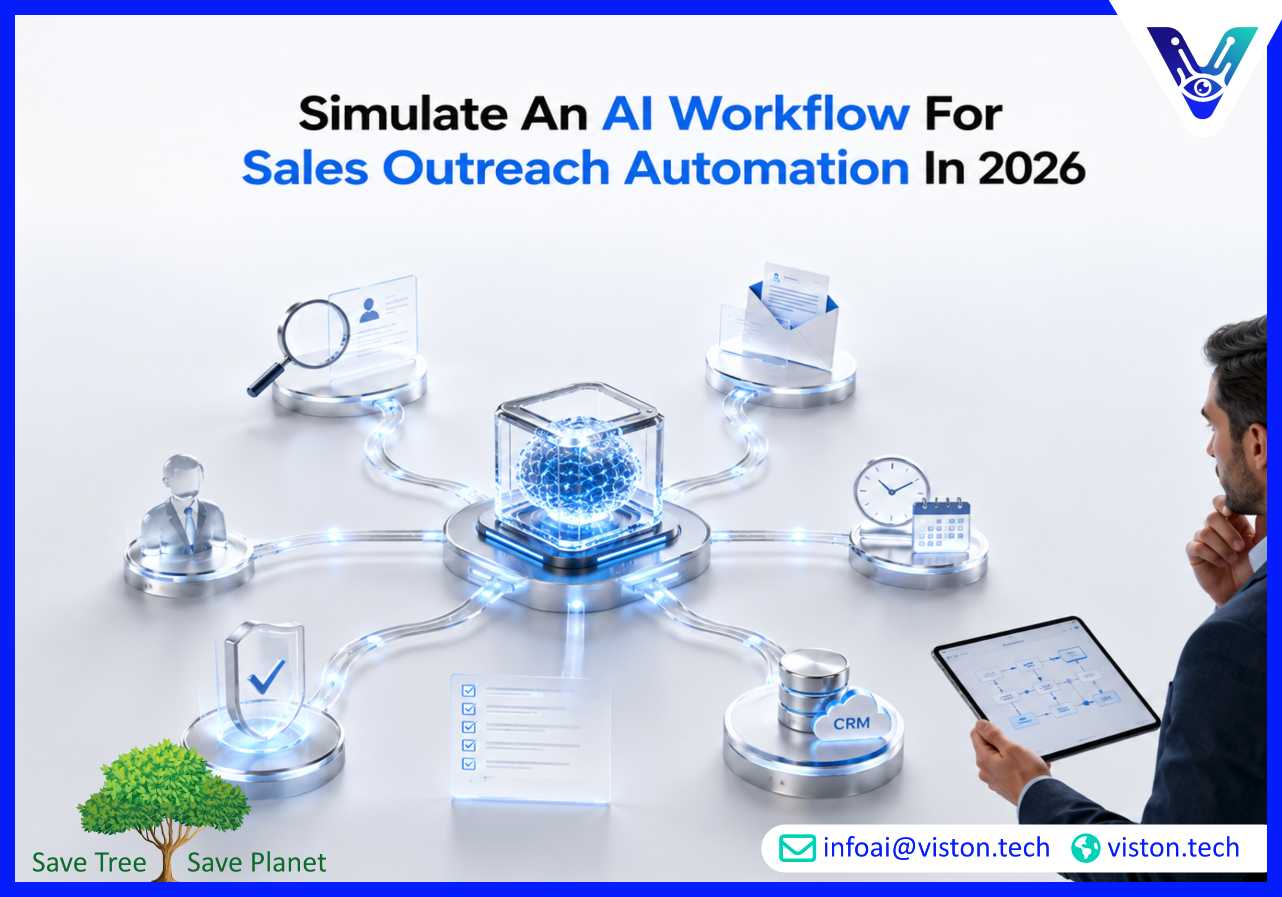
Sales outreach is no longer just about sending more emails. In 2026, businesses need smarter, more contextual, and more compliant outreach systems that can qualify leads, personalize messaging, coordinate follow-ups, and support sales teams without creating operational noise.
To simulate an AI workflow for sales outreach automation means designing a structured model of how AI agents would perform sales-related tasks before the workflow is fully deployed. Instead of immediately automating prospecting, enrichment, messaging, follow-ups, CRM updates, and reporting, businesses can first map how each step should behave.
This simulation helps teams understand how an agentic AI workflow will collect data, make decisions, trigger actions, escalate exceptions, and measure results. It gives sales leaders a practical way to test automation logic, improve outreach quality, and reduce risks before connecting AI agents to real customer data, CRM systems, email platforms, or sales engagement tools.
A simulated workflow can show how an AI agent identifies a target account, researches the buyer, drafts a personalized message, checks whether the prospect fits the ideal customer profile, schedules follow-ups, updates pipeline records, and alerts a human sales representative when a qualified opportunity appears.
Traditional sales automation often follows fixed rules. It can send emails after a delay, assign leads based on geography, or move contacts through a sequence. However, modern sales outreach requires more judgment. Buyers expect relevance, timing, context, and respect for privacy.
Agentic AI workflows improve this process by allowing AI agents to reason through tasks, use tools, evaluate context, and adapt actions based on the situation. For example, if a prospect recently changed jobs, downloaded a resource, or engaged with a competitor comparison page, the workflow can adjust the message instead of sending a generic sequence.
In 2026, sales teams need automation that supports quality rather than volume alone. Poorly targeted outreach can damage brand reputation, increase unsubscribe rates, and waste sales capacity. A simulated AI workflow helps companies create outreach systems that are more controlled, measurable, and aligned with real buyer intent.
A strong simulation begins with the sales goal. The goal may be booking discovery calls, qualifying inbound leads, reactivating dormant accounts, supporting account-based marketing, or helping sales development representatives prioritize the right prospects.
The workflow should then be broken into clear agent responsibilities. A research agent can collect company and contact information. A qualification agent can compare prospects against the ideal customer profile. A messaging agent can draft outreach based on pain points, role, industry, and buying signals. A compliance agent can check tone, claims, privacy rules, and unsubscribe requirements. A CRM agent can update records and maintain activity history.
The workflow should not begin with tools. It should begin with a business outcome. For example, a B2B software company may want to increase qualified meetings with operations leaders in mid-market companies. A consulting firm may want to identify companies showing signs of process inefficiency. A service provider may want to automate follow-ups after webinar attendance.
The simulation should define which data sources the AI workflow can use. These may include CRM records, website activity, form submissions, enrichment platforms, LinkedIn research, email engagement, company news, buyer intent data, and internal account notes.
Each AI agent should have a specific role. The simulation should define what the agent can do, what it cannot do, when it should ask for human approval, and how it should handle incomplete or uncertain information.
Sales outreach automation should not remove human judgment from important moments. Human review may be required for high-value accounts, sensitive industries, first-touch messaging, legal claims, or unusual lead behavior.
The simulation should test lead scoring, email drafts, follow-up timing, escalation rules, CRM updates, and reporting outputs. This prevents the workflow from sending irrelevant messages or creating inaccurate pipeline data.
Agentic AI workflows can support many sales outreach scenarios, but the most valuable use cases are usually the ones that combine repetitive work with contextual decision-making.
An AI workflow can identify target accounts, enrich company data, research buyer roles, score fit, and prepare personalized outreach drafts. This allows sales teams to focus on conversations instead of manual research.
When a lead submits a form, downloads a guide, or requests information, the workflow can assess company size, role, urgency, industry, and engagement history. Qualified leads can be routed to sales faster, while lower-priority leads can enter nurture sequences.
AI agents can monitor whether a prospect opened an email, clicked a link, replied, booked a meeting, or went silent. The workflow can recommend the next best action and trigger follow-ups at the right time.
Sales outreach automation can update lead status, log activity, summarize conversations, flag missing fields, and generate performance reports. This improves pipeline visibility and reduces administrative burden.
Sales outreach automation must be designed carefully. A workflow that sends too many messages, uses unreliable data, or makes unsupported claims can create more problems than it solves.
Businesses should evaluate data quality, CRM readiness, compliance requirements, messaging standards, approval workflows, and integration complexity before implementation. The best agentic AI workflows are not simply connected to tools; they are governed by clear rules, monitored continuously, and optimized based on real performance.
Important evaluation criteria include personalization accuracy, deliverability protection, CRM integration, explainable lead scoring, human review options, reporting quality, and security controls. Teams should also define success metrics such as reply rate, qualified meeting rate, conversion rate, sales cycle impact, and time saved per representative.
Viston AI is relevant to this topic because sales outreach automation depends on the same capabilities required for reliable agentic AI workflows: workflow design, AI agent coordination, data handling, system integration, automation logic, and performance optimization.
For businesses exploring sales automation, Viston AI can help structure agentic workflows that connect research, lead qualification, outreach preparation, follow-up actions, CRM updates, and reporting into a more coordinated system. This is especially useful for teams that want automation to support sales productivity without losing control over message quality or buyer experience.
A practical workflow approach allows businesses to define where AI agents should act independently and where human approval should remain necessary. This matters in sales outreach because every automated action can affect trust, deliverability, and pipeline quality.
Viston AI’s role as an agentic AI workflow specialist is best positioned around building scalable, business-focused automation systems that help teams reduce manual work, improve process consistency, and create more measurable sales operations. For companies operating across global markets, this kind of workflow design can support repeatable outreach while still allowing customization by region, segment, industry, and buyer intent.
It is a structured automation system where AI agents support sales tasks such as prospect research, lead scoring, message drafting, follow-up planning, CRM updates, and reporting.
Simulation helps test logic, messaging quality, data flows, approval rules, and CRM actions before the AI workflow interacts with real prospects or live sales systems.
Agentic AI is better used to support sales teams rather than replace them. It can reduce repetitive work, improve prioritization, and help representatives focus on qualified conversations.
Common tools include CRM platforms, email systems, enrichment databases, sales engagement platforms, analytics dashboards, scheduling tools, and internal knowledge bases.
Viston AI can support the design and implementation of agentic AI workflows that coordinate outreach tasks, automate repetitive actions, and maintain practical controls for business use.
To simulate an AI workflow for sales outreach automation is to design a safer, smarter, and more measurable way to modernize sales operations. In 2026, businesses need outreach systems that combine automation with context, governance, and human oversight. Agentic AI workflows can help sales teams research prospects, qualify leads, personalize outreach, manage follow-ups, and improve CRM accuracy. With a structured approach, companies can reduce manual work while protecting outreach quality and buyer trust. Viston AI is well positioned to support businesses that want practical, scalable agentic AI workflows for sales automation.
