
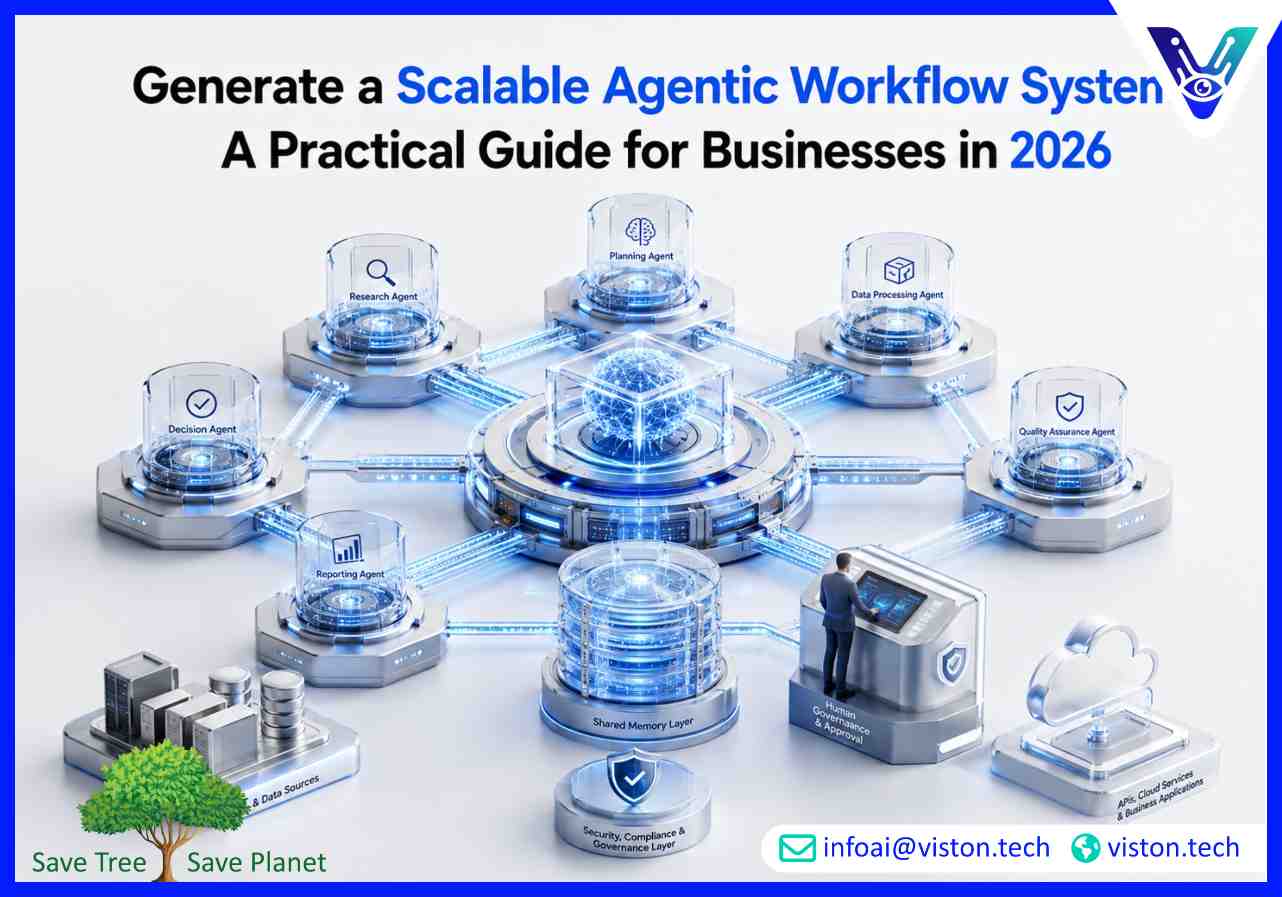
As organizations increasingly adopt artificial intelligence to automate operations, improve decision-making, and scale business processes, the demand for scalable agentic workflow systems continues to grow. Businesses no longer want isolated AI tools that perform single tasks. They need intelligent systems capable of planning, reasoning, collaborating, and executing complex workflows across multiple departments. A scalable agentic workflow system enables exactly that by combining autonomous AI agents with structured business processes.
A scalable agentic workflow system is a framework where multiple AI agents work together to accomplish business objectives through coordinated decision-making and task execution.
Unlike traditional automation systems that follow predefined rules, agentic workflows introduce autonomous behavior. Agents can understand goals, analyze information, make decisions, interact with external tools, and collaborate with other agents to complete tasks.
In practical business environments, an agentic workflow system may include:
These agents work together within an orchestrated architecture to achieve business outcomes efficiently and reliably.
Examples include:
Organizations are generating more data and managing more operational complexity than ever before. Traditional workflow automation often struggles when processes require judgment, adaptation, or collaboration.
Agentic workflows address these challenges by introducing intelligent decision-making capabilities.
As businesses grow, manual processes become increasingly difficult to manage. Agentic systems help organizations automate complex workflows without continuously increasing operational costs.
AI agents can analyze data, evaluate options, and make recommendations significantly faster than manual teams.
Many business processes suffer from delays caused by repetitive tasks. Agentic workflows eliminate bottlenecks by enabling autonomous execution.
Unlike human teams, AI agents can operate around the clock, ensuring business continuity and faster service delivery.
Agentic systems continuously collect and process information, helping organizations make more informed strategic decisions.
Building an enterprise-grade agentic workflow requires several interconnected components.
Agents form the foundation of the system.
Each agent is designed to perform specific responsibilities such as:
Specialized agents typically perform better than a single generalized agent.
The orchestration layer coordinates interactions between agents.
Its responsibilities include:
This layer ensures all agents work together efficiently.
Agentic workflows require memory to maintain context.
Common memory layers include:
Memory enables agents to make informed decisions based on historical information.
Agents become significantly more powerful when connected to external systems.
Common integrations include:
Enterprise workflows require oversight and control mechanisms.
Governance components typically include:
Creating a scalable system involves more than simply connecting AI models together. Successful implementations require a structured architecture.
Start by identifying the business problems the workflow should solve.
Examples include:
Clear objectives help define workflow requirements.
Document the complete business process.
Identify:
This creates the foundation for workflow orchestration.
Assign specialized responsibilities to individual agents.
For example, a lead generation workflow might include:
Clearly defined responsibilities improve reliability and scalability.
Agents must exchange information effectively.
Communication frameworks should support:
Shared memory allows agents to access relevant information across workflows.
Effective memory systems improve:
Not every decision should be fully autonomous.
Organizations often require human approval for:
This balances automation with governance.
Modular design enables organizations to add new agents without redesigning the entire system.
This improves:
Agentic workflows can automate prospect research, lead scoring, outreach personalization, follow-ups, and CRM updates.
This allows sales teams to focus on relationship building and closing deals.
AI agents can classify tickets, retrieve knowledge, generate responses, escalate issues, and monitor service quality.
The result is faster support and improved customer satisfaction.
Agentic systems help automate:
Agents can continuously monitor inventory, suppliers, logistics, and demand forecasts to improve operational efficiency.
Marketing teams can leverage agentic workflows for:
Building an agentic workflow system that works for 100 transactions is very different from building one that handles millions.
Workloads should be distributed across multiple services and infrastructure components.
Event-driven systems allow agents to react dynamically to changing business conditions.
Cloud platforms provide the elasticity required to support fluctuating workloads.
Enterprise workflows must continue operating even when individual components fail.
Organizations need complete visibility into workflow performance, agent behavior, and system health.
As AI systems gain access to sensitive business data, robust security controls become essential.
Important requirements include:
For organizations looking to implement scalable agentic workflow systems, expertise in AI architecture, workflow orchestration, automation strategy, and enterprise integration becomes increasingly important.
Viston AI specializes in Agentic AI Workflows designed to help businesses automate complex operational processes while maintaining governance, scalability, and reliability. Its approach focuses on combining intelligent AI agents, workflow orchestration frameworks, business system integrations, and enterprise-grade deployment practices.
Organizations exploring agentic workflow adoption often face challenges related to system design, agent coordination, data management, integration complexity, monitoring, and security. Through Agentic AI Workflow services, Viston AI helps businesses design architectures that align with operational goals while supporting future growth.
Whether the objective is lead generation automation, customer support transformation, internal operations optimization, or enterprise workflow modernization, scalable agentic systems require careful planning and execution. By focusing on practical implementation, workflow governance, and measurable business outcomes, Viston AI helps organizations move from experimentation to production-ready AI workflow environments.
Traditional automation follows predefined rules. Agentic workflows use AI agents capable of reasoning, planning, adapting, and making decisions based on changing conditions.
Yes. Well-designed agentic architectures can support workflows across sales, marketing, finance, operations, customer service, and other business functions.
Organizations typically use large language models, orchestration frameworks, vector databases, cloud infrastructure, APIs, monitoring platforms, and enterprise integrations.
They can be highly secure when implemented with appropriate governance controls, encryption, access management, compliance policies, and monitoring mechanisms.
Implementation timelines vary depending on complexity, integrations, and business requirements. Pilot projects may take weeks, while enterprise-wide deployments often require several months.
Yes. Viston AI provides Agentic AI Workflow services focused on workflow design, agent orchestration, system integration, governance, scalability, and business process automation.
Generating a scalable agentic workflow system requires much more than deploying AI models. Success depends on designing specialized agents, building robust orchestration frameworks, integrating enterprise systems, implementing governance controls, and ensuring long-term scalability. As businesses continue to pursue operational efficiency and intelligent automation in 2026, Agentic AI Workflows are becoming a critical component of modern digital transformation strategies. Organizations that invest in scalable, secure, and well-governed agentic systems will be better positioned to improve productivity, accelerate decision-making, and unlock new opportunities for growth.
