
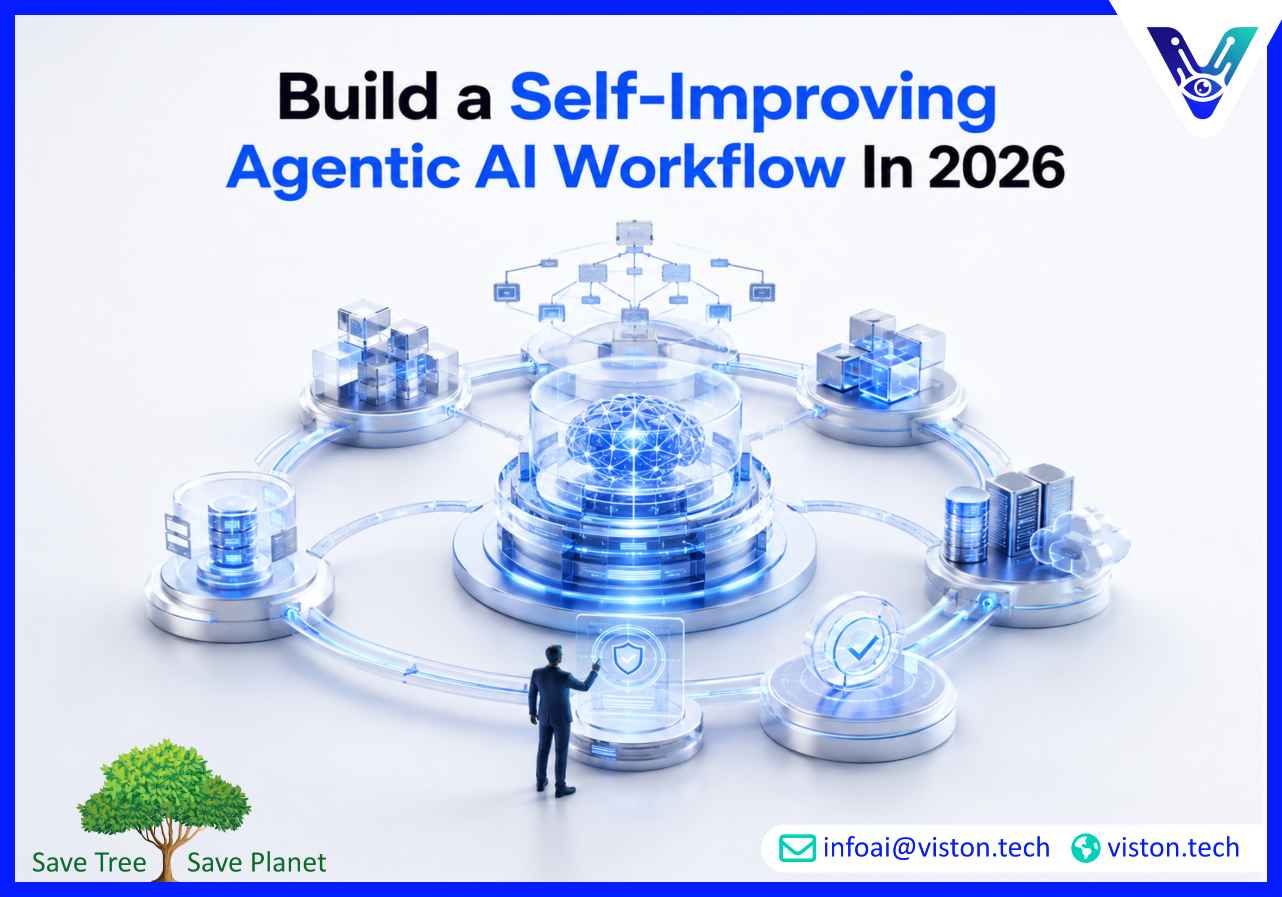
Businesses are moving beyond simple automation toward AI systems that can plan, act, evaluate results, and improve over time. A self-improving agentic AI workflow helps teams automate complex decisions while maintaining control, visibility, and measurable business value.
A self-improving agentic AI workflow is an automation system where AI agents perform tasks, review outcomes, learn from feedback, and refine future actions. Unlike static workflows that follow fixed rules, agentic workflows can adapt based on context, data quality, user intent, performance signals, and business constraints.
In practical business terms, this means an AI system can receive a goal, break it into steps, use tools or APIs, complete work, check its own output, escalate uncertain cases, and improve the next execution cycle. The workflow is not “fully uncontrolled AI.” It is a structured operating model with planning, memory, evaluation, approvals, monitoring, and governance.
For example, a sales outreach workflow may research prospects, draft messages, score leads, send approved emails, track replies, and adjust future messaging based on response patterns. A customer support workflow may classify tickets, retrieve policy information, suggest responses, identify recurring issues, and improve resolution routing.
In 2026, businesses expect AI automation to be more than task execution. Leaders want systems that reduce manual work, improve accuracy, integrate with existing platforms, and generate performance insights. This is where self-improving agentic AI workflows become valuable.
The main advantage is adaptability. Business processes rarely stay fixed. Customer expectations change, internal policies evolve, data sources shift, and teams need workflows that can respond without constant rebuilding. A self-improving workflow creates a feedback loop between execution and optimization.
Key benefits include:
However, self-improvement must be controlled. A reliable agentic AI workflow should improve based on approved data, defined evaluation criteria, human feedback, and measurable outcomes—not random autonomous changes.
Every workflow starts with a clear business objective. The agent must know what success looks like. This may include faster ticket resolution, higher lead qualification accuracy, reduced invoice processing time, better data enrichment, or improved internal reporting.
The AI agent breaks the objective into steps. These steps may include retrieving data, checking rules, calling APIs, generating content, validating outputs, or asking for approval. Planning prevents the workflow from acting randomly and keeps execution aligned with business logic.
Agentic AI workflows become useful when they connect with real systems. Common integrations include CRM platforms, email tools, helpdesks, databases, spreadsheets, analytics platforms, ERP systems, internal knowledge bases, and communication tools.
Self-improving workflows need controlled memory. This may include previous task outcomes, user preferences, approval decisions, error logs, customer history, or process rules. Memory should be structured, secure, and limited to relevant business use.
The evaluation layer checks whether the output is accurate, complete, compliant, and useful. This may involve rule-based checks, model-based review, confidence scoring, human review, or comparison against business metrics.
Feedback is what makes the workflow self-improving. The system learns from approvals, corrections, failed tasks, customer responses, user ratings, and performance reports. The goal is not uncontrolled learning, but continuous improvement through governed optimization.
Human approval remains essential for sensitive actions. Workflows that send external communications, update records, make financial decisions, or affect customers should include review points, escalation rules, and rollback options.
The best approach is to start with one high-value process rather than trying to automate everything at once. Choose a workflow with clear inputs, measurable outputs, frequent repetition, and visible business impact.
A strong self-improving workflow should not only complete tasks. It should show where performance is improving, where errors occur, and where human intervention is still needed.
Agentic AI workflows can support many business functions when designed with clear controls and measurable objectives.
AI agents can research companies, enrich lead data, score prospects, personalize outreach, recommend follow-ups, and update CRM records. The workflow improves by learning which messages, industries, roles, and signals produce better engagement.
Support agents can classify tickets, retrieve knowledge base answers, draft replies, detect urgency, summarize customer history, and route complex issues. Feedback from agents and customers improves future response quality.
Internal workflows can automate document handling, task assignment, reporting, data entry, approvals, and recurring process checks. Self-improvement helps reduce repeated errors and identify process bottlenecks.
Agentic workflows can assist with invoice processing, expense categorization, reconciliation support, anomaly detection, and reporting. Human approval is especially important where financial records or payments are involved.
AI agents can answer employee questions, summarize policies, assist onboarding, route requests, and improve knowledge base content based on repeated queries.
Viston AI is relevant to businesses exploring self-improving agentic AI workflows because its service focus includes AI automation and workflow bots that combine rule-based logic with generative AI capabilities. This type of capability is important for organizations that want automation to be practical, controlled, and connected to real business processes rather than limited to standalone chatbot interactions.
For companies evaluating agentic AI workflows, Viston AI can support use cases such as operational automation, email and task workflows, accounting process support, HR automation, and intelligent workflow design. These areas align closely with the needs of teams that want to reduce repetitive manual work while maintaining oversight and business reliability.
A self-improving workflow requires more than model access. It needs process mapping, tool integration, orchestration, feedback loops, monitoring, and responsible implementation. Viston AI’s positioning around AI automation and workflow bots makes it suitable for organizations looking to move from manual processes or basic automation toward more adaptive AI-enabled operations.
For global businesses or teams without a fixed target industry or location, this kind of service can be especially useful where workflows span multiple departments, tools, and approval paths. The real value comes from designing agentic systems that are specific to business goals, measurable in performance, and scalable as processes mature.
It is an AI-powered workflow where agents complete tasks, evaluate results, learn from feedback, and improve future performance within defined business rules and governance controls.
Normal automation follows fixed rules. An agentic AI workflow can reason, plan, use tools, adapt to context, and handle more complex multi-step processes.
Some low-risk tasks can run autonomously, but sensitive actions should include human approval, audit trails, access controls, and exception handling.
They are useful for businesses with repetitive, data-driven, or multi-step processes across sales, support, operations, finance, HR, marketing, and administration.
Viston AI supports AI automation and workflow bots that help businesses streamline tasks, connect processes, and apply generative AI within practical business workflows.
Building a self-improving agentic AI workflow is about creating a controlled system that can plan, act, evaluate, and improve over time. For businesses in 2026, the opportunity is not simply automation but smarter operational execution with measurable outcomes. Agentic AI workflows can reduce manual effort, improve process quality, and support scalable decision-making when designed with clear goals, integrations, feedback loops, and governance. Viston AI is well positioned for organizations exploring AI automation and workflow bots that turn business processes into more adaptive, efficient, and reliable systems.
