
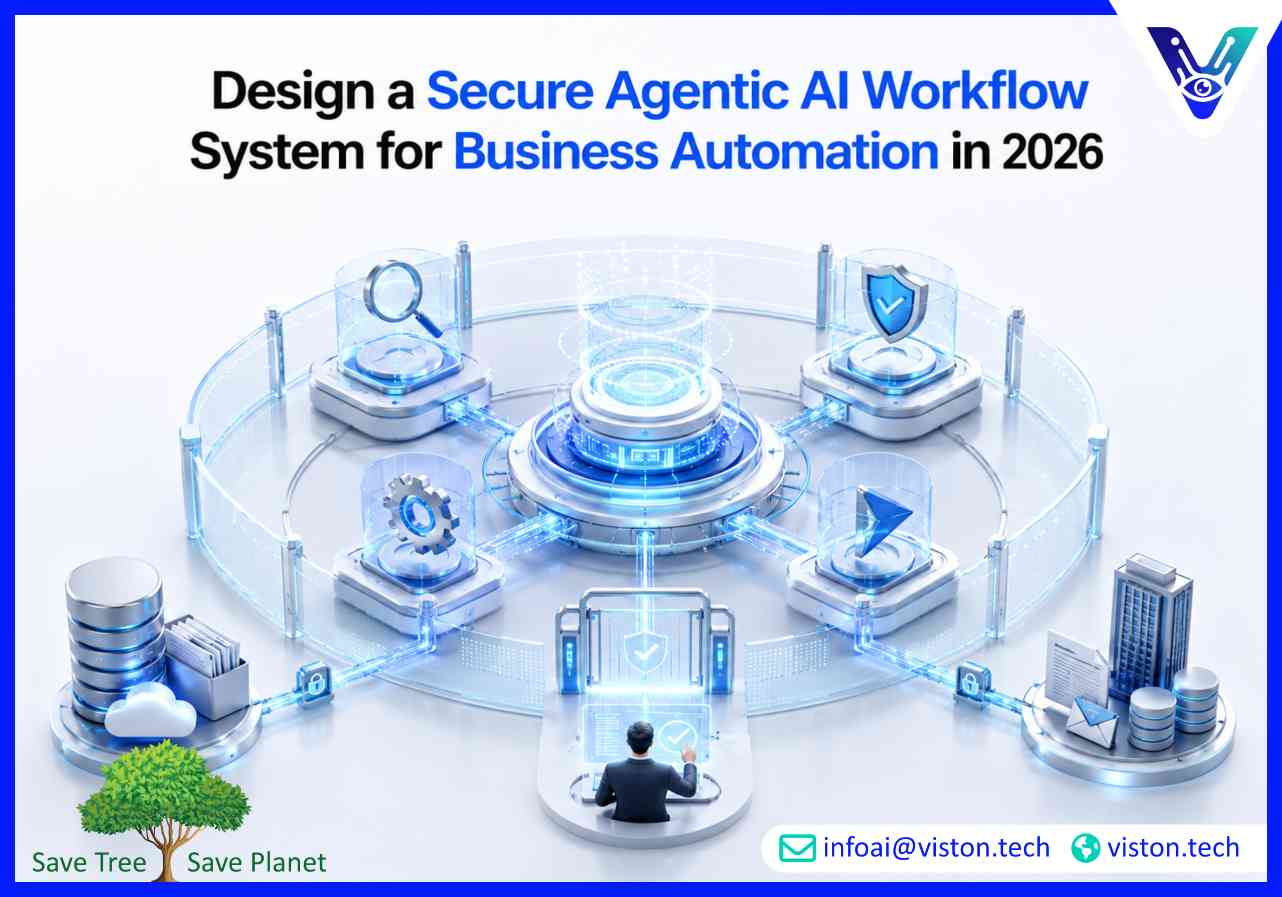
Designing a secure agentic AI workflow system is no longer only a technical challenge. For businesses adopting autonomous AI, security, governance, reliability, and measurable control must be built into the workflow from the first design decision.
A secure agentic AI workflow system is an AI-powered operating structure where intelligent agents can plan, reason, use tools, access data, complete tasks, and coordinate with other systems under defined business rules and security controls.
Unlike basic automation, agentic workflows do not simply follow fixed instructions. They interpret goals, decide the next step, call APIs, retrieve documents, summarize information, trigger actions, escalate exceptions, and learn from workflow outcomes. This makes them powerful for modern business operations, but it also makes security design essential.
A secure system must control what every agent can access, what actions it can take, which tools it can use, how decisions are logged, when human approval is required, and how sensitive data is protected. Without these controls, an AI workflow can create operational, compliance, privacy, and reputational risk.
In 2026, businesses are moving from AI experiments to production-grade AI workflows. Teams want AI agents that can support sales, customer service, finance, HR, procurement, analytics, compliance, marketing, software operations, and internal knowledge management.
The challenge is that production workflows interact with real systems. They may connect to CRMs, ERPs, helpdesks, email platforms, payment tools, databases, cloud storage, analytics dashboards, and communication apps. Once an AI agent can take action inside these environments, security becomes a core architecture requirement.
Common risks include unauthorized data access, prompt injection, tool misuse, incorrect task execution, data leakage, weak audit trails, poor access control, model hallucination, compliance failure, and over-automation without human review.
A secure agentic AI workflow system helps businesses reduce these risks by combining automation flexibility with structured governance. The goal is not to limit AI value. The goal is to make AI useful, controlled, traceable, and safe enough for real business processes.
Every secure AI workflow starts with a defined business purpose. The workflow should answer a practical question: what task should the agent complete, what systems does it need, what data is required, and what outcome should be delivered?
Examples include qualifying inbound leads, summarizing support tickets, extracting invoice details, routing compliance documents, preparing research briefs, updating CRM records, or monitoring operational alerts.
Clear scope prevents unnecessary tool access and reduces risk. Agents should only receive the permissions and context needed for their assigned workflow.
Secure agentic workflows work best when agents have specific responsibilities. A research agent should gather and summarize information. A validation agent should check accuracy. An execution agent should trigger approved actions. A monitoring agent should track performance and exceptions.
This role-based structure reduces uncontrolled behavior. It also makes it easier to test, monitor, and improve each part of the workflow.
Agents often need tools to complete work. These may include APIs, search tools, databases, internal documents, workflow platforms, email systems, CRMs, or ticketing platforms. Tool access should be permission-based and restricted by task.
An agent that drafts a customer response may not need permission to send it. An agent that analyzes invoices may not need access to payroll files. An agent that updates CRM data may not need access to billing systems.
Least-privilege access is one of the most important principles in secure agentic AI workflow design.
Not every AI action should be automatic. Secure workflows define when human approval is required. This is especially important for financial actions, legal communications, customer commitments, employee decisions, public content, sensitive data handling, and high-impact business updates.
Human review can be placed before final execution, before external communication, or when the agent detects uncertainty. This keeps automation efficient without removing accountability.
Agentic workflows depend on context. However, too much context creates unnecessary exposure. Secure design should control what data enters the workflow, how long it is retained, where it is stored, and whether sensitive details are masked or excluded.
Businesses should apply data minimization, encryption, access logging, secure retrieval, private knowledge bases, and strong identity controls. For regulated industries, privacy, consent, retention, and audit requirements should be addressed before deployment.
Start by documenting the manual process the AI workflow will improve. Identify inputs, decisions, systems, approvals, outputs, exceptions, and success measures. This prevents the workflow from becoming a disconnected AI experiment.
Break the workflow into agent roles. For example, a secure customer support workflow may include an intake agent, classification agent, knowledge retrieval agent, response drafting agent, policy validation agent, and escalation agent.
The security layer should include authentication, authorization, data access rules, tool permissions, API limits, approval gates, logging, monitoring, and failure handling. This layer should sit around the workflow, not be added later as an afterthought.
Validation checks help confirm that the agent’s output is accurate, relevant, safe, and aligned with business rules. Guardrails may include policy checks, source verification, restricted actions, content filters, confidence thresholds, and fallback instructions.
A secure agentic AI workflow system should be monitored after launch. Businesses should track accuracy, completion rates, escalation rates, failed tasks, user feedback, latency, tool errors, data access events, and security incidents.
Monitoring helps teams improve performance while maintaining control as business processes change.
Businesses should begin with a narrow workflow that has clear value and manageable risk. A focused pilot allows the team to test security controls, validate outputs, measure efficiency, and identify gaps before expanding automation across departments.
Strong documentation is also important. Every workflow should include agent roles, data sources, tools, permissions, approval rules, exception handling, and ownership. This helps technical teams, compliance teams, and business leaders understand how the workflow operates.
Another best practice is separating reasoning from execution. An agent may analyze information and recommend an action, but execution should happen only through controlled tools with defined permissions. This reduces the chance of unintended system changes.
Businesses should also test for adversarial inputs, prompt injection, inaccurate retrieval, incomplete context, API failure, and misuse of sensitive information. Security testing should be part of workflow quality assurance.
Finally, secure agentic AI workflows need ongoing governance. As models, tools, business rules, and regulations evolve, workflows should be reviewed and updated regularly.
Viston AI is relevant to businesses exploring secure agentic AI workflow systems because its service offering includes agentic AI workflows, custom AI agent solutions, multi-agent orchestration, agent integration services, AI automation and workflow bots, MLOps, model monitoring, AI strategy, and custom AI solution development.
For organizations that want to move from manual operations to intelligent automation, Viston AI can support the design and deployment of workflow systems where AI agents connect with business tools, analyze context, perform structured tasks, and support operational decision-making. Its capabilities align with common business needs such as automating emails, tasks, accounting workflows, HR processes, document handling, internal operations, customer engagement, research workflows, and data-driven reporting.
A secure implementation requires more than building an agent. It requires workflow planning, integration design, access control, monitoring, governance, and scalable deployment. Viston AI’s focus on automation, agent development, MLOps, business intelligence, and enterprise AI solutions makes it suitable for companies looking to build practical agentic workflow systems with security and reliability in mind.
For businesses across industries and global markets, Viston AI can help translate AI workflow ideas into structured systems that support measurable operational outcomes while keeping security, integration, and long-term maintainability central to the architecture.
A secure agentic AI workflow system is an AI automation architecture where agents can reason, use tools, and complete business tasks under controlled permissions, governance rules, data protection measures, monitoring, and human approval gates.
Security is important because AI agents may access business data, connect to internal systems, call APIs, and trigger actions. Without controls, they can expose sensitive data, make incorrect updates, or create compliance risks.
Every secure workflow should include role-based access, least-privilege permissions, tool restrictions, audit logs, approval checkpoints, validation rules, data protection, monitoring, and clear escalation paths.
Yes, but the workflow design should match the industry’s data sensitivity, compliance needs, operational complexity, and risk level. Finance, healthcare, manufacturing, retail, SaaS, logistics, and professional services often require stronger governance controls.
Viston AI can support businesses with agentic AI workflow design, custom AI agents, multi-agent orchestration, workflow bots, integration services, MLOps, and monitoring-focused AI implementation.
Designing a secure agentic AI workflow system requires more than connecting an AI model to business tools. It requires structured workflow design, controlled permissions, secure data handling, validation, monitoring, and human oversight where decisions carry risk. In 2026, businesses that build agentic AI workflows with security from the start will be better positioned to automate complex operations responsibly. With relevant expertise in Agentic AI Workflows, automation bots, AI agents, integrations, and model monitoring, Viston AI can support organizations looking to build practical, secure, and scalable AI workflow systems.
