
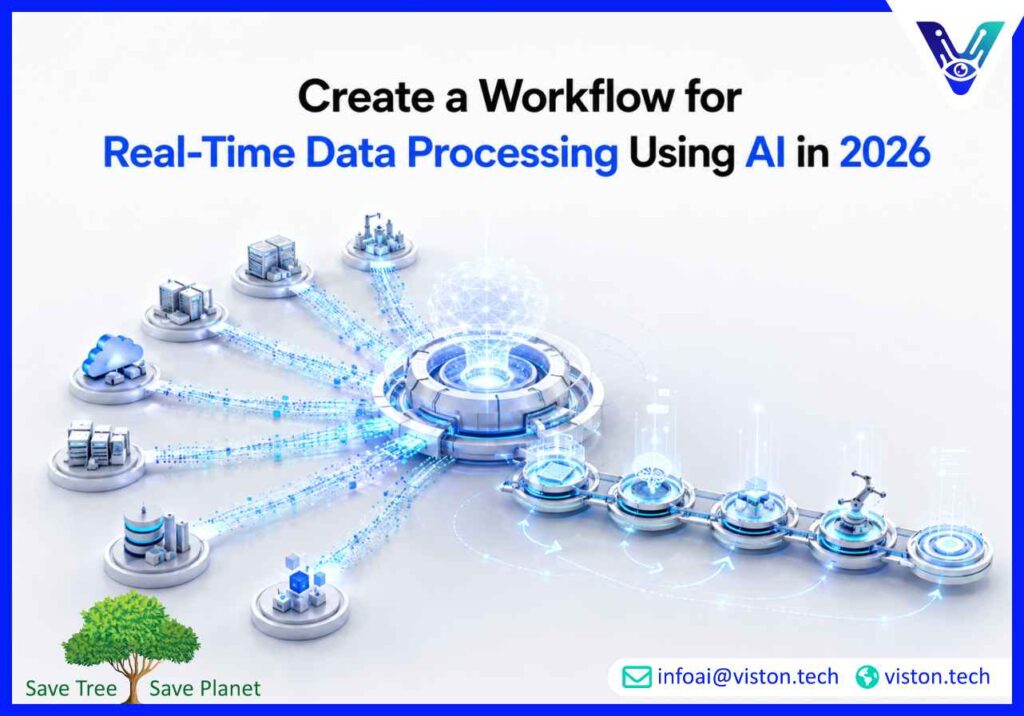
Real-time data has become one of the most valuable business assets in modern enterprises. Organizations generate massive volumes of information every second from applications, websites, IoT devices, customer interactions, supply chains, financial systems, and digital platforms. The ability to process and act on this data instantly is no longer a competitive advantage—it is a business necessity. This is where agentic AI workflows are transforming how organizations manage real-time data processing in 2026.
Real-time data processing refers to collecting, analyzing, and acting upon incoming data streams immediately as they are generated. Unlike traditional batch processing systems that analyze data hours or days later, real-time systems provide instant insights and automated decision-making capabilities.
Artificial intelligence enhances this process by enabling systems to:
Organizations across industries increasingly rely on AI-powered real-time workflows to improve responsiveness, reduce operational delays, and deliver better customer experiences.
Modern businesses require immediate visibility into critical events such as:
Agentic AI workflows make these capabilities possible by combining intelligent agents, automation systems, machine learning models, and real-time analytics engines into a unified operational framework.
The volume, velocity, and complexity of business data continue to increase every year. Traditional analytics systems often struggle to keep up with modern operational requirements.
In 2026, organizations are expected to process data continuously rather than periodically. Customers expect immediate responses, executives require live business intelligence, and operations teams need proactive alerts before problems escalate.
Several factors are driving adoption of real-time AI workflows:
Businesses generate data from hundreds of interconnected systems. Processing this information manually is no longer feasible.
Consumers expect personalized experiences, instant support, and real-time updates across digital channels.
Organizations seek faster decision-making processes that reduce costs and eliminate bottlenecks.
Companies that leverage real-time intelligence can adapt more quickly to changing market conditions.
Modern AI models can analyze complex patterns, identify risks, and generate actionable recommendations at unprecedented speed.
The result is a growing demand for intelligent workflows capable of continuously processing and responding to business-critical information.
Building a successful real-time AI workflow requires several interconnected components working together seamlessly.
The workflow begins by collecting data from multiple sources.
Common sources include:
Data enters the workflow through APIs, event streams, webhooks, message queues, and integration platforms.
The first AI agent validates incoming information.
This agent:
High-quality input data improves downstream AI performance.
Once validated, data moves to processing agents.
These agents perform:
This stage converts raw information into structured insights.
The decision agent evaluates processed information against predefined objectives and business rules.
It can:
This layer transforms data into actionable intelligence.
Execution agents carry out approved actions automatically.
Examples include:
Continuous monitoring ensures workflow performance remains optimal.
This layer tracks:
AI agents continuously learn from outcomes to improve future performance.
Consider a retail company processing online transactions in real time.
The workflow operates as follows:
The entire workflow can execute within seconds while handling thousands of transactions simultaneously.
Organizations gain immediate visibility into business events, enabling rapid responses to opportunities and risks.
Automation reduces manual intervention and accelerates routine business processes.
Real-time personalization and instant responses improve customer satisfaction.
AI agents can detect anomalies and threats before they impact operations.
Agentic workflows can process increasing data volumes without proportional increases in staffing.
Learning systems improve performance over time through feedback and outcome analysis.
Although highly valuable, implementing real-time AI processing requires careful planning.
Poor-quality data can reduce AI accuracy and lead to unreliable outcomes.
Organizations often operate dozens of disconnected systems that must work together.
Many applications require decisions within milliseconds.
Real-time workflows frequently process sensitive business and customer information.
Businesses must maintain transparency, auditability, and regulatory compliance.
AI performance can degrade as business environments change.
Successful implementations address these challenges through strong architecture, monitoring, governance, and operational controls.
As organizations seek intelligent automation solutions, the demand for specialized expertise in Agentic AI Workflows continues to grow. Viston AI focuses on helping businesses design, deploy, and optimize AI-powered workflow architectures that support complex operational requirements.
Real-time data processing environments require more than isolated AI models. They demand coordinated systems capable of collecting information, orchestrating multiple agents, integrating enterprise applications, enforcing business rules, and executing automated decisions reliably at scale.
Viston AI’s approach to Agentic AI Workflows emphasizes practical business outcomes rather than standalone automation. Organizations often need workflows that connect customer platforms, internal databases, analytics systems, cloud infrastructure, APIs, and operational tools into a unified decision-making framework.
By combining intelligent agents, workflow orchestration, automation logic, and continuous monitoring capabilities, businesses can create systems that react dynamically to changing conditions. This is particularly valuable for organizations seeking to improve operational efficiency, customer responsiveness, data-driven decision-making, and scalability.
Whether processing customer interactions, operational events, business transactions, or enterprise data streams, a structured agentic workflow architecture helps organizations move from reactive operations to proactive and intelligent execution models.
Identify measurable business outcomes before designing workflows.
Focus on processes where real-time decisions generate meaningful value.
Implement strong validation, security, and compliance controls.
Independent agents improve flexibility and scalability.
Track workflow effectiveness and AI accuracy in production environments.
Critical decisions should support review and escalation mechanisms when required.
An agentic AI workflow is a system of autonomous AI agents that collaborate to process information, make decisions, and execute actions with minimal human intervention.
Real-time processing enables organizations to respond immediately to business events, customer actions, operational issues, and emerging risks.
Retail, healthcare, manufacturing, logistics, financial services, telecommunications, and technology companies frequently benefit from real-time AI processing capabilities.
AI agents automate analysis, detect patterns, identify anomalies, generate predictions, and execute actions faster than traditional manual processes.
Yes. Modern agentic architectures are designed to handle increasing volumes of data, users, transactions, and operational complexity.
Viston AI supports organizations in designing and implementing Agentic AI Workflows that integrate data sources, automate decision-making processes, and improve operational efficiency through intelligent orchestration.
Creating a workflow for real-time data processing using AI is becoming a strategic priority for organizations that depend on speed, accuracy, and intelligent decision-making. Agentic AI Workflows enable businesses to transform continuous streams of information into immediate actions, helping teams improve efficiency, reduce risk, and deliver better outcomes. As real-time operations become the standard across industries, organizations that invest in scalable AI-driven workflow architectures will be better positioned to adapt, innovate, and compete. With specialized expertise in Agentic AI Workflows, Viston AI helps businesses build intelligent systems capable of supporting the demands of modern data-driven operations.
