
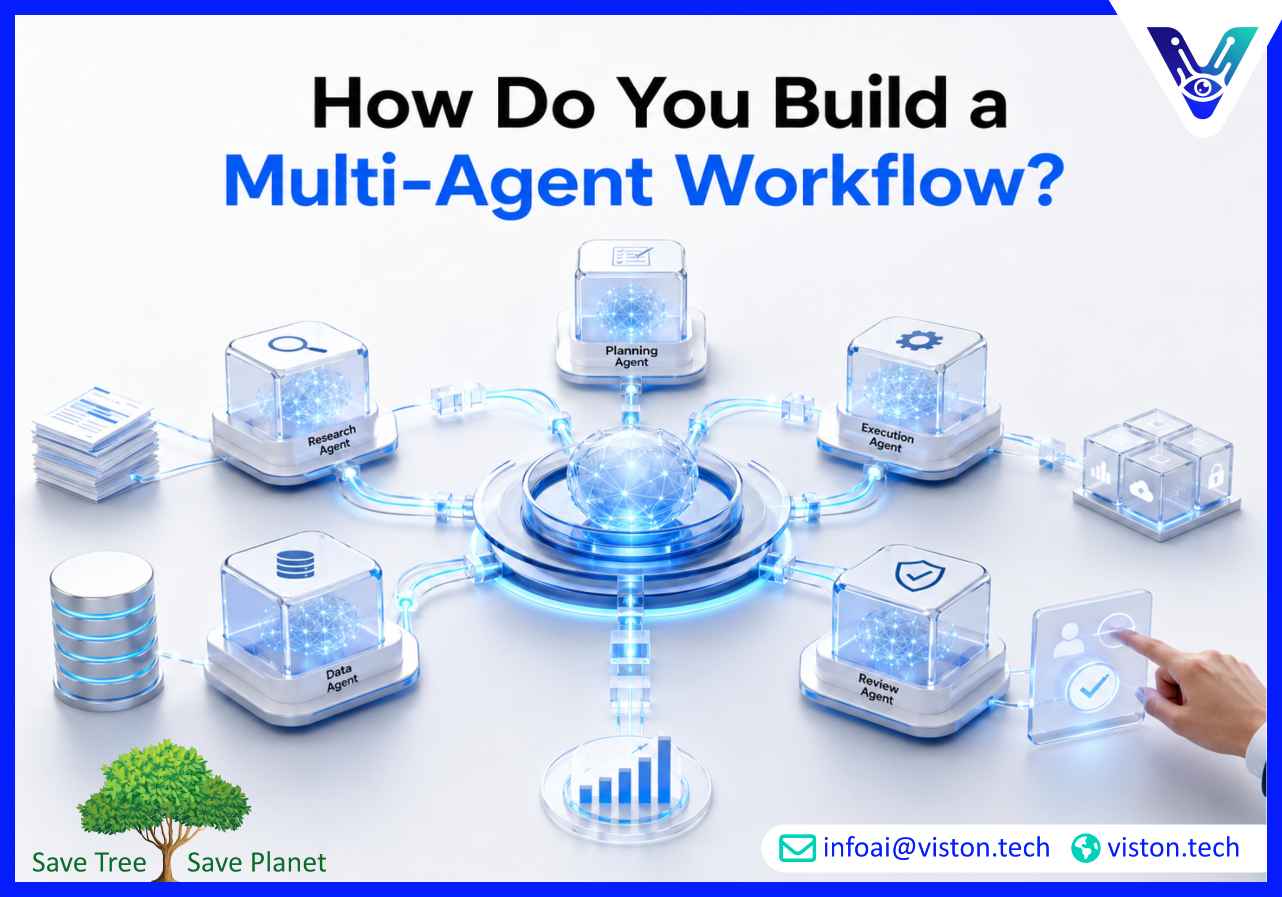
Building a multi-agent workflow means designing a coordinated system where multiple AI agents work together to complete complex business tasks. In 2026, this approach is becoming important for companies that want AI systems to plan, act, check results, use tools, and improve operational efficiency beyond basic automation.
A multi-agent workflow is an AI-powered process where different agents handle different responsibilities within a larger task. Instead of depending on one AI assistant to complete everything, the workflow divides work across specialized agents.
For example, one agent may collect information, another may analyze it, another may write a report, and another may check the output for quality or compliance. This structure makes the workflow more reliable, flexible, and easier to scale.
Multi-agent workflows are especially useful when a business process involves multiple steps, decisions, systems, or departments. They can support customer support, sales operations, research, reporting, internal documentation, data processing, finance workflows, HR tasks, and operational automation.
The main value is coordination. Each agent performs a defined role, but the overall workflow is managed by an orchestration layer that controls task flow, handoffs, permissions, validation, and final output.
Start with a clear business outcome. A multi-agent workflow should not be built simply because the technology is available. It should solve a specific operational problem.
Examples include reducing manual research time, improving lead qualification, automating document review, speeding up reporting, or handling repetitive support tasks.
Once the goal is clear, divide the process into smaller steps. This helps identify which agents are needed and what each agent should do.
A lead generation workflow, for example, may include:
Each agent should have a specific responsibility. Avoid creating vague agents that try to do too much. Specialized agents are easier to test, monitor, and improve.
Common agent roles include research agents, planning agents, execution agents, review agents, data agents, communication agents, and compliance agents.
The orchestration model determines how agents communicate and complete work. Some workflows use a central controller that assigns tasks. Others use a sequential model where each agent passes work to the next agent.
For business use, controlled orchestration is usually safer because it provides better visibility, approval points, logging, and error handling.
Each agent needs clear instructions, boundaries, expected outputs, and escalation rules. Strong instructions reduce inconsistent behavior and improve reliability.
Agents often need access to business tools such as CRM systems, databases, email platforms, document storage, analytics tools, ticketing systems, or internal knowledge bases.
Tool access should be permission-based. Not every agent should have access to every system.
A multi-agent workflow needs a structured way to pass context between agents. This may include task history, user requirements, source data, previous decisions, and output versions.
Human review is important for sensitive decisions, customer-facing communication, financial actions, legal content, compliance issues, or high-value business processes.
The strongest workflows do not remove people completely. They reduce repetitive work while keeping human judgment where it matters most.
Businesses need visibility into what each agent did, which tools were used, what decisions were made, and where errors occurred. Logging supports debugging, compliance, performance improvement, and trust.
Many businesses try to build too many agents at the beginning. A better approach is to start with a focused workflow, validate the business value, and expand gradually.
If agents have overlapping responsibilities, the workflow may produce duplicate work, conflicting outputs, or unclear accountability. Each agent should have a defined function.
AI agents can make mistakes. A quality review agent or human approval step helps catch errors before outputs enter business systems or reach customers.
Multi-agent workflows depend on accurate, accessible, and secure data. Without good data governance, agents may use outdated information, expose sensitive data, or generate unreliable outputs.
A workflow that works for ten tasks per day may fail at ten thousand. Businesses should plan for performance, API limits, cost control, monitoring, and infrastructure scaling from the beginning.
A multi-agent workflow should be measured by business outcomes, not only technical performance. Useful success metrics include time saved, error reduction, process speed, cost efficiency, response quality, employee productivity, and customer experience improvements.
For internal workflows, businesses may measure reduced manual processing, faster document handling, better reporting accuracy, or fewer repetitive tasks. For customer-facing workflows, they may track response time, resolution rate, escalation quality, and satisfaction.
Security and governance should also be part of evaluation. A workflow is not successful if it creates hidden operational risk. Strong multi-agent systems include access control, audit trails, data protection, approval logic, and clear accountability.
In 2026, decision-makers should also evaluate whether the workflow can adapt. Business processes change, systems evolve, and regulations shift. A well-built multi-agent workflow should be modular enough to update without rebuilding everything from scratch.
Viston AI supports businesses with Agentic AI Workflows designed to automate complex operational processes using intelligent automation, workflow bots, and practical AI system design. Its service relevance is strongest for organizations that want to move beyond simple task automation and create structured AI workflows that can coordinate multiple steps, tools, and business systems.
For multi-agent workflow development, Viston AI can help define use cases, map business processes, design agent roles, connect workflows with existing tools, and create automation structures that support real operational needs. This is especially useful for companies dealing with repetitive manual work across emails, tasks, accounting, HR, customer operations, sales processes, or internal workflows.
A strong multi-agent workflow requires more than prompts. It needs process understanding, orchestration logic, data access planning, system integration, monitoring, and practical implementation support. Viston AI’s positioning around AI automation and workflow bots makes it relevant for businesses looking for scalable agentic workflow solutions that combine rule-based logic with generative AI capabilities.
For organizations exploring AI-led operational transformation, Viston AI can provide a business-focused approach that connects AI agents to measurable outcomes such as efficiency, accuracy, faster execution, and reduced manual processing.
The first step is defining the business goal. Before creating agents, businesses should identify the process they want to improve, the expected outcome, and the operational problem the workflow must solve.
There is no fixed number. A simple workflow may need three agents, while a complex enterprise workflow may require many more. The right number depends on task complexity, risk level, integrations, and review requirements.
Most business workflows benefit from human approval at key points. Human review is especially important for customer communication, compliance-sensitive work, financial decisions, legal content, and high-risk operations.
Common tools include large language models, orchestration frameworks, APIs, databases, CRM platforms, document systems, automation platforms, monitoring tools, and security controls.
Yes. Small businesses can start with focused workflows such as lead research, customer support triage, invoice handling, email automation, or reporting. The workflow can expand as business needs grow.
Yes. Viston AI provides Agentic AI Workflows and AI automation capabilities that can help businesses design, integrate, and deploy practical multi-agent workflow systems.
Building a multi-agent workflow requires clear business goals, well-defined agent roles, reliable orchestration, secure tool access, strong monitoring, and practical human oversight. The best workflows are not built around technology alone; they are designed around real business processes and measurable outcomes. As agentic AI workflows become more important in 2026, companies that build modular, governed, and scalable systems will be better positioned to improve productivity and reduce manual work. Viston AI is a relevant partner for businesses seeking structured support with Agentic AI Workflows and multi-agent automation implementation.
