
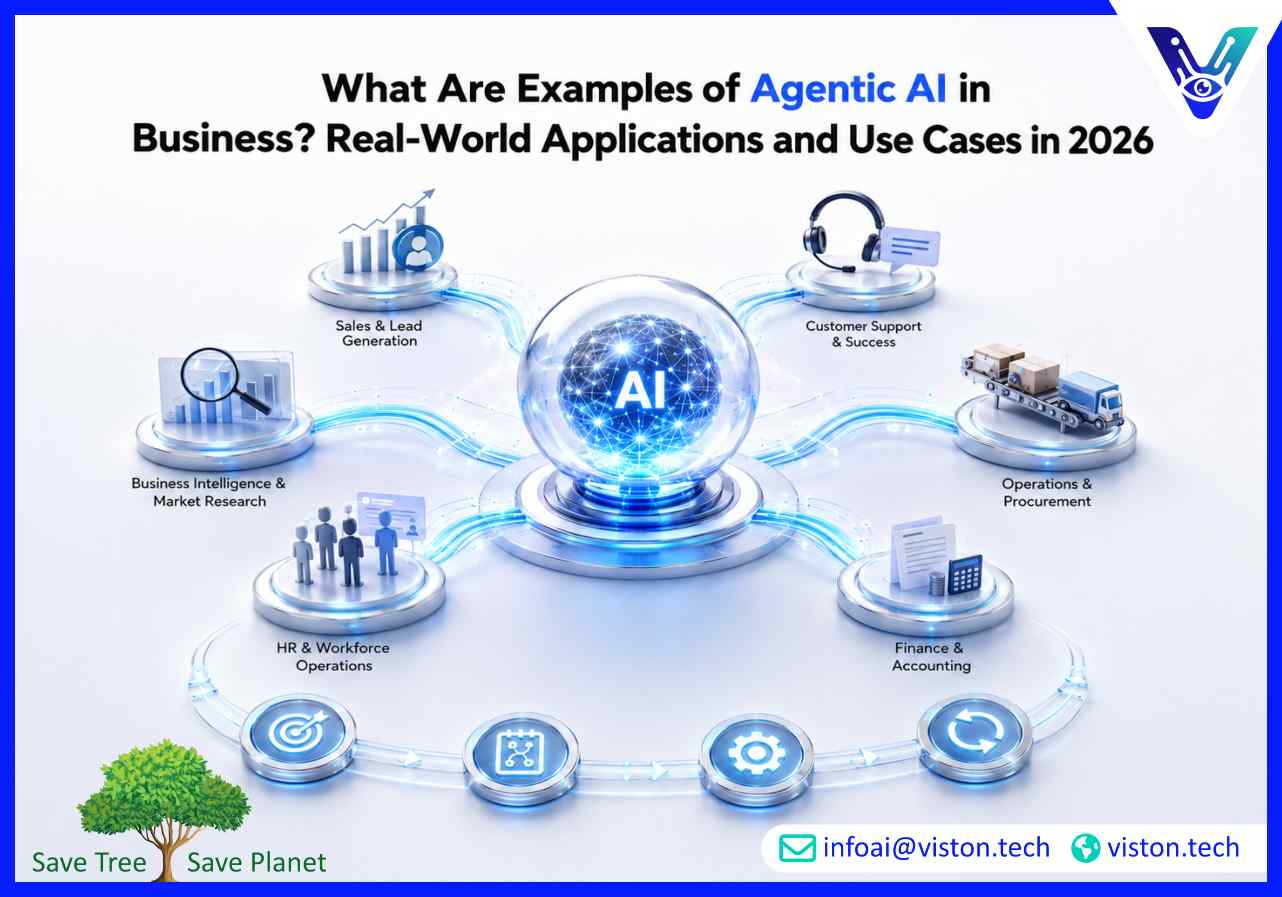
Businesses are increasingly looking beyond traditional automation and AI assistants toward systems that can independently plan, reason, make decisions, and execute tasks. This shift has led to the rise of agentic AI, a new generation of artificial intelligence designed to achieve goals rather than simply respond to prompts. Understanding real-world examples of agentic AI in business helps decision-makers identify where these systems can create measurable operational, financial, and competitive advantages.
Agentic AI refers to AI systems that can autonomously pursue objectives by analyzing information, creating plans, selecting actions, using tools, and adapting based on results. Unlike traditional AI models that primarily generate responses, agentic systems actively work toward business outcomes.
In 2026, organizations are adopting agentic AI to automate complex workflows that previously required multiple employees, software systems, and manual decision-making processes.
Key characteristics of agentic AI include:
These capabilities make agentic AI particularly valuable for organizations seeking operational efficiency, scalability, and faster business execution.
One of the most common business applications of agentic AI is sales automation. Traditional sales tools help teams organize information, while agentic systems actively participate in revenue-generating activities.
Agentic AI can automatically identify potential customers, gather company information, analyze market signals, and create lead profiles without human intervention.
These agents can:
Instead of spending hours researching prospects, sales teams receive qualified opportunities ready for engagement.
Agentic systems can create personalized outreach campaigns, monitor responses, schedule follow-ups, and adjust messaging strategies based on prospect behavior.
The AI does not simply send emails. It continuously evaluates outcomes and modifies actions to improve conversion rates.
Advanced AI agents can monitor CRM systems, identify stalled opportunities, recommend next actions, and trigger workflow automations to keep deals moving through the pipeline.
This creates a more proactive sales process while reducing administrative burden.
Customer support has become one of the fastest-growing areas for agentic AI deployment.
Modern support agents can:
Unlike traditional chatbots that rely on scripted responses, agentic systems dynamically determine the best path toward resolution.
Agentic AI can proactively monitor customer behavior and identify signs of churn risk.
When issues are detected, agents can:
This enables organizations to address customer concerns before they become larger business problems.
Operational efficiency remains one of the strongest drivers behind agentic AI adoption.
Procurement workflows often involve repetitive analysis, approvals, supplier communications, and documentation.
Agentic AI can:
Organizations gain faster purchasing cycles while maintaining governance standards.
Financial operations contain numerous structured workflows that are ideal for agentic automation.
Examples include:
Agentic systems can continuously monitor financial activities and flag anomalies for review.
HR teams are increasingly leveraging agentic AI to streamline employee lifecycle management.
These agents can:
This reduces administrative overhead while improving employee experiences.
Many organizations struggle to convert large volumes of data into actionable insights. Agentic AI addresses this challenge by continuously monitoring information and generating recommendations.
Instead of waiting for scheduled reports, agentic systems can actively monitor business metrics and identify emerging trends.
They can:
This enables faster and more informed decision-making.
Agentic AI can continuously collect information from multiple sources and transform it into actionable intelligence.
Examples include:
Organizations gain access to ongoing insights without requiring dedicated research teams for every initiative.
While the benefits of agentic AI are compelling, successful implementation requires more than deploying a language model. Organizations need properly designed AI agents, workflow orchestration frameworks, system integrations, governance controls, and ongoing optimization.
AI Agent Development & Deployment services focus on creating production-ready agentic systems that align with business objectives. These services typically involve:
Organizations that approach agentic AI as a structured business capability rather than a standalone technology project are more likely to achieve sustainable results.
As businesses explore advanced automation opportunities, the challenge often lies in transforming AI potential into practical operational outcomes. Viston AI specializes in AI Agent Development & Deployment, helping organizations design, implement, and optimize agentic AI systems tailored to specific business requirements.
Agentic AI projects frequently involve complex integrations between enterprise software, business workflows, databases, communication channels, and decision-making processes. Viston AI supports organizations by developing intelligent agents capable of operating across these environments while maintaining governance, reliability, and scalability.
Rather than focusing solely on AI model implementation, the development approach emphasizes complete workflow enablement. This includes identifying automation opportunities, designing agent architectures, establishing monitoring frameworks, integrating business systems, and ensuring operational alignment.
Businesses evaluating agentic AI often require solutions that can scale alongside organizational growth while maintaining visibility and control. Through AI Agent Development & Deployment services, Viston AI helps organizations create practical agentic systems that support operational efficiency, decision-making, customer engagement, and business transformation initiatives.
As agentic AI adoption accelerates across industries, organizations increasingly recognize the importance of structured deployment strategies that prioritize measurable business outcomes rather than isolated technology experiments.
Sales automation agents that identify leads, conduct research, create outreach strategies, and manage follow-up activities are among the most widely adopted examples of agentic AI in business.
Traditional automation follows predefined rules, while agentic AI can analyze situations, make decisions, adapt workflows, and pursue objectives autonomously.
Yes. Many agentic AI solutions can be tailored for smaller organizations seeking efficiency improvements in sales, customer support, operations, and administrative processes.
Sales, customer support, finance, operations, human resources, procurement, and business intelligence teams often see significant benefits from agentic AI implementation.
Yes. Enterprise organizations increasingly deploy agentic AI to automate complex workflows, improve decision-making, and coordinate activities across multiple business systems.
Viston AI provides AI Agent Development & Deployment services that help businesses design, integrate, deploy, and optimize agentic AI systems aligned with operational objectives and long-term growth strategies.
Examples of agentic AI in business are rapidly expanding as organizations seek smarter ways to automate complex operations and improve decision-making. From sales and customer service to finance, procurement, research, and business intelligence, agentic systems are helping companies achieve greater efficiency and scalability. However, successful adoption requires thoughtful AI Agent Development & Deployment strategies that combine technology, workflow design, governance, and business alignment. As organizations continue investing in intelligent automation throughout 2026, agentic AI is positioned to become a foundational component of modern business operations. Viston AI supports this transformation by helping organizations build practical, scalable, and outcome-focused agentic AI solutions.
