
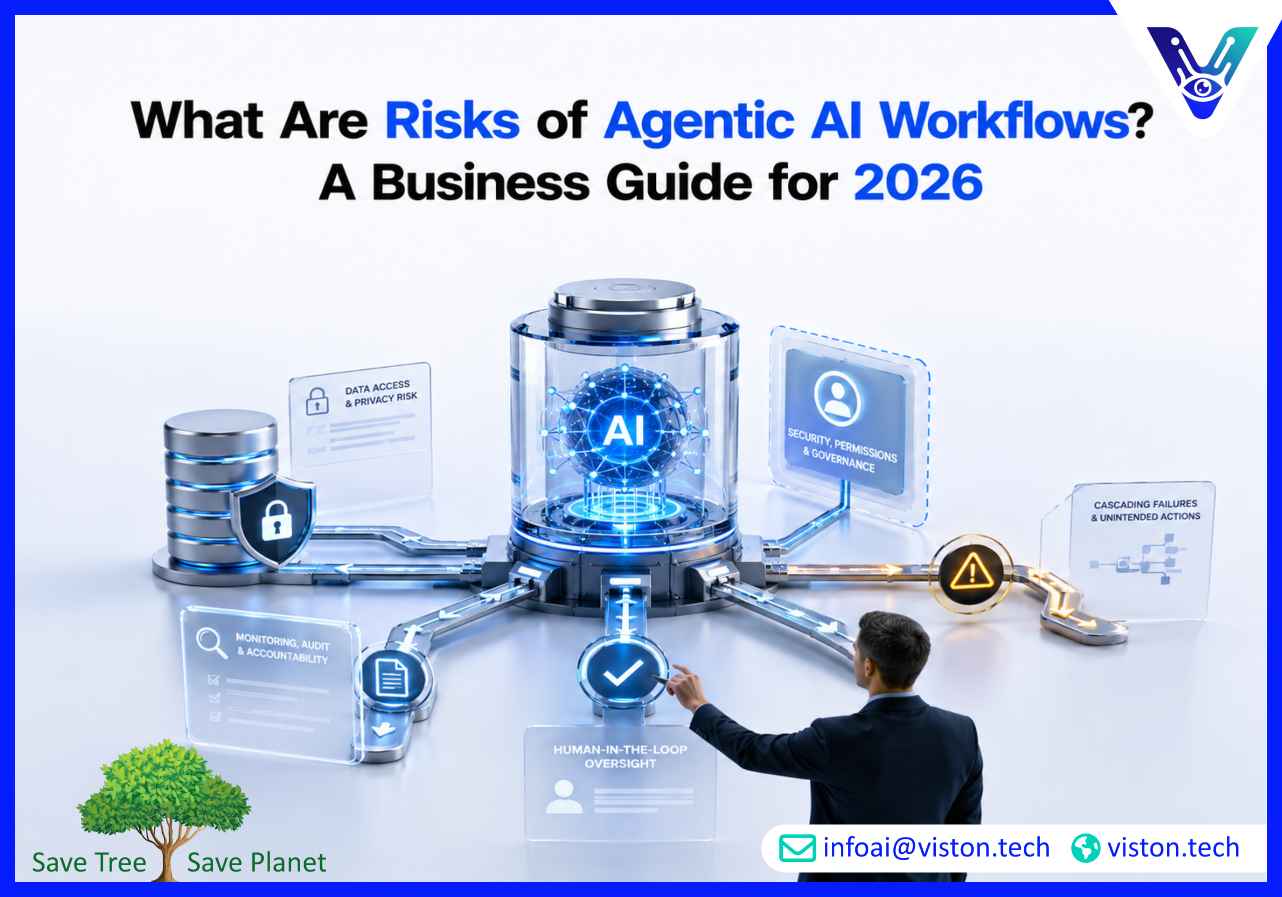
Agentic AI workflows are transforming how organizations automate decisions, coordinate tasks, and execute complex business processes. Unlike traditional automation systems that follow predefined rules, agentic workflows can analyze situations, make decisions, interact with tools, and take actions with limited human intervention. While these capabilities create significant business opportunities, they also introduce new risks that organizations must understand and manage effectively.
Agentic AI workflows differ from conventional automation because they operate with a higher degree of autonomy. These systems can perform multi-step reasoning, interact with software applications, access data sources, communicate with users, and execute actions across business environments.
The same capabilities that make agentic workflows valuable can also create operational, security, compliance, and governance challenges. As businesses increasingly deploy AI agents in customer service, operations, sales, marketing, finance, and data management, understanding these risks has become a critical business requirement.
Organizations that approach agentic AI strategically are typically able to maximize benefits while maintaining appropriate controls and safeguards.
Modern AI systems are becoming more capable and interconnected. Agentic workflows often interact with:
As the scope of AI-driven actions expands, the potential impact of errors, misuse, or security failures increases significantly.
One of the most common concerns involves operational reliability. Agentic systems make decisions based on available information, instructions, and objectives. If any of these inputs are flawed, outcomes may be affected.
AI agents may occasionally interpret information incorrectly or make decisions that appear logical but fail to align with business objectives.
Examples include:
Even highly advanced AI models are not immune to reasoning errors, particularly when dealing with ambiguous or incomplete information.
Many agentic systems operate through multiple interconnected agents. When one agent produces inaccurate outputs, downstream agents may continue acting on incorrect information.
This can result in:
Without proper monitoring, small errors can escalate across entire workflow chains.
Businesses sometimes attempt to automate processes that still require human judgment.
Examples include:
Excessive reliance on AI agents can reduce human oversight and increase the likelihood of costly mistakes.
Security remains one of the most significant concerns surrounding agentic AI adoption.
Agentic workflows often require access to enterprise systems, databases, and business applications.
If permissions are poorly configured, AI agents may gain access to information beyond their intended scope.
This creates risks involving:
Prompt injection has emerged as a major security concern in AI systems.
Attackers may manipulate inputs to influence agent behavior and bypass intended controls.
Potential consequences include:
Organizations deploying agentic workflows must implement robust validation and monitoring mechanisms.
Many industries operate under strict regulatory requirements.
Agentic AI workflows can create compliance risks if they:
Businesses operating in regulated environments must ensure AI workflows align with legal and compliance obligations.
Agentic workflows depend heavily on the quality of available data.
Poor data quality can lead to:
Strong data governance remains essential for successful AI implementation.
Beyond operational and security concerns, businesses must also evaluate long-term strategic risks.
Many AI systems function as complex decision-making engines. Understanding why an agent reached a particular conclusion can sometimes be difficult.
This lack of explainability may create challenges for:
Organizations increasingly prioritize explainable AI practices to address these concerns.
Many agentic workflows rely on external AI platforms, APIs, and cloud services.
Excessive dependence on a single vendor may create:
Strategic architecture planning can help minimize these dependencies.
AI-driven mistakes can quickly become public issues.
Examples include:
Brand trust can be difficult to rebuild once customer confidence is lost.
Introducing agentic workflows often changes existing business processes.
Employees may resist adoption if they:
Successful deployment requires change management alongside technical implementation.
Although risks exist, organizations can significantly reduce exposure through proper planning and governance.
Critical decisions should include human review before execution.
Examples include:
Organizations should define clear policies covering:
Agentic workflows should not be treated as “set-and-forget” systems.
Ongoing monitoring helps identify:
Applying the principle of least privilege can significantly reduce security risks.
Agents should only have access to the systems and data necessary to perform their intended tasks.
Every action performed by an AI agent should be logged and traceable.
Strong auditability supports:
As organizations adopt increasingly sophisticated AI systems, successful implementation requires more than simply connecting large language models to business processes. Safe, scalable, and reliable agentic workflows depend on thoughtful architecture, governance controls, security frameworks, monitoring systems, and operational alignment.
Viston AI specializes in Agentic AI Workflows designed to help businesses automate complex processes while maintaining visibility, control, and business accountability. Organizations exploring agent-based automation often need support with workflow design, system integration, orchestration strategies, security controls, AI governance, and performance optimization.
A practical implementation approach focuses on balancing autonomy with oversight. This includes defining decision boundaries, implementing human approval layers where appropriate, establishing audit mechanisms, managing permissions, and creating measurable performance metrics. These elements help ensure workflows remain aligned with business objectives while minimizing operational risk.
For companies evaluating agentic AI adoption, the objective should not be maximum automation at any cost. Instead, the goal is sustainable automation that improves efficiency, enhances decision-making, and supports long-term business growth without compromising security, compliance, or customer trust.
By combining technical expertise with business-focused implementation practices, organizations can build agentic workflows that deliver value while remaining manageable, transparent, and scalable.
The biggest risk is uncontrolled autonomous decision-making that may lead to incorrect actions, security issues, compliance violations, or operational disruptions if appropriate oversight is not implemented.
They can be secure when designed with proper access controls, monitoring, governance policies, audit trails, and security testing. Poorly configured systems may introduce significant risks.
Yes. Like all AI systems, agentic workflows can misinterpret information, generate inaccurate outputs, or take unintended actions. Human oversight remains important for critical business decisions.
Organizations can reduce risk through governance frameworks, permission controls, human review processes, continuous monitoring, testing, and strong data management practices.
Yes, but they require additional compliance controls, transparency measures, audit capabilities, and security safeguards to meet industry-specific regulations and standards.
Viston AI helps organizations design, integrate, govern, and optimize agentic AI workflows while focusing on scalability, security, operational reliability, and measurable business outcomes.
Understanding the risks of agentic AI workflows is essential for organizations seeking to benefit from advanced automation in 2026. While these systems offer powerful capabilities, they also introduce operational, security, compliance, and governance challenges that require careful management. Businesses that combine effective oversight, strong governance, and thoughtful implementation practices are better positioned to realize the benefits of Agentic AI Workflows while minimizing potential risks. For organizations evaluating or deploying intelligent automation solutions, working with experienced specialists such as Viston AI can help ensure that innovation is balanced with security, accountability, and long-term business value.
