
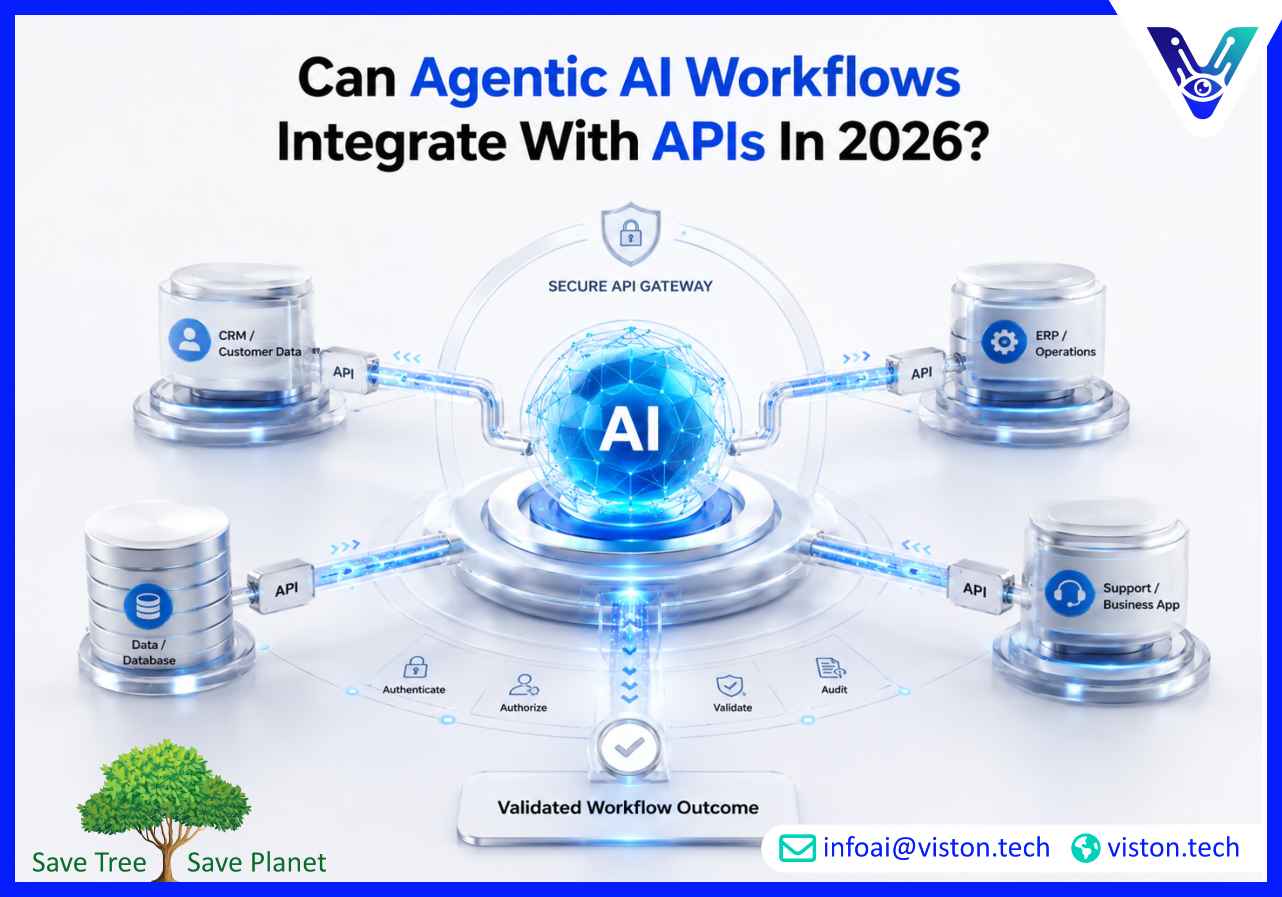
Agentic AI workflows can integrate with APIs, and for most businesses, API connectivity is what makes them useful beyond simple chat or task assistance. In 2026, companies need AI agents that can securely connect with CRMs, ERPs, databases, support platforms, payment systems, analytics tools, and internal applications to complete real business processes.
API integration allows agentic AI workflows to communicate with external software systems, retrieve data, trigger actions, update records, and coordinate tasks across business platforms. Without APIs, an AI agent can usually only interpret information or generate responses. With APIs, it can participate in operational workflows
For example, an agentic workflow connected through APIs can check a customer’s order status, update a CRM record, create a support ticket, send a notification, summarize an account history, or trigger an approval process. This turns AI from a passive assistant into an active workflow participant.
The important distinction is control. A well-designed API-integrated agentic workflow should not act randomly or independently without boundaries. It needs defined permissions, approved actions, authentication, logging, validation, and fallback rules. Strong integration design ensures the agent can complete useful work while staying within business, security, and compliance limits.
In 2026, businesses expect AI systems to work inside existing digital environments rather than operate as isolated tools. Most organizations already rely on multiple software platforms for sales, finance, operations, HR, marketing, customer support, procurement, and reporting. Agentic AI workflows need API access to these systems to deliver measurable value.
APIs help agentic workflows solve one of the biggest enterprise AI challenges: fragmented data. When business data is spread across many tools, AI agents need reliable integration paths to access the right context. A sales agent may need CRM data, email history, product pricing, meeting notes, and contract status. A finance agent may need invoice data, accounting records, approval rules, and vendor details.
API integration also improves workflow speed. Instead of asking employees to copy information between systems, the agent can retrieve, validate, and update data automatically. This reduces manual effort, shortens response times, and helps teams focus on decisions rather than repetitive system work.
Agent Integration Services help businesses design, build, secure, and maintain the connection layer between AI agents and business systems. This service is not only about connecting endpoints. It involves understanding business processes, API logic, permissions, data quality, exception handling, and operational governance.
The process usually starts by identifying which systems the agent must access and what actions it should perform. This may include CRM lookups, ticket creation, document retrieval, database queries, reporting updates, calendar actions, or internal approval routing.
Secure API integration requires proper authentication methods such as OAuth, API keys, role-based access, token handling, and permission scopes. The agent should only access the data and actions required for its workflow.
Agentic systems often use tool calling to interact with APIs. Each tool must have a clear purpose, input structure, output format, validation rule, and safety boundary. This prevents the agent from taking unsupported or risky actions.
Production workflows need logs, alerts, retries, fallback paths, and human escalation. If an API fails or returns incomplete data, the workflow should know how to respond safely instead of continuing with incorrect assumptions.
API-connected agentic workflows can support many business functions. In customer support, agents can retrieve customer profiles, check ticket history, update cases, and recommend next actions. In sales, they can enrich leads, qualify prospects, update CRM fields, and prepare follow-up tasks.
In operations, agents can monitor requests, route approvals, update project tools, and notify stakeholders. In finance, they can support invoice checks, payment status lookups, reconciliation assistance, and exception flagging. In HR, they can help manage onboarding tasks, policy questions, document requests, and employee service workflows.
The strongest use cases are usually repetitive, data-heavy, rule-guided, and connected to multiple systems. These are areas where API integration allows AI agents to save time while improving consistency and visibility.
Viston AI is relevant to businesses exploring API-connected agentic workflows because its work focuses on AI automation, workflow bots, and practical business process automation. For organizations that want agents to do more than answer questions, Agent Integration Services can help connect AI workflows with the tools, data sources, and operational systems already used by teams.
Its role in this space is especially useful when businesses need to combine generative AI with structured automation. API-integrated workflows require more than prompt design. They need workflow logic, secure data access, system compatibility, testing, monitoring, and continuous optimization. Viston AI can support this by helping companies identify where AI agents should connect, what actions should be automated, and how to keep those automations reliable.
For growing companies, the value is practical: fewer manual handoffs, faster task completion, cleaner operational data, and better coordination across business tools. Whether the workflow involves customer service, internal operations, sales processes, HR tasks, or reporting, API integration helps agentic AI become part of daily execution rather than a separate experimental layer.
They can connect to most modern APIs if documentation, authentication access, permissions, and technical compatibility are available. The complexity depends on the API quality, data structure, security model, and workflow requirements.
They can be safe when designed with role-based access, human approval points, audit logs, validation rules, and clear action limits. Security depends on implementation quality, not just the AI model.
They can integrate with CRMs, ERPs, helpdesk platforms, databases, analytics tools, payment systems, email platforms, project management tools, HR systems, and custom internal applications.
Not always, but APIs are usually required for workflows that need to retrieve live data, update systems, trigger actions, or coordinate tasks across business software.
Viston AI can support businesses by designing AI automation workflows that connect agents with business systems, helping teams reduce manual work and improve process efficiency through practical integration.
Agentic AI workflows can integrate with APIs, and API connectivity is one of the main reasons they are becoming valuable for real business operations in 2026. When agents can securely access systems, retrieve data, trigger actions, and update records, they move beyond conversation and become part of execution. Through Agent Integration Services, businesses can build reliable, governed, and scalable AI workflows that work with existing tools. Viston AI is a relevant partner for organizations that want practical AI automation connected to real business processes.
